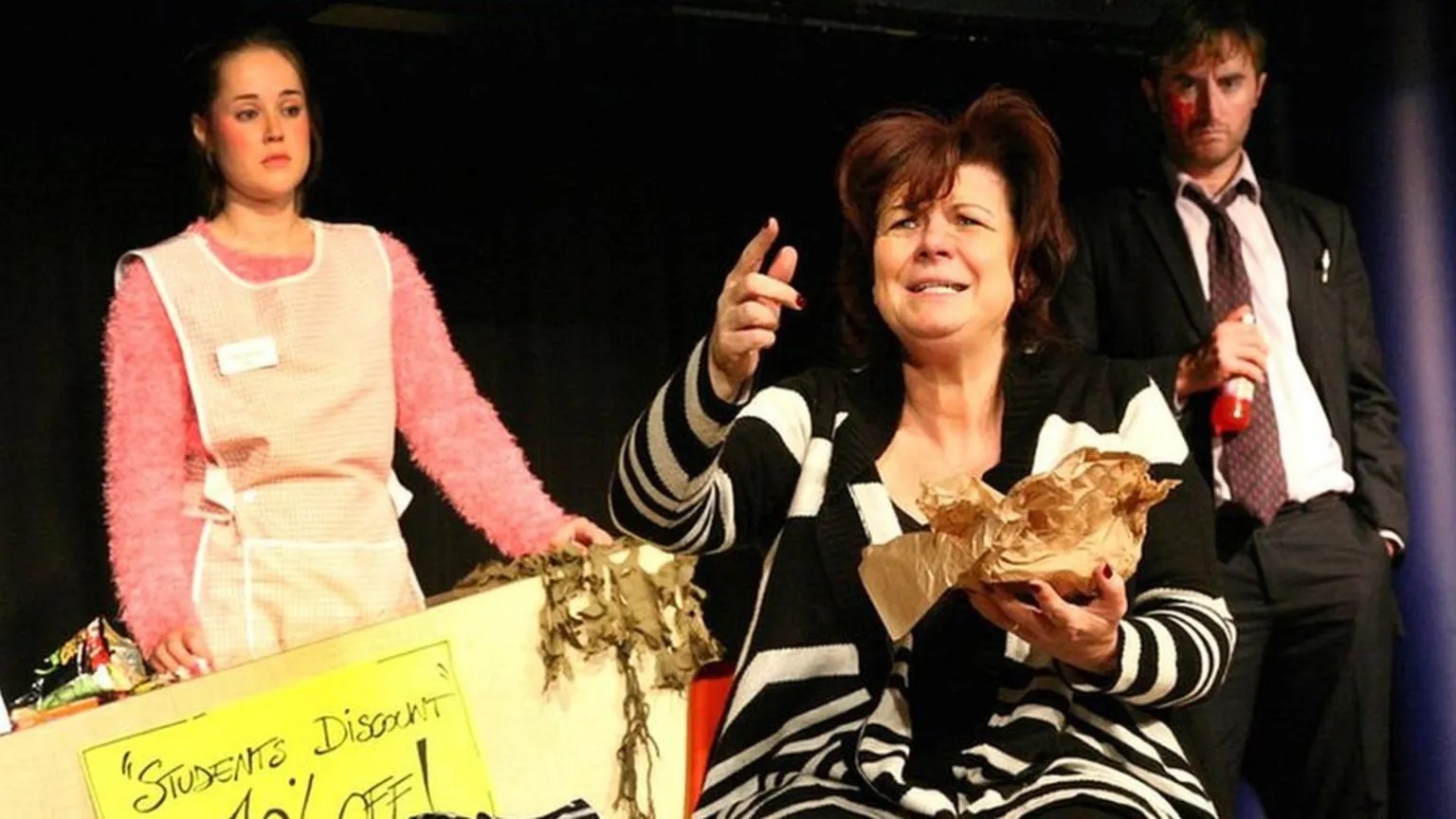
Photo: Lesley Black.
Theater company A Play, A Pie and a Pint produces up to 40 plays a year as well as two pantomimes in the Oran Mor venue in Glasgow, Scotland. Actor Elaine C Smith is pictured above.
I’m in the middle of reading a novel by one of my favorite mystery writers, Ian Rankin, who writes about Scotland. Besides his plots and characters, I love the Scottish slang. Sometimes I even have to look up expressions or words — Teuchter, Slainte, Howff. And it’s not just Gaelic words that are fun, but the Scottish way of putting English words together. For example, “getting mortal” means getting extremely drunk, smashed.
The murder mystery takes place during the offbeat theater festival known as the Fringe, which is why a recent BBC article about a Scottish theater group caught my eye.
Pauline McLean writes, “Established in 2004, A Play, A Pie and a Pint produces up to 40 plays a year as well as two pantomimes in the Oran Mor venue in Glasgow. It has given a platform to established names [and] has also helped new writers get a foothold in the industry, like Liam Moffat, whose play Jack opens the new season. …
“For Juliet Cadzow it is a bitter sweet moment. Her husband David MacLennan was the theatre director who came up with the idea. He died in 2014 after being diagnosed with motor neurone disease. …
“This is what he wrote at the time: ‘The actor Ralph Richardson once described acting as the art of keeping the audience from coughing. And Alfred Hitchcock said the length of a film should be directly related to the endurance of the human bladder. That’s why Colin Beattie and I started “A Play, A Pie, and a Pint.” ‘
“The first show was a play called Hieroglyphics, by Anne Donovan, author of Buddha Da. It was her first stage play. …
“Lunchtime theatre was already popular across Europe but the Scottish offer of a pie made it different, and brought its own challenges.
” ‘It was waiter service when it first started and everyone came and sat at long trestle tables and they were served their pie and It took time when it was busy,’ [actor Linda Duncan McLaughlin] says. ‘They wouldn’t have stopped serving before the play went up. So the waiters were trying to be quiet and and the audience were trying to be quiet but they were still eating.’
“But the concept quickly took off. ‘I think the fact that it was weekly helped,’ says Juliet. ‘If you didn’t like the play that was on that week, there would be a new one next week. And the audience were quite vociferous.
‘They would say to David “I didn’t like that one,” but they’d still come back the next week.’
“Those involved in the shows also liked the challenge of creating a 50-minute show with limited resources and rehearsals. Linda Duncan McLaughlin has written plays, as well as performing in them.
“She says: ‘You’ve got to get what basically is a full play into a fifty minute timeframe. You only have three actors, so if you wanted to write six parts, you’re going to have to be really good at writing doubling up parts and you have to make sure the actors can cope with that. It is limited but it’s a great discipline for a writer. And it really focuses your mind.’
“For some performers, it’s a chance to return to their roots, although Robbie Coltrane admitted his week long run in Peter MacDougall’s play My Father’s Old Suit in 2005 was a daunting one.
” ‘The idea of 500 Glaswegians drinking and having their dinner?’ he recalled in a 2010 documentary. ‘It’s like one of those Frank Sinatra concerts where all you can hear is the knives and forks clattering.’
“[Icelandic] writer Jon Atli Jonassan found the 2009 run of his play The Deep helped him into filmmaking. … ‘No one wanted to make it, but after the production here, we got interest from filmmakers. It was the most expensive film ever made in Iceland and was shortlisted for Best Foreign Film at the Oscars.’ …
” ‘If you’d asked us that first week, I’m not sure we would have been confident that we’d still be going twenty years hence,’ says Linda, who is co-chair of the Scottish Society of Playwrights. ‘It does offer an opportunity for new work to be on every week of the year for forty eight weeks of the year, which no other organization can offer. So it really does have a strong, vital part to play in Scottish theatre culture and long may it continue.’ “
More at the BBC, here.







 Suzanne's Mom's Blog