Feeds:
Posts
Comments

Posts Tagged ‘disappearing’

Photo: Richard Ellis/Alamy.
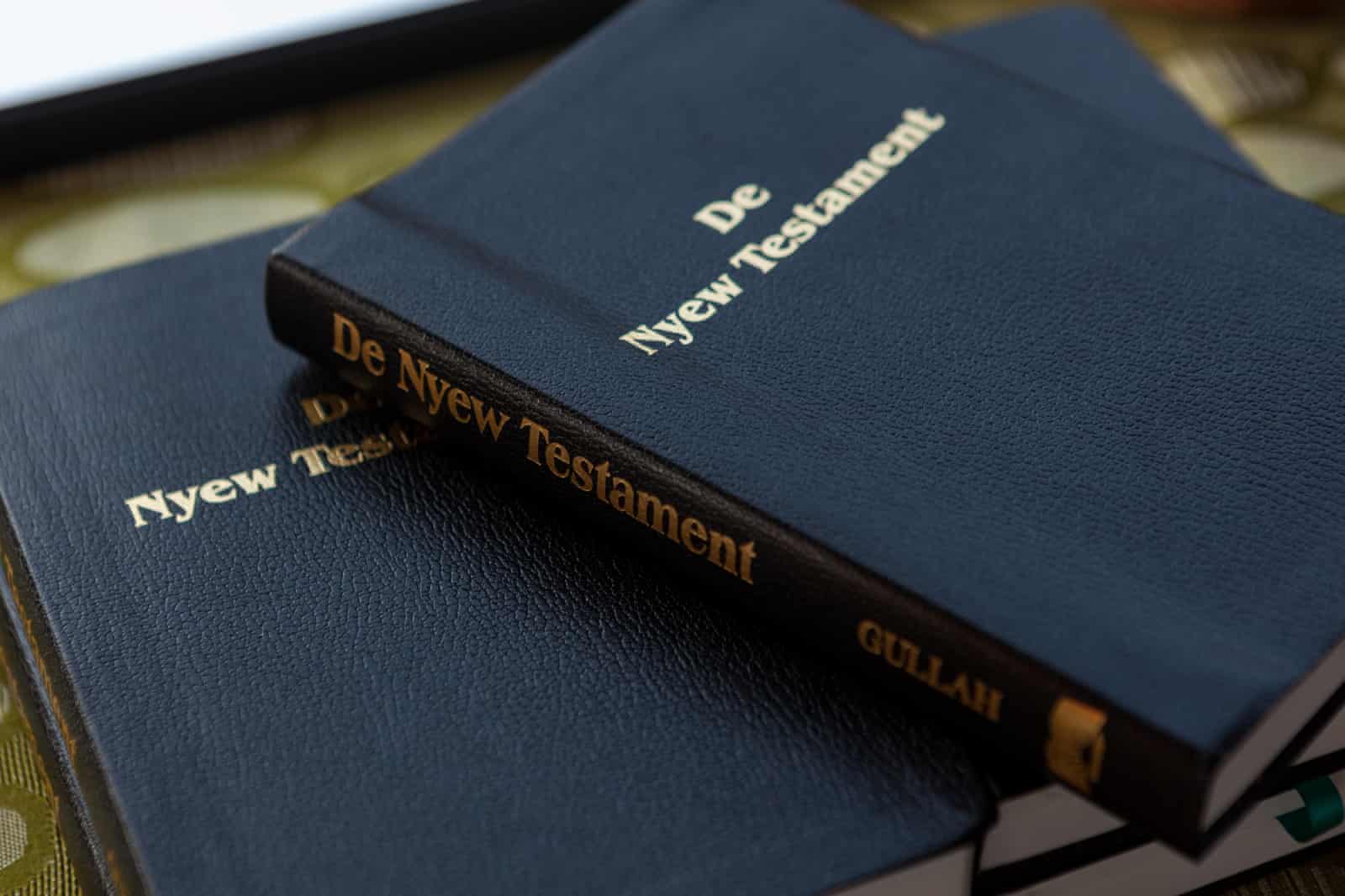
Copies of the Gullah-language Bible, De Nyew Testament. I once had a Bible collection that included this one. Some experts say artificial intelligence will help save endangered languages like Gullah Geechee.

For many reasons, including the fact that artificial intelligence “godfather” Geoffrey Hinton has said AI could wipe out humanity in three decades, I am not a fan. I know it can be helpful in medicine and other things I care about, but three decades is scary.

But what if AI saves dying languages?

Jonathan Abrams wrote recently at the New York Times about people using AI as a tool to do just that.

“While relaxing a couple of years ago, Prof. Joshua Caffery found himself in the mood to unwind with some old-time Cajun music. He asked Amazon’s Alexa to play selections from Dewey Balfa, a celebrated fiddler and singer credited with popularizing the genre.

“Instead, Alexa frustratingly steered him to the catalog of the modern pop artist, Dua Lipa, Caffery said.

“ ‘I love Dua Lipa,’ said Caffery, the director of the Center for Louisiana Studies at the University of Louisiana at Lafayette. ‘Don’t get me wrong. But it seems problematic if you’re interested in a different kind of culture and you want to surround yourself with the music of your region.’ …

“Louisiana French, the oral dialect of which Balfa was a cultural guardian, is part of the Bayou’s societal DNA, a link to its history, music and identity. Today, Caffery described the language as struggling and endangered. …

“In response, Caffery assembled a small team at the center to train its own language learning model in automatic speech recognition for Louisiana French, drawing from a trove of historical artifacts and interviews.

“Over the months, as the learning language model is trained on bits of the language — such as an old-age French nursery rhyme — it brings centuries-old dialect closer into the digital age.

“ ‘It’s scary how fast all this happened,’ Caffery said. ‘I don’t even think I knew a large-language model existed two years ago.’ …

“The efforts are part of inroads to preserve dialects at risk of being lost, and bridge a disconnect between large-language model machines, while maintaining a community’s ability to control and own its digital destiny.

“In the United States, questions exist over how to preserve languages like Louisiana French, the Gullah Geechee language (the English-based Creole language of some coastal regions in the Atlantic southeast) and Appalachian English in the modern, digital age.

“Globally, researchers at the University of Edinburgh are using artificial intelligence to strengthen and revive Scottish Gaelic and Manx. Google recently announced the availability of voice recordings of nearly 30 sub-Saharan African languages to help build tools like voice assistants and translation apps. …

“The importance of accurate speech recognition becomes greater as important tasks like job hiring and medical transcriptions become more automated and digitized, [Christine Mallinson, a professor of language, literacy, and culture at the University of Maryland, Baltimore County] said. …

” ‘There’s accents, patterns of grammar, word choice. Those differences are connected to our families, our neighborhoods, our age and gender and racial and ethnic and cultural backgrounds and where we grew up.’ …

“For centuries, Louisiana French was the predominant language spoken in South Louisiana. In 1921, a new state constitution declared English the primary language. Many parents stopped teaching their children the language out of fear of discrimination, as students who spoke Louisiana French in class were often punished with knuckle-rappings.

“A reversal came in 1968 when the Council for the Development of French in Louisiana was created to advance French, largely through education and community initiatives. In 2023, the Advocate of Baton Rouge estimated about 120,000 Louisianans still spoke French.

“Caffery grew up in Franklin, La., an antebellum town on Bayou Teche. As a child, he ate Cajun and Creole food. His grandparents sometimes sang Old French songs and passed along phrases in the language.

“ ‘Whether you spoke it or speak it, the language is floating in the air,’ he said. ‘There’s this feeling of there is this beautiful thing that we want to hang on to.’ …

“The Center of Louisiana Studies houses a vast trove of Cajun and Creole folklore recordings that include over 12,000 hours of oral histories, field recordings and music performances recorded on everything from wax cylinders to reel-to-reel tape. …

“The language is almost entirely preserved in vocal recordings. ‘A lot of it is sung in the language, and it’s something that’s vanishing,’ Caffery said. ‘Just in the same way you’d want food that’s local to your region, it’s important to have culture that is local to the region that makes you feel rooted and certain.’ ”

More at the Times, here,

Read Full Post »

Photos: Niijang Xyaalas Productions
Actor Tyler York performing in
SGaawaay K’uuna. Actors had to learn a vanishing language in order to understand their lines in this film about one of Canada’s First Nations.

We’ve had a number of posts about vanishing languages, languages spoken by few people because younger generations are choosing to (or be forced to) speak a language used more widely. Nowadays it’s usually English that leads to not only the loss of a native language but the way of life it represents. As Brian Friel said in his play Translations, about the Irish language and culture, “it can happen that a civilization can be imprisoned in a linguistic contour which no longer matches the landscape of fact.”

Dalya Alberge wrote in March at the Guardian about a new film shot in a disappearing language.

“Plenty of films are somewhat incomprehensible, but a forthcoming movie is in a language that only about 20 people in the world can speak fluently. With subtitles, audiences will be able to understand a feature film titled SGaawaay K’uuna, translated as Edge of the Knife. …

“It is in two dialects of the highly endangered Haida language, the ancestral tongue of the Haida people of British Columbia. It is unrelated to any other language, and actors had to learn it to understand their lines.

“The film is playing an important role in preserving the language, its director Gwaai Edenshaw said. He told the Guardian:

‘I know that, if our language is this far gone, statistically it’s supposed to be over. But that’s not something that we’re willing to accept.’

“The Haida are an Indigenous First Nations community whose traditional territory is Haida Gwaii (formerly Queen Charlotte Islands), an archipelago of forested islands off the west coast of Canada.

“Edenshaw said most of the fluent Haida speakers were in his Haida Gwaii homeland. … He added that the community generally lives off the sea and makes dugout canoes and houses from local red cedars. Noting that their numbers were ravaged by smallpox and other diseases in the 19th century, he said a former population of tens of thousands has dwindled to a few thousand today. …

“More than 70 local people worked on the production, with Haida speakers taking incidental roles, weavers creating the costumes and other craftspeople making props. … It is part of a wider push to preserve the Haida language, including a new dictionary and recordings of local voices. …

“2019 is Unesco’s Year of Indigenous Languages, ‘to preserve, support and promote’ them worldwide. Mark Turin, associate professor of anthropology at the University of British Columbia and a specialist in endangered languages, told the Guardian that about half of up to 7,100 languages worldwide were ‘severely endangered’ and would likely cease to be used as everyday vernaculars by the end of this century unless action is taken. …

“He pointed to recent research that shows a correlation between indigenous language sustainability and decreased youth suicide within indigenous communities: ‘Speaking your indigenous language [has] public health implications.

” ‘This film – which I’ve watched and loved – has done something that I don’t think I’ve ever seen before, using a feature movie as a process of language revitalisation.’

More here.

Actors in a film based on a legend of the Haida people of British Columbia had to learn the Haida language to understand their lines. The movie has subtitles.

Read Full Post »

Racing against the clock, the last fluent speaker of a Native American language records folktales and creates a dictionary.

Jia Tolentino writes at the website Jezebel, “Marie Wilcox, an octogenarian Native American woman from the San Joaquin Valley in California, was born on Thanksgiving in 1933; she grew up in a one-room house with the grandmother who delivered her and spoke her native Wukchumni …

“In this 10-minute mini-doc from the Global Oneness Project, via NYTLive, Marie talks about speaking primarily English to her children, who worked alongside her in the fields for a good part of the year. She started learning Wukchumni when her sister started speaking it again in an attempt to pass the endangered language on to each their kids.

“ ‘I was surprised she could remember all that,’ her daughter says. ‘She just started writing down her words on envelopes. … She’d sit up night after night typing on the computer, and she was never a computer person.’

“ ‘I’m just a pecker,’ says Marie. ‘I was slow.’

“She decided to make a dictionary. ‘Not for anyone else to learn — I just wanted to get it together.’ …

“According to a New York Times piece on this documentary from 2014:

Before European contact, as many as 50,000 Yokuts lived in the region, but those numbers have steadily diminished. Today, it is estimated that fewer than 200 Wukchumni remain.”

Watch the short film Marie’s Dictionary, by Emmanuel Vaughan-Lee, here. I found it moving.

Photo: Emmanuel Vaughan-Lee

Read Full Post »