Feeds:
Posts
Comments

Posts Tagged ‘discovered’

Photo: AP/Andrew Medichini.
A section of the restored 49-foot wall mosaic from the Painted City site, discovered in the late 1990s in Rome.

I’m not sure if you have to be a closet archaeologist to appreciate the beauty of tiny pieces of frescoe from long ago, but most of us are drawn to a mystery. And pictures like the ones in today’s story remind us that people who lived in ancient times may not have had cellphones, but they weren’t stupid or unskilled.

Nicole Winfield wrote at the Associated Press last month, “Authorities on Tuesday unveiled what is believed to be the largest fresco and mosaic complex of ancient Rome, a first century A.D. depiction of a maritime city in what became the largest bath complex in the world.

“Mayor Roberto Gualtieri presented the recently restored ‘Painted City’ fresco and ‘Great Mosaic’ that were discovered in an underground gallery during excavations in the 1990s of the Baths of Trajan on the Oppio hill near the Colosseum.

“The works are opening to the public for the first time, initially in small groups of 15 and during a trial period of weekend access starting this month. The aim is to determine how the delicate works respond to increased humidity and climactic impacts before allowing more general access.

“Gualtieri said the fresco, which features images of a walled port city from a birds-eye view perspective, was the largest wall fresco of its kind from ancient Rome and as such needs to be open to the public. …

“Rome’s cultural superintendent, Claudio Parisi Presicce, said the grandeur of the port city as depicted in the fresco, with buildings, a theater and temple, public piazzas and towers, was particularly well conserved. The restoration work included techniques to preserve and improve visibility, remove surface deposits and consolidate the grouting to keep the decorated surfaces intact. …

“The mosaic, for its part, measures some [49 feet] high and features intricately decorated columns and architectural elements and figures over four different levels. The top levels are up-close images with people that are almost like theatrical scenes, while at the bottom are views of the [unknown] port city’s layout from above.

“The Baths of Trajan, which were dedicated by Emperor Trajan in 109 A.D., extended over [15 acres] and were at the time the largest bath complex in the world.”

More at AP, here.
Read Full Post »

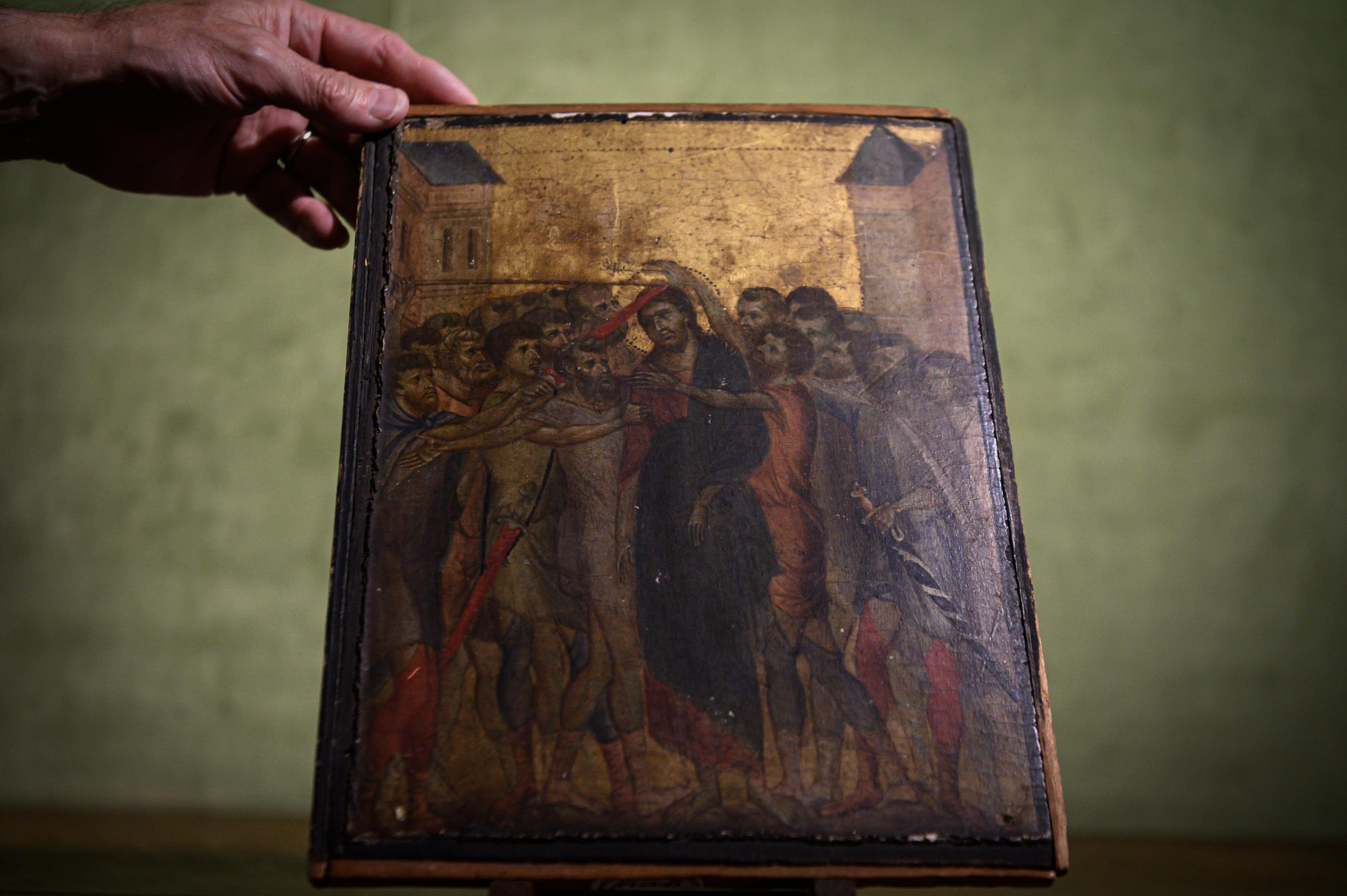
Photo: Philippe Lopez/AFP/Getty Images.
This valuable painting, called “The Mocking of Christ,” is by the 13th century Florentine artist Cimabue. It came close to being thrown away when a house in France was getting cleared out.

When the consignment guy comes to help with your lifetime downsizing, he naturally hopes to uncover some neglected item that turns out to be extremely valuable. That would have been OK with me, but the process went more in the opposite direction. Things I always thought were valuable, we couldn’t even give away for free.

Still, one always enjoys someone else’s discovery, like the one in today’s story. …

“Scott Reyburn reports at the New York Times, “A medieval painting that hung for years near the kitchen of an older Frenchwoman before being recognized as a work by the Italian artist Cimabue was auctioned [in October] in France for $26.8 million.

“The work was bought by the London-based dealer Fabrizio Moretti against competition from at least six other bidders.

” ‘I bought it on behalf of two collectors,’ Mr. Moretti said in an interview immediately after the auction. ‘It’s one of the most important old master discoveries in the last 15 years. Cimabue is the beginning of everything. He started modern art. When I held the picture in my hands, I almost cried.’ …

“The 10-inch-high poplar panel was discovered in June during a valuation of the contents of the house of an older Frenchwoman near Compiègne, north of Paris. Thought by the family to be an icon, the painting hung on a wall next to the kitchen.

“ ‘I had a rare emotion with this little painting, almost indescribable,’ said Philomène Wolf of [auction house] Actéon, who had made the discovery. ‘In our profession, we know that this emotion was the result of a great master.’ …

“Actéon consulted Eric Turquin, the Paris-based art expert on old masters, who collaborated on the sale of the painting. … Mr. Turquin said his research identified the Compiègne panel as ‘the only small-scale work of devotion to have been recently added to the catalog of authentic works by Cimabue.’ It was described as being in ‘excellent general condition.’

“ ‘This was an easy sale,’ Mr. Turquin said, comparing the auction of the Cimabue to the canceled public sale in June of the ‘Judith and Holofernes’ attributed to Caravaggio. ‘I was pleased at 10 million and tremendously happy at 15 million,’ he said of the Cimabue sale. ‘The price was more than I could have dreamed, and there was a contemporary art gallery bidding, which was new for us.’

“According to Mr. Turquin, ‘The Mocking of Christ’ was part of the same late-13th-century altarpiece that once included Cimabue’s similarly sized ‘Flagellation of Christ,’ now in the Frick Collection in New York, and the ‘Madonna and Child Enthroned Between Two Angels,’ now in the National Gallery in London.

“The Frick acquired its Cimabue in 1950. The ‘Madonna and Child’ was scheduled to be auctioned at Sotheby’s in 2000, but was sold to the National Gallery by private treaty for about 7.2 million pounds, about $10.8 million. …

“Traces of the original framing, the style and technique of the gold ornamentation and the pattern of wormholes on the back of the Cimabue panel ‘confirm that these panels made up the left side of the same diptych,’ Mr. Turquin said in a pre-auction statement.

“Cimabue pioneered a more fluent and naturalistic style of figure painting in Italy. … The Florence painter takes up the first biography in Giorgio Vasari’s hugely influential Lives of the Most Excellent Painters, Sculptors and Architects, published in 1550. Vasari describes how Cimabue emancipated himself from the ‘stiff manner’ of Byzantine artists and was ‘the first cause of the revival of painting’ before Giotto ‘overshadowed his renown.’ ”

More at the Times, here. If you enjoy this kind of story, see also the Guardian take on a neglected Botticelli, here.

Read Full Post »