Feeds:
Posts
Comments

Posts Tagged ‘diver’

Photo: Rob Schoenbaum/The Guardian.
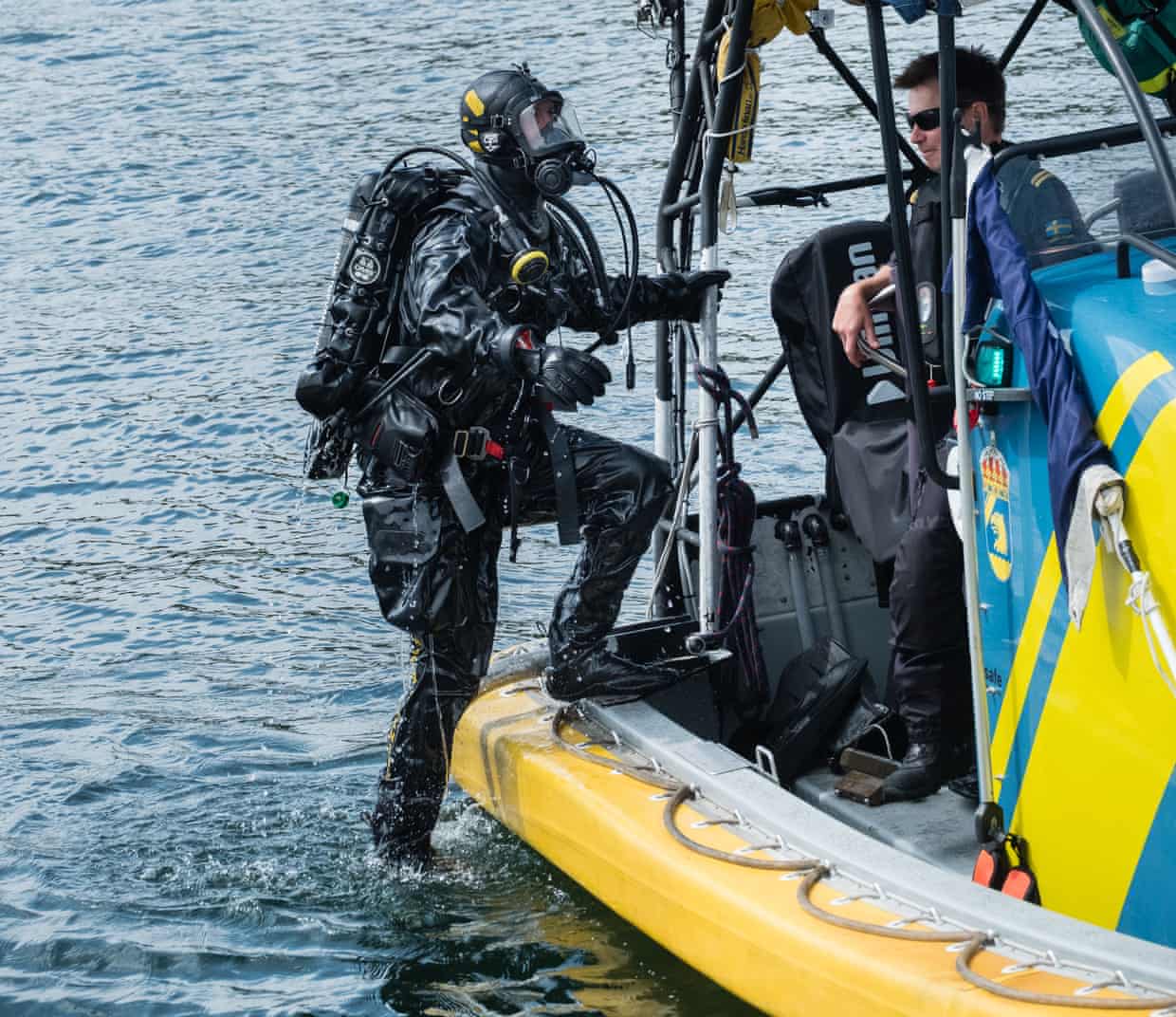
A Swedish coastguard diver exits the water after inspecting a wreck.

So many different kinds of work in the world! Today’s article, from the Guardian, describes an unusual job in Sweden. It involves going underwater to protect old shipwrecks from looters.

Miranda Bryant writes, “Among the rocky shores and wooden summerhouses of Dalarö, an exclusive Swedish summer retreat, there was little to indicate anything other than a typical summertime scene on the Stockholm archipelago.

“It was only as the coastguard boat reached a discreet yellow buoy that there was any suggestion of the 17th-century shipwreck lying, preserved, 30 metres beneath it. ‘STOP,’ read a sign. ‘Marine cultural reserve.’

“Bodekull, built by the English shipbuilder Thomas Day, is believed to have run aground in 1678 and sunk while transporting flour to the Swedish naval fleet in Kalmar, down the coast in south-east Sweden.

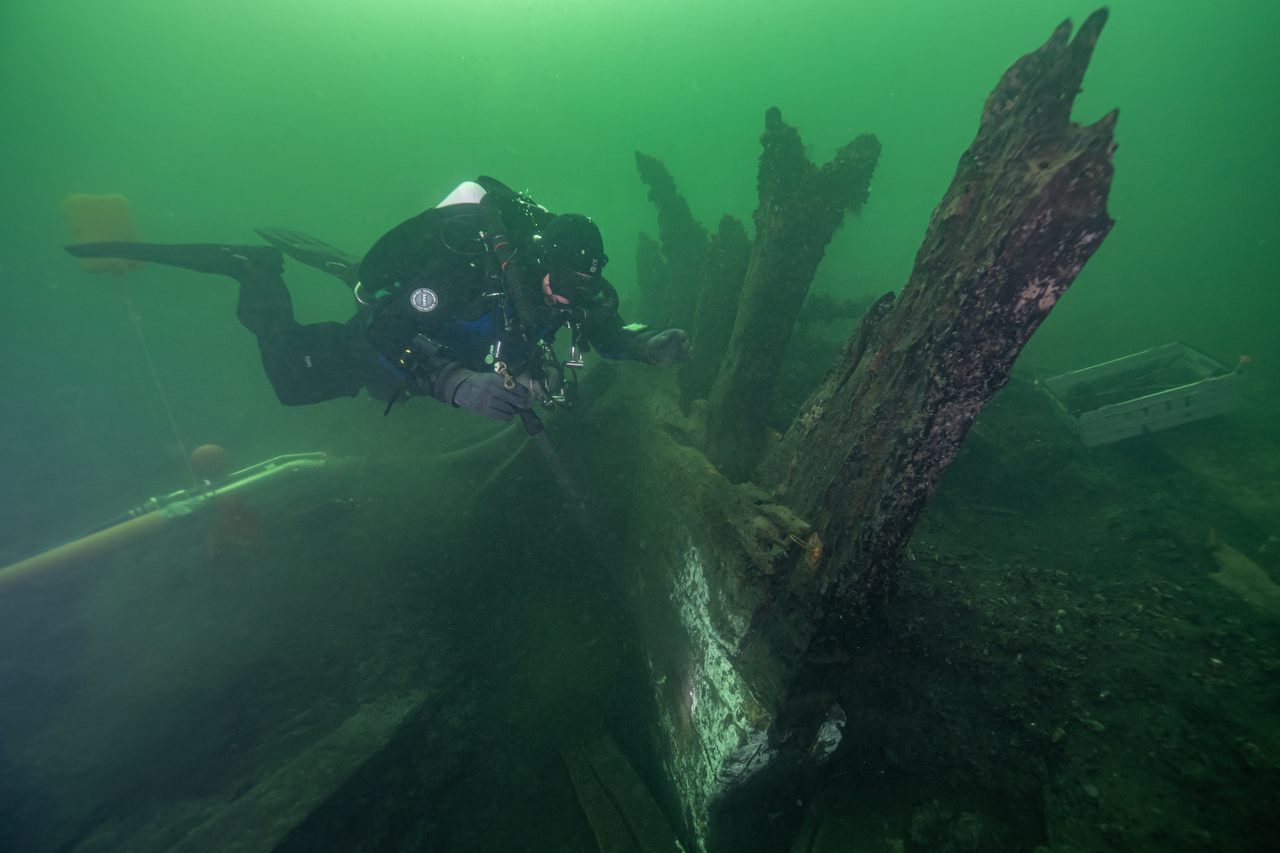
“Thanks to the Baltic’s brackish water protecting the wreck from shipworms, the 20-metre-long ship remains on the seabed, upright and largely intact, full of relics that are still being discovered. Two of its three masts poke up towards the sky in their original position.

“But now Bodekull faces a human threat to its existence. Authorities say that it is among thousands of historic wrecks across the Nordics that are at risk from plundering.

“On a monitoring operation last week, experts shared photographs with the Guardian that show that objects are vanishing from shipwrecks.

“Those responsible are believed to be a diverse array of offenders, from light-fingered sport divers in search of souvenirs to criminal gangs looking for high-value objects to sell. Such is the scale of the problem that the coastguard is now regularly sending divers down to monitor at-risk sites.

“ ‘The plundering problem isn’t just a Swedish problem, it’s a Baltic Sea problem,’ said Jim Hansson, a marine archaeologist at Vrak, the museum of wrecks, citing the sea’s low salinity and comparatively shallow average depth of 55 metres.

“These unique conditions, as well as the existence of an estimated 100,000 shipwrecks, make the Baltic a ‘mecca for marine archaeologists,’ he said. But it’s also increasingly attracting looters. Around Stockholm alone, Hansson knows of six wrecks that have been looted by international and Swedish divers. …

“ ‘Sweden has one of Europe’s longest coasts so it’s a lot of water to guard and it isn’t easy,’ said Hansson. …

” Coastguard divers normally work on environmental disasters, inspect ships for drugs and weapons and help police looking for murder weapons. ‘It is very unique for us to be part of this,’ [Patrick Dahlberg, a coastguard commander] said. …

“[On August 1] Coastguard diver Patrik Ågren said he didn’t see any evidence of tampering as he emerged from recording the contents of a tool drawer on the ship containing planes, sledgehammers, a basket and carpentry equipment. … Video footage he recorded during the dive will be compared with previous footage to check for changes.

“But on a later dive they discovered that a wheel on a cannon had been removed, a deck beam collapsed and a wine bottle moved since they last visited in January. While some of the changes may have been caused by nature, Hansson said it was difficult to see how the wheel and wine bottle could have been moved without human intervention. …

“Hansson said removing relics from wrecks prevented them from building a full picture of the type of ship, where it was going and what it was doing.

“ ‘We collect all the puzzle pieces just like a police or coastguard investigation,’ he said. ‘That’s why it is super important that objects are not moved because it is like ripping the pages from a book. In the end all you will have left is an empty shell.’

“Amid heightened tensions with Russia after its invasion of Ukraine, allegations of spying and Sweden’s hopes of imminently joining Nato, it is a critical time for the Baltic.

“But Hansson said that cultural monuments could also be used in war. ‘What happened with Nord Stream [gas pipeline bombings] could similarly happen with national cultural heritage monuments like shipwrecks. The first thing that happens with big conflicts is that you erase a nation’s integrity and history.’ ”

More at the Guardian, here.
Read Full Post »

Photo: Brett Seymour.
A trove of spices was found in the stern of the ship by Brendan Foley and a team of archaeologists. It had been there for centuries.

For those of us who hope that one day the lost island of Atlantis will be found, any story about underwater discoveries of ancient artifacts is thrilling.

Line Sidonie Talla Mafotsing writes at Atlas Obscura, “Built 1485, the Danish warship Gribshunden served as the flagship and mobile seat of government for King Hans of Denmark and Norway. In the summer of 1495, Hans set sail for Kalmar, Sweden, where he was set to negotiate with Swedish leader Sten Sture the Elder. The goal of the mission was to convince Sten Sture and the Swedish council to give up their sovereignty and rejoin the Kalmar Union, which had unified much of Scandinavia under a single ruler (and which Sweden had left a few decades before, despite the union being named for a Swedish town).

“The ship itself had a role to play: to show Hans’s authority to the Swedish council. It was also laden with goods — from gunpowder weapons to artwork to delicacies — to demonstrate his power.

“However, while anchored in the Baltic Sea near the port of Ronneby, Sweden, Gribshunden mysteriously caught fire. Though the king wasn’t on board at the time, many crewmen were, in addition to all those pricey goods. Although the exact number of deaths is unknown, many of the crew of 150 were on board when the ship sank to the bottom of the Baltic with its precious cargo. …

“In the 1970s, a local diving club came across a mysterious wooden wreck there, in 33 feet of water. It wasn’t until 2001 that the first archaeological excavations of the ship began, after one of the divers told local archaeologists about what they had found. It was another decade before the remains were identified as those of Gribshunden. All through the excavation of the wreck, remarkably preserved by the cold waters of the Baltic, amazing and sometimes odd artifacts have emerged and attracted media attention. In 2015, there was a nearly perfectly preserved wooden ‘sea monster’ figurehead. In 2019, archaeologists discovered a well-preserved rare Atlantic sturgeon. Further excavations in 2021 revealed something even more remarkable: a treasure trove of spices, plant material, fruits, nuts, and cereals, that somehow survived underwater for more than 500 years.

“In a study published in the journal PLoS ONE, Brendan Foley and Mikael Larsson, archaeologists at Lund University in Sweden, examined the finds for new insights into how nobility lived and ate during the Middle Ages, and shed light on how these organic materials survived so long underwater.

“Foley and a team had been excavating the stern when they made the finds. ‘We think, but we’re not sure, that the back part of the ship is probably where the highest ranking individuals were situated,’ says Foley. They sifted through the sand and silt and revealed almond shells and peppercorns. They recovered thin strands of saffron by hand. ‘We took four samples of botanical assemblage that included both local and exotic spices, fruits, and vegetables,’ says Larsson, including black mustard, dill, clove, ginger, cucumber, grape, and berries such as blackberry and raspberry. ‘The botanical remains that really stand out are the exotic spices,’ he says. Clove, ginger, and saffron had never been found before in the medieval Baltic.

Larsson says that their work is the first anywhere in the world to find saffron in such a setting. …

“Though the geographical origins of saffron are not completely understood, it is thought to have originated in the eastern Mediterranean, and been grown in Southwest Asia and the Mediterranean basin. Ginger is believed to have originated in Southeast Asia, and cloves are native to Indonesia. Black pepper comes from South India. Despite this time being known as the ‘Dark Ages’ in Europe, the finds show that Scandinavia wasn’t just a backwater of the world economy. …

“[One] question focuses on how these delicate organic remains were able to survive in the Baltic. ‘It’s a mystery,’ says Foley. ‘We don’t know, we didn’t find any containers.’ When they found the saffron, it was just in a lump in the sediment. ‘No glass jar around it, no ceramic jar, no wooden box, no silver box,’ he says. It may have been stored in some sort of fine textile bag that disintegrated over the years—but somehow the spice remained.

“ ‘The Baltic Sea is really weird,’ Foley says. For one, it has the lowest salinity found in the global oceans. This, combined with low temperatures and low dissolved oxygen to feed microbes, have given the Baltic a reputation for remarkable preservation of archaeological material, specifically wooden shipwrecks.”

More at Atlas Obscura, here. No firewall.

Read Full Post »

Photo: Ben Raines/ Alabama Press Register.
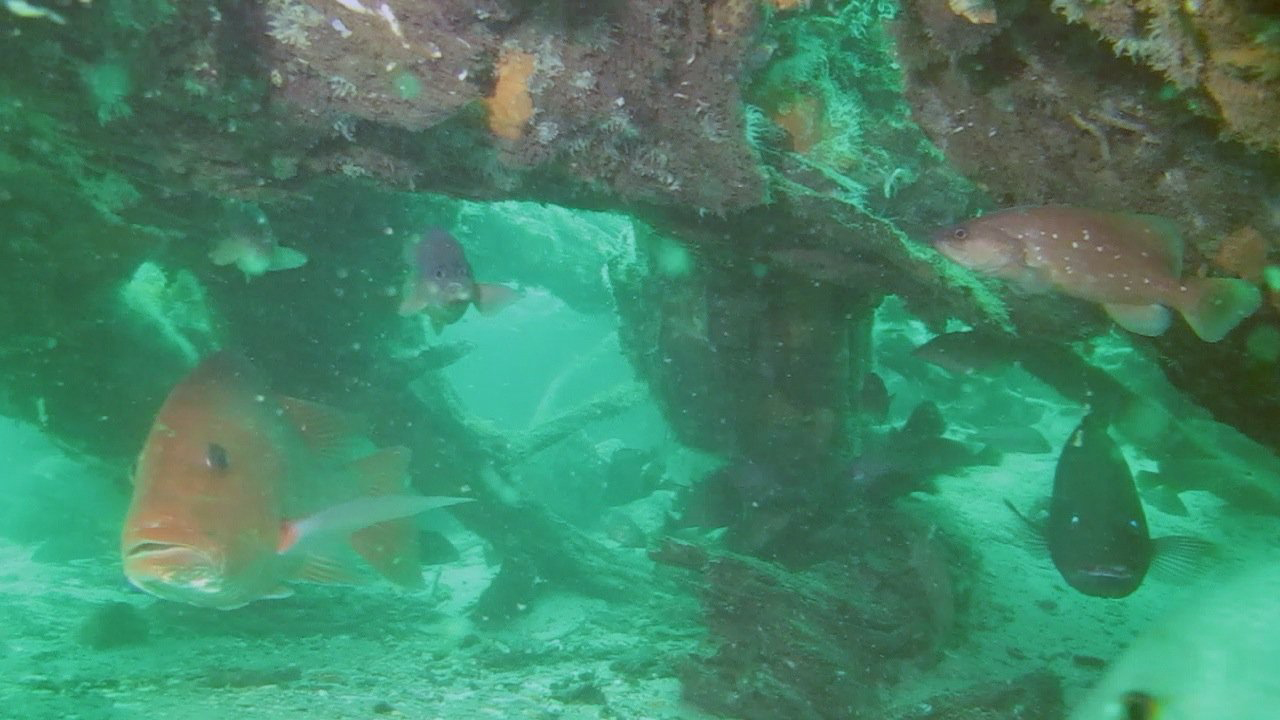
“Sixty feet beneath the waters off the Gulf coast of Alabama lies a forest of cypress stumps more than 50,000 years old,” says Living on Earth. “Fish hide among the roots of the trees.

Hello from Hurricane Central. The guy in charge of New Shoreham’s power company says to expect that Henri will cause a loss of electricity, so if I break my perfect 10-year-plus record of daily blogging, you’ll know why.

Meanwhile, let’s think about scuba diving in an ancient, submerged forest in the Gulf of Mexico.

Living on Earth host Steve Curwood interviewed Ben Raines in 2012 about this and reposted the story and video because of new urgency to get the area classified as a marine sanctuary before it’s exploited.

“STEVE CURWOOD: Deep beneath the surface of the Gulf of Mexico, off the Alabama coast, lie ancient cypress trees that only a handful of people have ever seen. One of those lucky few is Ben Raines, director of the [South Alabama Land Trust].

“BEN RAINES: For many years I was the environment reporter for the paper down here, the Press-Register, and so I had a buddy who owned a scuba diving shop, and he used to taunt me with this tale of an underwater forest that he had been diving on one time, and I pestered him for years and years and years, and he finally agreed to take me out there.

“He heard about it from a fisherman who just noticed a ledge on his bottom machine as he was riding across the gulf. So he started fishing there and catching a lot of Red Snapper. And he gave the numbers, the GPS coordinates, to my buddy that owns the dive shop and asked him to go out there and see what it was. He hit the bottom and said there’s a bunch of trees.

“CURWOOD: Now how deep is deep for an underwater forest?

“RAINES: Well, this is about 60 feet. Of course, all over the Earth, we know sea levels have gone down hundreds of feet. So we have a delta, a river delta here. Further up in the delta, about 80 miles inland, there’s sand dollars all over in these limestone bluffs. So we know sea level was that high at one time. Now we’ve got these trees 60 feet underwater, so sea level was that low, and it’s just a fascinating push and pull of the ocean through the climatic change over the eons.

“CURWOOD: So when did you finally get to visit the forest?

“RAINES: I got out there a year ago last August. …

The way we dive here, we’ll drop the anchor over whatever the GPS number is. And then we swim down the anchor line to get to the spot because the water’s a little murky — otherwise you get lost.

“I went down the anchor line, and when I hit the bottom, there it was. The first stump. And it was about as big around as a garbage can lid, but it had that very distinctive irregular shape that a Cypress trunk has. … Then it was surrounded by ‘knees.’ You know, Cypress trees have knees — you see them in the swamps — that stick up out of the water to kind of help hold them in place, and here was a Cypress tree on the bottom of the ocean. And I swam a few feet, and there was another one, and a few feet more, another one, and I quickly realized they were all around me in every direction. …

“It’s totally enchanting. You know, these trees are covered in anemones and crabs and shrimp — and then you have these huge clouds of Red Snapper and Grouper following you around. I was down there one day swimming along the ledge where the biggest stumps are, and I turned around and there was this huge funnel shape of fish behind me, I mean it must have been 200 Snapper, and they were just following me around. When I stopped, they would stop. When I turned around, they all fell in behind me. …

“[Groupers] come right up to you. And some of the fish that are down there, the trigger fish, will actually come up and chew on your camera. You have to shoo them away. They just seem to have no fear. …

“From the moment I hit the bottom and saw the stumps, it was just exhilarating. You knew you were in this sort of ‘land of the lost,’ this place that shouldn’t exist, but here it was, and I got the camera out, I hit the record button, and I never turned it off, and that’s exactly what I’ve done every dive I’ve made down there. And now I’ve been going down there with three cameras, you know, setting them up in different locations just to kind of capture this place while it’s there, because if we get a storm, it could theoretically come into the Gulf and change everything out there and bury this place up again. You know, it may be a very ephemeral place. We may only get to see it for a little while. …

“I cut some sections out of them, gave them to Christine DeLong at LSU, and she had them radio carbon dated, and they had to do them three times in all I think because they didn’t believe the results. So they expected them to be 12,000 years old, which was the last ice age. Instead they came back radio carbon dead each time they tested them, which means they’re 50,000 years old or longer. …

“We had another team come out from University of Southern Mississippi, and we had them do a sonar survey so we could try and get an extent of it because I’ve only been swimming around 300 yards of it. It turns out it’s spread close to a mile. …

“CURWOOD: We first aired this story back in 2012 and the fight to protect Alabama’s underwater forest from business interests continues. Scientists and advocates have asked the Biden administration to designate the site a marine sanctuary.”

More at Living on Earth, here.

Read Full Post »

whales-humpback-watercolor-mom-and-baby-olga-shvartsur

Art: Olga Shvartsur/Fine Art America
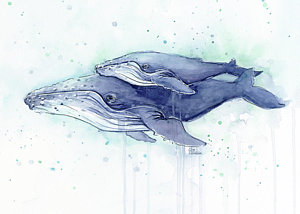
Humpback whale and baby. Recently, a humpback whale appeared to intentionally protect a researcher from a tiger shark.

A scientist who studies whales underwater was astonished and more than a little frightened in September 2017 when a whale kept pushing her toward her boat. After her colleagues pulled her to safety, she saw that in the other direction a dangerous tiger shark was lurking. The researcher believes that the whale was intentionally trying to protect her. Other scientists argue that whales aren’t altruistic.

I say, Who cares? The point is the whale’s action moved the diver away from danger, and she is grateful.

Sarah Gibbens writes at the National Geographic, “For 28 years, Nan Hauser has been researching and diving with whales. The biologist is the president and director of the Center for Cetacean Research and Conservation. … During a trip to look at whales in the Cook Islands in the South Pacific last September, Hauser says she had an encounter unlike any she had experienced before.

“A humpback whale, a marine mammal capable of weighing 40 tons and growing 60 feet long, swam toward Hauser. For ten minutes, it nudged her forward with its closed mouth, tucked her under its pectoral fin, and even maneuvered her out of the water with its back. …

” ‘I was prepared to lose my life,’ she says. ‘I thought he was going to hit me and break my bones.’

“In addition to conducting research, Hauser says she was also in the Cook Islands to work on a nature film, so at the time the whale approached, both she and a fellow diver were armed with cameras. Hauser’s point-of-view footage shows just how persistently the whale nudged her. A second whale can also be seen lurking just behind the first.

“When she finally made it out of the water and up onto her boat — bruised and scratched from the barnacles on the whale — Hauser saw a third tail moving from side-to-side.

” ‘I knew that was a tiger shark,’ she says.

“Now, after viewing the footage and reflecting on the whole harrowing experience, Hauser concludes that the whale who nudged her likely exhibited an extraordinary example of altruism. …

“Hauser’s retelling isn’t the first time scientists have questioned whether humpback whales can show signs of altruism. A 2016 study in the journal Marine Mammal Science looked at 115 instances from the past 62 years in which humpbacks interfered with a pod of hunting orcas.

“Banding together, humpbacks were seen effectively protecting their calves. But there were also examples of humpbacks showing the same behavior to protect other species of whales, seals, and sea lions. …

“Martin Biuw from the Institute of Marine Research in Nowary is skeptical of Hauser’s claim that altruism is at play in the video. Hauser had speculated the whale was male, but Biuw believes it appears to be a female.

” ‘If that is the case, it is possible that she may show protective behavior towards a human (or other animal for that matter) if she has for instance recently lost her calf,’ he says.

“Biuw explained that hormonal changes could have spurred the whale to show protective behavior.” Oh, ha, ha, hormonal changes? Good grief, give me a break.

More at the National Geographic, here.

Read Full Post »

Suzanne’s Mom was asked to review Revolution, a film by the young environmentalist, biologist, diver, and Sharkwater filmmaker Rob Stewart.

Encompassing gorgeous deep-sea photography, scientific climate-change testimony, a representative of the drowning country of Seychelles, and many youth demonstrations, the documentary forces you to think about what the burning of fossil fuels is doing to the oceans and what it means for the future of the planet. It also gives you the sense that anyone can do something about it — take up a camera, make a poster, or write a letter that makes a change.

The film is infused with a sense of youth, of young people saying, “Enough!” I particularly loved the moment early on when Stewart, who had read only two books on filmmaking, is flubbing his lines in front of Darwin’s Arch. What comes across in addition to the humorous inexperience is a feeling of energy, optimism, and determination.

The film has many engaging details about sea life that Stewart can’t resist throwing in, like how the endangered pygmy seahorse, which camouflages itself to look like coral, “mates for life — and the guy gets pregnant!”

He talks about how the burning of fossil fuels creates too much carbon dioxide, which is absorbed by the ocean and is harmful to anything that needs to grow a skeleton, which is pretty much everything but nasty, poisonous creatures that flourish in the muck where corals died, like the flamboyant cuttlefish. Coral expert Charlie Veron comments that at the same rate of ocean acidification caused by too much CO2, there will be no coral reefs in 50 years.

Stewart also looks at the island nation Madagascar, sole home of lemurs, explaining that endangered tropical forests are responsible for 1/4 of the world’s species and 1/3 of our oxygen. Madagascar scientist Serge Rajaobelina says that population growth on the island and the burning of the trees for development has meant the loss of 80 percent of the forest in 40 years, more than in 55 million years.

The movie goes on to cover perhaps a few too many youth protests, including one in which an inspired, tree-planting young boy says, “We have found we have to save our own future,” and is later arrested in tears.

But then we get to see that children and young adults are actually having an impact.

A sixth-grade class in Saipan writes letters to the Saipan government against killing sharks for shark fin soup, and the government signs a law preventing the practice. In fact, we are told, since the first Stewart film, China, the main adherent of shark-fin soup, has dropped the practice by 70 percent, and 100 countries have banned it.

The upbeat Saipan children who comment on their successful advocacy embody the truth of my favorite Pete Seeger line, “one and one and 50 make a million.” Says one, “Maybe the world might not end because of what we are doing.”

Watch the Revolution trailer here.

[We do not accept gifts here, so the DVD that the film company sends me for screening and reviewing will be forwarded to Save the Bay, RI.]

The late Rob Stewart. The filmmaker did not come up from a dive 1/31/17 near Key Largo.
rob_stewart_memdf

Read Full Post »

One of the sources I check for ideas to share with you is the website for the delightful environmental radio show, Living on Earth.

A story about the healthy coral reefs in the deep water off Cuba caught my eye, especially as there has been a resurgence of interest in Cuba lately.

Living on Earth host Steve Curwood interviews Robert Wintner about his latest book, Reef Libre: The Last, Best Reefs in the World.

“CURWOOD: Now, your book is very timely. Come on, tell me … you got some kind of tip off on this political thaw? …

“WINTNER: I thank Neptune for that. We got word of this particular reef system [that was] called the last best reef system in the world. And the three qualifiers for that rating were 100 percent biodiversity (that means all the species that were ever there are there now, and in fact some they thought were extinct), 100 percent coral cover and 100 percent host of apex predators, and that was the key right there to restoring these reefs to healthy conditions. No natural system can survive intact without apex predators, that’s what allows every level of the food chain beneath it to be at optimum balance. And the glaring example in the world today is Cuban reefs, our Jardines de la Reina. That’s the ocean people talk about, that the world used to have, that we used to love. It’s there in in Cuba.”

Read all about it here., or listen to the broadcast. Lots of amazing photos. And be sure to note how the Cubans control the invasive lionfish by removing the spines and conditioning bigger predators to the taste.

Photo: Robert Wintner at Living on Earth
Reef Libre: The Last, Best Reefs in the World is diver and photographer Robert Wintner’s most recently published book.

Read Full Post »