Feeds:
Posts
Comments

Posts Tagged ‘divide’

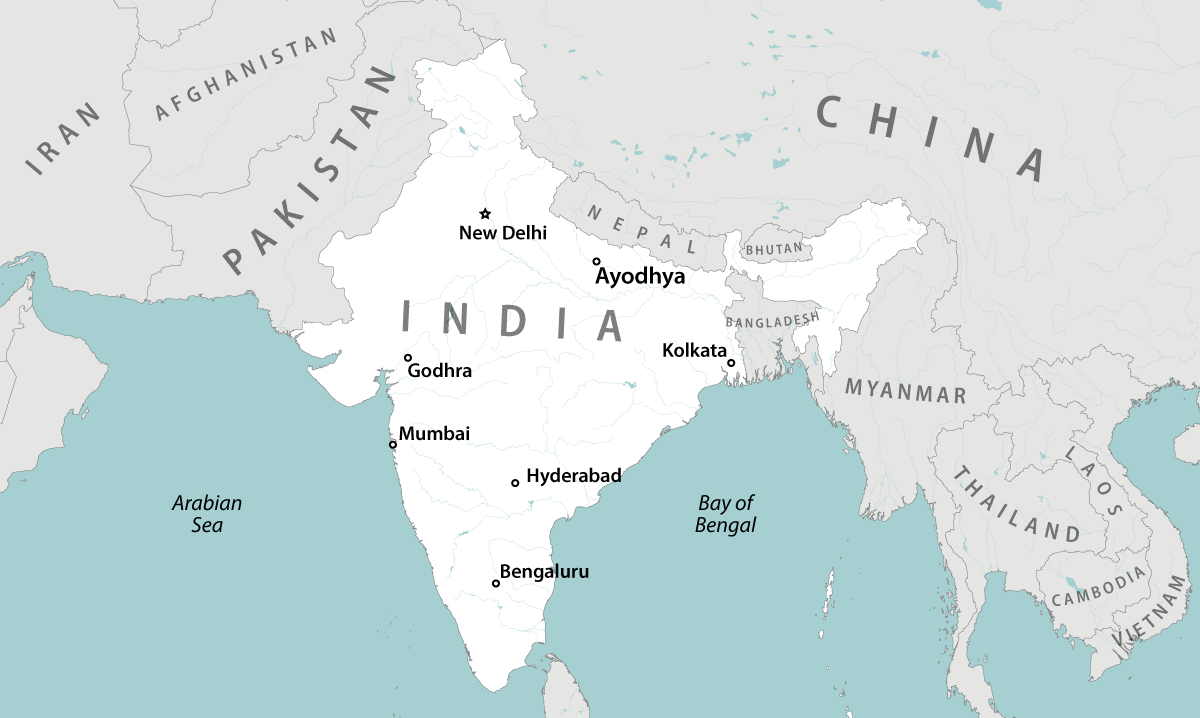
Map: Jacob Turcotte/CSM.
There are still people in India who appreciate having friends from other religions.

There is not much to celebrate about Hindu-Muslim relations in India these days, where the current power structure seems to have turned its back on peaceful coexistence. But trust the Christian Science Monitor to come up with a rare upbeat story! It’s about an interfaith friendship between Sadiq Ali, a Muslim, and Mahant Gyan Das, a Hindu, that has survived many political storms.

Shweta Desai  writes, “The light blue walls of Sadiq Ali’s living room are adorned with photos of Hindu seer Mahant Gyan Das. The two have been friends since the 1980s, when Mr. Ali was a volleyball player and Mr. Gyan Das a wrestler. They bonded over their shared love of sports, and Mr. Gyan Das regularly visited Mr. Ali’s family tailoring shop to get his tunics stitched. 

“About 20 years ago, their friendship took on a new meaning. Days of violent riots had rocked the nation and left more than 700 Muslims dead. It tore open old wounds in Ayodhya, a north Indian city where the Muslim community was still reeling from the destruction of the historic Babri mosque by a Hindu mob in 1992.  

“Sensing the need for an olive branch, Mr. Gyan Das, then head priest of the city’s historic Hanuman Garhi temple, invited 1,000 Muslims to the temple premises during Ramadan to break their daily fast. Mr. Ali helped host the feast, which still fills its organizers with pride and nostalgia – especially as Ayodhya is once again in the spotlight for Hindu-Muslim tensions.

“[Recently] Prime Minister Narendra Modi unveiled an opulent Hindu temple on the site where the Babri mosque once stood. 

“Like the mob which leveled the mosque, Mr. Modi and his supporters in the ruling Bharatiya Janata Party (BJP) claim that Babri was built over the birthplace of Hindu deity Ram, and the construction of the new Ram temple has become a rallying point for India’s growing Hindu nationalist movement. …

“In such polarized times, Mr. Gyan Das and Mr. Ali’s friendship offers a reminder of what Ayodhya could have – and perhaps still can – become: a symbol of multiculturalism and tolerance.

‘Ordinary people here want to live in peace,’ says Valay Singh, author of Ayodhya: City of Faith, City of Discord.

“He argues that the city’s reputation as India’s ‘ground zero’ of communal conflict overshadows its history as a heartland where different religious traditions have long intersected. In fact, he notes, the land for the Hanuman Garhi temple was donated to the region’s Hindu community by Muslim ruler Shuja-ud-Daula in the 18th century.

“ ‘It was a common tradition for the religious establishments to receive patronage from the Muslim rulers,’ he says. …

“[The] religious strife has deep roots – several weaving back toward Ayodhya. The destruction of the Babri mosque, for instance, came after decades of campaigning by right-wing Hindu groups, such as the Vishva Hindu Parishad (VHP), and led to months of communal violence across India. In Ayodhya, Muslims and their properties were singled out. Mr. Ali’s shop was plundered multiple times. …

“Indeed, the mosque’s demolition and resulting chaos left deep fissures between the Hindu majority and Muslim minority throughout the country. 

“Those rifts grew during the 2002 Gujarat riots, which were sparked by a deadly fire on a train carrying Hindu pilgrims from Ayodhya to Godhra, Gujarat. …The following year, Mr. Gyan Das approached Mr. Ali with his idea to organize an interfaith iftar fast-breaking meal at Hanuman Garhi.

“At first, the tailor was baffled. He reminded Ayodhya’s most influential seer that after breaking fast, Muslims must offer the namaz prayers. Will the Hindu seers accept prayers to Allah on the temple’s premises? Mr. Gyan Das was confident they would.

“In November 2003, with fanfare and high security, saffron-robed priests from several local temples welcomed their Muslim guests, serving them fruits and yogurt. Around sunset, calls of ‘Allahu Akbar!’ mingled with the sounds of conch shells and temple bells, as rows of Muslims bowed down to read the namaz. Both sides prayed together for peace and brotherhood to prevail across the country.

“The Muslim community reciprocated. After the iftar, hundreds of seers marched to Mr. Ali’s home to break the Hindu Ekadashi fast with seviyan, a traditional sweet prepared by Muslims on festive occasions. …

“The iftar [inspired] Yugal Kishore Shastri, one of few outspoken Hindu priests who have left the far-right and put their faith in the spirit of Indian secularism. Mr. Shastri says he split from the VHP after discovering that there was ‘no evidence of an ancient Ram temple under the mosque structure.’ …

“Although it’s getting harder for activists to cut through the vitriol and bring communities together … ‘There will always be a place for people who work for Hindu-Muslim peace,’ he says.”

More at the Monitor, here.
Read Full Post »

Photo: Political Blind Date
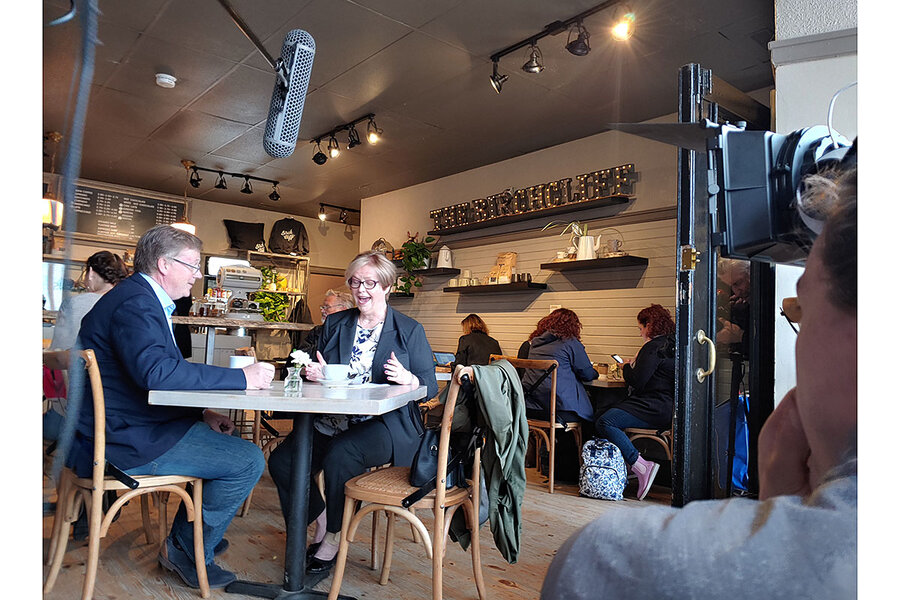
Toronto City Councilors Gary Crawford and Shelley Carroll, who hold very different political views, chat in a Toronto coffee shop during an episode of the TV show “Political Blind Date.”

What if each of us tried to reach across the divide? My brave friend Nancy does it in a class at the Council on Aging, where she actually talks politics. I’m not strong enough for that, but I really do work at nurturing the things I have in common with people whose politics are different. There are always things we have in common. After all, if Earth got invaded by hostile space aliens, we’d all be helping each other out without a second thought.

In Canada, they aren’t waiting for space aliens.

Sara Miller Llana writes at the Christian Science Monitor about a popular television show that has participants reaching across the political divide.

“When Gary Crawford confided to Shelley Carroll on TV that he has a daughter with a disability, the mother who raised a daughter diagnosed with autism replied instinctively, ‘Oh, Gary’ – conveying an empathy so obvious in just two words.

“It’s not that the Toronto city councilors didn’t know one another. They’d worked together in City Hall for the better part of a decade. But more often than not, they were dug in on either side of the chamber, battling over city finances.

“So this meeting, at a cozy Toronto coffee shop, was an intentional step away from those fiery legislative sessions, a way to help two rival politicians find common ground in sustaining North America’s fastest-growing city – even if Ms. Shelley envisions new revenue tools while Mr. Crawford dubs himself a ‘keep taxes low kinda guy.’

“Welcome to ‘Political Blind Date.’ The popular Canadian television show might sound like a hokey reality show for the political set. But for its creators, the aim is to undo some of the stubborn binaries that have built up around contentious issues from gun rights to taxation to immigration to climate change.

“Getting beyond the media scrum, the yelling during parliamentary question periods, the sound bites on nightly news, and the callous swipes over social media, producers set the stage for participants to engage one another with the time and respect that complex problems require.

‘Respect is at the heart of it. Not only are politicians, in the way they are using political rhetoric, not respecting each other; they’re disrespecting their citizenry,’ says Mark Johnston, showrunner of ‘Political Blind Date.’ ‘And at the same time, there’s been a disrespect and dehumanization of politicians.’ …

“With the filming of a fifth season underway, about 50 politicians have already participated, spending two days together with each other’s constituents and wrestling with legalization of marijuana, Indigenous rights, and climate change. It’s not easy: In one episode, a politician who supports gun rights visited a Toronto mother whose children were hit by bullets at a playground. 

“The goal is not to get the two politicians to reverse their positions, something that rarely happens. It’s to slow down and study policies in all their complexity, and to hear the human concerns and perspectives that lie behind their support. …

“During the episode on Toronto city finances, which aired in January 2020, Mr. Crawford hands Ms. Carroll a button to put on. Hers is a big yellow disk with an arrow pointing upward, reading ‘High Property Taxes.’ His reads the opposite, the arrow pointing downward next to ‘Low Property Taxes.’ 

“But after the show, he realizes the buttons don’t make as much sense as he originally thought. They both want their constituents to be able to stay in their homes and rely on services their taxes pay for. …

“He says he’s still a ‘low tax kinda guy.’ But the experience opened him up to a conversation he would not have been willing to have before the episode. And both say they talk more than they ever did before. ‘We’re often understaffed, under-resourced, and really stretched for time,’ says Ms. Carroll. ‘We don’t get to know enough about each other’s personal lives. So you don’t know where each other are coming from. 

“ ‘You can have different politics, but it always helps if you can humanize and say, “OK, I get your point of view and it’s different from mine, but I know where you’re coming from, so let’s work on it,” ‘ she says. …

“Anna-Kay Russell, co-founder and director of funding partnerships for the Canadian Black Policy Network, says this kind of connection between two rivals has a trickle-down effect. ‘The “us versus them” mentality not only seeps into the behavior of our politicians, but down into the mindsets of the voters, and it detracts from the fact that we’re a nation that needs to and should be operating as one, collectively,’ she says. …

“The show has averaged about 195,000 viewers per episode, a solid number for a small network like TVO, says [John Ferri, an executive of TVO, the television network that airs the show,] and it has been optioned to the United Kingdom, France, Israel, and South Africa. The show’s creators are also shopping it to the United States, given all the divisions that have grown amid the pandemic. …

“[Johnston] sees potential even in the explosive political environment of the U.S. ‘It’s easy to sit behind a Twitter account or stand up in a legislature,’ he says. ‘But if you agree to go on a journey with another human being, I just think in general people are going to listen to each other.’ ”

More at the Christian Science Monitor, here.

Read Full Post »

Chaos and Calm

Can’t help thinking that whatever adds to the current chaos is bad for everything — people, creatures, trees, air. Throughout history and mythologies, chaos is generally not considered a good thing.

What to do?

I like people who seek calm and who, when enmity is abroad in the land, try harder to find commonalities.

Yesterday as I was reading an advice column in the Globe, I saw a situation I recognized. A reader was upset that on social media, her hair stylist had criticized a politician she supports, and she was thinking of switching to a different salon. Maybe even telling her stylist the reason.

To the columnist’s credit, she didn’t think much of her reader’s rigidity.

But I recognized that thought process. Four years ago, I experienced some of the same impulses after reading a social media post. Fortunately, I came out safe on the other side. It didn’t seem like leaving my stylist would have been the action of a grownup, making a break with someone that I liked, that I shared many common interests with, that I never discussed politics with anyway. If I couldn’t build a bridge to someone I enjoyed talking to about recipes, children, Halloween costumes, nature, museums, and elephants, how could I (or the country) ever move beyond the point where we seem so stuck?

And there are other things to consider. I could afford to leave. I had options. She couldn’t afford to find a different job if she wanted to get away from the high percentage of clients whose politics opposed hers. She needed the income.

Another thought: shouldn’t that advice-column reader and I both be thinking about why hairdressers might have the kind of lives and experiences that make them gravitate toward a different kind of candidate or listen to a different kind of station for news? Who am I to say what this hardworking single mom’s life experience tells her?

A writer I admire who has lived on both sides of the current divide has been doing a great job of explaining one side to the other. Her name is Sarah Smarsh, and I heartily recommend the book that introduced me to her, Heartland: A Memoir of Working Hard and Being Broke in the Richest Country on Earth.

I also appreciated her insights in this recent Guardian article about the presidential election, and I’m on my library’s waiting list for her upcoming book on Dolly Parton, She Come By It Natural. Get to know her.

Read Full Post »