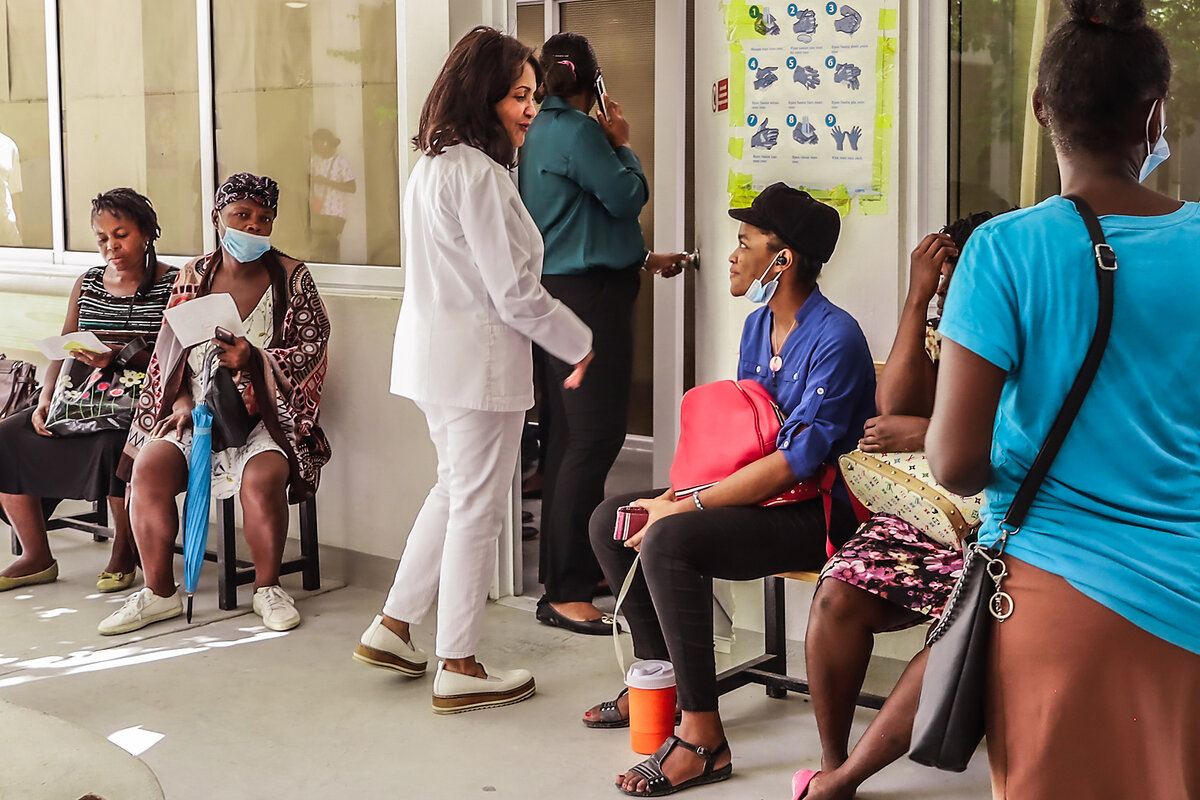
Photo: Victoria Onelien/Special to the Christian Science Monitor.
Dr. Marie-Marcelle Deschamps walks through the medical area of the Gheskio center, welcoming patients, in Port-au-Prince, Haiti, in July.
It’s hard to imagine that in a country ruled by armed gangs like Haiti, a doctor keeps doing her work “without fear.” Would we be without fear if our country were taken over by armed gangs?
Linnea Fehrm writes at the Christian Science Monitor, “Marie-Marcelle Deschamps was speaking at a conference in Washington last spring about her work running one of Haiti’s most innovative hospitals when the startling news started spilling in: Criminal gangs were releasing incarcerated people from a prison in Port-au-Prince, police stations and government buildings were under attack, and the international airport was shuttered. …
“ ‘Every day that I can’t go back is a catastrophe for me,’ she said with a sigh, speaking from her hotel room in Miami several weeks later, where she was anxiously awaiting the possibility of flying back to Haiti. ‘I can’t sleep at night. My staff are struggling, people are dying.’ …
“Dr. Deschamps is co-founder and deputy executive director of Gheskio, a hospital in Port-au-Prince known by its French acronym, where she has worked for the past 42 years. It’s not a typical clinic; it looks beyond physical health to tackle issues such as education, women’s leadership, job training, and community-building. …
“The doctor has guided the organization through earthquakes, epidemics, state coups, and political unrest. But when she finally returned to Port-au-Prince in April, she says she was faced with the most severe crisis she has ever seen. Hundreds of thousands of Haitians had fled their homes due to insecurity, many of whom began flooding her hospital in search of safety and treatment. Some people arrived close to starving, others with gunshot wounds, she says. …
“Gheskio is in downtown Port-au-Prince, adjacent to an enormous, gang-controlled area known as the City of God. The dusty access roads are teeming with heavily armed gangs, whose ranks have been reinforced by people who have escaped from prison. They regularly block the roads and kidnap people from passing cars. …
“Only a handful of hospitals have survived the past year’s violence in Port-au-Prince, according to Jean Bosco Hulute, head of UNICEF’s health program in Haiti. About a five-minute drive from Gheskio is the State University of Haiti Hospital, the largest health facility in the country. For more than four months this year, it was under gang control; doctors and patients were chased off the grounds and wards were looted of everything from medical supplies to ceiling fans.
“Gheskio receives some funding and equipment from UNICEF, requiring Mr. Hulute to occasionally visit. These trips require ‘careful planning and authorization from the head office’ for safety purposes, he says.
“ ‘Dr. Deschamps, however,’ he says with a chuckle, ‘she just takes her car and drives there.’
“She holds weekly meetings with local community representatives, helping to earn respect for her organization’s work – even among gang leaders. When armed men on the street see her hospital ID, they let her pass, she says. …
“Today, the Gheskio grounds are like an oasis amid Haiti’s political and security-related chaos. Dr. Deschamps says she comes here to regain her strength, surrounded by green lawns, verdant gardens, and birds chirping from towering palm trees. …
“Shortly after founding Gheskio, Dr. Deschamps was selected by a group of Haitian and American doctors to study in the U.S. There, she trained under Dr. Anthony Fauci, who would later become a household name during the COVID-19 pandemic.
“ ‘He always had a positive attitude, so we were similar in that way. It has become a strategy in my life to team up with positive people.’ “
Just think of the comfort that her attitude must give to patients!
More at the Monitor, here. No paywall. Subscriptions are reasonable.


 Suzanne's Mom's Blog