Feeds:
Posts
Comments

Posts Tagged ‘dutch’

Photo: Robles Casas & Campos.
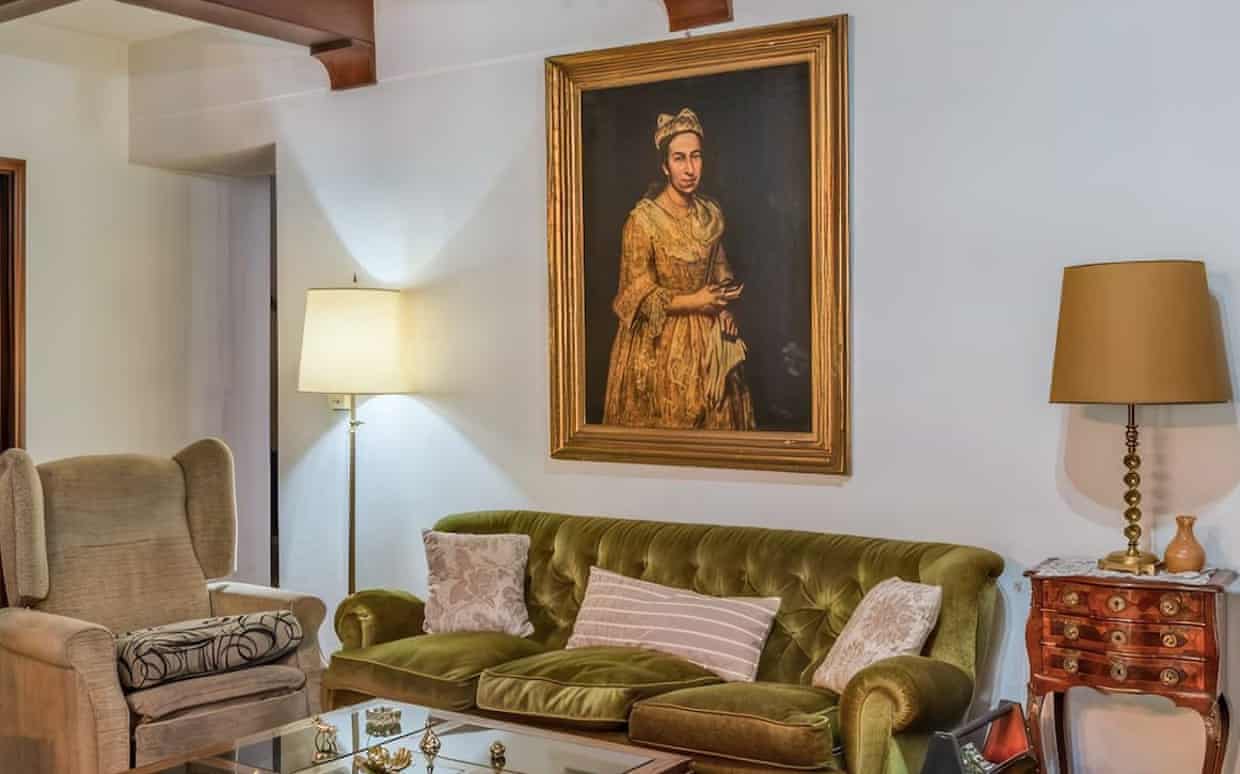
The painting by Italian artist Giuseppe Ghislandi in a living room in Mar del Plata. The 18th-century painting ‘Portrait of a Lady’ (Contessa Colleoni) was stolen by an SS officer and rediscovered this year in Argentina.

Guilty secrets don’t stay hidden forever. It may take a long time, as in today’s story about Nazi loot, but more often than not, truth eventually surfaces.

Facundo Iglesia  and Jon Henley write at the Guardian, “There was nothing very remarkable about the middle-aged couple who lived in the low, stone-clad villa on calle Padre Cardiel, a quiet residential street in the leafy Parque Luro district of Argentina’s best-known seaside town, Mar del Plata.

“Patricia Kadgien, 59, was born in Buenos Aires, five hours to the north. Her social media described her as a yoga teacher and practitioner of biodecoding, an obscure alternative therapy that claims to cure illness by resolving past traumas.

“Her husband, Juan Carlos Cortegoso, 61, built and raced go-karts. Like many in this neighborhood, the couple were comfortably off, and discreet. …

“Then, last month, they put their house up for sale. A photographer from a local estate agent, Robles Casas y Campos, came round to shoot the spacious, elegantly furnished interiors. The pictures went up. And their quiet existence came crashing down.

“The fifth photograph on the agency’s listing showed a general view of the villa’s living room. Hanging on the wall, above a buttoned sofa in plush green velvet and next to a polished antique commode, was a highly distinctive oil painting of a woman.

“More than [6,000 miles] away, the Dutch news outlet AD had, for several years, been quietly investigating the fate of old master paintings looted by the Nazis and still listed by the Dutch culture ministry as ‘unreturned‘ after the second world war.

“Journalists had made several attempts to speak to Patricia Kadgien, the owner of the property, and to her elder sister, Alicia, the daughters of a high-ranking Nazi official Friedrich Kadgien, who was known to have settled in Argentina after the war.

“Their calls and messages had consistently gone unanswered, or been rebuffed. But then a Dutch reporter based in Buenos Aires, Peter Schouten, went knocking on the door of the villa – and spotted a ‘for sale’ sign.

“What followed, after Schouten and his colleagues in Rotterdam clicked on the link to the property and instantly recognized the work, made headlines around the world as the story unfolded of the unlikely recovery of an 18th-century portrait missing for 80 years. …

“After the media reports of the work’s likely location, and before a police search, the couple had tried to obstruct the investigation, the prosecutor argued, by taking down the online property listing and for sale sign and replacing the portrait with a tapestry.

“Despite knowing they were under investigation, it was alleged that the defendants had also attempted a civil action claiming the painting was rightfully theirs, turning it over only after they were placed under house arrest and facing further police raids.

“Through their lawyer, Kadgien and Cortegoso have denied concealment, saying they had always been willing to hand over the painting, and obstruction, arguing that their civil action was aimed at establishing ownership and not at hiding the artwork. …

” ‘Portrait of a Lady’ belonged to Jacques Goudstikker, a Jewish-Dutch art dealer who fled Amsterdam in mid-May 1940 to escape the Nazis, but died after falling through an open hatch into the hold of the SS Bodegraven, the ship carrying him to the UK.

“Goudstikker carried with him a notebook detailing his collection of more than 1,100 artworks, including pieces by Rubens, Giotto, Titian, Rembrandt and Van Gogh, all of which were snapped up for a fraction of their value by Nazi officials.

“Some were later recovered and displayed as part of the Dutch national collection in the Rijksmuseum, before 202 works were restored to the dealer’s sole heir, his daughter-in-law, Marei von Saher, in 2006. ‘Portrait of a Lady’ was not among them. …

“Born in 1907, Kadgien joined the Nazi party in 1932 and the SS in 1935. By 1938, he was a special representative working for Göring on the four-year economic plan drawn up by Adolf Hitler to rearm Germany and prepare it for self-sufficiency by 1940. …

“Kadgien ‘confiscated a large amount of property from Jewish merchants, including jewelry and diamonds in Amsterdam, and oversaw the sale of expropriated shares and securities through banks and front companies in Switzerland’ [federal prosecutor Carlos Martínez] said.

“He fled to Zurich early in 1945, then to nearby Baden, where in 1948 he set up a successful finance and trading firm, Imhauka. With pressure growing after questioning by Swiss and US investigators, Kadgien left for South America in 1949. …

“Kadgien resurfaced in Rio de Janeiro in 1951, settling in the Santa Teresa district and establishing a Brazilian branch of Imhauka. … Imhauka secured valuable contracts with Juan Perón’s government, including acting as an intermediary for major German engineering firms such as Siemens. …

“The fate of ‘Portrait of a Lady,’ which will be registered with Argentina’s supreme court, is now uncertain. Prosecutors have requested it be held, but not displayed, at the Holocaust Museum in Buenos Aires while its ultimate ownership is determined. This week von Saher, Goudstikker’s heir, lodged a legal claim to the work with the FBI in New York.”

More at the Guardian, here. No firewall.
Read Full Post »

Photo: MWA Hart Nibbrig.
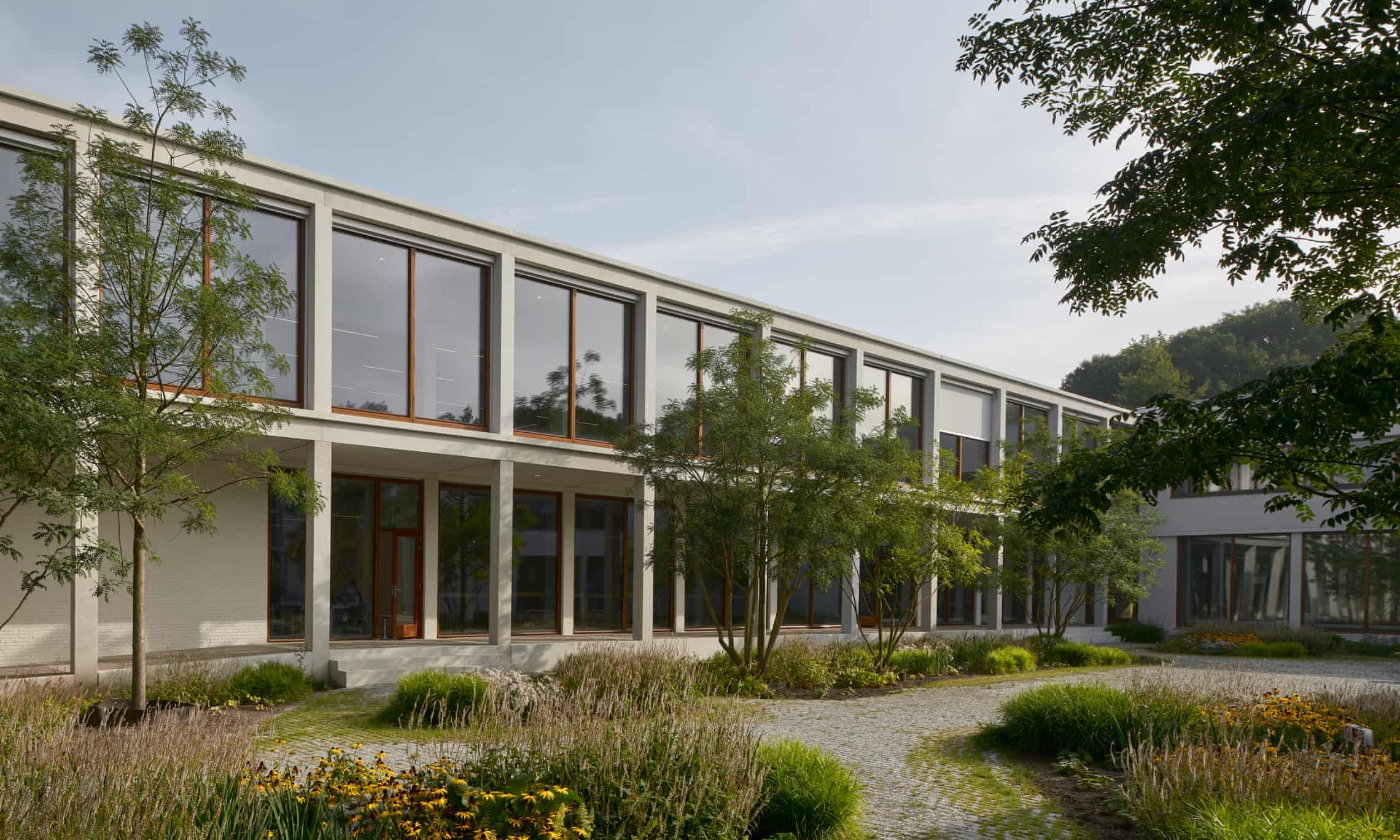
The makeover by Maarten van Kesteren Architects of  a 1960s Utrecht college at less than half the cost of a new building and a third the carbon footprint is a lesson in sustainability.

In today’s story, a design company worked with what was available to make an old building sustainable. Apparently there’s some controversy about the approach, refitting the old instead of building everything new. See what’s happening in the Netherlands.

Rowan Moore writes at the Guardian, ” ‘The greenest building,’ to quote a slogan now popular among architects, ‘is one that is already built.’ It sums up the belated realization that the carbon impact and energy consumption of demolition and new building can be more significant than those of heating, cooling and running a building when it’s in use. It’s still a principle that is only patchily put into practice, in the UK and elsewhere. But the Dutch not-for-profit organization Mevrouw Meijer (meaning Mrs Meijer), which works to give new life to old school buildings, is quietly showing how it can be done.

“Her organization’s approach, says its founder, Wilma Kempinga, makes environmental, financial and practical sense, but it’s also about the experiences and memories of childhood. ‘It’s very important that students experience beauty,’ she says. ‘This is a place you will remember for the rest of your life.’ For Kempinga, beauty is best achieved by making the most of existing buildings – even those thought unremarkable – and getting the best young architects to design the transformation.

“We’re sitting in Nimeto, a trade school in Utrecht where students aged 16 to 21 learn shop window dressing, theatre set design, painting and decoration, specialist restoration and other skills. It’s a decent work of 1960s Dutch welfare state modernism – one of thousands from the country’s postwar educational construction boom: well lit and well proportioned, built in white-painted brick, within whose plain walls are the sights, sounds and smells of young people making things. Some of them are painting at encrusted easels beneath north-facing skylights, or planing and cutting timber; others trying out their decorating techniques on a house-like structure built to offer them as many awkward junctions and other challenges as possible. The school is populated with trompe l’oeil fragments of architecture – parts of stage sets – and experimental displays of objects you might find in a shop window.

“Now it’s better than ever. Where once the school was divided into two main blocks, they are now linked by first floor bridge and gallery with a colonnade underneath. A central courtyard that was a car park is now a garden that marks the cycle of the school year with yellow-and-white flowers in September, and blue-and-white flowers in spring. Double-height spaces bring light into a large basement, which can now be used for learning rather just storage. They also break open a regimented former arrangement of internal corridors double-loaded with classrooms. You can now look up, down, sideways and across, as well as straight ahead.

“The canteen is in one of the two blocks, the library in another, meaning that the two facilities shared by all students are distributed across the school. Previously, says Nimeto’s principal, Henk Vermeulen, students working in one part would refer to those in another as being ‘on the other side,’ but now all parts of the building are equally theirs. …

“The new design, by Maarten van Kesteren, a young architect based in The Hague, is about opening up and connections and making a shared container for the multifarious creativity of the students. The ‘whole school has a feeling that you are part of a lively workshop,’ as Van Kesteren puts it. The detail is simple, with what Kempinga calls ‘very beautiful pure materials that are unusual in school buildings,’ such as an oak floor whose woody smell mixes with that of the workshops. The project is achieved by the minimum of means, the only new structure being the long gallery/bridge, and gains additional education space. … It is also less than half the cost of an equivalent new building, with 30% of the carbon footprint.

“Mevrouw Meijer’s role, here and elsewhere, is to make the case for renovating rather than replacing, generating the evidence that it will be cheap, practical and climate-friendly. They also help select the architect. … Young practices without previous school experience, such as Van Kesteren’s, are preferred. ‘We don’t want an old guy or an old girl,’ says Vermeulen, but someone who will bring fresh thinking. As his school is always making the case that its inexperienced students should be trusted with opportunities, he says, it should do the same when appointing architects. …

“The original Nimeto building is typical of many in the Netherlands, whose design is quietly humane without being spectacular or special enough for it to be designated as significant heritage. Yet, says Kempinga, they are part of the country’s shared memory. …

“Schools also tend to be located in the centre of the communities they serve, whereas new replacements are often more remote. Yet, as Vermeulen puts it, ‘our neighborhood should profit from a new school, and our students are supposed to be working for this society,’ so it’s better if they stay put. The external landscape at Nimeto has been designed so as to connect the school’s garden with its surroundings and form part of the ‘ecological structure,’ as Van Kesteren says, of Utrecht.

“Mevrouw Meijer now have a number of school projects under way and recently completed. … Mevrouw Meijer is named after a well-loved children’s book character who worries a lot about nothing until she adopts and raises a baby blackbird, which teaches her to concentrate on essentials. If this sounds whimsical, the organization’s projects seem to be based on impeccable logic and well-founded aspirations; the only mystery is why their ideas are not applied more widely. There’s a mistaken belief that the best way to be sustainable to is to build something with all the latest environmental materials and devices. …

“Kempinga says it’s a question of attitude. ‘A lot of people like new buildings,’ she says, ‘and don’t have the imagination to see what’s possible with old ones.’ “

More at the Guardian, here.

Read Full Post »

Photo: rkd/Mauritshuis.
Wilhelm Martin, the director of the Mauritshuis museum, quietly resisted by removing artworks from the museum during the Nazi occupation. And he hid people.

Today we go back to WW II to gather new information on the difficult choices that people had to make under Nazi occupation and how some Dutchmen practiced resistance while hiding in plain sight.

The Guardian‘s Senay Boztas reported the story from the Netherlands.

“The 13-year-old boy answered the doorbell,” she begins. “ ‘Tell your dad I’m here,’ said a man, who stored his bicycle and then disappeared upstairs.

“It was 1944, and right under the noses of Nazi command, people were hiding in the attic of The Hague’s Mauritshuis museum from forced labour conscription – Arbeitseinsatz – under which hundreds of thousands of men from the Nazi-occupied Netherlands were conscripted to work in Germany.

“The memories of 93-year-old Menno de Groot – a Dutch-Canadian who was that young boy – form an extraordinary part of a book and an exhibition of the secret history of the Dutch museum during the second world war.

“ ‘He must have gone all the way to the attic,’ De Groot tells his granddaughter Kella Flach in a video for the exhibition, referring to the man who he assumed had arrived to go into hiding. ‘I don’t know how many were up there. I have no idea how they lived up there, how they got there.’

“The chance find of a logbook by De Groot’s father, Mense de Groot, an administrator who from 1942 lived in the Mauritshuis museum with his wife and children, including Menno, inspired researchers to examine the museum’s history.

“ ‘People were hiding in November 1944 because of the Arbeitseinsatz, but hiding in the Mauritshuis was hiding in plain sight,’ Quentin Buvelot, a researcher and curator, said. ‘It was a house in the storm.’

“Art from the museum, including Johannes Vermeer’s Girl With a Pearl Earring, was first hidden in a bomb-proof bunker underneath the building and later stored in locations around the Netherlands. The German-born museum director Wilhelm Martin played a careful role, allowing the Nazis five propaganda exhibitions while also quietly resisting.

“A newly discovered note on Martin’s retirement in 1953 revealed he was involved in supporting people who had gone undercover on Assendelftstraat and in the museum. ‘Martin doesn’t say how many, but he says that on a daily basis, 36 loaves of bread were delivered. …

“Secret concerts were also held in the museum’s basement between 1942 and 1944, according to Frank van Vree, an author and researcher at the NIOD institute for War, Holocaust and Genocide Studies. ‘They were held to support musicians who were cornered by their resistance to German measures, especially compulsory membership of the Nazi Kultuurkamer,’ he said. …

“Mense de Groot, who was hired to work at the museum when the janitor retired, also worked for the resistance. ‘He usually got Trouw, an underground newspaper,’ Menno de Groot says in the exhibition. ‘And my dad, he copied them, made more copies. …

“Life under occupation was a series of difficult choices, according to Eelke Muller, a historian and NIOD specialist in looted art. ‘There was little knowledge [before this research] about how culture could be a political instrument for resistance from the Netherlands but also a strong ideological instrument for the occupier,’ she said. ‘Every museum, every civil servant in times of war was confronted with huge dilemmas: do you choose principled resistance, enthusiastically get behind Nazi ideas, or are you somewhere in the middle?’ More at the Guardian, here. No paywall.

Nina Siegal at the New York Times adds details about the famous Vermeer that Martin also hid.

“At first it went to a bomb shelter in the basement of a museum, then an art bunker built into the dunes on the North Sea in the Netherlands. Toward the end of the war it was hidden in a secured cave in Maastricht, a Dutch city near the Belgian border.

“Starting in 1939, as war in Europe spread and the Nazi invasion of the Netherlands loomed, leaders of the Mauritshuis, the jewel box museum in The Hague, took extraordinary steps to protect Johannes Vermeer’s ‘Girl With a Pearl Earring’ and other works central to its collection.

“Wilhelm Martin, the museum’s director at the time, removed it and other famous works … before the Germans arrived because he understood that they would be in peril, both from bombardments and from potential Nazi looting afterward.

“The survival of these works, through strategic planning, diplomatic appeasement and the German affinity with the conquered Dutch as ethnic brethren, is now the subject of an exhibit at the Mauritshuis. ‘Facing the Storm: A Museum in Wartime,’ which is on view until June 29, coincides with the 80th anniversary of the liberation of the Netherlands in 1945 and is based on extensive new research.”

I hope blogging chefs Michiel and Jeen in the Netherlands get to see this.

Read Full Post »

Photo: Sander Korvemaker.
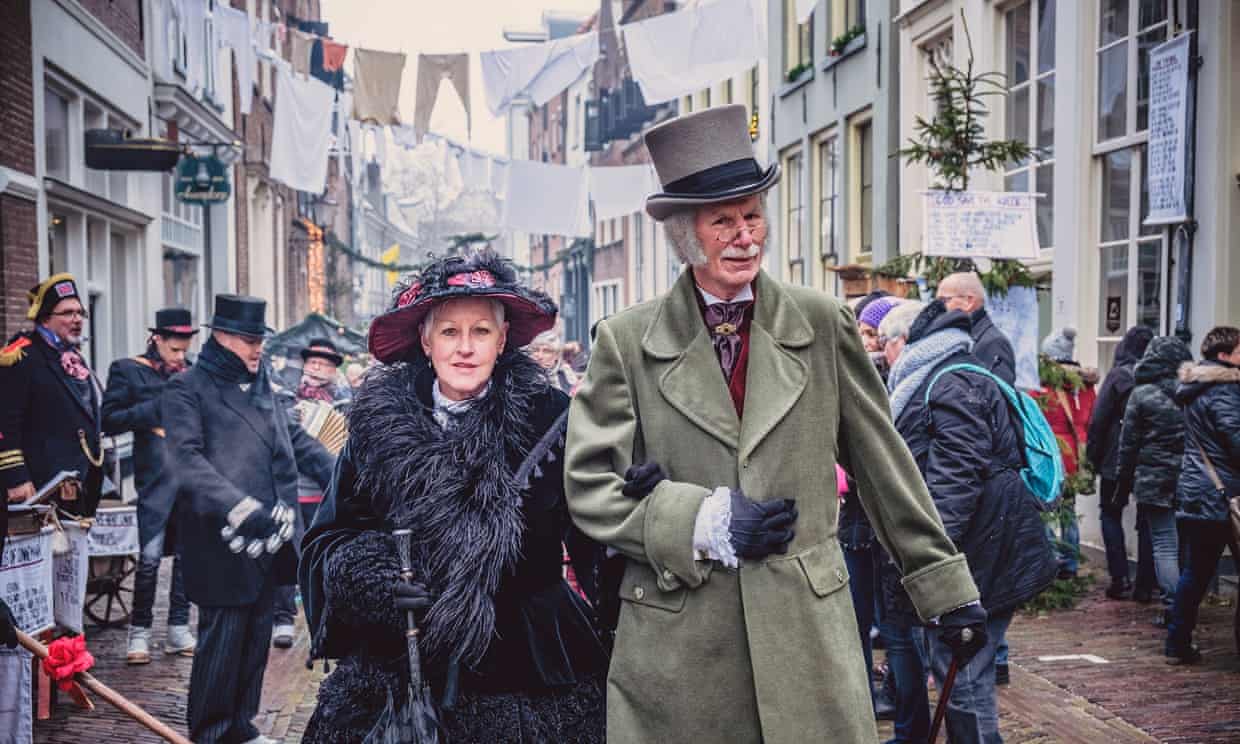
Despite no known historical connection with Charles Dickens, this Dutch town plays host to an annual Dickens festival, the world’s largest.

Today’s story about a town that loves Charles Dickens drew me in because I also love Dickens. That is, I love his novels. With the exception of The Old Curiosity Shop and Barnaby Rudge — neither of which I liked — I have read them all multiple times. But I have also read about the man himself and am pretty sure he was not a very nice guy.

The surprising Dickens festival that Senay Boztas writes about at the Guardian focuses on both the novels and the guy.

Boztas reports, “Soon after limited Sunday trading started in the Netherlands, an anglophile shopkeeper in the small city of Deventer decided it could all be a bit more fun.

“ ‘My 82-year-old mother, Emmy Strik, is England-minded because my grandfather always went to England and read a lot of Dickens,’ said her daughter, Liesbeth Velders, who now runs the Dille & Kamille homeware store. ‘So when we were going to open on Sunday, she decided to make it a fancy-dress party – except the fancy-dress party got a bit out of hand.’

“Decades later, Strik’s experiment in literary frivolity has gone further than she could have imagined. The event she began in 1991 to commemorate Charles Dickens has run for 33 years, with a two-year break during the Covid pandemic.

“Despite no known historical connection with the author, Deventer, in the eastern province of Overijssel, now plays host to what is believed to be the world’s largest Dickens festival. This weekend [in December 2023], 950 volunteers will fill the streets of the ancient Bergkwartier, performing street theatre and selling hot punch and Victorian treats. There are strict rules for actors and traders: no [sneakers], modern watches or mobile phones.

“Among the expected 125,000 visitors will be Ebenezer Scrooge, Tiny Tim, Queen Victoria, Miss Havisham, beggars, thieves and, for the first time, Dickens himself.

“Ojon van Strijland, a bookseller and volunteer at the Dickens Kabinet museum, said he and Strik had learned while on a trip to Kent, where Dickens spent much of his childhood, that authenticity was essential.

“ ‘Years ago, Emmy and I went to [the city of] Rochester’s Dickensian Christmas festival to seek inspiration but there were things there we would not want,’ he said. ‘There were people walking around with Christmas lights on, Santa hats and polyester costumes.’ …

“Strik amassed almost 1,000 authentic costumes, collected enough Dickensian items to fill a museum and grew the Dickens Festijn with commercial sponsorship and support from Events dEVENTer. She has now – largely – handed over the reins to her daughter.

“ ‘We can’t roast chestnuts in big drums any more; there’s a fist-thick book of rules from the fire brigade and the police, but it’s still a real festival,’ said Velders.

“The festival has huge local status. One couple’s 50th wedding anniversary is being incorporated into this year’s edition, while 62-year-old system administrator Wessel Lindeboom is polishing insults in multiple languages for his dream role of Scrooge. …

“At a time when Dutch children’s reading skills are declining, some hope the festival will encourage a wider love of literature. ‘A lot of the visitors have never read a Dickens book but everyone recognizes Scrooge, who walks around calling “humbug!” and insulting people,’ said Velders. ‘There are also storytellers who recount the story of the books.’ …

“The mayor of Deventer, Ron König, hopes visitors will have an enormous amount of fun but also take home a more profound message. ‘The festival beautifully portrays the differences between rich and poor, an issue we are still trying to tackle.’ …

“Peter Jan Margry, professor of European ethnology at Amsterdam University, believes this kind of event provides a welcome break, particularly in dark days. …

“ ‘The festival of Christmas is also about stepping out of your own time into an atmosphere of carols and Christmas trees and a flight from reality,’ he said. ‘But it’s also a form of occupying yourself, a type of tourism, stepping out of your daily life, that you see in all fantasy and live action role-playing. … It’s about stepping into another world.’ “

I hope my blogging friends at Cook and Drink will weigh in on this aspect of life in their beautiful and surprising country.

More at the Guardian, here. No firewall. Subscriptions encouraged.
Read Full Post »

Photo: Pixabay.
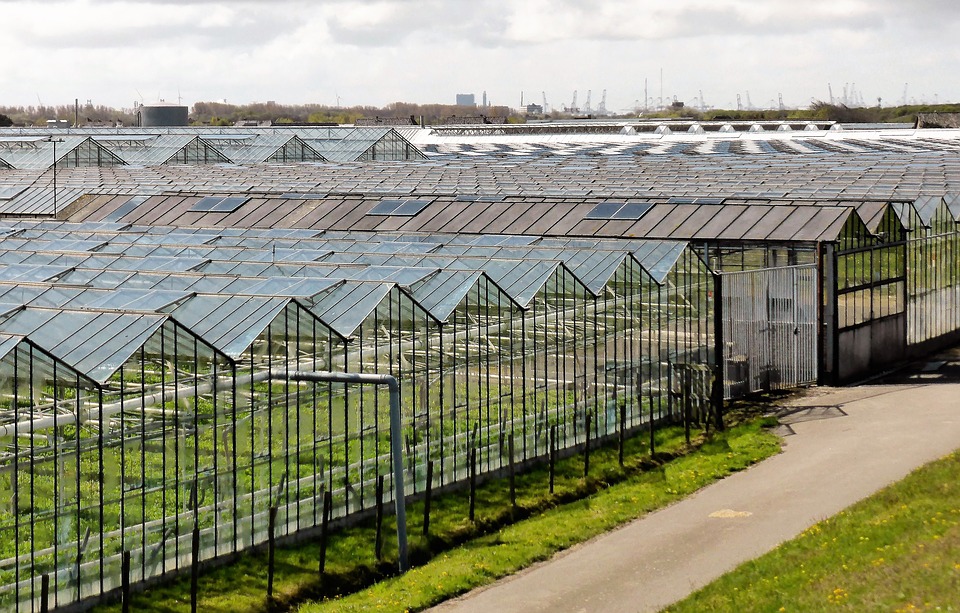
Believe it or not, little Holland is the world’s second-largest food exporter.

We know from childhood stories that the Dutch have always been innovative. Think about all that land taken from the sea by means of dikes. But who knew that such a little country as the Netherlands was the world’s second-largest food exporter? How do they do it?

Laura Reiley at the Washington Post has the details.

“The rallying cry in the Netherlands started two decades ago, as concern mounted about its ability to feed its 17 million people: Produce twice as much food using half as many resources.

“The country, which is a bit bigger than Maryland, not only accomplished this feat but also has become the world’s second largest exporter of agricultural products by value behind the United States. Perhaps even more significant in the face of a warming planet: It is among the largest exporters of agricultural and food technology. The Dutch have pioneered cell-cultured meat, vertical farming, seed technology and robotics in milking and harvesting — spearheading innovations that focus on decreased water usage as well as reduced carbon and methane emissions.

“The Netherlands produces 4 million cows, 13 million pigs and 104 million chickens annually and is Europe’s biggest meat exporter. But it also provides vegetables to much of Western Europe. The country has nearly 24,000 acres — almost twice the size of Manhattan — of crops growing in greenhouses. These greenhouses, with less fertilizer and water, can grow in a single acre what would take 10 acres of traditional dirt farming to achieve.

Dutch farms use only a half-gallon of water to grow about a pound of tomatoes, while the global average is more than 28 gallons. …

“With their limited land and a rainy climate, the Dutch have become masters of efficiency. But there are challenges: The greenhouse industry has flourished in part because of cheap energy, but Western Europe is facing soaring gas prices. And the country’s intensive animal agricultural practices are also at risk. This summer, a conservative government coalition pledged to halve nitrogen emissions by 2030, which would necessitate a dramatic reduction in the number of animals raised in the country. Farmers and ranchers have protested. …

“Dutch companies are the world’s top suppliers of seeds for ornamental plants and vegetables. There is an area in the northwest called Seed Valley, where new varieties of vegetables and flowers are in constant development. Enza Zaden is headquartered here, just north of Amsterdam.

“In three generations, Enza Zaden has evolved from a family-owned seed shop into a global market leader in vegetable breeding, with more than 2,500 employees and 45 subsidiaries in 25 countries.

“Jaap Mazereeuw, Enza Zaden’s managing director, said the company spends $100 million annually on research, introducing about 150 new vegetable varieties each year.

“ ‘We are very much a research company,’ he said. ‘With climate change, we are seeing the weather becoming more extreme. We’re looking at resilient varieties, seeds for organic farms as well as varieties that are more salt tolerant for places where water quality is not good. We need to find solutions for subsistence farmers all the way up to large-scale farmers. …

“ ‘We have our own indoor farm here where we develop the varieties of the future, crops that can grow quickly and be harvested quickly: lettuce, herbs, leafy crops. The genetics can be improved, as well as the whole technology — indoor farming will only become cheaper.’ …

“More than 12 billion heads of lettuce are grown each year from Enza Zaden’s seeds, but it was a tomato in the early 1960s that really put the company on the map — and perhaps what, in turn, put the Netherlands on the map for tomatoes. The country’s greenhouses produce nearly a million tons of tomatoes a year, with exports totaling around $2 billion annually.

“ ‘There’s a new tomato virus and we recently found the resistance to that virus in our seed bank,’ Mazereeuw said. The company stores its seeds in a temperature-controlled vault — called a seed bank — to preserve genetic diversity, but because seeds don’t stay viable forever, each stored variety must be grown out and those seeds, in turn, saved. …

“ [Eelco Ockers is] chief executive of PlantLab, which develops and operates custom-built indoor farms worldwide — systems they call ‘plant production units.’ Indoor vertical farmers trade in the free power of the sun for much more expensive electric light, but the benefit is they can much more easily control every variable to get consistent and reliable yield, Ockers said.

“The three founders put together their first prototype in 2008 and launched the company in 2010, helping Dutch greenhouse and indoor farmers increase yields with LED lights even when the technology was in its infancy. They have a system whereby enough crops to supply 100,000 residents daily with nearly half a pound of fresh vegetables each can be grown in an area no larger than two football fields. …

“PlantLab’s research and development center in Den Bosch is the largest such center for vertical farming in the world, and it uses limited light spectrum LEDs and plastic stacked production trays, and the plants grow in vermiculite with their roots in water. ‘Nothing is hand-harvested, nothing is touched by human hands,’ Ockers said. The water is recirculated, meaning no water is lost in the growing process. For now, the system is most effective for growing leafy greens, herbs and tomatoes, but he said cucumbers, zucchinis and all types of berries are suited to this growing system. And by limiting the time between harvest and consumption, he said, food waste is minimized and nutrient density is much higher than traditionally grown crops.”

Outdoor farming in Holland is really creative, too. The article covers not only growing vegetables outdoors but raising pigs, cows, and chickens. Read it all at the Post, here.

Read Full Post »

As a volunteer in English classes (all online these days), I am aware that most immigrants are determined to contribute to the countries they arrive in. Consider, for example, the Muslim husband and wife in Germany who were largely responsible for the miracle vaccine developed in one year against the odds.

In the Netherlands, the Refugee Company has immigrants employed in making face masks to protect the Dutch against Covid-19.

Michal van der Toorn at the Local Europe has the story.

“Why be dependent on factories on the other side of the world if you can produce face masks locally? That’s exactly what Dutch entrepreneurs Jaap Stelwagen, Fleur Bakker, Johan Blom and Naz Kawan thought in March. The Netherlands, like many other countries at the time, was dealing with a big deficit of surgical face masks.

“Stelwagen, who lived in China, together with his wife who is originally from China, called several people there to ask whether it would be possible to get material. Bakker’s sister, a KLM pilot, managed to get hold of a roll of [fabric] that you need to make face masks, and brought it to the Netherlands on a plane full of other health equipment. Later that month, on one of the few flights that were running at the time, two face mask machines flew 7,000 kilometres to Amsterdam.

“But who would operate them? [One] Company already had a sewing workshop and restaurants in place where people with a refugee background were able to acquire work experience. [The company writes its name Refugee Company to focus on the work, not immigration status.]

“ ‘As a response to the pandemic,’ project spokesperson Peter-Paul de Jong explains, ‘we decided to set up a face mask factory: the Mondmaskerfabriek. … The project not only responded to the deficit of masks in Dutch healthcare,’ de Jong explains, “but also provides people with a refugee background with work experience and knowledge about the labour market in the Netherlands.’

“Firas al Naif, 33, is one of the employees in the factory. ‘I’m doing different tasks,’ he says. ‘I for example have to make sure the masks are properly wrapped and check if the machines work.’ It is all new for Al Naif, as in Syria, he worked as a biology teacher. ‘I wasn’t used to doing technical tasks. The first month was pretty hard, but now it’s going really well. …

” ‘We have a paid four-hour programme next to work, in which we can improve our language and become more familiar with the labour market, and we make for example a CV, application letters, we see how you can find work. …

“ ‘The one thing I like most about this work is solving problems,’ says Al Naif. ‘If there is a problem with the machine from China, I like to look for ways to get it working again.’

“And there were other problems, de Jong explains. After the challenges of getting the right machines and material, the next problem arose: getting certification to create surgical face masks for healthcare professionals. In order to be used in the healthcare sector, the face masks have to be certified by a laboratory to say they meet strict standards. And that took some time. …

“As the building is old, ventilation is a problem and it’s hard to get it up to the antibacterial standards, Bakker writes on the website. The location caused occasional deviations that stood in the way of the factory’s certification.

“The project tried different ways to ensure the masks were up to medical standards, including sterilizing them with gamma radiation and setting up a special sterile production room within the factory with purified air and an antibacterial floor.

“In mid October the certification was acquired and the factory started supplying the Dutch centralized point for healthcare products. …

“ ‘That distinguishes the Mondmaskerfabriek from other projects from the Refugee Company,’ de Jong explains, ‘as we can use the profits to pay employees, instead of only relying on funds and donations.’ …

“ ‘I love how much I learned about technology,’ [al Naif] says. But he would rather be a biology teacher again. ‘When my Dutch is good enough, I want to go back to the classroom.’ ”

More at the Local Europe, here.

Read Full Post »

mediamatic_eten_serre_separee_6-0

Photo: Anne Lakeman/Mediamatic ETEN
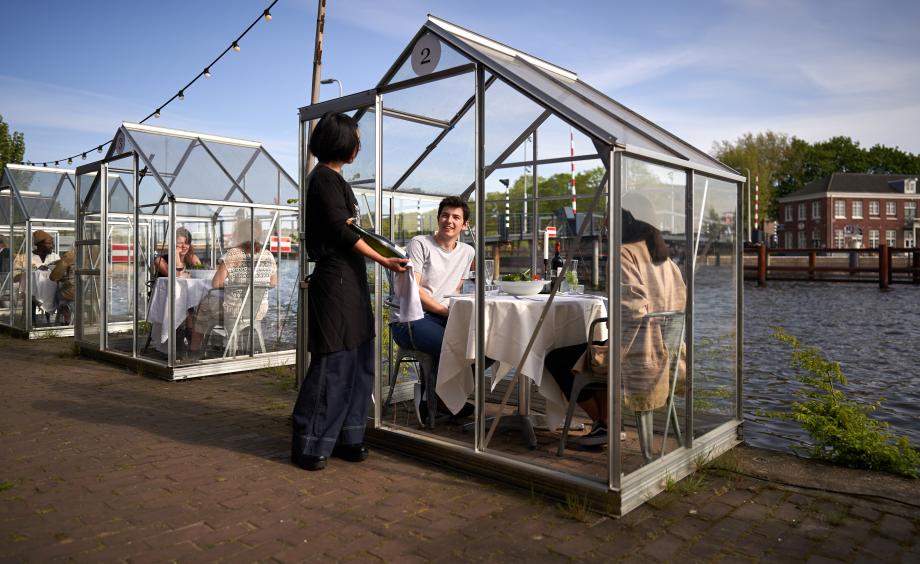
Testing the Serres Séparées safe-eating concept at Mediamatic restaurant in the Netherlands.

My husband keeps saying he can’t imagine that going to restaurants will ever be the same after coronavirus. In fact, he says, if nice restaurants continue doing takeout, maybe we should just stick with that.

Of course, restaurant owners are already thinking about these issues.

Byron Mühlberg reports from the Netherlands that the possibility of future guests requesting their own separate spaces has got some restaurateurs thinking creatively.

“With Dutch restaurants, bars and other catering services engulfed in uncertainty over how they might adjust to the 1.5-meter society,” he writes, “one Amsterdam restaurant is set to experiment with a brand new way of condoning off its guests: Using enclosed greenhouses.

“Mediamatic ETEN, part of a larger arts and entrepreneurship center focusing on sustainability, is a vegan restaurant. … From May 21, the restaurant will begin taking in guests, only this time they will be seated inside Serres Séparées (‘separated greenhouses’), enclosed glass structures, each equipped with a table for two or three diners.

” ‘This was one of the most feasible ideas from a large list of ideas we had when brainstorming,’ Mediamatic’s founding partner Willem Velthoven told NL Times. …

Initially, no more than three guests will be allowed to dine inside each greenhouse, even though there is the capacity for more. ‘[This is] is because we are now careful with our optimism,’ Velthoven explained. …

” ‘Bigger groups could [come] now, but then they should be families. For now, bigger groups are being discouraged because, from our experience, they are just louder and then you get the excited behavior causing spittle to fly and so on, and that’s the kind of behavior that would make the virus spread faster,’ Velthoven said. …

“Catering industry association KHN told NL Times, ‘We sent a protocol to the government two weeks ago, containing advice on how best to open the 1.5 [meter] distance. It is crucial that the government provide perspective quickly.’

“While KHN said it would not yet advise restaurants to reopen on June 1, renowned catering tycoon Laurens Meyer … questioned the idea of people becoming too careful with space.

” ‘We have to realize that there will always be some kind of virus. Whether it is worse than the flu, we have to see. If there is nothing left of our economy, we will no longer be able to afford health care and that will also cost human lives,’ explained Meyer.

“Velthoven, on the other hand, disagrees with Meyer’s approach, urging caution before advising restaurants to open their doors to the public without careful examination. ‘It’s about others and not just yourself in this case,’ he said. …

“Velthoven also understands the business argument, even though he has spent a career looking for creative solutions to problems instead of blunt responses. He ultimately wondered what the government’s plan is for the catering sector if those businesses are ordered to stay closed for a longer duration. If billions of euros are being diverted to KLM, he wonders what the government will be able to do to bail out his industry.

” ‘If I am not allowed to do anything the rest of this year, it’s finished,’ he lamented.” More at NL Times, here.

If you have heard of other good ideas for restaurants and bars in our cautious Covid-19 world, please share them in Comments. Pretty sure that there’s a large group of potential patrons who will be looking for the safest way to dine out — at least until a vaccine is widely available.

Read Full Post »

skynews-students-yacht-atlantic_4977292

Photo: Sky News
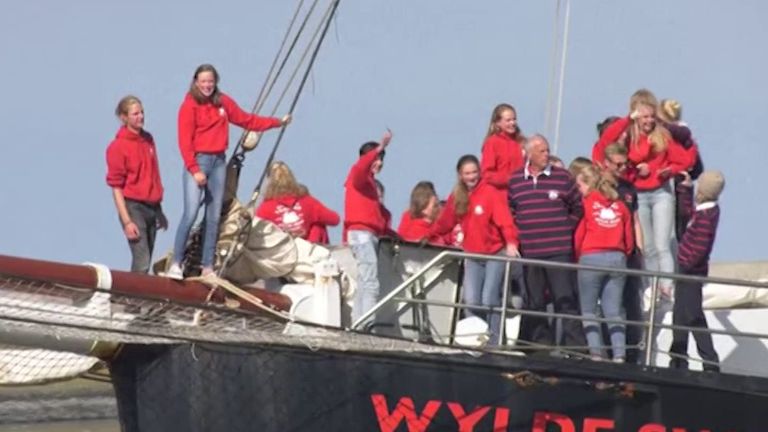
Dutch students sail across the Atlantic to get home after coronavirus blocks their flight.

Of all the nutty adaptations caused by Covid-19, this is one of the most unusual. A group of Dutch students who were on an educational sailing trip in the Caribbean were unable to fly home. So they sailed all the way back over the Atlantic Ocean.

Aleksandar Furtula (with contributions from Associated Press writer Mike Corder in The Hague) reports at the Washington Post, “A group of 25 Dutch high school students with very little sailing experience ended a trans-Atlantic voyage Sunday that was forced on them by coronavirus restrictions.

“The children, ages 14 to 17, watched over by 12 experienced crew members and three teachers, were on an educational cruise of the Caribbean when the pandemic forced them to radically change their plans for returning home in March.

“That gave one of the young sailors, 17-year-old Floor Hurkmans, one of the biggest lessons of her impromptu adventure. …

“ ‘The arrival time changed like 100 times. Being flexible is really important.’

Instead of flying back from Cuba as originally planned, the crew and students stocked up on supplies and warm clothes and set sail for the northern Dutch port of Harlingen, a five-week voyage of nearly 7,000 kilometers (4,350 miles), on board the 60-meter (200-foot) top sail schooner Wylde Swan. …

“The teens hugged and chanted each other’s names as they walked off the ship and into the arms of their families, who drove their cars alongside the yacht one by one to adhere to social distancing rules imposed to rein in the spread of the virus that forced the students into their long trip home.

“For Hurkmans, the impossibility of any kind of social distancing took some getting used to. … Her mother, Renee Scholtemeijer, said she expects her daughter to miss life on the open sea once she encounters coronavirus containment measures in the Netherlands.

“ ‘I think that after two days she’ll want to go back on the boat, because life is very boring back at home,” she said. ‘There’s nothing to do, she can’t visit friends, so it’s very boring.’ …

Masterskip, the company that organized the cruise, runs five educational voyages for about 150 students in all each year. Crossing the Atlantic is nothing new for the Wylde Swan, which has made the trip about 20 times.

“The company’s director, Christophe Meijer, said the students were monitored for the coronavirus in March to ensure nobody was infected. He said he was pleased the students had adapted to life on board and kept up their education on the long voyage.

“ ‘The children learned a lot about adaptivity, also about media attention, but also their normal school work,’ he said. ‘So they are actually far ahead now of their Dutch school colleagues. They have made us very proud.’

More at the Washington Post, here. A Reuters article with other details is here.


Read Full Post »


Photo: YouTube
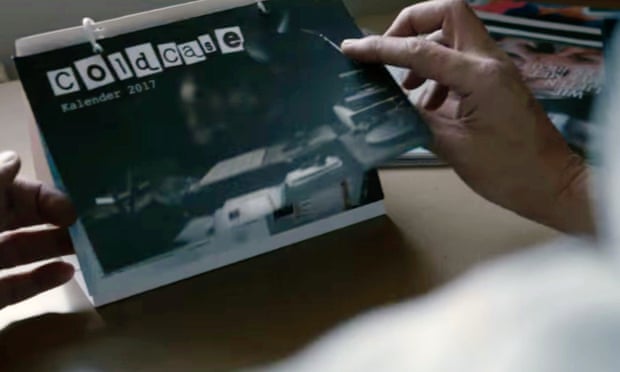
One of the calendars used in the Dutch prison system to encourage prisoners to help solve cold cases.

Here’s a new twist on solving cold cases. It’s being implemented in the Netherlands, and I was going to say, “Trust the creative Dutch to come up with this idea!” But it turns out they got the idea from the United States.

Daniel Boffey writes at the Guardian, “Prisoners across the Netherlands are to be issued with calendars for their cells featuring unsolved murders or disappearances as part of a drive by the Dutch police to crack unsolved cases.

“The so-called cold case calendars will be handed to all 30,000 prisoners in the country after a trial run in five jails in the north resulted in 160 tips to the police.

“Each week of the year in the brightly coloured 2018-19 calendars will be illustrated with a photograph of a missing person and details of the case. The hope is that many of those in jail will know details of some of the crimes or may have heard other criminals chatting about them. …

“Jeroen Hammer, the calendar’s inventor, told Dutch newspapers the calendars had also proved popular with bored prisoners, although some had regarded the initiative as an attempt to turn them against their own. …

“The calendar has been printed in Dutch, Arabic, Spanish, English and Russian to maximise its impact, and a €800,000 reward is being made available for those whose information ends in a successful conviction. …

“The police say they can offer anonymity to people in certain cases.

“ ‘There is no penalty for keeping information about a criminal offence committed. Therefore, you do not have to fear persecution if you have been sharing information, even after years of deliberation,’ they said.

“The idea of the calendars was borrowed from the United States, where every year several states distribute a deck of cards containing information about cold cases among prisoners.”

More here. Someone should study whether participating prisoners are motivated mostly by the reward, by boredom, by outrage at certain crimes, or something else.

Read Full Post »

Despite its size, the compassionate Netherlands has welcomed a large number of refugees during the largest migration since World War II, perhaps remembering the terrified families that fled Hitler.

To house all the newcomers is naturally a challenge, but a design competition has yielded creative ideas.

Jon Comulada writes at Upworthy, “As the worldwide refugee crisis continues, innovative solutions are needed so that the people fleeing civil war and sectarian violence have a safe place to live. …

“In January 2016, the Netherlands launched a design competition called ‘A Home Away From Home’ in which entrants were tasked with designing temporary housing for refugees and disaster victims. All of the winning designs rethought the idea of public housing, adding amenities and innovations to make the buildings more like fully functioning homes than simply a bed to sleep on.

“The winners of the contest recently appeared on display in Amsterdam as part of Dutch Design Week and included things like solar power, water purification systems, and ingenious use of space and material.

“The cube design of the Farmland [below] means dozens can be stacked, placed together, and moved easily. The architects of this design imagined the miniature villages establishing a ‘DIY economy’ with local towns. …

“Home is a concept many of us take for granted, but it’s not a small thing. It makes us feel safe, comfortable, and human.

“The current refugee crisis hasn’t showed signs of slowing down, and with climate change creating more and more dangerous weather systems, we’re likely to see climate refugee numbers grow sharply. All of those people are going to need places to live. Innovative solutions like these help them to not only live, but live with dignity and opportunity.”

Check out several other designs from the competition at Upworthy, here.

Photo: A Home Away From Home
This Farmyard shelter is designed to transform vacant farmland into mini villages.

Read Full Post »

According to Josh Planos at the Atlantic, the forward-looking Dutch are at it again. Not only are they on the cutting edge in matters such as energy use and floating forests, they have anticipated the increase in Alzheimer’s diagnoses, creating a village where patients can feel normal.

“The isolated village of Hogewey lies on the outskirts of Amsterdam in the small town of Wheesp. Dubbed ‘Dementia Village’ by CNN, Hogewey is a cutting-edge elderly-care facility — roughly the size of 10 football fields — where residents are given the chance to live seemingly normal lives.

“With only 152 inhabitants, it’s run like a more benevolent version of The Truman Show, if The Truman Show were about dementia and Alzheimer’s patients. Like most small villages, it has its own town square, theater, garden, and post office. Unlike typical villages, however, this one has cameras monitoring residents every hour of every day, caretakers posing in street clothes, and only one door in and out of town, all part of a security system designed to keep the community safe. Friends and family are encouraged to visit. Some come every day.

“Last year, CNN reported that residents at Hogewey require fewer medications, eat better, live longer, and appear more joyful than those in standard elderly-care facilities. …

“Residents are only admitted if they’re categorized as having ‘severe cases of dementia or Alzheimer’s disease.’ Vacancies are rare, given that a spot only opens when a current resident passes away, and the village has operated virtually at full capacity since it opened in 2009.

“Hogewey was primarily funded by the Dutch government and cost slightly more than $25 million to build. The cost of care is nearly $8,000 per month, but the Dutch government subsidizes the residents—all of whom receive private rooms—to varying degrees; the amount each family pays is based on income, but never exceeds $3,600.”

More at the Atlantic.

Where did I just hear about someone with Alzheimer’s? Oh, right. A detective series on TV. So moving. Boy, I hope that detective’s daughter knows about this village.

Photo: Gabriel Rocha/Flickr

Read Full Post »

A Dutch diplomat started following me on twitter. He’s a Yale World Fellow, so how bad could it be? (Better than, say, Contagious Disease Fellow.)

@Alex_Verbeek is focused on environmental issues, and today he tweeted about the Stockholm Environment Institute, “ is ranked second best think tank worldwide.”

Because of my Swedish relatives, I naturally felt curious about SEI and looked it up. The website doesn’t say which think tank is first — or at least not prominently — but it does say that the US office is in Somerville, Mass., of all things. You learn something every day. I did know that the great environmental radio show Living on Earth is in Somerville, but the city is still a bit under the shadow of its industrial past.

From SEI’s website: “SEI’s vision is a sustainable future for all. Our mission is ‘to support decision-making and induce change towards sustainable development around the world by providing integrative knowledge that bridges science and policy in the field of environment and development’.

“To deliver on our mission, we work across issues like climate change, energy systems, water resources, air quality, land-use, sanitation, food security, and trade, and we approach these issues from a range of perspectives from the natural and social sciences.

“We combine scientific research with policy analysis, connecting our work to decision-makers and civil society in global governance, national public policy, regional cooperation, local planning, and the private sector. We generate and share knowledge that catalyses action, and always take a highly collaborative approach: stakeholder involvement is at the heart of our efforts to build capacity, strengthen institutions, and equip partners for the long term.

“Making scientific knowledge accessible is a priority. We publish our own series of open-access reports and briefs, alongside articles in leading academic journals, and work creatively through a range of media to ensure that our research is available to those that need it. We convene seminars and conferences that bring together decision-makers, academics, and practitioners to debate key issues and share knowledge, and engage in and inform policy processes, development action, and business practice worldwide.”

Whew! Wonky! Wish I could introduce SEI to Somerville neighbor Steve Curwood of Living on Earth. He’s pretty good at using everyday language for listeners.

I hope to learn more about the Stockholm Environment Institute, in any case, and am delighted its US office is so close to home.

Photo: Stockholm Environment Institute
One environmental concern SEI is studying is disaster risk in the Asia-Pacific region.

Read Full Post »

New online services make it easy to borrow things you need temporarily but don’t want to buy.

Janet Morrissey writes at the NY Times, “When vandals broke into Stephanie Ciancio’s Land Cruiser in 2014 and stole her car stereo, she did not have the time and money to replace it. It was particularly vexing for Ms. Ciancio, a 34-year-old San Francisco resident, because she had been planning to take a four-day road trip to Fern Canyon, Calif., over the long July 4 weekend, and the idea of making the eight-hour drive without music was depressing.

“So she logged onto Peerby.com, typed in her predicament, and within 40 minutes was connected with someone willing to lend her a Beats wireless Bluetooth speaker for her car trip.” She was thrilled.

Peerby founder Daan Weddepohl, Morrissey contintues, “was born in Rotterdam in 1980 and developed a passion for computers and programming at a young age. ‘I asked for a compiler for my 13th birthday,’ he said.

“He pored over books and joined online bulletin boards to hone his programming skills. His parents, both psychiatrists, encouraged his entrepreneurial spirit and interest in technology. But it was a fire that ignited the Peerby dream.

“In February 2009, fire ripped through Mr. Weddepohl’s apartment building, … Most of Mr. Weddepohl’s belongings were destroyed by fire, water or smoke.

“He was devastated. But in the months after, Mr. Weddepohl watched in amazement as friends — and even strangers — offered furniture, tools and other items to help him get back on his feet. It was a revelation. “’ discovered that the people around me were so much more important than the stuff,’ he said. ‘People love to help other people out — we’re wired to help others.’ ”

Read how the Peerby concept grew from the ashes, here.

I blogged earlier this year about this concept. You can read “Borrowing Gadgets you Need Only Once,” here.

Photo:Jason Henry for The New York Times
Stephanie Ciancio was able to borrow a wireless Bluetooth speaker from Matt Dodge through an online service called Peerby.com. 

Read Full Post »

And while we’re on the subject of the energy-saving bike trails in the Netherlands, we note a brief report in the NY Times to the effect that those clever Dutch also have a road that powers houses.

SolaRoad, according to its website, “is a pioneering innovation in the field of energy harvesting. It … converts sunlight on the road surface into electricity: the road network works as an inexhaustible source of green power.”

Adds the Times, “Sten de Wit of the engineering firm TNO said … that each square meter of road generated 50 to 70 kilowatt-hours of energy per year, or enough for the initial strip to supply power to one or two Dutch households. The test is scheduled to run three years and will cost 3 million euros ($3.7 million). Mr De Wit said despite the high costs of developing the first SolaRoad, successor projects may be more profitable as solar cells grow cheaper and more efficient.”

Check out the SolaRoad website, here.

Read Full Post »

Liz Stinson writes at Wired magazine about a bike lane in the Netherlands created to evoke Van Gogh’s painting Starry Night.

“If you happen to be near Eindhoven in the Netherlands, you can walk or bike down a glowing path modeled after Van Gogh’s masterpiece. The one kilometer lane is the work of Daan Roosegaarde …

“The Van Gogh-Rooosegaarde bike path (located near where Van Gogh himself lived from 1883-1885) uses a luminescent material that charges during the day and glows at night. These glowing bits look like little pebbles, but they’re actually not rocks at all. Using the smart coating material developed with Dutch infrastructure company Heijmans, Roosegaarde was able to create 50,000 fluorescent ‘rocks’ that he then embedded into wet concrete in a swirling, pointillism pattern reminiscent of Starry Night. …

“The big goal is to make the coating as dynamic as possible—shifting colors, markings or appearing and disappearing altogether—to account for our ever-changing urban spaces. …

“The designer suspects the path’s real draw will change from person to person. ‘Some people will come because they’re interested in safety and energy-friendly landscapes, others will come because they want to experience art and science,’ he says.”

More here.

Photo: Studio Roosegaarde
Daan Roosegaarde created a glowing bike path in the Netherlands based on Vincent van Gogh’s Starry Night.

Read Full Post »

Older Posts »