 Source: Biodiversity Heritage Library
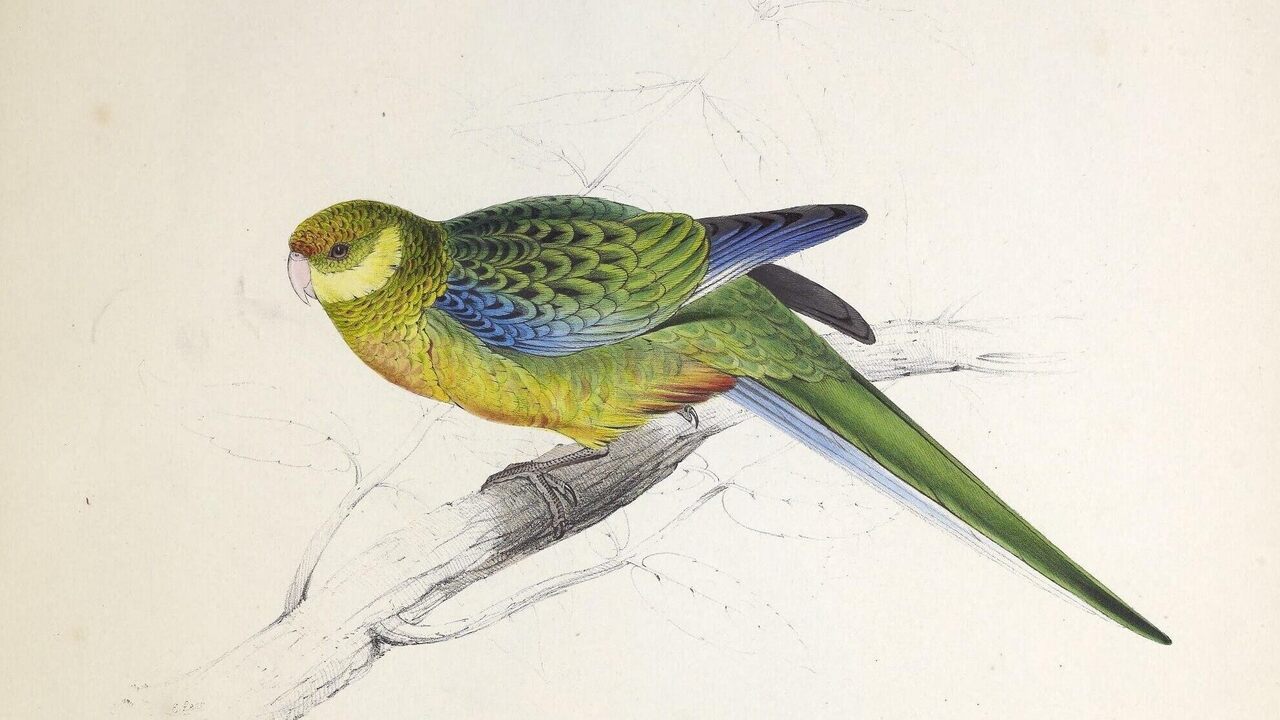
A Stanley parakeet, one of 42 plates in Edward Lear’s Illustrations of the Family of Psittacidae, or Parrots.
Years ago, I read a biography of Edward Lear in which I learned that Lear had distinguished himself at a young age as an illustrator of nature — long before his playful limericks found an audience.
A new biography by Jenny Uglow brings more details to Lear’s story. And Cara Giaimo has a post about him at Atlas Obscura, where she reviews Peter Levi’s Lear biography.
“Edward Lear was a man unafraid of his own imagination,” writes Giaimo. “In his best-known nonsense poems and limericks, he wrote of things the world has never seen: green-headed Jumblies; toeless Pobbles; oceanic romances between birds and cats.
“But before he began bringing these impossibilities to life, Lear had a different focus: he drew parrots. When he was young, Lear was employed as an ornithological illustrator, and he spent years learning to draw birds, favoring live models in an era when most worked from taxidermy. Before he turned 20, he’d published Illustrations of the Family of Psittacidae, or Parrots, a critical success, and the first monograph produced in England to focus on a single family of birds.
“Lear was born in London in 1812. One of the youngest of a gaggle of kids. … He was raised mostly by his oldest sister, Ann. According to biographer Peter Levi, it was Ann who taught Lear to draw. …
“Early on in Lear’s childhood, his father went into debt, and his family fell on hard times. When he turned 15, he decided to put his talents to work professionally, and began taking commissions for everything from decorative fans to ‘morbid disease drawings for hospitals,’ as he later wrote a friend. In this way, he explained, he managed to make enough money ‘for bread and cheese.’
“But when he found the time to choose his own subjects, he often made his way to London’s Zoological Gardens. … While many artists of the time relied on taxidermied specimens—which, after all, were better at staying still—Lear preferred drawing live animals, and was known to occasionally enter their cages, so as to get a better look. …
“Lear’s models inspired at least one bit of verse. In December of 1830, he ended a letter to a friend with an account of a parrot-filled day that had left him rather peckish:
‘Now I go to my dinner,
‘For all day I’ve been a-
‘way at the West End,
‘Painting the best end
‘Of some vast Parrots
‘As red as new carrots,—
‘(They are at the museum,—
‘When you come you shall see ‘em,—)
‘I do the head and neck first;
‘—And ever since breakfast,
‘I’ve had one bun merely!
‘So — yours quite sincerely.
“As this poem suggests, the job was rather demanding. … Eventually, though, he boiled the process down to a science. First, Levi writes, ‘A young zookeeper would hold the bird while Lear measured it in various directions.’ Then Lear would make a few pencil drawings of the parrot, in different poses, doing his best to ignore the curious public (although sometimes he drew them, too). …
“By 1831, he and Ann had moved houses to be closer to the Zoo; the next year, he put out what would be his final batch of parrot lithographs, drew up a table of contents, and encouraged his subscribers to bind them into a complete book. He was 19 years old.
“Although he started out expecting to produce 14 sets of illustrations, depicting about 50 species, Lear ended up stopping just short. … He didn’t want to make the same mistakes as his father. ‘To pay colourer and printer monthly I am obstinately prepossessed,’ he explained, ‘[and] I had rather be at the bottom of the River Thames than be one week in debt.’ …
“Levi writes of Lear’s participation in [John] Gould’s Birds of Europe, ‘The queerer the animal the more it arrested him.’ ”
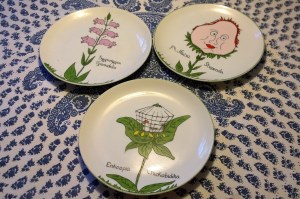
Lear-inspired plates that my family members have cherished for years.


 Suzanne's Mom's Blog