Feeds:
Posts
Comments

Posts Tagged ‘el alto’

In Bolivia, an indigenous woman who would have been disenfranchised before the presidency of Evo Morales has become a popular wrestler. And  she loves what she does.

connects with Angela La Folklorista in La Paz to report her story at WBUR’s Only a Game.

“She calls herself, ‘Una mujer de la pollera.’ Woman of the skirt. That’s another way of saying ‘I’m a cholita.’ Cholitas are indigenous women of Bolivia, usually ethnically Quechuan or Ayamaran. You can recognize cholitas by their ankle-length puffy skirts and their tiny bowler hats, which seem like they’ll fall off any minute. …

“Until recently, cholitas were second-class citizens, boxed out from higher education and often stuck cleaning homes,” generally relegated to the kitchen.

“Where Angela works is nothing like a kitchen.

” ‘In the ring,’ Angela says in Spanish, ‘I have a technical fighter style. I’m not rough. I’m on the nice side. There are bad cholitas, as you would call them, but my style is technical.’

“Angela is a cholita luchadora — a Bolivian pro-wrestler. She fights in a league similar to Lucha Libre in Mexico or the WWE in the United States. It’s the kind of wrestling with heroes and villains, entrance songs. Angela gives me two ringside tickets for the upcoming bout in El Alto – La Paz’s sister city. She’s the headliner. …

“Angela doesn’t fight other women. She fights the men. There’s some weird sexist stuff happening, but by the end of the match Angela is always the winner. …

“ ‘I’m very happy and content to have another night of fighting,’ she says in Spanish, ‘another night of art, adrenaline and strength, another night that I’m in the center of the ring, happy, doing what I like most.’ She’s covered in sweat.

“ ‘Mi madre es luchadora,’ Angela’s middle-school aged daughter Theresa says.

“ ‘It’s a pleasure for me that she’s a wrestler,’ Theresa says in Spanish, ‘I’m very proud of her, I’m her number one fan.’

“Theresa describes the cholitas luchadoras as one of the Seven Wonders of the World. But she doesn’t want her mom’s job. It’s too dangerous for her. And unlike the cholitas who came before her, Theresa can choose her own dream.”

More here.

Photo: Trevin Spencer/Only A Game
The cholitas luchadoras of El Alto. Angela La Folklorista is on the far right.

Read Full Post »

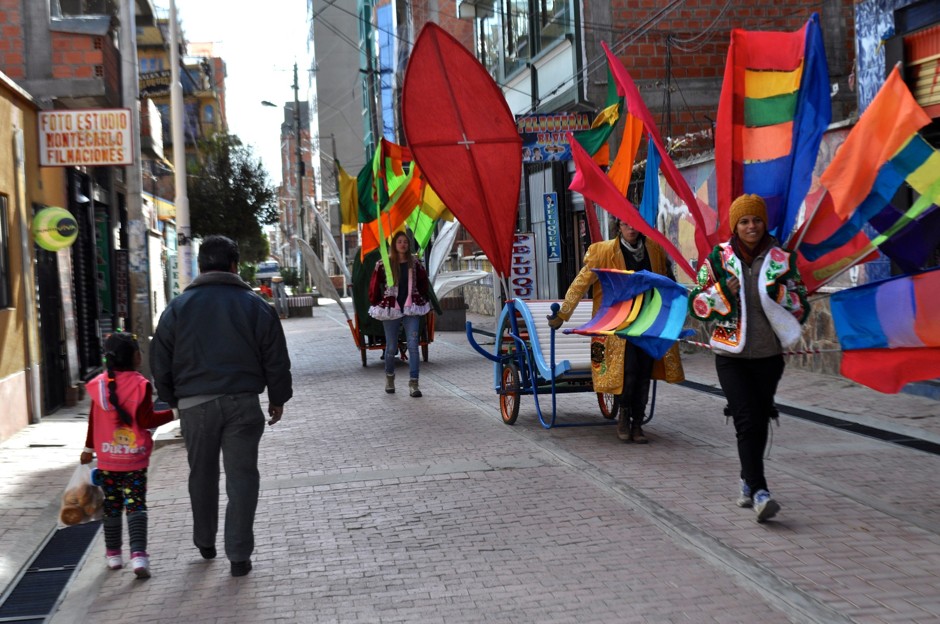
Azzurra Cox at the Atlantic‘s City Lab website wrote recently about design students and a nonprofit theater group that “created a ‘park-in-a-cart’ to serve the fast-growing city of El Alto, Bolivia.

“One bright July afternoon in El Alto, Bolivia, a playground paraded across a busy intersection.

“In the country’s second-largest city—and, at approximately 13,500 feet, the highest major urban settlement in the world—desfiles are a frequent occurrence, even a way of life. …

“But this parade was different. Dodging a stream of minibuses, a few individuals wearing carnivalesque costumes tugged two colorful metal carts—one resembling an astroturf bee, the other an elephant—to the center of a nearby plaza.

“Working in the harsh sunlight, they set about disassembling the carts. The shell of the bee became a series of green mounds, while the elephant trunk revealed itself as a slide.

“In a matter of minutes a playground was born, and the sounds of children playing rippled across the plaza. …

“In this dense city, driven by commerce at all scales, streets, sidewalks, and communal spaces are often transformed into informal markets, where vendors and minibuses compete for real estate. While this competition brings vitality, it requires novel methods of occupying urban space for play.

“The pop-up playground aims to do just that. Over three summers, the International Design Clinic (IDC), a ‘guerrilla design’ collective, has collaborated with Teatro Trono to design and build a pair of mutable, movable playspaces …

“Toward the end of that July afternoon, the park collapsed its way back into the carts. As one mother convinced her five-year-old to take her last turn down the slide, she asked one of the designers where she could find the playground next. Megan Hoffman, who studied anthropology at Temple University, recalls a grandmother who offered the group a sleeve of crackers to express her gratitude.

“ ‘That day,’ Hoffman says, ‘our pop-up playground was a space of joy.’ ”

More at City Lab.

Photo: Megan Hoffman
The mobile park on parade in El Alto this summer.

Read Full Post »

The Associated Press had a story not long ago about some energetic Bolivians  competing at handball.

“A group of Bolivian grandmothers and great-grandmothers have a pretty nontraditional way of easing the aches and pains of old age. These Aymara women get together every Wednesday in the city of El Alto and play handball.

“The ‘awichas,’ as grandmothers are known in the Aymara language, don sports jerseys over their traditional skirts and look forward to meeting and exercising with friends every week. …

“Team handball is an Olympic sport; two teams pass a ball using their hands to throw the ball into the opposite team’s goal.

“The handball team is part of a program where about 10,000 older people are practicing sports and playing Andean music; they also get free medical care.”

See some great great quotes and photos at NBC News, here.

Photo: Juan Karita/AP
In this Feb. 4, 2105 photo, 72-year-old Aurea Murillo prepares to make a pass during a handball match among elderly Aymara indigenous women in El Alto, Bolivia.

Read Full Post »