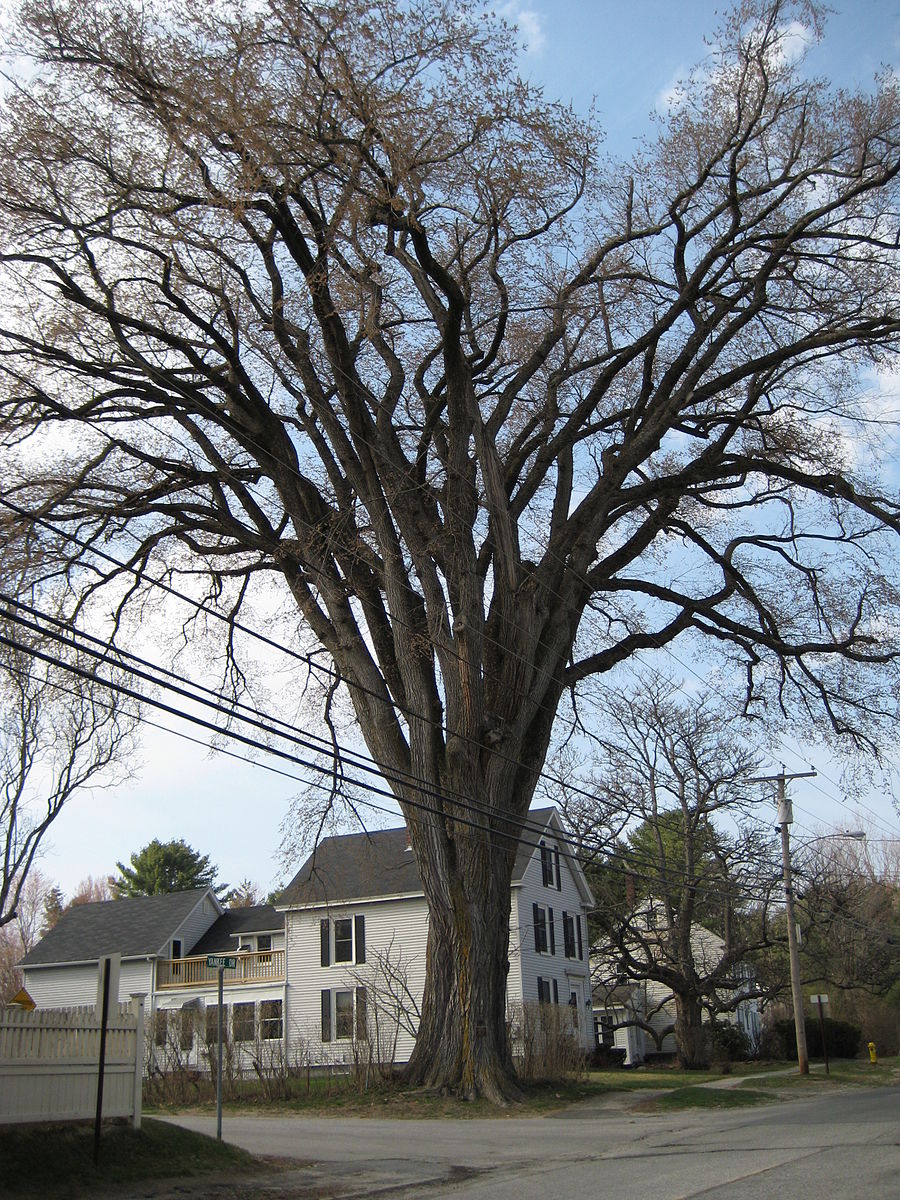
“Herbie,” a notable American Elm in Yarmouth, Maine. America lost nearly all its graceful elms after the arrival of Dutch elm disease.
My father used to talk about the beautiful elms near his childhood home in Syracuse, New York, before the advent of Dutch elm disease. The trees’ graceful vase shape provided lots of shade on hot days.
Elizabeth Evitts Dickinson at the Washington Post has found a few surviving elms in Maine, where people take good care of their trees.
“It’s a sunny September day in Castine, Maine, and I’m standing in a stranger’s yard debating how best to hug a tree. Not just any tree, but an American elm, a fully mature Ulmus americana.
“I want to hug this elm for practical reasons. At least that’s my justification. I remember hearing somewhere that your arm span roughly equals your height — 5-foot-7 in my case — and I wonder if I can better decipher the size of this elm by encircling it. I’m sure my hands won’t come close to touching. The trunk is massive, channeled by thick gray ridges of bark and reaching high overhead to an elegant vase-shaped canopy. The light has changed under its shade; the sun filtered through so many leaves creates a chlorophyll coolness.
“This tree, which is tall enough that a schooner coming into Castine Harbor could navigate by it on a clear day, has been here awhile. I know from the literature on the Castine elms that many were planted in the 1850s. … This elm, with its view of the water, has seen villagers ship off for a Civil War, a First World War, and then a second one. It has survived its own pandemic, Dutch elm disease, which leveled the elms of Europe before hitting America in the 1930s and felling over 70 million of its species. So, truth be told, I wouldn’t mind hugging this particular tree just for the hell of it. This tree is a miracle. …
“Castine is one of the few places in America where you can still see hundreds of mature Ulmus americana. Roughly 300 survive in the historic village and surrounding area by a recent inventory, which is an exceptional number. Exploring Castine is a trip back in time to a landscape no longer visible anywhere else. A town shaded by mature elms, some nearing two centuries old. The town motto: Under the Elms and By the Sea. …
“Castine is one of North America’s oldest settlements. In the 1600s, Europeans coveted the land for its auspicious trade location on the Eastern Seaboard and its deep-water harbor, never mind that the Abenaki, Penobscot and Mi’kmaq tribes already lived here. Castine, bounded by Penobscot Bay and the Bagaduce River, has the feel of an island, but it’s really a peninsula that’s shaped like an ax head lying on its side. …
“Around the same time that New Yorkers were waking up to discover these elms [in the 1930s], an arborist in Ohio discovered Dutch elm disease in a tree there. The elm bark beetle had arrived from the sea, carried in the hull of a ship. Elm wood burls bound for the ports of America and meant to be used as veneer in decorative furniture carried the castaway, Scolytus multistriatus. The tiny beetle likes to feed on the sapwood of the elm, and it carries on its body a fungus, the spores of which infect a healthy elm by needling their way into the tree’s vascular system. Soon the tree is no longer able to carry nutrients or water to its outer branches. The elm is effectively strangled. …
“By the 1960s, the blight had spread across the country. ‘People speak of worrying about the trees,’ the novelist Elizabeth Hardwick wrote from her home in Castine in 1971. … ‘The great old elms, with their terminal woe, are dying grandly,’ she wrote.
“Most of America’s elms were dead by the 1980s. ‘It was an ecological calamity that changed the face of the American nation,’ … [Thomas J. Campanella, author of a cultural history of the tree, Republic of Shade: New England and the American Elm] wrote. But not in Castine.
“ ‘There was action taken back in the late ’60s and early ’70s by several townspeople to save the trees,’ Don Tenney tells me.
“Tenney holds what is quite possibly the greatest public office ever invented, that of the Castine tree warden. It’s Tenney’s job, along with the elected Tree Committee, to care for the town elms, about 75 of which are actively being treated to stave off Dutch elm disease.
“Back in the 1970s, no real treatment existed. Richard Campana of the University of Maine was one of the early researchers to try to create a serum to inoculate against the disease. Castine’s elms were injected with his experimental fungicide; Tenney, who is 75, remembers those early interventions: ‘One summer there were these orange tanks strapped to the trees all over town, and they were pressurized to deliver the fungicide. It was a total experiment.’
“Some believe it was this treatment that helped save many of the elms. Others [posit] that it is Castine’s unique topography, on a wind-swept peninsula, that made it hard for the beetles to take purchase here. Still, the disease found its way to Maine and on neck to Castine, and now, arborists fear, it’s on the rise.”
More at the Post, here, where you can read about the tree’s chances in the future. P.S. Maine also has a miracle chestnut tree, here.


 Suzanne's Mom's Blog
