Feeds:
Posts
Comments

Posts Tagged ‘emissions’

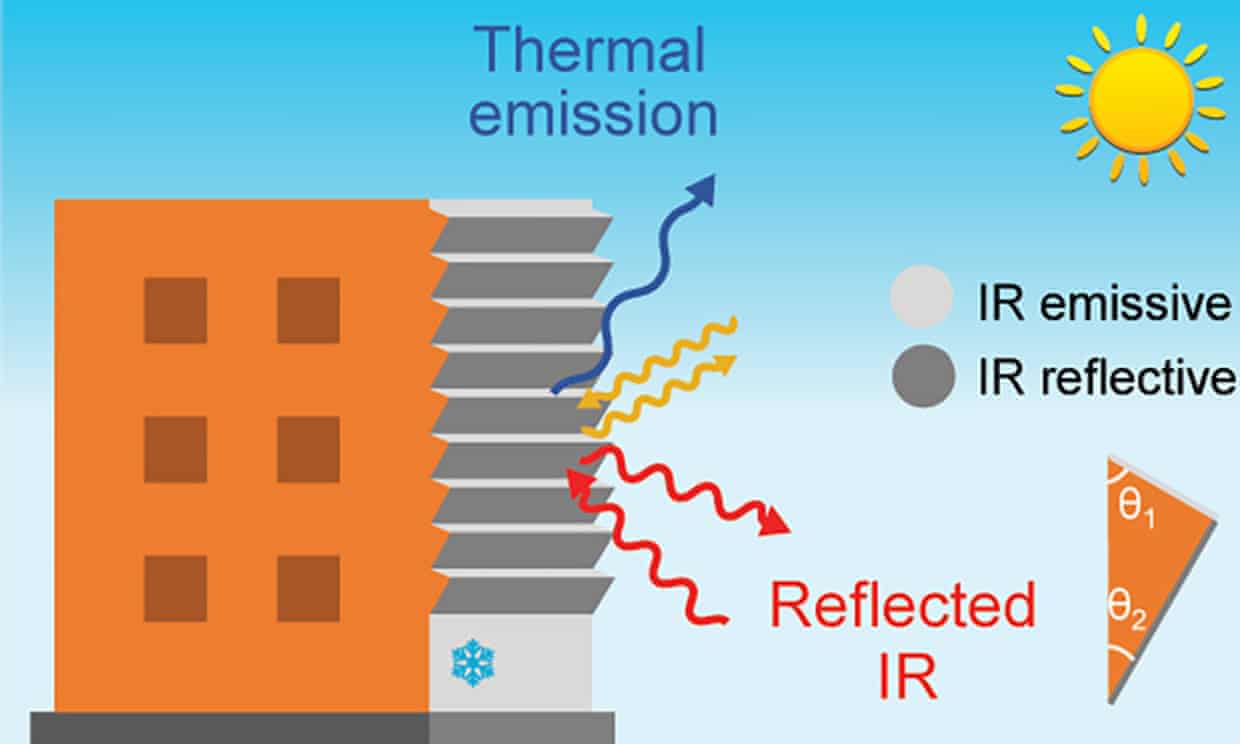
Diagram: Q Cheng/Nexus.
How a building’s zigzag wall could emit and reflect heat. IR refers to infrared energy.  

In the department of “good ideas for a new year,” we learn about zigzag walls and how they might cool buildings without fossil fuels or even electricity. It’s kind of the opposite of “passive solar heat,” which you’ve heard of. This approach involves passive cooling.

Isabelle Rodney reports at the Guardian, “Incorporating zigzag patterns into building walls could help cool overheated buildings, research has found.

“Buildings are now responsible for approximately 40% of global energy consumption, contributing more than a third of global carbon dioxide emissions. A significant fraction of this energy comes from air conditioning usage. Scientists expect this figure to double by 2050 if left unchecked.

“As the planet continues to warm, the demand for cooling in buildings continues to rise. In response to this growing challenge, scientists have been exploring passive cooling solutions that do not rely on energy consumption.

“A research team led by Qilong Cheng at Columbia University in New York has developed a promising solution that could help reduce energy use, by redirecting the sun’s energy away from buildings.

“Cheng’s team has proposed a structural wall design featuring a zigzag pattern that can reduce a building’s surface temperature by up to 3C [37.4 degrees] compared with flat walls, without consuming any energy. …

“The design consists of walls with a series of protrusions that create a zigzag shape when viewed from the side. This configuration takes advantage of radiative cooling – a passive cooling strategy that reflects sunlight and emits long-wave infrared radiation through the Earth’s atmosphere into outer space. …

“Common strategies, such as painting rooftops white to reflect sunlight, have been effective for horizontal surfaces but are less ideal for vertical walls, which also absorb heat from the ground. The zigzag wall design addresses these challenges by creating surfaces that emit heat in the atmospheric transparency window and reflect infrared heat, rather than absorbing it.

“While this innovative cooling method shows promise for hotter climates, it could increase heating demands in colder regions during winter. To address this, Cheng and his colleagues have proposed an adaptive design featuring hinged ‘fins’ that can be raised in winter to increase heat absorption and lowered in summer to reduce it. More at the Guardian, here.

At LinkedIn, Cheng describes himself thus: “My overarching research goal is to contribute to the development of energy-efficient systems and high-performance devices, fostering a more environmentally sustainable and efficient society.

“At Columbia University, I developed thermal radiation regulated walls to reduce energy consumption in buildings. At UC Berkeley, I studied heat transfer in data storage devices and addressed related mechanics and tribology issues [tribology is the study of friction, lubrication, and wear in systems where surfaces are in relative motion]. I am currently continuing my academic journey at Purdue University.”

A chemistry PhD once told me emphatically that scientists did their most important work when they were young. Here’s hoping that this young researcher never loses his creativity.

Read Full Post »

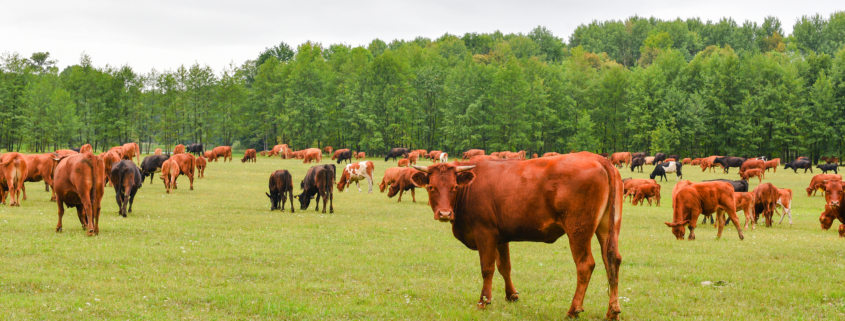
Livestock produces a lot of methane, which is unlikely ever to be balanced out by carbon captured in the soil. The Soil Association Exchange wants you to know about a few positive effects, however. 

It’s an ongoing process to keep up on the latest, especially when it comes to protecting the planet. I myself once thought that massive tree planting had the biggest bang for the charitable buck. Then I learned that, although trees are important, they can’t help much without due consideration given to where and how they are planted, and what varieties of trees they are.

Today I’m trying to bone up on the situation with cows, which we all know (including a young grandson who has cut beef out of his diet) produce too much climate-warming methane gas.

James Tapper reports at the Guardian, “New data shows [cows] may play an important role in renewing farm soil. Research by the Soil Association Exchange shows that farms with a mixture of arable crops and livestock have about a third more carbon stored within their soil than those with only arable crops, thanks to the animals’ manure.

“This also has an effect on biodiversity: mixed arable and livestock farms support about 28 grassland plant species in every field, compared with 25 for arable-only and 22 for dairy-only.

“Joseph Gridley, chief executive of SAE, which was set up by the Soil Association in 2021 to support and measure sustainable farming, said it was unlikely that carbon captured in soil would balance out the enormous amounts of methane created by cattle. Farm livestock around the world creates about 14% of human-induced climate emissions.

“ ‘It’s pretty unequivocal in the data that having livestock on your farm does mean you have more emissions – five or six times more emissions,’ he said. ‘But if you integrate livestock into the system, on every metric on soil health, there’s an improvement, and on a lot of the biodiversity measures as well.’

“Soils are degrading, but by how much exactly is unclear. In 2015, the UN Food and Agriculture Organization claimed that the world had only 60 harvests left, but researchers at Oxford University and Our World In Data said in 2021 that there was a complex picture. …

“Lee Reeves, UK head of agriculture at Lloyds bank, which helps fund SAE … suggested ministers should create a decarbonization strategy, and a standardized carbon calculator, so that farmers and other businesses could use a single tool to calculate their carbon impacts.

“ ‘Moving from traditional to regenerative farming can see a dip in profitability for the first five years, so the government needs to support farmers and banks in that,’ he said.

“[In the UK] the Department for the Environment, Food and Rural Affairs has been investigating so-called methane blockers as a way to reduce emissions. Adding substances such as essential oils, probiotics and even seaweed to cattle feed can reduce the amount of burps and wind they generate.

“Last month the Green Alliance charity said that feeding Bovaer, a methane blocker, to a third of the UK’s dairy cows would cut the country’s emissions by about 1%. Yet this is not happening, the campaign group warned, because farmers were unwilling to pay extra for something they did not benefit from. It said methane blockers should be subsidized, as other green farming schemes were.”

More at the Guardian, here. The Natural Resources Defense Council explains more about regenerative farming here.

Read Full Post »

Photo: Thomas M Jauk.
This theatre’s climate impact report found wood made up half of the 41 tons of raw materials it used last year, but produced only 1% of its emissions.

What does it take to be climate neutral? This theater in Germany believes we all have role to play.

In June, Kate Connolly reported at the Guardian, “A handful of Spanish conquistadors fight through thick undergrowth to emerge in the ivy-clad ruins of a fallen civilisation during a rehearsal of Austrian playwright Thomas Köck’s Your Palaces Are Empty.

“Premiered last month at the Hans Otto Theater in Potsdam, south-west of Berlin, the bleak and unforgiving drama probes the wounds of a shattered capitalist world that has exploited its people and the planet’s resources.

“But it is not just the dystopian play that is embracing the subject of the climate crisis.

“The production itself has been declared climate neutral under a €3m [~$3.3 million] pilot project launched by Germany’s federal ministry of culture. The project, called Zero, is sponsoring the Potsdam theatrer and 25 other cultural institutions across Germany, from dance companies to libraries and museums, to completely restructure their creative modus operandi.

“ ‘It leads to restrictions,’ says the director, Moritz Peters, crouching on a wooden stool on stage as he takes a break from rehearsals. ‘But it also forces greater creativity.’

“No aspect of the process of making a play has been left unturned. From the lighting (switching to LED bulbs) to reducing travel (rehearsals are longer but less frequent to cut down on journeys) ‘everything has come in for scrutiny,’ says Marcel Klett, the managing director.

“Swapping to a green source of electricity in 2022 had already improved the theatre’s carbon footprint, reducing its annual 661 tons of emissions, or the ‘equivalent of 66 households,’ by more than 10%, but did not go far enough, Klett says. No less challenging is tackling a change in attitude. ‘Nurturing a sense that we all – from the set designer to the theatergoer – have a role to play and have to ask ourselves: “what can I concretely do?” ‘ Klett says.

“The costume designer, Henriette Hübschmann, says she initially struggled with having to abandon her usual task of creating new costumes from scratch. ‘At least half of the costumes have to come from the existing collection of props and costumes now,’ she says, on a tour of the wardrobe in the theater’s underbelly. ‘The rest should be from recycled, easily recyclable or renewable materials.’ …

“An inventory of its resources forms the basis of the theater’s first climate impact report. … It states that wood makes up half of the 41 tons of raw materials that the theater used last year, but is responsible for only about 1% of the emissions produced, while just four tons of steel and aluminum used in productions made up almost 30%. …

“Other forms of stage-set building are also being experimented with, such as growing constructions out of the organic building material mycelium. The potential use of this in other areas, such as exhibition architecture, is already being explored.

“Most [theaters], from a certain size upwards, will be required to do so from next year, under EU legislation that will treat theaters the same as all big commercial enterprises.

“Klett is hopeful of a knock-on effect among audiences and theatre staff as well as from other cultural institutes joining in. …

“He is appealing to local politicians to embrace the project by sponsoring the erection of solar panels on the theater’s roof and allowing the space – a former Prussian military stables – to be insulated, which is currently not allowed because the building is listed.

“The success of the project, though, will largely depend on the audience and the way they choose to travel to the theater. … Travel remains the theater’s single biggest polluting factor, contributing to about 50% of Hans Otto’s emissions. In response, theater tickets will double up as public transport passes in the three hours before and after the play.”

More at the Guardian, here. No paywall. Donations solicited.

Read Full Post »

il_794xn.1399122456_n197

Photo: KerryCan/Etsy
Online markets like Etsy and Amazon currently rely on fossil fuels for deliveries, which is why Etsy is leading the way in addressing climate effects.

I’m happy to see that more individuals and organizations are taking action against the climate crisis. In this story it’s Etsy, the site where many people sell handcrafts. (I hope you have checked out blogger KerryCan’s gorgeous vintage linens there.)

As Emily Dreyfuss wrote in February at Wired magazine, the online market favored by “indie makers” is working toward a carbon neutral future.

“Tomorrow, all the carbon emissions spewed into the atmosphere from US ecommerce deliveries — some 55,000 metric tons of CO2, by one estimate, from trucks and planes shipping packages across the country — will be neutralized.

“It’s all thanks to Etsy, the global online market for indie makers, which is picking up the tab on high-quality carbon offsets for itself as well as its competitors on Thursday. Etsy’s largesse ends after tomorrow, but it will continue to offset its own carbon footprint going forward, becoming the first ecommerce company to completely offset all its emissions generated from shipping.

“Etsy estimates that doing so will cost less than a penny per package — less than $1 million for the year. The company made more than $200 million in just the last quarter of 2018. The price of covering the industry’s emissions for one day won’t even reach six figures.

“ ‘It’s a pretty trivial cost,’ says Etsy CEO Josh Silverman, who joined the company in 2017 and has been credited with turning around its fortunes. Before he joined, the company’s sales seemed poised to be gobbled up by Amazon. Though Amazon has only continued to dominate — accounting for almost 50 percent of total online sales last year, by one estimate — Etsy has regained its foothold on the craft market. …

“Silverman sees tackling sustainability as core to his stewardship of the brand. Ecommerce has come under scrutiny for its environmental consequences, but Silverman believes Etsy sellers and customers are eager to minimize their harm to the planet. …

“If every ecommerce company offset its emissions, it would make a difference. Transportation is the single biggest source of greenhouse gas emissions, according to the US Environmental Protection Agency — more than electricity or industry. …

“If Amazon wanted to offset its shipping emissions now, some back-of-the-envelope math using available numbers suggests how much it might cost. The company says it shipped over 5 billion items using Amazon Prime in 2017. Amazon Prime, with its free two-day delivery, has been accused of having a larger environmental impact, since the expedited time frame can make bundling items in the same package or delivery vehicle less practical. If each of those items was shipped separately, and if I borrow from Etsy’s calculation that it costs less than a penny per package to offset emissions, then it would cost Amazon less than $50 million to offset the emissions of Amazon Prime shipments in a year … less than 5 percent of Amazon’s reported $11.2 billion profit from 2018. …

“While experts agree that carbon offsets are the best option for an organization wanting to take immediate action, they caution that it’s a stopgap measure and not a solution to climate change. ‘Offsets are sort of second best because, essentially, what it does is allow you to continue emitting, and what we have to actually do is stop emitting,’ says Phil Duffy, president of the Woods Hole Research Center, the leading climate change think tank in the US. …

“Etsy knows this. According to Mozen and Silverman, the company’s goal is to eventually cut down on actual emissions. … Today it becomes the first ecommerce company to offer its customers the promise that packages delivered from Etsy are not hurting Earth. It’s a pretty good start.”

Until Amazon gets serious about its impact on the climate, maybe you’d rather find what you’re looking for at Etsy. Read more at Wired, here.

Read Full Post »

What is it about Nordic countries that they seem to find more solutions to global challenges than the rest of us? Do they have fewer challenges to worry them, better education, more ability to focus?

Here are some of their successful and replicable tactics for combating global warming.

Christian Bjørnæs writes at Cicero, “By scaling up just 15 proven Nordic solutions, countries all over the world can save 4 [gigatons] of emissions every year by 2030, which is as much as the EU produces today. The costs for this scale-up equal the amount spent in just 9 days on fossil fuel subsidies.

“These results come from the Nordic Green to Scale study which was launched during the UN Climate Conference in Marrakech. …

“ ‘The main concern decision makers have is that it’s either too difficult or too expensive to rapidly reduce emissions,’ says Senior Advisor Oras Tynkkynen, who led the Nordic Green to Scale analysis on behalf of [the Finnish Innovation Fund Sitra].

“ ‘Our objective with this study is to highlight what different countries have already achieved on climate action and what other countries can learn from their successes.’ …

“Urban Danes cycle on an average almost 3 km every day. If other countries followed the example of Denmark and promoted cycling in cities, it would reduce emissions by almost as much as Slovakia produces in a year.

“In Finland, most of industrial and district heating is provided with energy efficient combined heat and power production (CHP). If other countries used CHP like this, it would reduce emissions by almost as much as Japan produces in a year.

“Iceland produces almost 30% of its electricity and most of its heat with geothermal energy. If countries with significant geothermal potential started using it like Iceland does, it would reduce emissions by more than Denmark produces in a year.

“Last year, almost every fourth new car sold in Norway was an electric or plug-in hybrid vehicle. If other wealthy countries used as many electric vehicles as Norway does, it would reduce emissions by almost as much as Denmark produces in a year.

“Sweden has the world’s highest number of heat pumps per population. Scaling up the solution to selected European countries would cut emissions by as much as Cuba produces every year.

“In addition to direct emission reductions, the 15 solutions also create considerable co-benefits. These include improved air and water quality, higher energy security, more local jobs, lower fuel bills, less traffic jams, and sustained biodiversity.”

More here.

Photo: Cicero
Biking can help reduce global warming.

Read Full Post »

Is it possible for a group of people to collaborate effectively enough to make their quaint English village carbon neutral?

Tatiana Schlossberg has an answer at the New York Times: “Ashton Hayes is different in an important way when it comes to one of the world’s most pressing issues: climate change. Hundreds of residents have banded together to cut greenhouse emissions — they use clotheslines instead of dryers, take fewer flights, install solar panels and glaze windows to better insulate their homes.

“The effort, reaching its 10th anniversary this year, has led to a 24 percent cut in emissions, according to surveys by a professor of environmental sustainability who lives here.

“But what makes Ashton Hayes unusual is its approach — the residents have done it themselves, without prodding from government. About 200 towns, cities and counties around the world — including Notteroy, Norway; Upper Saddle River, N.J.; and Changhua County, Taiwan — have reached out to learn how the villagers here did it.

“As climate science has become more accepted, and the effects of a warming planet are becoming increasingly clear, Ashton Hayes is a case study for the next phase of battling climate change: getting people to change their habits.

‘We just think everyone should try to clean up their patch,’ ” said Rosemary Dossett, a resident of the village. ‘And rather than going out and shouting about it, we just do it.’

Oh, ye-es! One and one and 50 make a million.

More here.

Read Full Post »

Happy President’s Day! Why are you working?

​According to Mother Jones, economist David Rosnick has “found that dialing back the amount of time the average person works by 0.5 percent per year would mean a significant reduction in greenhouse gas emissions. If you work 40 hours a week, that would mean shaving about 12 minutes off the average work week per year. Working one minute less per month seems pretty doable. Basically, we’re using a whole lot more of everything when we’re working – electricity, gasoline, heating, air conditioning, etc. Leisure requires less greenhouse-gas-producing activity.”

I forget were I found this story first, but you can read more at Mother Jones, here.

Photograph: http://yasmincolemanportraits.wordpress.com/
“Lazy Bones, sleeping in the shade. How you ‘spect to get your corn meal made?”
(Hoagy Carmichael)

Read Full Post »