Feeds:
Posts
Comments

Posts Tagged ‘ethnic’

Photo:  Shereefdeen Ahmad.
“Today you do not play as rivals, but as brothers,” a match organizer tells the men from Nigeria and Benin.

One of the worst things about colonialism is the way it arbitrarily separates ethnic groups and plunks families down in different countries. Today we see how a sport is bringing relatives back together.

Shereefdeen Ahmad writes for the Christian Science Monitor, “It’s game day at the village soccer field, and spectators bunch along the sidelines with banners and drums to support their teams.

“They watch as the captains of the two squads walk to the center of the field for a coin flip to determine who kicks off first. …

“This match is part of a festival celebrating the culture of the Borgu, an ethnic group that straddles the border between Benin and its eastern neighbor, Nigeria. The teams and fans gathered here today have come from both countries, part of an effort to use soccer to bridge the divide imposed by colonial powers more than a century ago.

“ ‘I believe that football can reconnect us beyond those lines,’ says organizer Adam Kabirou, who regularly hosts cross-border matches.

“Mr. Kabirou grew up hearing stories about the Borgu kingdom, a civilization tracing its roots to the late 15th century. He also learned how colonial powers carved up his people’s lands in the late 19th century, splitting the Borgu between present-day Benin and Nigeria.

“Today, the majority of Borgu, approximately 1.4 million, reside in Benin, with a smaller population in Nigeria.

“As a child, Mr. Kabirou saw firsthand how that border created a rift between his community and the Borgu people living just 15 miles away on the other side. For one thing, the two groups often literally didn’t have the words to speak to one another.

Borgu in Nigeria learned English, the colonial language there, while Borgu in Benin spoke French, the language of their former rulers.

“These languages mingled with Batonu, the Borgu language, changing the way it was spoken on each side of the border.

“Meanwhile, Western-style schooling in both countries had pushed the Borgu people away from their shared customs and traditions, says Lafia Hussaini, a Borgu ethnographer and adjunct lecturer at the Centre for Cultural Studies and Creative Arts at the University of Ilorin in Nigeria. [Simultaneously] the border created an administrative division that made close ties practically difficult. …

“Sometimes the division even cut through a single community. For instance, half of the village of Chikanda sits in Benin, the other half in Nigeria. The difference is most clear at night. Electric lights illuminate the houses on the Beninese side of the border, while the Nigerian side, which doesn’t have an electricity connection, is dark.

“Over the years, Mr. Kabirou, a farmer, occasionally attended cross-border soccer matches, and saw how the game shrank the distances between the two communities. So in 2022, he decided to organize a tournament.

“In its most recent edition, in 2024, the Tournoi Brassage Culturel – the Cultural Blend Tournament – drew five teams from Nigeria and 15 from Benin. Mr. Kabirou estimates that more than 4,000 fans attended the final match between Gwanara, Nigeria, and Tchatchou, Benin.

“For the players who participate in these matches, the importance stretches beyond soccer.

“Bashiru Adamu, a Nigerian player, says he barely knew his paternal family in Benin before crossing the border to play a match here in 2023. Now, whenever he comes to play a game, he pays them a visit as well. …

“Today, there are three separate tournaments bringing together Borgu teams from Nigeria and Benin. … They have been important not only for the players, but for spectators as well.

“Watching these matches ‘has really brought us together,’ says Souaibou Seko, a resident of Nikki, Benin. In addition to the soccer itself, he says, he appreciates the cultural performances from Borgu artists that often take place before matches or at halftime.

“These performances ‘stress our newfound cultural unity,’ says Sanni Sika Gounoun, chairman of the organizing committee for the Solidarity Tournament. ‘This camaraderie is growing organically.’ “

This article is published in collaboration with Egab,” which focuses on stories from lesser known areas.

More at the Monitor, here.
Read Full Post »

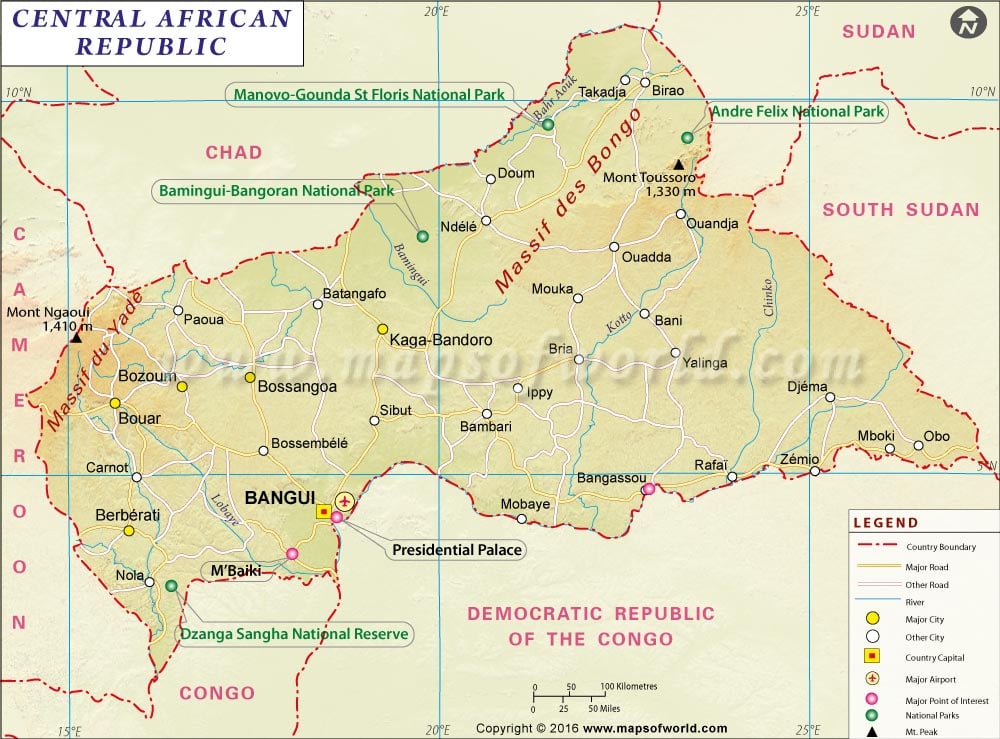
Map: Maps of the World.
The National Ballet in the Central African Republic brings to life traditional dance forms from different ethnic groups across the country. 

In parts of Africa where colonialism glommed together disparate tribes with ancestral enmities, wars have continued off and on for decades. But the Central African Republic (CAR) is setting a different example, with the help of its national ballet company. The idea is to give all the CAR groups a moment in the sun by highlighting the dance traditions of each. The effort also brings people together in new ways.

In the following article, we learn about a number of ethnic dance groups, including the National Artistic Ensemble that performed recently at the Africa Day of School Feeding (ADSF) in Bouboui. [See the African Union site for an explanation of ADSF. Interesting.]

France24 reports: “The dancers shake their hips, kicking their feet to the beat of the age-old ‘dance of the caterpillars,’ typically performed in the south where the insects are gathered for food.

“Three times a week the National Ballet rehearses traditional dances of the many ethnic groups making up the Central African Republic.

” ‘The creations they ask of us are based on the particularities of each ethnicity. I’m Banda and I have to suggest dance steps from the Banda ethnic group,’ Sidoane Kolema, 43, said.

“They aim to preserve the heritage of the CAR, a mosaic of ethnic groups that is scarred by decades of conflict and instability and is among the world’s poorest countries.

“From behind the scenes, 26-year-old Intelligentsia Oualou began singing in Gbanu, the language of her native southwestern Ombella-M’poko region.

“To the jingle of bells and rhythmic thud of the drum and xylophone-like balafon, the spinning silhouettes of the other dancers soon appeared across the dilapidated stage, set up on waste ground in the capital Bangui.

” ‘All my relatives are artists and I’ve dreamed of being an artist too,’ said Oualou. She is one of 62 dancers in the National Artistic Ensemble, created by CAR President Faustin Archange Touadera in 2021.

” ‘Promoting our cultures means going to the hinterlands to find the different dance steps of the Central African Republic in order to create a show that is diverse,’ National Ballet choreographer Ludovic Mboumolomako, 55, said. He spent three weeks living among the Pygmies in their ancestral forests in the south in order to enrich his choreography with their dances, songs and ways of living. …

“The company is often called upon to perform the ancestral dances in public at political gatherings, inaugurations and official ceremonies. In front of officials or at festivals, they dance in costumes of raffia skirts topped with pearl belts and patterned wax-print fabrics.

” ‘We need to raise awareness among young people … by dancing the different dances of our different ethnic groups in front of everyone. Tomorrow, if we are no longer here, it will be up to them to take over,’ Kolema said.

“The dancers were even recently integrated into the civil service, just like the actors and musicians who also belong to the National Artistic Ensemble.

“One of the upsides is that the dancers ‘have not a subsidy, but a salary’ [Culture Minister Ngola Ramadan] said. …

“Kevin Bemon, 44, said he had been able to put his former ‘difficult’ life dancing at neighborhood wakes behind him, thanks to the monthly salary of [$124] – just over twice the minimum wage in the CAR. …

“For a decade until 2013, the CAR was wracked by civil wars and intercommunal conflict, and although the violence has lost intensity since 2018, tensions persist.

” ‘Traditional dance has brought us together. After the recent wars, different ethnic groups were divided. Thanks to dance, we’ve become children of the same family,’ Oualou said.”

Check out the great photos at France 24, here. No paywall.

Read Full Post »

Photo: AFP/Sebastien Rieussec
A dancing contest in Mali challenges entrants to excel in traditional dances not their own. Here is a contestant in the “Faso Don,” performing during the filming of the show in the Malian capital, Bamako.

In Mali, an African country still suffering from the effects of French colonialism, ethnic groups have often had trouble getting along, and extremists have moved into vulnerable areas. (See my blog post about a secret operation to save ancient manuscripts from the radicals’ destructive rampage.)

But better days are ahead, especially if more people act on their ideas to promote peace and coexistence.

Sebastien Rieussec wrote recently for Agence France-Presse [APF] about one such person.

“All 3,000 seats in the cavernous Palace of Culture in Bamako had been snapped up, and the mood was at fever pitch as the TV dance competition reached its climax. The three finalists took to the floor one by one, dancing alongside a celebrity — a format familiar to viewers of talent shows around the world.

“But here’s the difference: the three hopefuls each had to perform a traditional dance from a region of Mali that was not their own. …

“In the landlocked Sahel state of Mali, the show has been a raging success. And it has bred a desperately-needed sense of unity in a country burdened by jihadist violence and ethnic tensions.

“The competition is the brainchild of dancer and choreographer Sekou Keita. Just six years ago, he was wondering how he could reverse the decline of traditional dance in Mali, a country whose music is now achieving global fame.

” ‘Our dances are so varied, we have a number of ethnic groups — we’re very lucky to have such cultural wealth,’ he told AFP. … ‘But [dancers] don’t know the traditional dances of their own country.’

“From this came his idea for a program that explored ancient cultural roots and built bridges across ethnic divides — ‘Faso Don,’ or ‘Dances of the Country’ in the Bambara language.

“Over six weeks, TV audiences shared the fate of eight young men and women from different regions, who shared a house Big Brother-style in Bamako, the capital.

“Each week they performed before an audience and the TV cameras, their numbers progressively falling as a competitor was eliminated by a vote by the public and the jury. … The final took place last weekend before an audience exhilarated by the ground-breaking, cross-cultural performances.

“Dressed in traditional costumes, the finalists performed one dance from their region and one from another region, accompanied by Malian stars such as musician Bassekou Kouyate and singers Habib Koite and Oumou Sangare. …

“The winner was Rokia Diallo, a woman from the Fulani pastoral community in Sikasso, southern Mali. Dressed in a flowing gown and a veil, she interpreted the takamba, a sinuous, sensuous dance from the Songhai group in the far north of the country.

” ‘It’s the first time I’ve seen something like this,’ said hip-hop dancer Oumar Tamboura, who had come to support a relative who was also one of the finalists. ‘Until now, people weren’t interested in folk dance, tradition and costumes.’

“Faso Don has not just revived interest in generations-old regional dances in Mali. It has also reinforced mutual respect in a country whose reputation for hospitality is tragically being supplanted by one for violence.”

Read more of this hopeful initiative here. It’s another example of one solitary individual having an idea and making a big difference.

Read Full Post »

Do you ever read Kevin Lewis’s Sunday Globe column, “Uncommon Knowledge”? He covers new research in the social sciences. Thanks to him, I learned about this study on helping minority boys get engaged in education.

“A disproportionate number of students struggling academically are minorities, ” he writes. “Can we do better?

“In what they claim is the first credible study of the effect of an ethnically grounded education, researchers at Stanford analyzed the effect of a ninth-grade course offered in several San Francisco public schools covering ‘themes of social justice, discrimination, stereotypes, and social movements from US history spanning the late 18th century until the 1970s’ and requiring students ‘to design and implement service-learning projects based on their study of their local community.’…

“The researchers found that taking the course ‘increased attendance by 21 percentage points, GPA by 1.4 grade points, and credits earned by 23 credits (or roughly four courses).’ They call the results ‘surprisingly large effects,’ which were concentrated among boys.”

The paper, by Thomas S. Dee, and Emily Penner, is The Causal Effects of Cultural Relevance: Evidence from an Ethnic Studies Curriculum.” It was posted at the National Bureau of Economic Research in January.

More here.

Photo: Stanford University
Teacher David Ko instructs an ethnic studies class at Washington High School in San Francisco. A Stanford study found students benefit from such courses. Here, Ko is explaining an assignment about the role of advertising in reinforcing cultural stereotypes.

Read Full Post »