Feeds:
Posts
Comments

Posts Tagged ‘futbol’

Photo: AP.
Spain’s World Cup winners return home.

Did you read about the popularity of Spanish-language television during the World Cup games last summer? I thought it was interesting that so many English speakers who don’t understand any Spanish turned away from American soccer coverage. I thought I’d look into it.

Tim Reynolds and Obed Lamy wrote about this in July at the Associated Press.

“Ashleigh Hallam teaches English as a second language at her local library in Indiana. Soccer is now teaching her Spanish as a second language. …

“Hallam is among a sizable number of English-speaking people in the U.S. who are doing something these days that might be considered a bit surprising: They’re watching broadcasts of World Cup matches in Spanish on Telemundo, even though they have little idea — or in some cases, no idea — what the announcers are saying.

“ ‘I can’t really understand everything they’re saying on Telemundo because they’re speaking in Spanish,”’Hallam said. ‘But you understand what’s going on.’ …

“Census figures show that about 20% of the U.S. is Hispanic, yet Telemundo points to Nielsen ratings to show that roughly half the World Cup viewers in the U.S. have watched at least some portion of some matches in Spanish. Every match of the tournament has been available for U.S. viewers in English on Fox or FS1, on Telemundo or Universo in Spanish, and there are streaming options such as Fox One or Peacock.

“Among the reasons commonly cited by viewers who spoke with the Associated Press in recent days: A fascination with famed broadcaster Andrés Cantor’s ‘¡goooooool!’ call. Telemundo doesn’t cut away for commercials (as Fox does) during the much-maligned hydration breaks. The broadcasts, some simply find, are more entertaining. And in other cases, it’s a cost-based decision: Peacock, which includes Telemundo, is lower-priced than Fox One.

“Jackson Braunius is a Michigan native who watched a U.S. game last week from a bar seat at a steakhouse in Miami Lakes, Florida. He said he speaks almost no Spanish — ‘I know “cerveza, ” ‘he said, tapping his beer glass — but didn’t mind watching on Telemundo whatsoever.

“ ‘I figured out the science here,’ Braunius said. ‘When they’re not talking too loud, nothing is happening. When they get loud, there’s a chance. When they get real loud, it’s probably going to be a goal.’

Comedian Trevor Noah has been hosting World Cup watch parties on YouTube. He’s made the switch to Spanish-language feeds, and the hydration break issue was a huge part of that decision.

“ ‘We’re seeing the players on the pitch discussing what’s happening. You see which coach is more stressed. Some players are tapping each other on the back. This is part of the game,’ Noah said on one of his YouTube streams. ‘I feel like when you cut to ads, you lose this — you lose the stress, you lose the joy, the anticipation. So, shout out again, Telemundo: Really, really amazing coverage.’

“Telemundo is hearing the praise, and has thanked English-speakers — as well as Noah directly — for lauding its coverage.

“The good news for everyone is this: There seems to be more than enough viewers to go around right now. And the success of this tournament could lead to a bidding war for the 2030 World Cup, with some reporting the rights for English-speaking and Spanish-speaking television will be packaged together in that deal. That wasn’t the case for this World Cup. …

“William Kennedy of Miami is married to a Colombian woman, whose native language is Spanish. He says he knows only enough Spanish to be able to order meals in restaurants. And yet, he finds himself often watching World Cup matches on Telemundo.

“If Colombia was on, the Kennedy house was watching Telemundo. If Colombia — which was ousted in penalty kicks by Switzerland on Tuesday — isn’t on, Kennedy finds himself usually making his way to Telemundo anyway.

“ ‘When the American commentators are doing the game, I don’t know what game they’re watching. I just don’t,’ Kennedy said. ‘I’d rather get the excitement in Spanish because essentially what happens is they’re talking, and then they’re talking really, really fast, and then they’re getting loud and your brain is just like, “Oh, something’s happening — even if I don’t know what’s happening.” ‘ “

More at AP, here.
Read Full Post »

Photo: Joseph Prezioso/AFP/Getty Images.
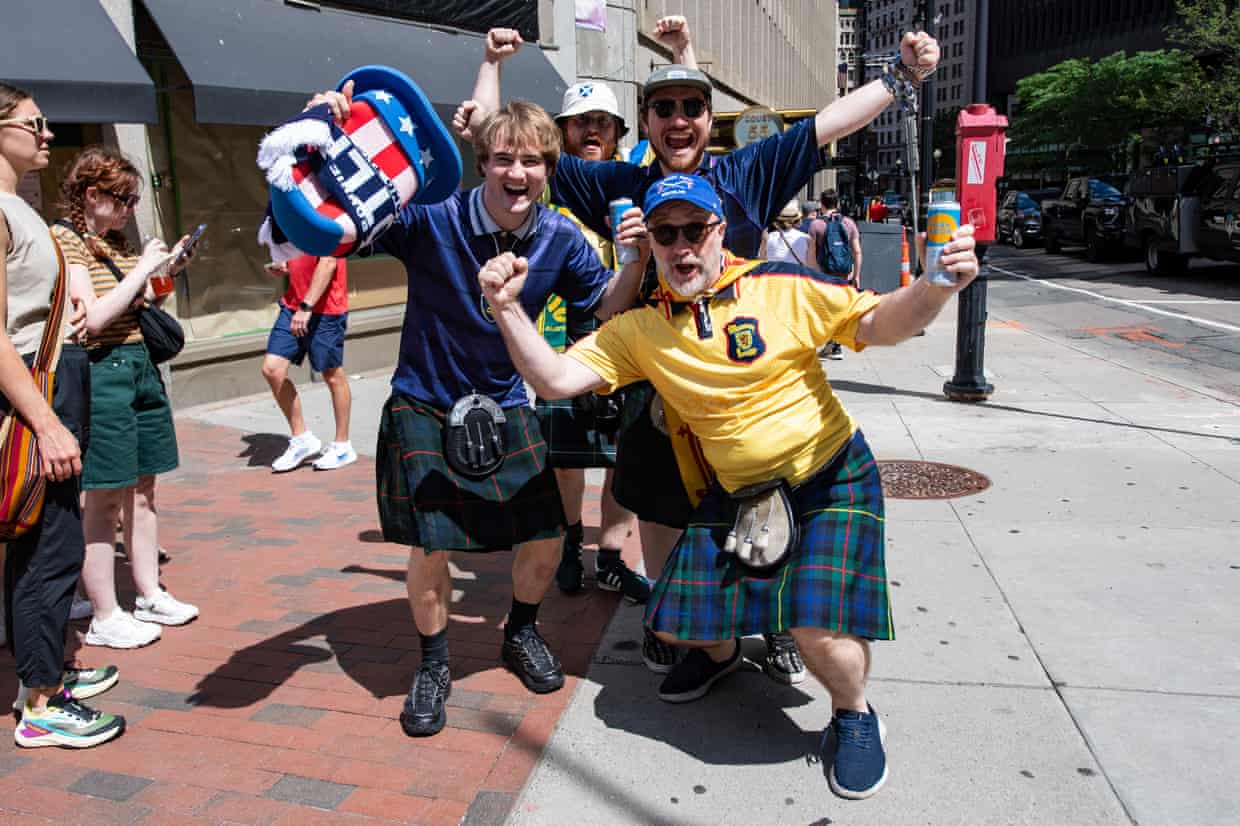
Members of the Tartan Army before one of Scotland’s 2026 World Cup games. 

There were many things about the 2026 World Cup that gave Americans a kind of unexpected permission to be happy. Among those things were enthusiastic fan groups that came from abroad. Consider Scotland’s Tartan Army and the fun of having kilts and bagpipes filling the streets.

Adeel Hassan wrote at the New York Times in May, “Fans of Scotland’s World Cup team, thousands strong, will march on Providence, Rhode Island’s capital, next month and local officials will be applauding and cheering them every step of the way.

“Providence aggressively and strategically promoted itself as an alternative to host the parade of fans, known as the Tartan Army. City officials helped broker hotel deals and open up college dormitories to house the Scottish team supporters, a fan said. …

“Many of the approximately 10,000 Scottish team supporters will be staying in Providence-area hotels, college dormitories and Airbnbs, Rhode Island officials said.

“ ‘Our estimate is around 40 percent savings on accommodation compared to Boston rates,’ Ian Cox of the Providence Tartan Army said. ‘The real reasons supporters are choosing Providence are simple: It is actually closer to Gillette Stadium, it is a beautiful and walkable city, and the people here have been incredibly welcoming and helpful throughout our planning.’ …

“The proximity of the two cities presents fans with a choice of where to make a home base for part of the 39-day tournament.

“There are two kinds of fans, international and domestic, said Victor Matheson, a professor of economics at the College of the Holy Cross in Worcester, Mass., and a longtime soccer fan. …

“ ‘Tourist No. 1 is the soccer fan who is using the World Cup as an excuse to go do other cool things that they’ve always wanted to do,’ he said. ‘That sort of tourist is obviously going to pick Boston over Providence because, from an international tourism perspective, Boston is a place to come.’

“The second fan is here only for the soccer matches, said Professor Matheson, who studies the economics of large sporting events.

“Describing the perspective of a die-hard soccer fan, he said: ‘I’m just not going to walk the Freedom Trail. I don’t care about Paul Revere. I don’t care about Old Ironsides. What I care about is soccer.

“ ‘Those fans are looking for like-minded fans,’ he added. ‘They’re looking for a place with cool bars, and a place that’s moderately cheap, so they can afford tickets to the event.’ …

“The only direct train service to Gillette Stadium is from Boston, though, and most fans from Rhode Island will be arriving by bus.

“The Tartan Army negotiated its own bus contract, and its members will arrive on game day on roughly 40 school buses, at $45 per person, less than half the established rate of $95, Mr. Cox said.

“Plenty of the Scottish fans and others staying in Rhode Island are using short-term housing rentals.

“ ‘Globally, what we’ve heard is that Airbnbs are as, if not more, popular than some hotels,’ because of the nature of how fans are traveling for the games, [Providence Mayor Brett] Smiley said. ‘Visitors seem to be coming in groups.’

“Airbnb housing, he said, distributes fans throughout the city’s neighborhoods, helping other businesses, rather than having all the fans concentrated downtown.

“Airbnb gave $250,000 to Ocean State 2026, the state’s official tournament organizer, to support soccer clinics, community celebrations and cultural programs. It is also giving two dozen World Cup tickets to children through a lottery.

“About a million people are expected to travel through the Providence area, according to Ocean State 2026. … The benefits will be spread out across the state, said James Diossa, chairman of Ocean State 2026 and the state’s general treasurer.

“Central Falls, a majority-Latino city, will be home to Colombia’s large fan base, he said, while Pawtucket and East Providence will be where many fans of the Cape Verde and Portugal teams will congregate. There will also be a fan zone for the Portugal national team in Providence. …

“Scotland’s last appearance in the World Cup was in 1998, and its fans have already left a mark on this one. They have made a $10,000 donation to Hasbro Children’s Hospital in Providence.

“ ‘Part of what makes that possible is the money our supporters have saved,’ Mr. Cox said. ‘Every dollar not spent on overpriced bus tickets, FIFA’s outrageously expensive parking, Boston 2026’s unaffordable train, or Boston hotel rates, is a dollar that can go back into the community.

“Providence has welcomed us with open arms, and we intend to repay that warmth in full.’ ”

More at the Times, here.

Read Full Post »

Photo:  Shereefdeen Ahmad.
“Today you do not play as rivals, but as brothers,” a match organizer tells the men from Nigeria and Benin.

One of the worst things about colonialism is the way it arbitrarily separates ethnic groups and plunks families down in different countries. Today we see how a sport is bringing relatives back together.

Shereefdeen Ahmad writes for the Christian Science Monitor, “It’s game day at the village soccer field, and spectators bunch along the sidelines with banners and drums to support their teams.

“They watch as the captains of the two squads walk to the center of the field for a coin flip to determine who kicks off first. …

“This match is part of a festival celebrating the culture of the Borgu, an ethnic group that straddles the border between Benin and its eastern neighbor, Nigeria. The teams and fans gathered here today have come from both countries, part of an effort to use soccer to bridge the divide imposed by colonial powers more than a century ago.

“ ‘I believe that football can reconnect us beyond those lines,’ says organizer Adam Kabirou, who regularly hosts cross-border matches.

“Mr. Kabirou grew up hearing stories about the Borgu kingdom, a civilization tracing its roots to the late 15th century. He also learned how colonial powers carved up his people’s lands in the late 19th century, splitting the Borgu between present-day Benin and Nigeria.

“Today, the majority of Borgu, approximately 1.4 million, reside in Benin, with a smaller population in Nigeria.

“As a child, Mr. Kabirou saw firsthand how that border created a rift between his community and the Borgu people living just 15 miles away on the other side. For one thing, the two groups often literally didn’t have the words to speak to one another.

Borgu in Nigeria learned English, the colonial language there, while Borgu in Benin spoke French, the language of their former rulers.

“These languages mingled with Batonu, the Borgu language, changing the way it was spoken on each side of the border.

“Meanwhile, Western-style schooling in both countries had pushed the Borgu people away from their shared customs and traditions, says Lafia Hussaini, a Borgu ethnographer and adjunct lecturer at the Centre for Cultural Studies and Creative Arts at the University of Ilorin in Nigeria. [Simultaneously] the border created an administrative division that made close ties practically difficult. …

“Sometimes the division even cut through a single community. For instance, half of the village of Chikanda sits in Benin, the other half in Nigeria. The difference is most clear at night. Electric lights illuminate the houses on the Beninese side of the border, while the Nigerian side, which doesn’t have an electricity connection, is dark.

“Over the years, Mr. Kabirou, a farmer, occasionally attended cross-border soccer matches, and saw how the game shrank the distances between the two communities. So in 2022, he decided to organize a tournament.

“In its most recent edition, in 2024, the Tournoi Brassage Culturel – the Cultural Blend Tournament – drew five teams from Nigeria and 15 from Benin. Mr. Kabirou estimates that more than 4,000 fans attended the final match between Gwanara, Nigeria, and Tchatchou, Benin.

“For the players who participate in these matches, the importance stretches beyond soccer.

“Bashiru Adamu, a Nigerian player, says he barely knew his paternal family in Benin before crossing the border to play a match here in 2023. Now, whenever he comes to play a game, he pays them a visit as well. …

“Today, there are three separate tournaments bringing together Borgu teams from Nigeria and Benin. … They have been important not only for the players, but for spectators as well.

“Watching these matches ‘has really brought us together,’ says Souaibou Seko, a resident of Nikki, Benin. In addition to the soccer itself, he says, he appreciates the cultural performances from Borgu artists that often take place before matches or at halftime.

“These performances ‘stress our newfound cultural unity,’ says Sanni Sika Gounoun, chairman of the organizing committee for the Solidarity Tournament. ‘This camaraderie is growing organically.’ “

This article is published in collaboration with Egab,” which focuses on stories from lesser known areas.

More at the Monitor, here.

Read Full Post »

My, but we work hard at the office. At 4 today, everything stopped and we went to the break room to watch the World Cup. A co-worker from Ghana called his brother. Everything had stopped in Ghana, too.

In honor of the world’s fascination with soccer today, I am posting a futbol story from Bill Littlefield’s radio show Only a Game.

At the show’s website, Ellis O’Neill describes an encounter he had with homeless soccer: “It’s 9 p.m. and the sun went down long ago, but that’s not stopping this group of about 20 young men from playing soccer under the bright lights of a turf field in Puente Alto, a poor suburb to the south of Santiago, Chile.

“Homeless Soccer aims to offer the benefits of sports to Chile’s homeless. It’s been so successful that, over the past eight years, it’s grown from one team that practiced in one Santiago park to almost 100 teams all over the country.

“Domingo Correa is a longtime participant in Homeless Soccer. He first joined back in 2011, and his nickname is Jack Sparrow. With his long dreadlocks and beard, his piercings and rings and his high, sharp cheekbones, he lives up to the name. But Correa doesn’t have a pirate ship, much less any treasure. For 15 years, he lived on the streets of Santiago.

“ ‘There’s no way out, you know?’ Correa said. ‘You think everything has been lost. You have no hope of finding stable work. Also, I had been involved in crime, so I had “stained papers,” as we say here: I had a criminal history. The distance between society and living on the street is enormous.’

“One day, while Correa was watching a Homeless Soccer practice in a Santiago park, the team’s psychologist invited him to join in. He decided to take a stab at it, and he liked what he found. For the first time, there was a group of people that was always there for him – every Monday and Wednesday evening on the soccer field.”

Read how soccer changed Correa’s life, here.

Reminds me of what running means to the Back on My Feet homeless folks that my friend Meg told me about, here.

Highlights from the 2011 Homeless World Cup

Read Full Post »