Feeds:
Posts
Comments

Posts Tagged ‘world cup’

Photo: Carlos Muñoz.
Cape Verdean fans watched the national team play at the PVD Fan Zone in Providence, R.I.

I’m into the World Cup more than usual this year, mostly because the kids and grandkids are but also because so many fun things are happening close to home.

Carlos R. Muñoz wrote recently at the Boston Globe that the fan zone in Providence, Rhode Island, for example, has not only been fun but a great unifier.

“Since the World Cup began,” he wrote, “fans of international football have flooded into the PVD Fan Zone at Station Park in Providence, turning an underused green space into what Mayor Brett Smiley calls the best display of the city’s ‘rich diversity.’

“The Fan Zone has attracted more than 70,000 visitors, and after the FIFA Fan Festival Boston shut down following the end of the World Cup group stage, the Providence spot is the only remaining FIFA-sanctioned event outside Boston Stadium.

“FIFA required host cities to run fan festivals throughout the tournament, which ends with the World Cup Final on July 19, but relaxed its requirements because of funding, according to the Sports Business Journal.  

“ ‘From the outset, FIFA worked closely with Host Cities and local stakeholders to help shape meaningful fan experiences beyond the stadiums that are community-led, fan-oriented and aligned with the spirit of the FIFA World Cup,’ FIFA wrote in an email. …

“A fan festival costs about $1 million a day to operate, according to Fortune. The PVD Fan Zone costs about a third of that amount, according to Joe Wilson, the director of Art, Culture and Tourism for the City of Providence, and producer of the Fan Zone. City officials have committed to keeping it open for the full World Cup.

“Wilson said that cities struggled to pay for security and to make sure that city service costs were being covered. Station Park is located between the Amtrak/MBTA train station, the State House, and Providence Place mall and is an open area that is not typically used for events.

“ ‘Every city who had some kind of interface with FIFA and the World Cup were grappling with a variety of challenges related to budgets, scheduling, and safety,’ Wilson said. ‘One piece that made us say “39 days” is that we already have infrastructure footprint that we cannot move without using cranes that we’re securing 24/7. If we have to secure it, we might as well be open.’

“Providence did an economic impact assessment of life in the city two years ago, according to Wilson, and found that between 5 and 9 p.m. the city is ‘as international a city as Los Angeles’ with communities that have rich, strong immigrant populations who love football. …

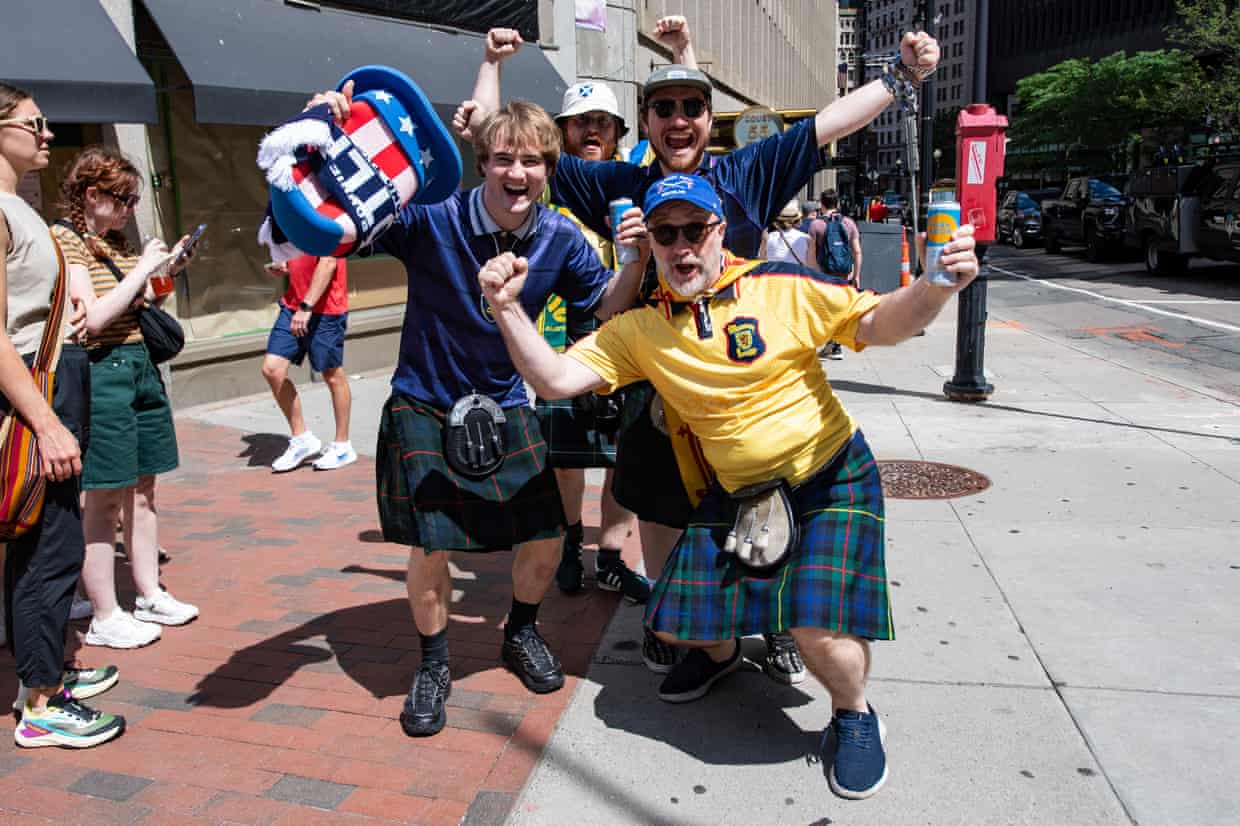
“Wilson said the state’s ‘built-in audiences’ and proximity to Boston Stadium attracted groups like the Tartan Army and Ghana fans to Providence. Ghana’s national football team is staying at the Graduate Hotel [in Providence] and practices at Bryant University [in Smithfield].

“ ‘This is the first time this format of a World Cup is taking place over a continent, so even down to the logistics of this, we’re producing the singularly largest sustained event in the history of the city,’ Wilson said. …

“The World Cup has been a unifying event, Smiley said. ‘In the context of a moment where there’s so much stress and strife and division, this has been a really wonderful moment for communities to come together,’ he said. ‘It’s been entirely peaceful and family friendly, and just a nice and joyful occasion.’ …

” ‘We’re not doing this to make money for the city itself, and if the Fan Zone proper breaks even in terms of city impact, but all our businesses thrive, then it will have been a success,’ Smiley said. ‘We’ll have a full accounting of the city’s investment in the Fan Zone by the time we’re done and I’m optimistic that we’ll cover a lot of our expenses.

“City Councilman John Goncalves, whose ward covers much of downtown Providence, said the Fan Zone has been an incredible celebration of soccer, culture, and community.

“ ‘As Team Cape Verde, we’ve seen firsthand how the Fan Zone has united thousands of people around pride, identity, and joy,’ he said. ‘The energy has been incredible.’ …

“Smiley said the turnout for the Cape Verdean matches is one of his tournament highlights.

“ ‘That was a near record attendance night,’ he said. ‘We think we had about 8,000 fans that evening, and not only did I get to see and experience that energy, but to have 8,000 fans at night in a place with adult beverages and have zero issues.’ ”

More at the Globe, here.

Read Full Post »

Soccer and Samba

Photo:MB Media/Getty Images.
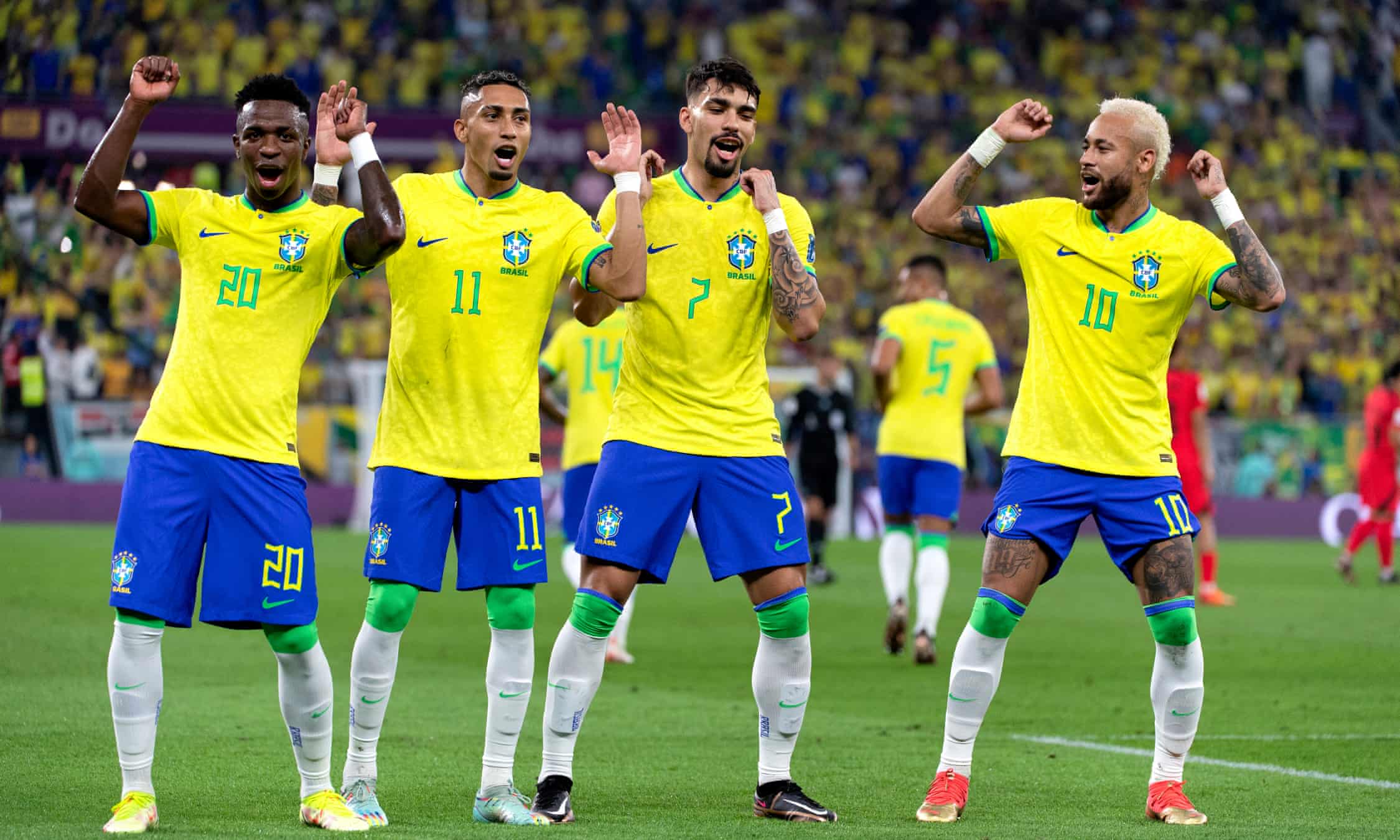
Brazil’s players celebrate by dancing the samba after their win over South Korea. 

Is it my imagination or is there new excitement in the US over the World Cup this year? We have never been prominent among soccer teams, and that’s changing. Also, we have many immigrants and naturalized Americans from big “futball” nations. So there’s that.

In any case, it’s been fun. Suzanne and Erik and the kids each picked a team at the start, and three of them have had to swallow their disappointment and choose a second favorite. Suzanne is still standing.

Every soccer country has its own way of reacting to wins and losses. Not many are subdued. Today’s story is about the form that Brazilian soccer celebrations take.

Ed Aarons opens his story at the Guardian with a player’s memories of games in the 1930s.

” ‘I was afraid of playing football [soccer] because I had often seen a black player get struck on the pitch for committing a foul,’ said Domingos da Guia, a defender who played for Brazil in the 1938 World Cup. ‘But I was a very good dancer and that helped me on the pitch. I invented the short dribble by imitating the miudinho, a form of samba.’

Roy Keane did not like it but when Brazil’s players – and the coach, Tite – celebrated scoring against South Korea in their last-16 victory on Monday by performing Richarlison’s trademark pigeon dance, they were following a historic tradition that represents the very soul of the Seleção. Samba, which has its roots in Angola and the Democratic Republic of Congo via the African slave trade, and football were adopted by Brazil’s working classes just as Da Guia was making his international debut in 1931.

“According to Brazilian sociologist Gilberto Freyre, the distinctive style of play Brazil has become known for comes from the indelible link between the two:

‘In football, as in politics, a feature of the Brazilian racial blend is a taste for bending the rules, an element of surprise or frills that calls to mind dance steps and the Capoeira.’ …

“When a 17-year-old Pelé and the winger Garrincha inspired them to their first World Cup victory in 1958, the song A Taça do Mundo é Nossa – The World Cup is Ours – left no doubt about the vital importance of music to the team’s success. …

“According to legend, the celebrated samba singer Elza Soares fainted in the stands at the end of Brazil’s 3-1 win over Czechoslovakia in the final but recovered in time to perform a song in honor of her future husband Garrincha in the changing room.

“Pelé was among those to pay tribute to Soares in January after her death at the age of 91, describing her as a ‘legend of our music, historic, genuine, unique and unparalleled.’ …

“The tradition of celebrating goals with dance routines is generally a more recent phenomenon that has not been restricted to Brazilians. Roger Milla’s corner flag wiggle at Italia 90 and again at USA 1994 were inspired ‘by his own imagination’ according to the Cameroon striker, while Papa Bouba Diop celebrated his goal against France, the holders, in 2002 by removing his shirt and performing a mbalax dance with his Senegal teammates. But after Bebeto and Romario’s cradle-rocking routine in 1994 that was a tribute to the former’s newborn Mattheus Oliveira – now 28 and playing in the Portuguese second division – it is Brazil that has always had the strongest tradition to uphold.

“ ‘Dance is the symbol. We symbolize the joy of scoring a goal. We don’t do it to disrespect, we don’t do it in front of the opponent,’ said West Ham’s Lucas Paquetá after the South Korea match. ‘We get together, you can look. Everyone is there and we celebrate. It’s our moment, we scored the goal, Brazil is celebrating.’

“For Vinícius Júnior, who scored the first goal against South Korea, the criticism will have had particular resonance. In September, the Real Madrid forward was accused of not respecting his opponents and told to ‘stop playing the monkey’ by Pedro Bravo – a leading agent and president of the Association of Spanish Agents – on live television after celebrating his goals by dancing. …

“ ‘They say happiness upsets. The happiness of a black Brazilian successful in Europe upsets much more,’ Vinícius wrote. ‘Weeks ago they began to criminalize my dances. Dances that are not mine. They belong to Ronaldinho, Neymar, Paquetá, [Antoine] Griezmann, João Félix and Matheus Cunha. … They belong to Brazilian funk and samba artists, reggaeton singers, and black Americans. Those are dances to celebrate the cultural diversity of the world. Accept it, respect it. I’m not going to stop.’ ”

More at the Guardian, here.

Meanwhile, in Switzerland, riots break out after the World Cup loss to Portugal.

Read Full Post »

My, but we work hard at the office. At 4 today, everything stopped and we went to the break room to watch the World Cup. A co-worker from Ghana called his brother. Everything had stopped in Ghana, too.

In honor of the world’s fascination with soccer today, I am posting a futbol story from Bill Littlefield’s radio show Only a Game.

At the show’s website, Ellis O’Neill describes an encounter he had with homeless soccer: “It’s 9 p.m. and the sun went down long ago, but that’s not stopping this group of about 20 young men from playing soccer under the bright lights of a turf field in Puente Alto, a poor suburb to the south of Santiago, Chile.

“Homeless Soccer aims to offer the benefits of sports to Chile’s homeless. It’s been so successful that, over the past eight years, it’s grown from one team that practiced in one Santiago park to almost 100 teams all over the country.

“Domingo Correa is a longtime participant in Homeless Soccer. He first joined back in 2011, and his nickname is Jack Sparrow. With his long dreadlocks and beard, his piercings and rings and his high, sharp cheekbones, he lives up to the name. But Correa doesn’t have a pirate ship, much less any treasure. For 15 years, he lived on the streets of Santiago.

“ ‘There’s no way out, you know?’ Correa said. ‘You think everything has been lost. You have no hope of finding stable work. Also, I had been involved in crime, so I had “stained papers,” as we say here: I had a criminal history. The distance between society and living on the street is enormous.’

“One day, while Correa was watching a Homeless Soccer practice in a Santiago park, the team’s psychologist invited him to join in. He decided to take a stab at it, and he liked what he found. For the first time, there was a group of people that was always there for him – every Monday and Wednesday evening on the soccer field.”

Read how soccer changed Correa’s life, here.

Reminds me of what running means to the Back on My Feet homeless folks that my friend Meg told me about, here.

Highlights from the 2011 Homeless World Cup

Read Full Post »