Feeds:
Posts
Comments

Posts Tagged ‘EU’

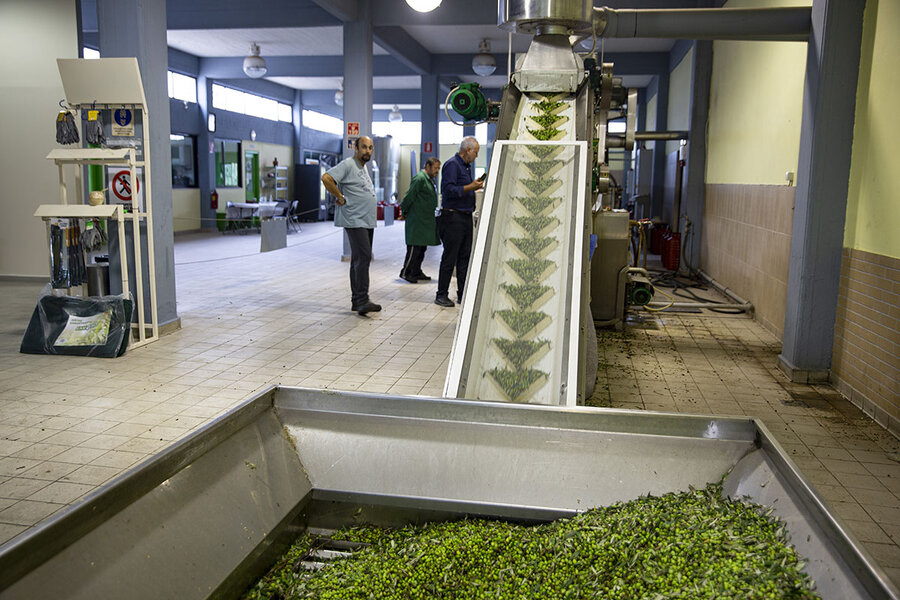
Photo: Dominique Soguel.
Michael Antonopoulos, president of the Agricultural Cooperative of Kalamata, tells the Christian Science Monitor, “We want to adjust as soon as possible to the environment and be pioneers. Our place has to be fully ecological.”

In Greece, where farmers have grown olives for millennia, global warming has imposed a new normal. Nevertheless, writes Dominique Soguel at the Christian Science Monitor, “the result is not resignation. Rather, it’s fresh thinking and approaches.”

Soguel continues, “Olives and olive oil have become synonymous with Greece, and are credited, in part, with fueling the rise of Greek civilization. But despite a history spanning thousands of years, these culinary pillars of Greek identity are under threat. Small farmers expect this year’s harvest season, which got underway in November, to be one of the worst years on record, thanks to climate change and the irregular seasonal shifts it has wrought upon the flowering process and fruit development.

“ ‘We are collecting olives much earlier than ever before. Our producers do not recall any year like this,’ says Michael Antonopoulos, president of the Agricultural Cooperative of Kalamata. …

“He is not alone in expecting southern Europe to look like northern Africa in the span of 50 to 100 years. But Mr. Antonopoulos, a geologist and geotechnical environmentalist by training, is optimistic. He points to a series of steps that the community is taking to adapt to unseasonal temperature variations.

‘You can’t change the climate, but you can adjust.’

“[He] notes that traditional olive groves have an important role to play in combating climate change. They are carbon sinks and could easily be integrated into carbon-offsetting projects, increasingly popular but also controversial methods used to reduce the carbon footprint of a company or country. Kalamata is among six Greek cities participating in the European Union mission for 100 climate-neutral and smart cities by 2030.

“ ‘We want to adjust as soon as possible to the environment and be pioneers,’ he says. ‘Our place has to be fully ecological. We don’t care about higher productivity. We care about sustainability. We know people in the future will appreciate that more than anything.’

“One November day in Kalamata, as the mill that serves a community of roughly 300 olive oil producers operates at full throttle, the rain outside turns to hail. … It’s been that kind of year for Kalamata’s olive crop. In 2023, it endured winter conditions during the spring and, unlike much of Greece, experienced relatively low summer temperatures. That unusual weather, coupled with low rainfall, resulted in fewer and smaller olives. …

“ ‘If you don’t have certain weather conditions at a certain time,’ explains Mr. Antonopoulos, ‘you can’t have olive oil.’

“But the mill is also representative of how Greek olive farmers are adapting to the new environment. It is designed to run as sustainably as possible. Waste compost from the mill enriches the soil of the surrounding groves. It is the first mill in the region to rely on solar panel energy, and it recently secured a deal to sell electricity to the Greek government. Further, its farmers have adjusted their pruning tactics to optimize water use. And geothermal energy heats the olive oil extraction plants. …

“ ‘It’s all about feeding the soil,’ says George Kokkinos, head of the Nileas olive oil producers cooperative in the broader Messenia region, which encompasses Kalamata. ‘Soil health is top priority.’ …

“ ‘The philosophy was to look at how olive tree cultivation adapts to climate change,’ adds Mr. Kokkinos. ‘It was the first time that we heard of the expression “climate change.” … The consequences only start to be seen and felt here in 2016.’

“One of the most visible of these consequences, he says, are warmer, humid winters. This led to the spread of fungal diseases. Another change … summer now starts in July and lasts longer. All that confuses the olive tree, which decides in February whether to flower and delivers olives in April. …

“ ‘The normal, maximum temperature for this place this time of year would have been 16-18 C [60-66 F]. Typically, we would start the harvest wearing heavy clothes. Now we harvest in our T-shirts.’

“The mitigation measures are working, he says, even though recent summer heat waves dried up thesoil. He sees evidence of that in a 30% loss of productivity this year on his grove, compared with much higher losses among those who took no measures. The techniques they tested in the project now form part of the EU sustainable agricultural policy. But he worries that the Greek government is not prioritizing action and the spread of know-how to other farmers.

“ ‘The farmer stands in the middle and does not connect the dots,’ he says. ‘The average farmer in Greece is 60 years old. It’s a hard time. That’s true. But there are opportunities. The key is to adjust.’ ”

More at the Monitor, here. No paywall.

Read Full Post »

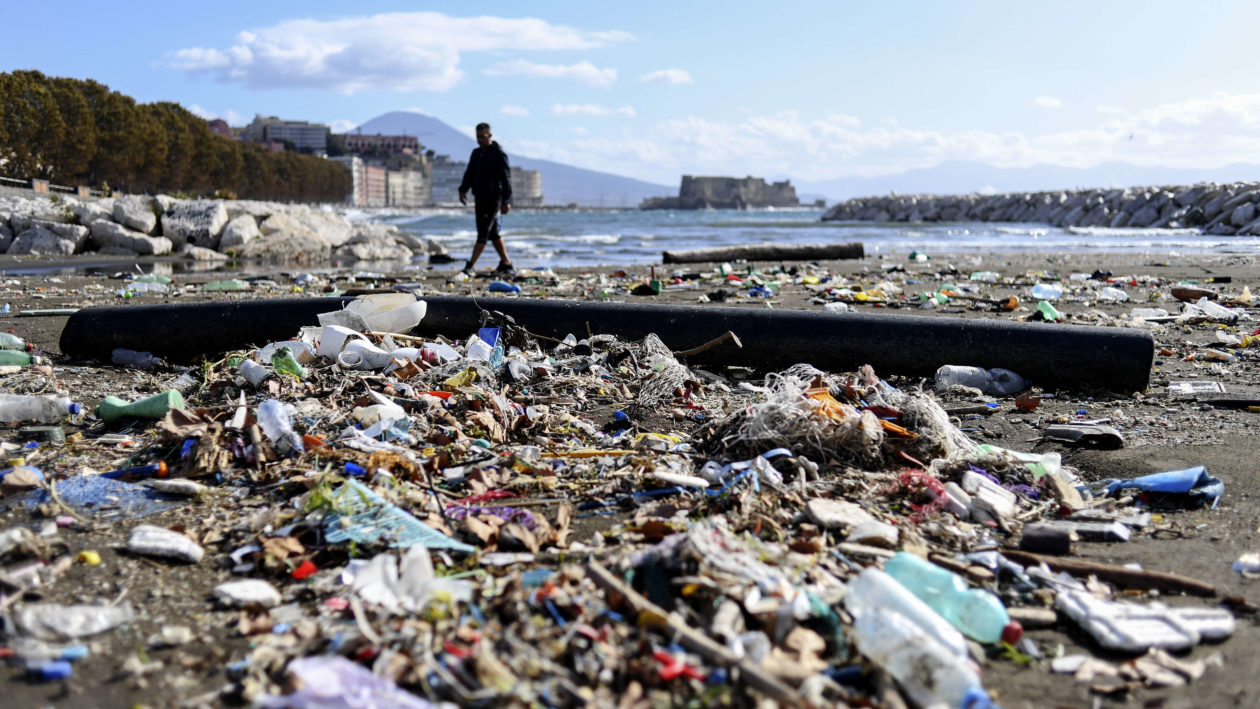
Photo: Salvatore Laporta / KONTROLAB / LightRocket via Getty Images.
A beach in Naples, Italy, covered in plastic waste following a storm in 2018.

The pandemic unfortunately increased my use of takeout meals packaged in plastic, but today I’m back to thinking about ways to reduce plastic consumption. For example, instead of buying brands that usually come in plastic, I look for alternatives in glass: mayonnaise, olive oil, applesauce, lemon juice. Suzanne showed me a brand of yogurt that comes in glass, too. And my water bottle is glass with a kind of rubber coating.

You do have to hunt for these things. It’s not like government here is going to help you as the European Union would. This month, for instance, the EU banned many throwaway plastic products.

At YaleEnvironment360, Paul Hockenos reports, “In Europe, beachgoers have grown accustomed to the dispiriting sight of plastic garbage strewn along shorelines. Indeed, 85 percent of the continent’s saltwater beaches and seas exceed pollution standards on marine litter. The Mediterranean Sea is the most defiled of all, with researchers collecting an average of 274 pieces of plastic refuse per 100 meters of shoreline. And beneath the waves, microplastics have turned coastal waters into toxic ‘plastic soups.’

“In an all-out push to clean up Europe’s beaches — one plank in the European Union’s trailblazing efforts to address the almost 28 million U.S. tons of plastic waste it generates annually — a ban comes into effect July 3 that halts the sale in EU markets of the 10 plastic products that most commonly wash up on the continent’s shores. These include, among other items, plastic bottle caps, cutlery, straws and plates, as well as Styrofoam food and beverage containers.

“The ban is the most visible sign of Europe’s efforts to curtail plastics pollution by creating the world’s first-ever circular plastics regime. By the end of this decade, this will lead to a ban on throwaway plastics, the creation of a comprehensive reuse system for all other plastics, and the establishment of an expansive and potentially lucrative European market for recycled plastics.

“A raft of EU measures is now driving investments and innovation toward circular solutions that, according to experts and EU officials, will come to define Europe’s low-carbon economy and enhance its global competitiveness. A circular economy is one in which products and materials are kept in use along their entire life cycle, from design and manufacturing to reuse or recycling. In contrast to the current, linear system, products don’t end up in the rubbish bin, but rather are reintroduced into the production process.

“Under the EU Plastics Strategy, put forward in 2018, waste guidelines will overhaul the way plastic products are designed, used and recycled. All plastic packaging on the EU market must be recyclable by 2030, and the use of microplastics circumscribed.

The measures are the toughest in the world and have already pushed plastic packaging recycling rates in the EU to an all-time high of 41.5 percent — three times that of the United States.

“The EU has set a target for recycling 50 percent of plastic packaging by 2025, a goal that now looks within reach. And in 2025, a separate collection target of 77 percent will be in place for plastic bottles, increasing to 90 percent by 2029.

“This overarching regime will rely on the widespread adoption of extended producer responsibility schemes, which means that if a company introduces packaging or packaged goods into a country’s market, that firm remains responsible for the full cost of the collection, transportation, recycling or incineration of its products. In effect, the polluter pays. …

“ ‘The EU is taking the creation of a circular economy very seriously, and plastics are at the center of it,’ said Henning Wilts, director of circular economy at Germany’s Wuppertal Institute for Climate, Environment and Energy. …

“The U.S., which generates the largest amount of plastic waste in the world, is awash in waste now that China — the largest manufacturer of plastic — no longer accepts imported waste; many U.S. cities end up pitching plastic waste into landfills or burning it. Congress has commissioned the National Academies of Sciences to conduct a sweeping review of the U.S. contribution to plastic waste, due out at the end of this year. …

“ ‘The 10-items ban is big. It’s not greenwashing,’ said Clara Löw, an analyst at the Öko-Institute, a German think tank. ‘There are many more measures afoot within the European Green Deal to rein in plastics and establish circularity as the cornerstone principle of Europe’s plastics economy. Even most Europeans aren’t aware of how much is happening right now.’ …

“Carmine Trecroci, an economist and recycling expert at the University of Brescia in Italy, said that external factors like the price of oil have a major impact; as long as oil is cheap, which it has been in recent years, so too is plastics production, making it all the harder to rein in. The plastics sector in the EU is big business, employing 1.5 million people and generating 350 billion euros in 2019. Trecroci said the powerful Italian plastics lobby fought fiercely to block the 10-item ban, and then to slow and dilute it. In the end, however, the EU approved the ban.”

More at Yale Environment 360, here. Vested interests are always going to fight back against measures like that, but the EU shows that common sense can prevail. In the US, if consumers boycott plastic, I think we will see companies changing.

July 22, 2021 Update: Wow, I just saw that Maine is doing what we’ve been asking for. Read this.

Read Full Post »