Feeds:
Posts
Comments

Posts Tagged ‘eurovision’

Photo: SRG/SSR.
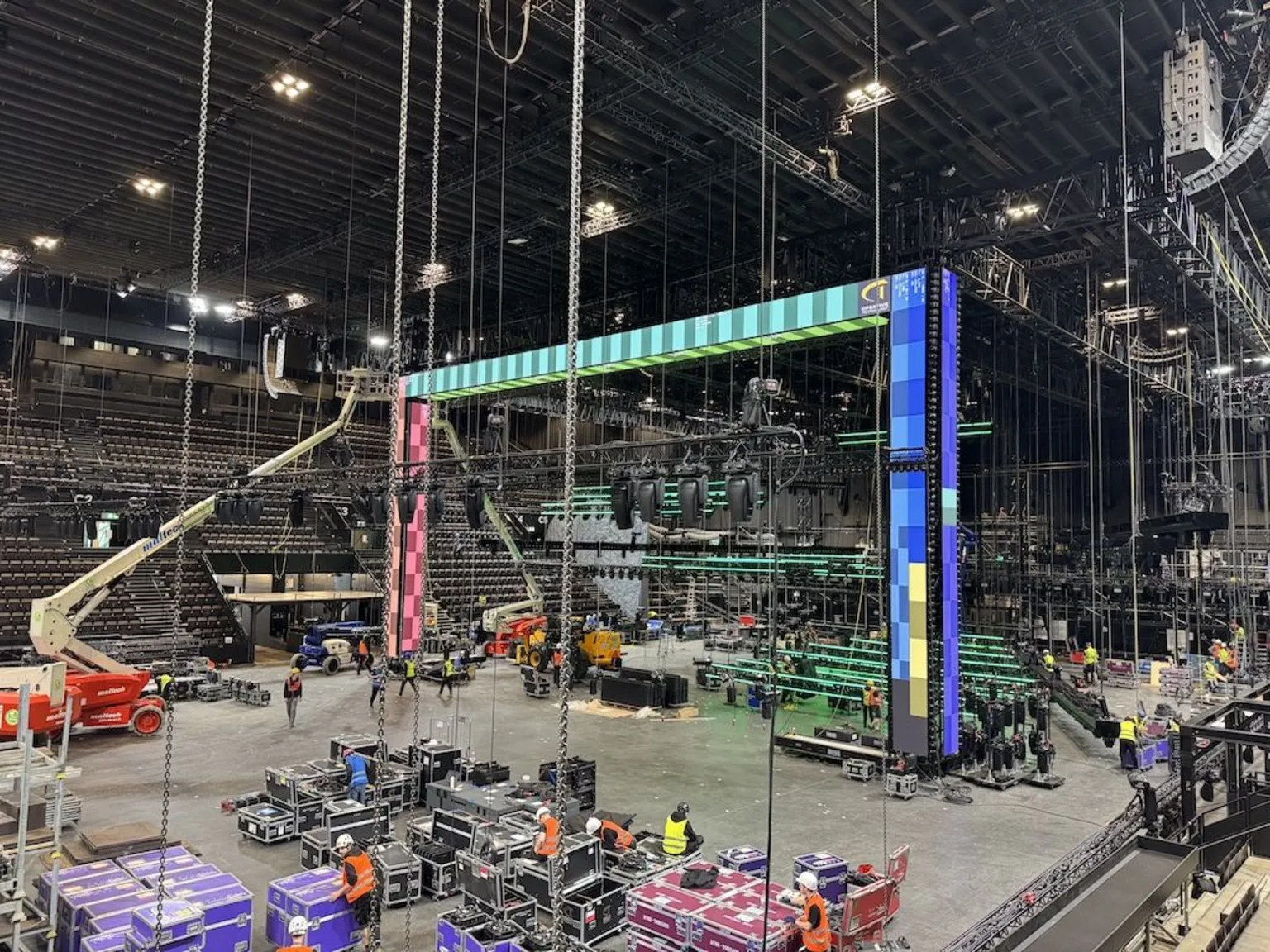
Construction of this year’s Eurovision stage began in early April, three weeks before rehearsals kicked off.

You have to admire the ambition that goes into producing an extravaganza. Just envisioning it seems beyond the imagination of normal mortals. Today’s story describes the behind-the-scenes magic of the 2025 European song competition known as Eurovision, in which fans root for their own countries.

Mark Savage reports at the BBC, “Thirty-five seconds. That’s all the time you get to change the set at Eurovision. Thirty-five seconds to get one set of performers off the stage and put the next ones in the right place. Thirty-five seconds to make sure everyone has the right microphones and earpieces. Thirty-five seconds to make sure the props are in place and tightly secured. …

” ‘We call it the Formula 1 tire change,’ says Richard van Rouwendaal, the affable Dutch stage manager who makes it all work. ‘Each person in the crew can only do one thing. You run on stage with one light bulb or one prop. You always walk on the same line. If you go off course, you will hit somebody.’

“The stage crew start rehearsing their ‘F1 tire change’ weeks before the contestants even arrive. Every country sends detailed plans of their staging, and Eurovision hires stand-ins to play the acts. …

“As soon as a song finishes, the team are ready to roll. As well as the stagehands, there are people responsible for positioning lights and setting pyrotechnics; and 10 cleaners who sweep the stage with mops and vacuum cleaners between every performance. …

“The attention to detail is clinical. Backstage, every performer has their own microphone stand, set to the correct height and angle, to make sure every performance is camera perfect.

” ‘Sometimes the delegation will say the artist wants to wear a different shoe for the grand final,’ says Van Rouwendaal. ‘But if that happens, the mic stand is at the wrong height, so we’ve got a problem!’ …

” ‘It’s a big logistics effort, actually, to get all the props organized,’ says Damaris Reist, deputy head of production for this year’s contest. ‘It’s all organized in a kind of a circle. The [props] come onto the stage from the left, and then get taken off to the right. Backstage, the props that have been used are pushed back to the back of the queue.’ …

“What if it all goes wrong?

“There are certain tricks the audience will never notice, Van Rouwendaal reveals. If he announces ‘stage not clear’ into his headset, the director can buy time by showing an extended shot of the audience. …

” ‘There’s actually lots of measures that are being taken to make sure that every act can be shown in the best way,’ says Reist. …

“It’s no surprise to learn that staging a live three-hour broadcast with thousands of moving parts is incredibly stressful. …

“The shifts are so long that, back in 2008, Eurovision production legend Ola Melzig built a bunker under the stage, complete with a sofa … and two (yes, two) espresso machines.

” ‘I don’t have hidden luxuries like Ola. I’m not at that level yet!’ laughs Van Rouwendaal ‘But backstage, I’ve got a spot with my crew. We’ve got stroopwafels there and, last week, it was King’s Day in Holland, so I baked pancakes for everyone.’ “

More at the BBC, here.

This year the winner was Austria’s Johannes Pietsch, or JJ, and the song was “Wasted Love.”

Read Full Post »

You may recall that six grandmothers from the former Soviet Union competed in Eurovision. We blogged about them here. Loreen from Sweden won first prize, but the babushki came in second.

In a follow-up story in the NY Times, Andrew Kramer writes that the grandmas’ fame is bringing a modicum of prosperity to their forgotten village. In particular, it is rebuilding the church that Stalin destroyed and that they loved in secret. They chose to spend their winnings on the church.

“For years, Buranovo was a dying village, one of many in the Russian countryside left behind by an oil-driven boom that revitalized drab Soviet cities and drew the young away from the farms that had sustained their parents. …

“Now, the women’s good fortune is transforming not only their lives, but also Buranovo. In appreciation of the group’s near victory, the local government is building a water pipeline, installing streetlights and high-speed Internet for the village’s sole school and laying new gravel on the main roads. …

“It all began with a miracle, said Olga N. Tuktareva, the leader of the singing group …. Ms. Tuktareva recalled strolling about the village with a friend in 2008 and lamenting a sad episode in local history: the destruction of the Church of the Trinity, taken down like countless other churches in Stalin’s Russia. …

“During that walk, Ms. Tuktareva recalled, her cellphone rang. It was a music producer in Moscow who had heard of the singing babushki …”

Read more.

Photograph: Oleg Nikishin

Read Full Post »

Your blogger is one grandma all excited about having some baby time this weekend.

But in Azerbaijan, six grandmas from Russia are competing in a pop-music contest.

“Eurovision 2012 is under way, and about half a billion viewers are expected to tune in for the finale on Saturday. …

“The song contest started in the 1950s, and each country competing is represented by a single singing group or soloist. Because Azerbaijan won last year, Eurovision is being staged in its capital, Baku. …

“Representing Russia this year is a group of six grandmothers. Their song, ‘Party for Everybody,’ tells the story of the babushkas welcoming their grandchildren home. ‘This song itself is kind of appalling, but Eurovision isn’t about the best song,’ [says William Lee Adams, editor-in-chief of Wiwibloggs]. ‘It’s about the best act. And this one comes with attitude and spunk and spirit, and the belief that you can keep on moving no matter how old you are.’ ” Amen to that.

Read more at NPR, and watch the videos. If you catch what language the babushkas speak, please let me know. It is not actually Russian but a minority language.

Read Full Post »

Thousands of languages are becoming extinct as the last of the people who speak them die off.

In a race against time, some determined souls who value the richness and insights that individual languages provide are making efforts to save as many minority languages as possible. We posted about that here.

Today National Public Radio had a feature on another approach to preservation, the Liet International Song Contest.

“Auditions are now underway for next May’s Eurovision Song Contest — that often-ridiculed television spectacle that has drawn millions of viewers around the world every year since 1956. In 2012 the host country will be Azerbaijan, since that country fielded last year’s winner. The show’s performers rely on outlandish costumes, dance moves and gimmicks to grab attention because most viewers can’t understand what they’re singing. But language is at the heart of another Eurovision-sponsored song and performance competition this weekend in Italy. The Liet International Song Contest is a very serious attempt to keep some of the continent’s neglected languages alive.”

Read more.’


Read Full Post »