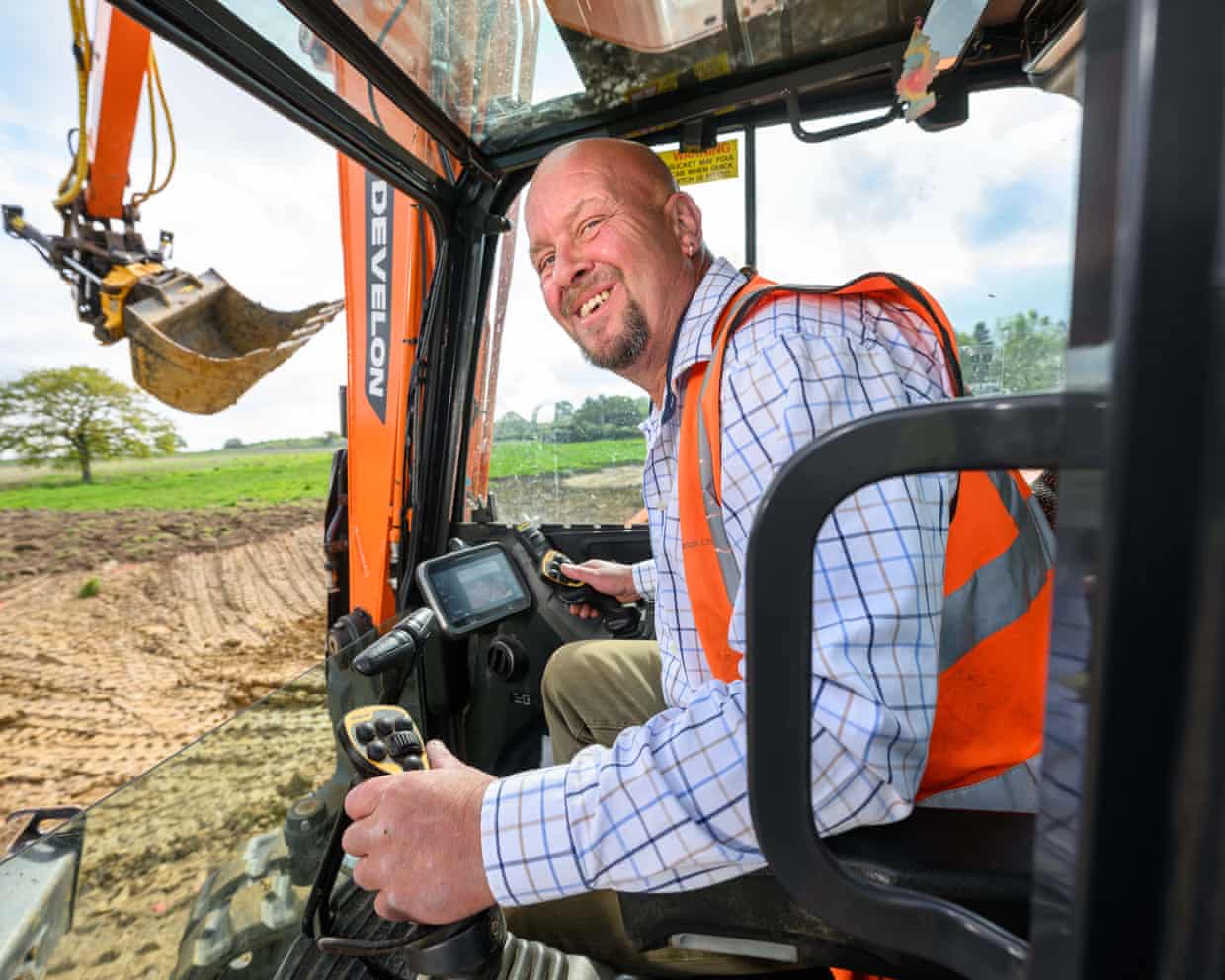
Photo: Adrian Sherratt/The Guardian.
Shaun Hancox, the “Picasso of Ponds,” says the excavator “becomes an extension of yourself, it just flows.“
I find the rewilding movement (taking developed land and returning it to nature) inspirational for several reasons. Of course it benefits the environment but it also reminds me that it’s possible for humans to reverse some of the damage they create.
Patrick Barkham writes at the Guardian about a guy in the UK who is using his golf-course building skills in a new way.
“He is known as ‘the Picasso of ponds’ but the tableaux being created by Shaun Hancox in a boggy field in Somerset currently looks more like a building site. An orange and black excavator is rhythmically removing lumpy clay soil and sculpting it into brown banks.
“The result looks like a scar of bare earth on what was once green pasture – but the magic happens as soon as rain fills the newly created depressions. Plants seed swiftly, invertebrates and amphibians rapidly find the water, and life explodes.
“Britain has lost at least 400,000 ponds over the past century, according to the Freshwater Habitats Trust. A similar number remain but many are overgrown, degraded or affected by nutrient pollution.
“Everyone realizes we’re in a sorry state with freshwater and it needs to be addressed,’ says Hancox, of Creative Wetlands, a contractor who has dug scores of new ponds for charities and rewilding projects across Britain.
“Hancox acquired his skills … digging landfill sites and golf courses for his family’s groundworks company. ‘My original job was a shaper on golf courses. We travelled all over, to Portugal, Germany, Belgium, building bunkers and drainage – everything really that wasn’t good for wildlife. I’ve always had a massive interest in wildlife, so we’ve got to the stage now where we want to put something back.’
“Building golf courses helped Hancox become a master of pond creation. … He says, ‘A golf ball rolls very much how water moves. When you’re putting in a wildlife pond, you look at the landscape and give your pond the best chance of holding water and doing what it should do. It’s the same if you’re doing a fairway – you want to shed the water or get it into a drainage system or into certain areas. The shapes of the ponds are almost golf course bunkers but in a more rustic, natural way.’
“At Heal Somerset, a 185-hectare (460 acre) former dairy farm being turned over to nature by the charity Heal Rewilding, Hancox is digging four new ponds, including one double-bowled pond 30 metres in diameter.
“The ponds are specifically for great-crested newts, which have been found in low numbers on the farm but have no suitable ponds in which to breed. Usually within a year of being created the ponds fill with aquatic life, including damselflies and dragonflies, and provide food and shelter for birds, from moorhens to house martins, who feed on the insects and use the pond-side mud to build nests.
“Crucially, these new ponds are not connected to any river system, which can wash nutrient-rich or polluted water into them. Instead, they are charged by clean rainwater or clean groundwater, enabling more delicate aquatic plants to thrive.
“Pete Case, of the Newt Conservation Partnership, says: ‘You can fiddle with rivers all you like but pond creation is the simplest and cheapest way of bringing clean water back to the landscape.’ …
“Case is full of praise for Hancox’s skills. The partnership, a coalition of the Freshwater Habitats Trust and the Amphibian and Reptile Conservation Trust, identifies new pond sites, builds and monitors them. It is funded by the NatureSpace partnership, whereby housebuilders pay to create replacement terrestrial wetland habitat or ponds that are lost or damaged by development. This project, which operates across 70 local authorities in England, ensures that any new pond habitat is maintained for 25 years, with the ponds inspected and the landowner receiving an annual payment to manage it.
“It guarantees that they will be suitable for newts in 25 years’ time,” Case says. The partnership assesses the surrounding land to check it will meet newts’ needs. ‘When it comes to newt conservation, everyone focuses on making a pond, but newts spend two-thirds of their life on land. If you don’t get that bit right, they aren’t going to do so well.’ “
Oh, my goodness! Don’t you love that there are humans who create and sustain an organization called the Newt Conservation Partnership?
More at the Guardian, here.


