Feeds:
Posts
Comments

Posts Tagged ‘expensive’

Photo: Sean Waugh.
NOAA’s National Severe Storm Lab has been looking into the hail problem.

Here’s my periodic reminder that cutting out funding for scientific research can affect your life. The important work of the National Severe Storm Lab of National Oceanic and Atmospheric Administration (NOAA) in Oklahoma is just one example of what may be lost.

Nick Gilmore at public radio WVTF in Virginia reported recently on NOAA’s research into hail.

“Just picture this – it’s a warm afternoon and a thunderstorm starts to roll overhead. You head indoors and hear rain begin to fall. As the cracks of thunder get louder, you peek out the window to see large chunks of ice on the ground. … Rain makes sense to fall from a storm – but large pieces of ice?

“ ‘Hail is one of those things that we don’t really know how it forms,’ says Sean Waugh, a research scientist at NOAA’s Severe Storms Laboratory.

“We do know some of the basics. Strong thunderstorms have strong updrafts – think like a vacuum cleaner that’s able to lift moisture high up into the atmosphere. It’s cold up there, so that water freezes into a small stone. It collects more water, refreezes as it cycles through the storm – more water, refreezes. … Eventually, the hailstone gets too heavy and tumbles to the earth below. Waugh says wind speed, direction and moisture in the air also play a part in hailstorm development.

We also know hail can be expensive.

“ ‘In any given year, it’s 60-80% of the damage that comes from severe thunderstorms,’ says Ian Giammanco – a meteorologist at the Insurance Institute for Business and Home Safety. He says we’re just getting more hailstorms these days.

“ ‘Rewind the clock all the way back to 2008 – every year since then, we’ve had over $10 billion in damage from hail. This has crept up now to a $20-30 billion problem.’

“Giammanco says that’s why research like what Sean Waugh is doing is so important – finding out what hail looks like before it hits the ground. …

“Waugh says, ‘We don’t know what broke when it landed, how much of that mass, or size or shape have we lost between when it fell and when we find it, right? I’ve seen six-inch diameter stones melt before I can get out of the car to pick them up.’ …

“There are other questions, too: how fast does hail fall? Does it fall in a specific orientation? Does the stone melt while it’s falling to the earth below?

” ‘These are all really, really important questions if you’re trying to ascertain what hail looks like to a radar. And that’s a really critical piece of knowledge if you’re trying to warn for hail in real time, which is obviously the goal! Most people want to know if there’s going to be golf balls falling at their house or softballs.’ …

“Waugh and his team have built a complex rig that observes hail in free fall and in real time. They head out from Oklahoma – typically to the Southern Plains – to get the system in front of a storm producing large hail.

“The rig has high speed and high-quality cameras, and Waugh says there’s another key component.

” ‘But we need a lot of light to do that. Otherwise, the image would just be dark,’ he explains. ‘So, the LED array I have on the back of the truck produces about 30% more light than the sun!’ …

“ ‘We can use that knowledge to improve our forecasts of what storms are likely going to produce hail days in advance. By understanding the type of hail that different storms produce, that increases our ability to model it properly and then forecast that in the future,’ Waugh says. ‘And that way people can take appropriate action to protect life and property.’ ”

More at public radio WVTF, here. Cool video of hail in flight.

I don’t get the funding cuts. The jobs that will be lost at the weather center are in Oklahoma, so it’s not just coastal communities that will be hurt. And anyway, don’t hurricanes damage golf courses in Florida sometimes? Weather is something no human can be the boss of, so it’s just common sense to try to understand it.

Please share your hail stories.

From the University of Oklahoma news site, OU Daily.

Read Full Post »

Photo: Bonfire Visuals/Greenville Journal.
Beautiful gowns are part of the competitive ballroom-dancing experience.

Do you ever watch ballroom competitions on television and wonder where the women get their amazing gowns? At the Washington Post, Cathy Alter provides an answer — for those who can afford it. The gowns are pretty expensive.

“It could be any house in suburban Annandale, Va.,” writes Alter, “among the split-level Colonials with manicured boxwood shrubs — except, around back, past the statue of the red fox and down some steppingstones, there’s a sign on the basement door to greet visitors: ‘You’re about to enter a sparkle splash zone. Twirling encouraged.’

“Inside, Julie Wilson runs a business here in the family home, known by those who need to know as Encore Ballroom Couture. It’s considered the ballroom dance industry’s leading consignment and consignment-rental dress company. Competitive dancers come here from far and wide, as do the frocks. The abiding aesthetic is more is more: feathers, sequins, fringe, crystals. …

” ‘Dancing With the Stars’ is scheduled to return to ABC’s prime-time schedule with its 32nd season this fall (after a sidestep to Disney Plus for a season); Bravo, in its endless hunt for reality-based drama and conflict among ambitious women and certain men, concluded its first season this summer of ‘Dancing Queens.’ …

“Fans of these shows, or just of the scene itself, may wonder where the gowns come from, or where they go after they’ve been worn. A good place to start is here in Wilson’s basement empire.

“Wilson danced competitively for 20 years, which included a decade as an instructor. She was a pageant queen, too. (Ms. Virginia; Ms. Ireland USA.) The years went by, and her closets bulged with the glimmering evidence of moments in the spotlight. There was no place for the family to keep winter coats. Wilson remembers when her mother, Brenda, had enough: ‘She said, “Julie, you need to do something about this.” ‘

“Wilson, 44, says it was hard to part with her girls. (Gowns, in this community, are all female.) ‘I didn’t trust eBay to take care of my dresses,’ she says. Plus, the resale space for competitive ballroom dancing dresses was ‘a black hole.’

“Brenda Wilson, a retired OB/GYN nurse, and Julie, a government contractor, decided to open Encore, transforming the basement of the home they shared with husband and dad Walter into a dance destination. Chandeliers simulate the lighting of competition dance floors, white ostrich feathers are arranged in vases and a small refurbishing station stands ready for dresses that need a bit of first aid. Instead of nails and screws, small drawers contain a color spectrum of crystals.

“At first, Julie sold her own dresses. Then she sold her friends’ dresses. Fourteen years later, Encore has an inventory of around 450 dresses, consigned by dancers who retired, overhauled their image or whose closets needed some breathing room. Consignors get 60 percent of the sale price, which can be quite considerable; dresses here start around $4,000. Dress rentals begin at $300.

“One of the first girls Wilson resold that wasn’t her own belonged to Rose-Ann Lynch, a lieutenant colonel in the U.S. Marine Corps. … When Mike prepared to retire in 2005, Rose-Ann handed him a honey-do list, which included dance lessons. ‘I told him, “I don’t want you to lead if you don’t know where you’re going,” she says.

“The duo competed for the first time that same year and are currently the 23-time USA Dance Senior Amateur national champions, a category for people ages 55-64. Tight as drums, Mike and Rose-Ann make a compelling case that the fountain of youth can be found on the dance floor. A logistician by training, Mike possesses rational, chess-like strategies that come in handy on the dance floor. With multiple couples whirling and twirling at the same time, avoiding a collision is vital when the judges determine their final scores.

“Today, the Lynches have come to Encore Ballroom Couture in search of an American Smooth dress for Rose-Ann. A primer, for those who need one: Competitive ballroom dancing includes both American and International categories. American style includes Smooth (waltz, tango, fox trot, Viennese waltz) and Rhythm (cha-cha, rumba, swing, bolero, mambo); International is separated into Standard (waltz, tango, Viennese waltz, slow fox trot, quickstep) and Latin (cha-cha, samba, rumba, paso doble, jive).

“American Smooth and International Standard styles call for dresses with floats (think fluttery silks that move behind the dancer like wisps of steam), and Rhythm and Latin necessitate something shorter and sexier.

“In American Smooth, partners separate and dance side by side, a la Fred and Ginger, so dresses must look good both coming and going. In International Standard, the couples dance closely, so dresses need look amazing only from the back.

“If Rose-Ann finds a dress today, it will appear in one of the most important dance competitions of the year: the Amateur National Championship, next March in Pittsburgh. ‘I always like to be prepared for Nationals,’ she explains.” 

Yesterday I peeked in at a ballroom refresher class for folks in my retirement community. The couples looked pretty sedate. And there certainly weren’t any swirling gowns.

Nice photos and more than you ever wanted to know on this topic at the Post, here.

Read Full Post »

Photo: Lea Suzuki / The Chronicle.
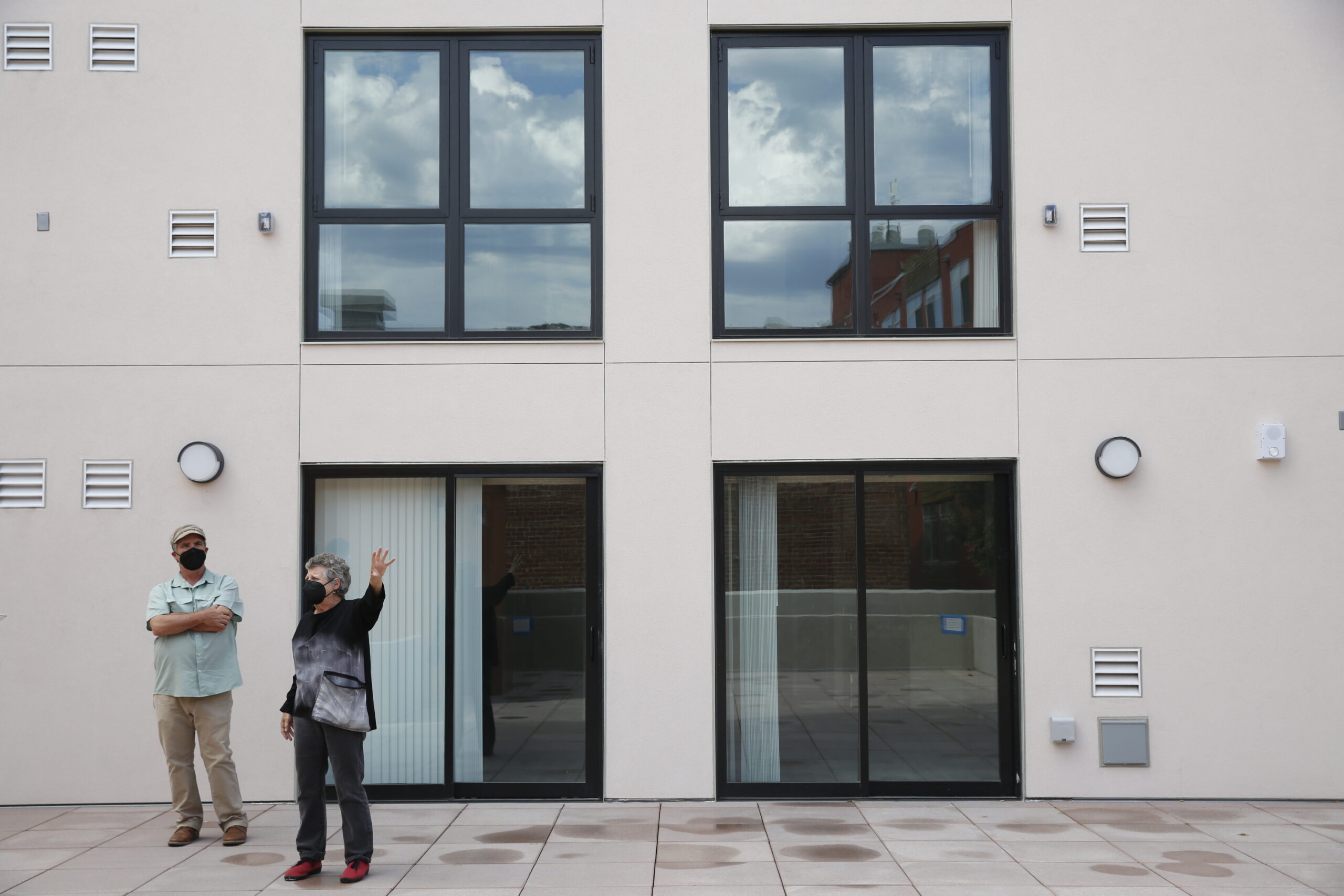
Mark Morrisette, facilities director, and Susie Medak, managing director of Berkeley Rep, at a building that will host performers in the pricey Bay area.

Every day, it seems, I read a story on how the current cost of housing affects a different group of people. Yesterday it was about elderly people in Rhode Island becoming homeless and advocates asking the governor to lift local restrictions to house them.

Today it’s about arts leaders using their characteristic creativity to figure out a solution for visiting performers in one of the most expensive regions in America.

Lily Janiak  reports at the San Francisco Chronicle, “Across the breezeway from Berkeley Repertory Theatre’s new Medak Center, fuchsia light from the set of the new musical Goddess streamed through an open loading bay door, like a portal to Narnia.

“Such a sight might frequently greet the company’s out-of-town actors, directors, designers and playwrights — as well as its fellows, Berkeley Rep’s interns — when they wake up each morning and walk next door to work from their new home.

“But the 42,885-square-foot, $26.2 million center, which plans to host a dedication ceremony on Sept. 3, isn’t just about short commutes. It marks a historic and visionary investment in artist housing in a region with ballooning real estate costs.

“Berkeley Rep’s outgoing managing director, Susie Medak, the center’s namesake and the driving force behind its construction, remembers when housing out-of-town artists cost the company $300,000 to $400,000 per year. These days it’s more like $2 million. Before the pandemic postponed the most recent season opening, Berkeley Rep had committed to paying for 7,000 nights at a nearby Marriott hotel for this past year. …

She remembers when housing out-of-town artists cost the company $300,000 to $400,000 per year. These days it’s more like $2 million.

“Assuring comfort and quiet was another objective for the Medak Center. In a university town, a living situation that looked promising during daylight hours might be beset by 3 a.m. parties.

“ ‘I can’t tell you the number of times we’ve had to move actors in the middle of a run,’ Medak said.

“The new center, located next door to Berkeley Rep’s Roda and Peet’s theater, has 45 units with capacity for 128 occupants. Fellows will share three-bedroom units. When Berkeley Rep’s not using those rooms, it plans to rent them to other nonprofits. …

“The building also features a classroom and a studio workshop space, which could host anything from movement classes to small experimental performances. … Other amenities include new storage space, a third-floor terrace with gardening beds for organic produce for residents, and a covered loading dock for the theaters so crews no longer have to load and unload sets while exposed to the rain.

“The building has key-card access, laundry on every floor and full kitchens in every unit. It’s also Gold LEED-certified for environmental efficiency.

“A trendy gray palette marks the interior. For one wall of the exterior, Berkeley Rep has commissioned a four-story mural by Oakland artist Cece Carpio to honor Ohlone peoples, on whose ancestral and unceded lands Berkeley Rep now sits.

“The theater has owned the property where the Medak Center was built since 1991, but for years it contained an empty lot and a warehouse. The project was a decades-long dream until Signature Bank helped finance it. The theater company finally broke ground in 2019.

“One comparable local facility is the San Francisco Conservatory of Music’s Ute and William K. Bowes Jr. Center for Performing Arts, which opened in 2020 and can house 400 conservatory students and 10 visiting artists, as well as 52 students from the San Francisco Ballet School. Those students pay for rooms, however, while Berkeley Rep’s fellows get free housing as part of their contract as workers.

“ ‘The Bowes Center brought together a range of our ambitions: positioning the institution right in the middle of Civic Center, providing much needed additional performance and teaching space, giving our students beautiful, safe accommodations in a place where they can work and live,’ said President David H. Stull.

“That meansfor example, a guest artist such as superstar Chinese pianist Yuja Wang might live and create and record music in the same building as students. …

“The San Francisco Ballet School has been able to increase student beds from 40 to 52 since the Bowes Center opened, said Jennie Scholick, director of education and training.  And now that students live right next to where they take classes, as opposed to a bus ride away in Pacific Heights, the school can accept younger students.

“At Berkeley Rep … the company’s first fellows [were] set to move into the new building Sept. 26, followed by visiting artists in Berkeley Rep’s Ground Floor program, and then the cast and creative team for Wuthering Heights later in the fall.

“The board’s commitment to the Medak Center through pandemic delays and uncertainty, Medak said, was ‘the greatest statement of our intent to exist on the other side of this pandemic. Building this building is a statement of optimism.’ ”

It’s not something every city will have the priorities or resources to tackle, but it’s an inspiring idea, don’t you think? More at the San Francisco Chronicle, here.

Read Full Post »