Feeds:
Posts
Comments

Posts Tagged ‘farmland’

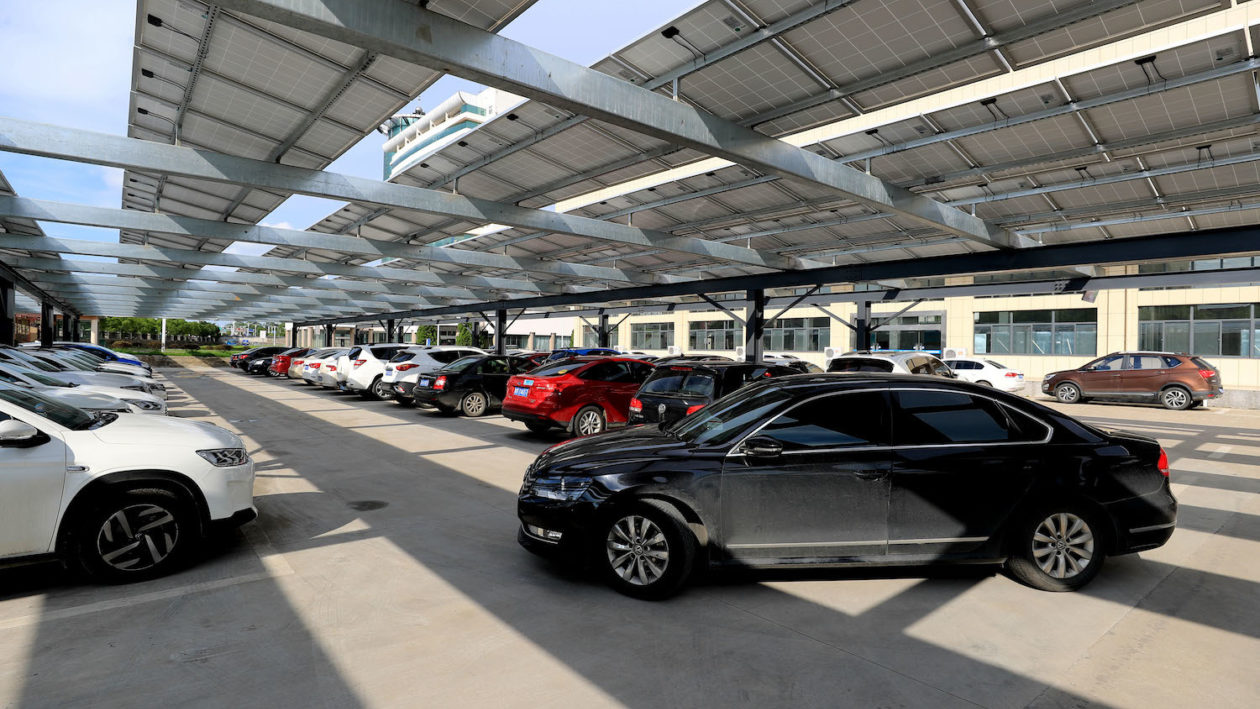
Photo: Imagine China via AP Images.
A solar-covered parking lot at the plant of Anhui Quanchai Engine Co., Ltd. in Chuzhou, China.

We have to keep a close watch on our innovations, even the ones we think are good. Take solar. Sometimes you read about aggressive solar companies decimating wooded lots to build an array. What? Trees are even better than solar at fighting global warming.

Let’s consider places where solar doesn’t harm anything. How about over a parking lot?

Richard Conniff writes at YaleEnvironment 360, “Fly into Orlando, Florida, and you may notice a 22-acre solar power array in the shape of Mickey Mouse’s head in a field just west of Disney World. Nearby, Disney also has a 270-acre solar farm of conventional design on former orchard and forest land. Park your car in any of Disney’s 32,000 parking spaces, on the other hand, and you won’t see a canopy overhead generating solar power (or providing shade) — not even if you snag one of the preferred spaces for which visitors pay up to $50 a day.

“This is how it typically goes with solar arrays: We build them on open space rather than in developed areas. That is, they overwhelmingly occupy croplands, arid lands, and grasslands, not rooftops or parking lots, according to a global inventory published last month in Nature. In the United States, for instance, roughly 51 percent of utility-scale solar facilities are in deserts; 33 percent are on croplands; and 10 percent are in grasslands and forests. Just 2.5 percent of U.S. solar power comes from urban areas.

“But that doesn’t necessarily make it smarter. Undeveloped land is a rapidly dwindling resource, and what’s left is under pressure to deliver a host of other services we require from the natural world — growing food, sheltering wildlife, storing and purifying water, preventing erosion, and sequestering carbon, among others. And that pressure is rapidly intensifying. By 2050, in one plausible scenario from the National Renewable Energy Laboratory (NREL), supplying solar power for all our electrical needs could require ground-based solar on 0.5 percent of the total land area of the United States … 10.3 million acres.

“Because it is more efficient to generate power close to customers, some states could end up with as much as five percent of their total land area — and 6.5 percent in tiny Rhode Island — under ground-based solar arrays, according to the NREL study. If we also ask solar power to run the nation’s entire automotive fleet, says Margolis, that adds another 5 million acres. It’s still less than half the 31 million acres of cropland eaten up in 2019 to grow corn for ethanol, a notoriously inefficient climate change remedy.

“The argument for doing it this way can seem compelling: It is cheaper to build on undeveloped land than on rooftops or in parking lots. And building alternative power sources fast and cheap is critical in the race to replace fossil fuels and avert catastrophic climate change. It’s also easier to manage a few big solar farms in an open landscape than a thousand small ones scattered across urban areas.

Despite the green image, putting solar facilities on undeveloped land is often not much better than putting subdivisions there.

“Developers tend to bulldoze sites, ‘removing all of the above-ground vegetation,’ says Rebecca Hernandez, an ecologist at the University of California at Davis. That’s bad for insects and the birds that feed on them. In the Southwest deserts where most U.S. solar farms now get built, the losses can also include ‘1,000-year-old creosote shrubs, and 100-year-old yuccas,’ or worse. The proposed 530-megawatt Aratina Solar Project around Boron, California, for instance, would destroy almost 4,300 western Joshua trees, a species imperiled, ironically, by development and climate change. … In California, endangered desert tortoises end up being translocated, with unknown results, says Hernandez. …

“The appeal of parking lots and rooftops, by contrast, is that they are abundant, close to customers, largely untapped for solar power generation, and on land that’s already been stripped of much of its biological value.

“A typical Walmart supercenter, for instance, has a five-acre parking lot, and it’s a wasteland, especially if you have to sweat your way across it under an asphalt-bubbling sun. Put a canopy over it, though, and it could support a three-megawatt solar array, according to a recent study co-authored by Joshua Pearce of Western University in Ontario.

“In addition to providing power to the store, the neighboring community, or the cars sheltered underneath, says Pearce, the canopy would shade customers — and keep them shopping longer, as their car batteries top up. If Walmart did that at all 3,571 of its U.S. super centers, the total capacity would be 11.1 gigawatts of solar power — roughly equivalent to a dozen large coal-fired power plants. Taking account of the part-time nature of solar power, Pearce figures that would be enough to permanently shut down four of those power plants.

“And yet solar canopies are barely beginning to show up in this country’s endless acreage of parking lots. The Washington, D.C., Metro transit system, for instance, has just contracted to build its first solar canopies at four of its rail station parking lots, with a projected capacity of 12.8 megawatts. 

“New York’s John F. Kennedy International Airport is now building its first, a 12.3 megawatt canopy costing $56 million. Evansville (Indiana) Regional Airport, however, already has two, covering 368 parking spaces, at a cost of $6.5 million. According to a spokesperson, the solar canopy earned a $310,000 profit in its first year of operation, based on premium pricing of those spaces and the sale of power at wholesale rates to the local utility.

“Rutgers University built one of the largest solar parking facilities in the country at its Piscataway, New Jersey campus, with a 32-acre footprint, an 8-megawatt output, and a business plan that the campus energy conservation manager called ‘pretty much cash-positive from the get-go.’ ”

Lots more info at YaleEnvironment360, here.

Read Full Post »

Upscale housing developers used to advertise tennis courts, pools, or golf courses as desirable amenities. Today they are increasingly likely to tout farmland.

Amy Hoak writes at MarketWatch about a family in suburban Chicago, where neighbors’ lawn chemicals have killed off pollinators. She reports that the Faheys are moving to a community that offers more opportunity for growing vegetables.

“Set in Hampshire, Ill., about 50 miles from downtown Chicago, Serosun Farms is a new home-conservation development, restoring wetlands, woodlands and prairie, and preserving farmland throughout. Already, the frog population has grown exponentially from the conservation work done onsite, and monarch butterflies are also on the rebound, said Jane Stickland, who is working on the project with her brother, developer John DeWald. Their efforts also are boosting the bee population. …

“Serosun plans to incorporate about 160 acres of working farmland, making farm-to-table a way of life for residents through regular farmer’s markets. The community also offers eight miles of trails, an equestrian center and fishing ponds: 75% of the development will be reserved for farming and open space. …

“The concept isn’t new, but ‘agrihoods’ are gaining in popularity, said Ed McMahon, senior resident fellow for the Urban Land Institute, an organization that focuses on land-use issues. He tracks about 200 agrihoods, where residential development coexists with farmland. …

“ ‘We started to realize you could cluster houses on a small portion of a farm and keep the farm working,’ he said. People were often drawn to the open spaces. More recently, however, there has been a huge interest in locally grown food. ‘All of a sudden, agrihoods have become a hot commodity in residential development,’ McMahon said.” More here.

This concept is not only for upscale developments. In urban neighborhoods without access to a local grocery or healthful food, affordable housing combined with community gardens and sales outlets are moving along without much fanfare. In Providence, for example, West Elmwood Housing Development Corporation‘s new Sankofa Apartments partner with the Sankofa Initiative, an outlet for homegrown food and handmade crafts from many countries. The initiative is satisfying to residents on a personal-development level and as a way to meet neighbors and build community.

Photo: J. Ashley Photography
Serenbe farmers’ market.

Read Full Post »

In a move that will benefit the environment, farmers are placing increased emphasis on the quality of their soil and cutting back on ploughing. It took a kind of soil evangelist to create the revolution.

Erica Goode has the story at the NY Times.

“Gabe Brown is in such demand as a speaker that for every invitation he accepts, he turns down 10 more. …

“Mr. Brown, a balding North Dakota farmer who favors baseball caps and red-striped polo shirts, is not talking about disruptive technology start-ups, political causes, or the latest self-help fad.

“He is talking about farming, specifically soil-conservation farming, a movement that promotes leaving fields untilled, ‘green manures’ and other soil-enhancing methods with an almost evangelistic fervor.

“Such farming methods, which mimic the biology of virgin land, can revive degenerated earth, minimize erosion, encourage plant growth and increase farmers’ profits, their proponents say. And by using them, Mr. Brown told more than 250 farmers and ranchers who gathered at the hotel for the first Southern Soil Health Conference, he has produced crops that thrive on his 5,000-acre farm outside of Bismarck, N.D., even during droughts or flooding.

“He no longer needs to use nitrogen fertilizer or fungicide, he said, and he produces yields that are above the county average with less labor and lower costs. ‘Nature can heal if we give her the chance,’ Mr. Brown said.” More here.

Sounds like wisdom that even a backyard farmer could embrace.

Photo: Brandon Thibodeaux for The New York Times
“My goal is to improve my soil so I can grow a better crop so I can make more money,” [says Texas farmer Terry] McAlister, who farms 6,000 acres of drought-stricken cropland. 


Read Full Post »

Good news for Letterbox Farm Collective in New York State! The environmental nonprofit Scenic Hudson’s interest in protecting a Hudson River tributary has enabled the young farmers to purchase land.

Scenic Hudson’s Jay Burgess writes, “Scenic Hudson has acquired a conservation easement protecting 62 acres of productive farm fields and watershed lands in Greenport, just south of the City of Hudson. The easement’s purchase enabled a group of young farmers who had been leasing the property to purchase it, securing the future of their farm operations.

“Known as the Letterbox Farm Collective, the farm partners supply specialty vegetables, herbs, pork, poultry, rabbits and eggs to a variety of regional and New York City markets — local bakeries and food trucks, many restaurants (including New York City’s renowned Momofuku restaurants) and two farmers’ markets. In the spring the farmers will launch a diversified Community Supported Agriculture (CSA) operation. …

“ ‘Achieving the goal of Scenic Hudson’s Foodshed Conservation Plan — meeting the growing demand for fresh, local food in the Hudson Valley and New York City — depends on successful partnerships like this, which provides a stable base of operations for the dedicated young farmers in the Letterbox Farm Collective. We also thank these farmers for enabling a future public access point to our protected lands along South Bay Creek, which present exciting opportunities for Hudson residents and visitors to enjoy the outdoors,’ said Steve Rosenberg, executive director of The Scenic Hudson Land Trust. …

“ ‘We were lucky to have Scenic Hudson with us while we gathered our financing and at the closing table when the moment came and we were able to buy our land,” said Letterbox’s Faith Gilbert.” More here.

Thanks to Sandy and Pat for letting me know and congrats to their niece for being successfully launched in farming.

Photo: Nathaniel Nardi-Cyrus

Read Full Post »

There are people who want to grow crops but have no land and people with arable land that lies fallow, and never the twain shall meet.

Oh, wait a minute.

“Susan and Paul Shay bought their four-acre dream spread years ago, with the idea of returning some of the land to farming,” writes Michael Prager at the Boston Globe.

“Meanwhile, when Seona Ngufor immigrated to America 10 years ago, she held onto the idea she would take up farming — as in her native Cameroon — if only she could get access to a farmable plot. …

“They were brought together by an unusual matchmaking service that uses geographic information system mapping data to pair would-be farmers with property owners who have extra land.

“The matching service is the work of the New Entry Sustainable Farming Project, a nonprofit organization in Lowell that trains farmers in organic growing and helps them find a plot to work. …

“New Entry uses GIS mapping data to screen for potential farm plots. The map sets contain a long list of criteria to distinguish individual parcels. … The system is so sophisticated it can pick out suburban homesteads with large patches of unused land, so New Entry was no longer limited to looking at obvious candidates, such as existing farms. …

“Once New Entry identifies sites, it approaches agricultural officials in the towns involved to work with landowners interested in turning over property to farmers.

“In Groton, for example, New Entry and the town’s agricultural commission hosted an information session with property owners. …

“ ‘There was a lot of information, a lot of resources,’ said Susan Shay, 63, a programmer and analyst at a medical malpractice insurer in Boston. …

Program director Rebecca Weaver “brought Ngufor, 56, who had taken the New Entry training program, to meet the Shays. …

“The Shays were so eager to see some of their land used for farming that they drove an easy bargain: rent of $1 a year, in exchange for a free go at whatever is growing.”

To see how New Entry’s maps identify potential farm space and to read the whole story, see the Globe article, here.

Photograph: Suzanne Kreiter/Globe Staff
Susan Shay (left) leased land she owns in Groton to Cameroon native Seona Ngufor for farming. Ngufor has just completed her first growing season.

Read Full Post »