Feeds:
Posts
Comments

Posts Tagged ‘feed the world’

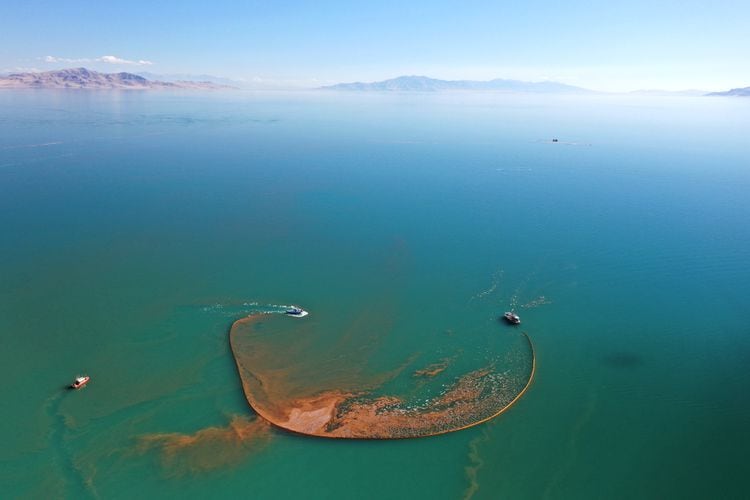
Photo: The Salt Lake Tribune.
Harvest watercraft encircle brine shrimp in Great Salt Lake using containment booms in preparation for harvesting.

Although today’s story about brine shrimp feeding the world is interesting in itself, the thing that stands out to me is thinking of Uzbek scientists. Uzbekistan feels so foreign to me, it’s like talking about scientists from the far side of the moon. That’s how limited my world view is, alas.

Here’s what Leia Larsen and Levi Bridges have to say at the Salt Lake Tribune about scientists in Uzbekistan and elsewhere who are studying brine shrimp.

“As the rising sun casts golden rays over the Aral Sea, a group of Uzbek fishermen wearing sweatshirts and knit caps gathered on a chilly beach to discuss the day’s plan.

“For two days they had waited in vain for brine shrimp. A dead calm in the first cold days of winter replaced winds that usually blow large slicks of the tiny crustaceans to shore.

“Standing and smoking cigarettes beside ramshackle cabins covered in sheets of plastic to keep out the elements, the fishermen debated whose turn it was to check if any shrimp had drifted in. Two volunteers jumped on a rattling old truck and chugged off miles into the distance to scour the beach.

“When the winds blow just right, Aral Sea fishermen work up to 36 hours gathering brine shrimp eggs, also known as cysts. They often labor with headlamps through the darkness. Winter temperatures can dip as low as minus 40 degrees Fahrenheit.

“ ‘Sometimes we get so sleepy you feel drunk,’ said Miyrbek Mirzamuratov, an Uzbek fisherman who has spent two winters gathering cysts on the Aral Sea.

“The Great Salt Lake remains the world’s largest source of brine shrimp cysts, exporting 40% of the global supply. The shrimp are a key food source used in aquaculture. Seafood is the main source of protein for billions of people across the planet, and aquaculture, fueled by brine shrimp, now produces roughly half of the world’s commercial seafood.

“But drought and decreasing water resources have put new pressure on brine shrimp in both Utah and Central Asia. In 2022, the Great Salt Lake’s shrimp populations almost collapsed due to record-low water elevation and spiking salinity.

“ ‘We’re all starting to realize just how much the lake touches us in many ways that we don’t appreciate,’ said Tim Hawkes, a former Utah state representative and current general counsel for the Great Salt Lake Brine Shrimp Cooperative. …

“Environmental challenges are also forcing scientists in Uzbekistan to devise ways to save their own brine shrimp – and help keep the world fed if Utah can’t ensure its own inland sea survives. Despite being too salty for fish, the Great Salt Lake’s aquaculture industry infuses Utah’s economy with up to $67 million each year, thanks to brine shrimp.

“That’s because their cysts, no bigger than a grain of sand, tolerate extreme conditions.

“ ‘You can boil them, you can freeze them, you can send them to outer space,’ Hawkes said. ‘And still, under the right conditions, if you put them in a little bit of salt water and give them some light, they’re going to hatch out.’

‘It makes brine shrimp cysts an ideal product to package and ship across the world, where they’re raised as an essential food source for the farmed seafood humans eat, particularly prawns and cocktail shrimp.

“Although farm-raised seafood has generated controversy due to its runoff pollution and impacts to wild fisheries, the United Nations issued a 2020 report identifying it as a critical player in global food security. It provides nutritious protein at low cost to rural and developing communities that have a hard time producing other farmed goods. …

“Globally, the average person ate 44.5 pounds of seafood in 2020, up from 31.5 pounds in the 1990s, according to the U.N. More than half of that came from farms.

“ ‘If we lost the Great Salt Lake,’ Hawkes said, ‘or we lost the ability to produce brine shrimp from the Great Salt Lake, it would have a significant impact on our ability to feed the world.’ …

‘Companies on the Great Salt Lake gather brine shrimp cysts from the water with boats and floating booms similar to those used to contain oil spills, but the work is still mostly done by hand in Uzbekistan and other Asian countries. …

‘Islambek Shumomurodov said he earns about $1.50 for every pound of Aral Sea cysts he gathers. The average annual household income in Uzbekistan is around $1,600. ‘Some people even buy new houses and cars from working here,’ Shumomurodov said.

“Although Uzbekistan’s brine shrimp production represents just a fraction of Utah’s output, the crustaceans created an economic opportunity after the Aral Sea’s traditional fishery shriveled.

“The Aral Sea, like the Great Salt Lake, has declined significantly from agricultural demand and human water consumption. Once a freshwater lake teeming with fish, the Uzbek portion of the Aral turned saline — a trend scientists don’t expect will change.

“Neighboring Kazakhstan spent millions damming off their portion of the North Aral Sea to keep the freshwater fishery viable. Brine shrimp, which likely hitchhiked to the region as cysts stuck to the feathers of visiting shorebirds, are the only creatures with commercial value able to survive in the shrinking southern Uzbek portion of the lake. …

“ ‘It’s just a matter of years now before [the Uzbek side of] the Aral Sea can no longer support brine shrimp,’ said Ablatdiyn Musaev, a biologist at the Uzbek Academy of Sciences.”

More at the Salt Lake Tribune, here. No firewall. Nice photos. There’s an audio version of the story at PRX’s The World.

Read Full Post »

Photo: Kurt Stüber.
Some amaranth species are cultivated as leaf vegetables, says Wikipedia. The Guardian adds, “The plant is indigenous to North and Central America but also grown in China, India, Southeast Asia, West Africa and the Caribbean.”

Here are a couple stories on plants that may hold the potential to feed the world. One is the amaranth; the other is a bioengineered wheat grass called kernza. Pretty sure that one will not go over well with the non-GMO crowd.

Cecilia Nowell reports on amaranth at the Guardian, “Just over 10 years ago, a small group of Indigenous Guatemalan farmers visited Beata Tsosie-Peña’s stucco home in northern New Mexico. In the arid heat, the visitors, mostly Maya Achì women from the forested Guatemalan town of Rabinal, showed Tsosie-Peña how to plant the offering they had brought with them: amaranth seeds.

“Back then, Tsosie-Peña had just recently become interested in environmental justice amid frustration at the ecological challenges facing her native Santa Clara Pueblo – an Indigenous North American community just outside the New Mexico town of Española, which is downwind from the nuclear facilities that built the atomic bomb. Tsosie-Peña had begun studying permaculture and other Indigenous agricultural techniques. Today, she coordinates the environmental health and justice program at Tewa Women United, where she maintains a hillside public garden that’s home to the descendants of those first amaranth seeds she was given more than a decade ago. …

“Tsosie-Peña and her guests spent the day planting, winnowing, cooking and eating them – toasting the seeds in a skillet to be served over milk or mixed into honey – and talking about their shared histories: how colonization had separated them from their traditional foods and how they were reclaiming their relationship with the land.

“Since the 1970s, amaranth has become a billion-dollar food – and cosmetic – product. Health conscious shoppers embracing ancient grains will find it in growing numbers of grocery stores in the US, or in snack bars across Mexico, and, increasingly, in Europe and the Asia Pacific. As a complete protein with all nine essential amino acids, amaranth is a highly nutritious source of manganese, magnesium, phosphorus, iron and antioxidants that may improve brain function and reduce inflammation.

“ ‘This is a plant that could feed the world,’ said Tsosie-Peña. …

“ ‘Supporting Indigenous people coming together to share knowledge’ is vital to the land back movement, a campaign to reestablish Indigenous stewardship of Native land, and liberation of Native peoples, Tsosie-Peña said. ‘Our food, our ability to feed ourselves, is the foundation of our freedom and sovereignty as land-based peoples.’ …

“Amaranth is an 8,000-year-old pseudocereal – not a grain, but a seed, like quinoa and buckwheat – indigenous to Mesoamerica, but also grown in China, India, south-east Asia, west Africa and the Caribbean. Before the Spanish arrived in the Americas, the Aztecs and Maya cultivated amaranth as an excellent source of proteins, but also for ceremonial purposes. When Spanish conquistadors arrived on the continent in the 16th century, they [feared] that the Indigenous Americans’ spiritual connection to plants and the land might undermine Christianity. …

“Although the Spanish outlawed amaranth when they arrived in Central America, Mexico and the south-western United States, Indigenous farmers preserved the seeds – which grew with remarkable resilience. …

“While amaranth is no longer banned, Tsosie-Peña says ‘planting it today feels like an act of resistance.’ Reestablishing relationships with other Indigenous communities across international borders is part of a ‘larger movement of self-determination of Indigenous peoples,’ she says, to return to the ‘alternative economies that existed before capitalism, that existed before the United States.’ …

“Every year … farmers with [a Guatemalan agricultural community called Qachuu Aloom, or ‘Mother Earth’] have traveled to the United States to share their knowledge of amaranth with predominantly Indigenous- and Latino-led gardens. … In 2016, when Tsosie-Peña and her colleagues at Tewa Women United broke ground on their public garden in Española, Qachuu Aloom was there to plant amaranth once again. …

“Tsosie-Peña says that this exchange between North and Central American farmers isn’t just about amaranth as a crop; it’s also about reconnecting to ancient trade routes that have been disrupted by increasingly militarized borders.

“Maria Aurelia Xitumul, a member of Qachuu Aloom since 2006 who has traveled on exchanges to California and New Mexico, echoes Tsosie-Peña.

‘The goal is to share experiences, not necessarily generate income, like capitalists. What we want is for the whole world to produce their own food. … For the seeds, distance doesn’t exist. Borders don’t exist.’ …

“The week before the emergency declaration of the pandemic Tsosie-Peña was in Guatemala. When international borders began closing, she had to rush home to the United States. But a few months ago, after vaccines were widely distributed in the US, she and a handful of delegates from each of the farms that had begun planting Qachuu Aloom’s seeds traveled back to Guatemala. With them, they brought seeds from the amaranth they had each grown in their home gardens … to plant in a shared plot: a kind of solidarity garden.

“ ‘We’ve always viewed our seed relatives as relatives and kin,’ says Tsosie-Peña. ‘We have co-evolved with them as fellow Indigenous peoples of this place.’ ”

More at the Guardian, here.

Meanwhile another plant that’s supposed to feed the world was described recently at the Washington Post. Sarah Kaplan reported on kernza, “a domesticated form of wheatgrass developed by scientists at the nonprofit Land Institute. … A single seed will grow into a plant that provides grain year after year after year. It forms deep roots that store carbon in the soil and prevent erosion. It can be planted alongside other crops to reduce the need for fertilizer and provide habitat for wildlife.” More on kernza here.

Read Full Post »