Feeds:
Posts
Comments

Posts Tagged ‘filmmaker’

Photo: Kat Baulu/Wikipedia.
Alanis Obomsawin in photo of the crew of Canadian film
Waseteg, 2010.

What caught my attention in one story about Alanis Obomsawin was that when an instagrammer I follow went to a dinner with the filmmaker, the 91-year-old prepared the food herself. That is, she’s still going strong.

CBC Radio interviewed Alanis Obomsawin not long ago in an episode produced by Nicola Luksic.

“At the age of 91, prolific Abenaki artist and filmmaker Alanis Obomsawin is not slowing down. For nearly 70 years, her storytelling and documentary work has served as a mirror for Canada, vividly capturing and reflecting Indigenous experiences, providing a space for all Canadians to witness perspectives that have otherwise been suppressed and ignored.

“Obomsawin talks about her life’s influences and the quiet power of listening in her 2023 Beatty Lecture at McGill University.

” ‘I continue making documentaries. In those days, everything was so full of pain and danger. It was hard for our people to imagine change,’ she told an audience at Pollack Hall on McGill’s downtown campus. ‘My dear brothers and sisters, we are all born with a gift. And to each one of you. Your life is sacred. You must change the perspective from limitations to all is possible. Slowly change came.’ …

“Making documentaries was a way to provide a space for Indigenous experiences that would otherwise go unseen and unheard, nurturing better Indigenous and settler relations. …

“After her Beatty Lecture, the legendary documentary filmmaker and artist spoke to IDEAS host Nahlah Ayed. …

Nahlah Ayed
“You said that you see this as a moment when all is possible. Can you speak a bit more about you know, you’ve seen a lot of change in the relationship between the Indigenous people of this country and the settlers on this land? 

Alanis Obomsawin
“I think that it didn’t happen overnight. It’s been very bad for many generations. And part of that is why I’m still here, because I really believe what is possible. But the extraordinary thing, like let’s say even 10 years ago, I could not have talked the way I do now.

“For instance, if you’re in conversation with anybody from anywhere, if you mentioned the word treaty, the reaction I know with me was all, ‘Oh, that doesn’t even exist anymore. No, there’s no treaty.’ And it really annoyed me. Something awful. But I made a film called Trick or Treaty. That tells you a lot. And since then, it is very much used at all levels. …

Ayed
“What’s changed? 

Obomsawin
“I think the educational system has changed. For many generations, the books that were used in places were called The History of Canada, written by the brothers of the Catholic Church, which was pretty ugly, full of lies and designed to create hate towards our people. I was getting beat up all the time as a child. When I figured it out, I thought if the children could hear a different story, they wouldn’t be like that. They’re not born racists. And that’s when I started singing and it took quite a while to get to that point. But telling stories to children. I’ve done hundreds of schools over the years, and I still do whenever I can. …

“I can say that now I can see Canada is at the front for a lot of things concerning education. So then this is a big change. And I don’t want anybody who is making the changes to get discouraged. I want to praise them because I see the difference. And I think I’m lucky to have lived this long to see the difference. …

Ayed
“What do you look forward to as evidence of a genuine attempt at truth and reconciliation in Canada?

Obomsawin
“Well, you’re not going to believe me, but it’s happening. I don’t know what exactly it will come to. And I never thought that, for instance, I could be part of a group with the government that we criticize and you know, they’re listening. We have some of our own people who are working there [in government]. There are the possibilities and the strength is there. I’m not saying it’s going to happen tomorrow, but we work on it.” More at CBC Radio, here.

This post about Obomsawin was inspired by Eve Respini (Curator_on_the_Run), who wrote at Instagram: “Honored to be invited to dinner at home with 91 year old legend, film-maker, singer and activist #alanisobomsawin. She cooked us (colleague @sirishr and I) a wonderful meal, serenaded us with songs and stories, and reminded us to cherish the sweet moments in life. Merci Alanis.”
Read Full Post »

Photo: Francesca Magnani.
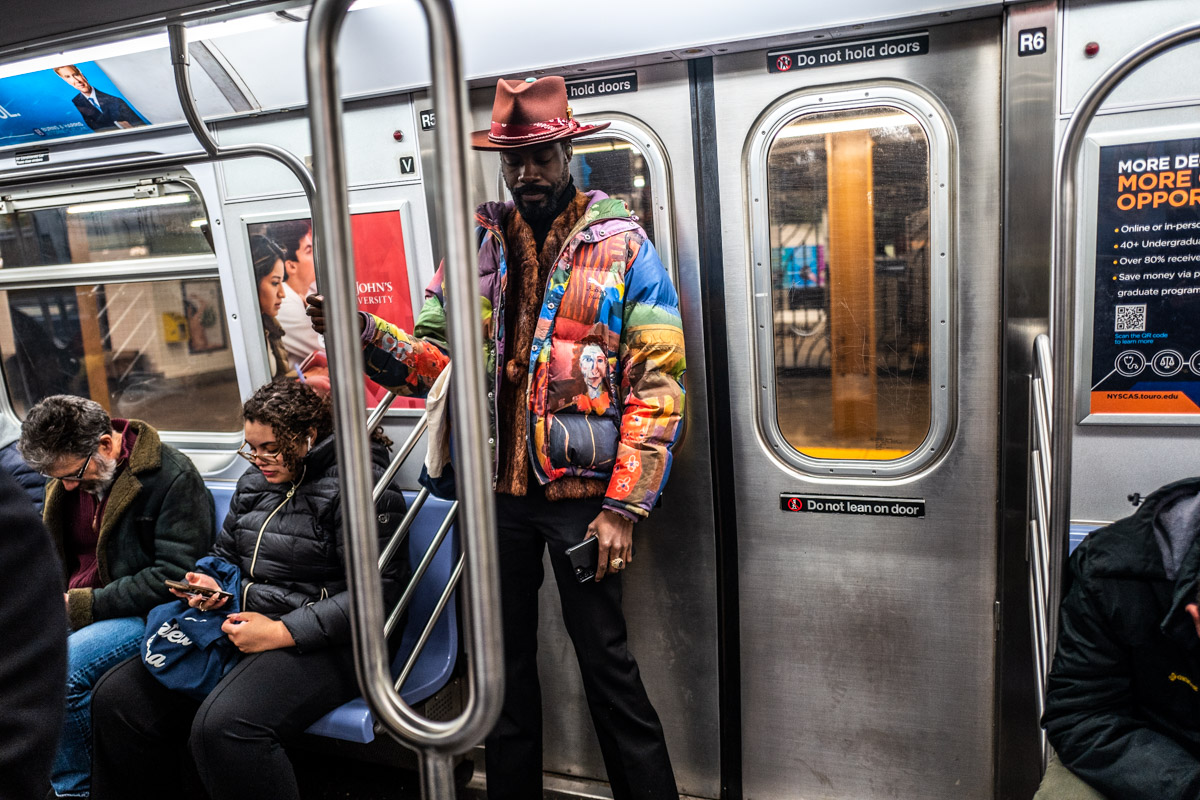
Film- and hat-maker Richard Faison on the G train in Brooklyn. A photographer’s chance encounter on the subway led to this story.

Do you notice how very creative people are good in almost any field calling for creativity? I have a friend like that who takes classes in many kinds of art and always does a nice job even if she is never going to make that particular skill her main thing.

Photographer Francesca Magnani wrote recently at the art newspaper Hyperallergic about a filmmaker who became a creative haberdasher.

“One December morning, among the sparse riders waiting for the G train in Brooklyn, New York, I saw a tall Black man with a colorful jacket and a cowboy hat. I took some photos as I introduced myself to Richard Faison. ‘I am also an artist and I actually made this hat,’ he told me. 

“A few weeks later, a friend who was visiting from Florence casually mentioned she wanted to buy a hat while here, and I arranged to see Faison in his lab, which turned out to also be his apartment. The one-bedroom apartment was filled with dozens of hats at various stages of existence and along with my friend Michèle’s green hat, two more were being ‘blocked’ and were drying by the window. On the wall was hanging a shtreimel, the first one that Faison made: these hats, traditionally worn by Orthodox Jewish men, were in fact his specialty.

“Sitting down with Faison on his sofa on that day, and once again more recently, I asked him some questions. Our conversations have been edited and condensed for clarity.

Francesca Magnani: You used to be a filmmaker. How did you become a milliner?

Richard Faison: I went to a small program at NY Film Academy for eight months. I started doing film by carrying around my mom’s video camera and shooting all my friends and my adventures, editing cool videos and creating a series that got pretty popular on Facebook. That led me to make music videos. I went to Toronto after meeting a few artists out there, and I became an editor and cinematographer for short films and documentaries.

“I started making hats legit by coincidence. I was friends with a Hasidic gentleman, Lov, and he came by my place for some drinks with friends. He said, ‘You always wear cool hats, you should work with a guy I sell fur to.’ That’s how I met my mentor and this entire adventure started.

FM: How do the two worlds, film and millinery, work in synergy?

RF: They are similar. You have to have an eye and a certain aesthetic that you want your pieces to have. The vision I see of a hat is like how I used to envision how I wanted certain shots to look like before going out to shoot, and just creating something with a story that people can either relate to or admire.

FM: You started your own business just a few months ago, last September. How did you build your own company, Oliver Lewis Hats?

RF: My mentor helped me: I worked for him in Williamsburg, Brooklyn, for about three years. The day I asked for a second raise, he took me on a long car ride and looked me directly in the eyes. He said, ‘You are a true artist with your hands, but I’ll never pay you what you deserve.’ Those words were the most beautiful and hurtful I’ve heard in one sentence. After that, he got me my first hat body and told me where to get more, and I took off running.

FM: Coming from a background in filmmaking, are there artists and directors you look to for inspiration?

RF: My number one influence would have to be Jimi Hendrix. His style, his grace, the chances he took, how groovy he was, everything! I used to watch his old concerts and get lost in his rhythm and clothing choices. The second is André 3000 of Outkast. I moved to Atlanta in 2003 for high school. I remember getting bullied for wearing tight jeans back then but then I would look at the shirts, pants, and hats André 3000 would wear, and it gave me the confidence to be myself no matter what others thought. …

RF: I reach my customers best through Instagram, where I can show my skills through video reels and also communicate directly with my audience. I have an even number of male and female clients — the age range is usually 30 to 40. …

FM: You said you devised your own gluing technique for shtreimels; you use as ornament some Swiss figurines usually found in ‘Swiss cowboy’ belts, and the name of your business comes from Oliver Lewis, the first Black jockey to win the Kentucky Derby. How do influences from different cultures inform your creations? 

RF: Influences are how I came to be. They’re the essence behind my entire being and work. Growing up in Brooklyn, I had so many cultures surrounding me that would impact me. My dad being from Trinidad and being a huge cowboy lover was one of the biggest for me. I watched Clint Eastwood movies with him and thought cowboys were the coolest people on earth. Then I found out that most cowboys were actually Mexican and Black and that piqued my interest. … I get a lot of inspiration from the Italians in NYC (such smooth style!), Jamaicans, and Hispanic communities. The melting pot in Flatbush helped me create my unique style.”

Need a hat? Or do you “already have all” your hats, as they used to say of the ladies in Boston? Check out Oliver Lewis Hats on Instagram.

More at Hyperallergic, here. No firewall. Lots of cool photos.

Read Full Post »

Photo: Bettmann Archive/Getty Images
Though her works have largely been lost, Lois Weber made at least 138 films before 1940 — many of which addressed social issues like capital punishment, urban poverty and birth control.

Early movies were made of highly flammable nitrate, which is one reason many have not survived. In the case of the filmmaker Lois Weber, another reason might have to do with being a woman.

Howie Movshovitz reports at National Public Radio [NPR], “As Hollywood continues to struggle with the underrepresentation of women behind the camera, most people have forgotten that 100 years ago, one woman ruled.

“Her name was Lois Weber. Counting shorts and feature-length movies, she directed at least 138 films — all before 1940. She became the first American woman to direct a feature-length dramatic film with The Merchant of Venice in 1914.

” ‘In her day, she was considered one of the three great minds of the early film industry, alongside D.W. Griffith and Cecil B. DeMille,’ says Shelley Stamp, a film historian at the University of California, Santa Cruz.

“Today, most of her works are virtually impossible to see. But two of her most important films have now been restored and released to theaters and on disc.

“Shelley Stamp wrote a book about Weber and the notes for the new DVDs. She says the filmmaker often took a different tack from her contemporaries.

” ‘She was a very vocal advocate for cinema’s ability to portray complex social issues in a popular narrative form,’ Stamp says. ‘She considered cinema what she called “a voiceless language.” And by that I think she meant cinema had an ability to convey ideas to anybody, regardless of their educational level, regardless of their command of English, right, at a period when there were many immigrants to the U.S. who did not speak English as a first language.’

“Weber was born in 1879 outside Pittsburgh to a religious middle-class family. She was a child prodigy pianist who spent two years playing organ and evangelizing around the city.

” ‘She started preaching on shop corners, and when she went to New York, she started working at these Salvation Army-type places to help people,’ Dennis Doros says. With his wife Amy Heller, Doros co-founded and runs Milestone Films, which is releasing the restored version of Weber’s movies. ‘She was never really a preacher, but she was always an activist for the poor.’ …

“Before she became a filmmaker, Weber left evangelizing to tour the country as a concert pianist — until one night a key broke and shattered her nerve to perform. She left the concert stage for the theater stage, and eventually directed her first short film in 1911.

“From early on, she advocated for complex roles for women and for serious engagement with social issues. According to Stamp, Weber made films about the fight to abolish capital punishment, about drug addiction, about urban poverty, about the campaign to legalize contraception.

“Weber took up the cause of young women going to work in her 1916 film Shoes, which has been released by Milestone with a new score. …

“The same year that Weber wrote and directed Shoes, she was entrusted with Universal Pictures’ anchor film, The Dumb Girl of Portici (dumb as in mute). It stars internationally famous Russian ballerina Anna Pavlova in a sweeping historical epic.”

More at NPR, here. I was sad to read this part: “Lois Weber died penniless in 1939. Friends paid for her funeral.”

Read Full Post »

Although Ginia Desmond had been writing scripts for 12 years, she had never made a movie. Now at 74, she has risen to the challenge.

Johanna Willett writes at the Arizona Daily Star, “Ginia Desmond had a decision to make. Buy a house. Make a movie. Buy a house. Make a movie. She made a movie.

“The 74-year-old has been writing scripts for a dozen years, but ‘Lucky U Ranch’ is her first feature-length film to make it to the big screen.

“That’s because she funded it.

” ‘I consider myself the writer,’ she says of the low-budget film, which so far isn’t readily available for viewing. ‘I wrote the script, and I wrote the checks.’

“Writing screenplays is not Desmond’s first career — or even her second. This act follows others that starred Desmond as a mother and wife, professional artist and businesswoman. …

“For almost 30 years, she imported goods such as furniture and baskets to sell in her Tucson store Sangin Trading Co. on Sixth Avenue. She sold the business in 2003. …

“ ‘Ginia is an interesting combination of very creative and very practical,’ says Victoria Lucas, a Tucson screenplay consultant with a 20-year career in Los Angeles.

” ‘She has that sense of the big picture and how a business is run, and with her writing skills and talent, she has the ability to understand characters. … Very few writers write visually so that when you read the script, it’s like you have seen the movie. … Ginia writes like that. She has a real gift for getting under the skin of characters and making the reader or audience understand them. … She is a treasure for Tucson.” Read more here.

Thank you, Cousin Claire for posting the story on Facebook. Like Desmond, Cousin Claire lives in Tucson, and she has at least one script stored away somewhere about an adventurous female ancestor. I read it. And I know for a fact she is under 74, so …

Photo: Kelly Presnell/Arizona Daily Star
Ginia Desmond, 74, is reflected in her movie poster’s glass.

Read Full Post »

Photo: Greenfusefilms.com

Vanessa Gould, the sister of one of Suzanne’s elementary school buddies, is a documentarian. A while back, she made a Peabody-winning film about makers of advanced origami called Between The Folds. More recently, she was given unheard-of access to the New York Times obituary desk.

Her parents just sent an e-mail about the resulting movie and what Vanessa has been up to in general.

“Vanessa recently worked on Showtime’s Years of Living Dangerously, a nine-part series tackling the challenges of climate change. … Vanessa was a producer on several of the stories and did additional cinematography on others. You can see most of her work in episodes three (“Super Storm Sandy”) and nine (“Chilean Andes”). Episode three, “The Rising Tide” with Chris Hayes, airs tonight, Sunday, April 27, at 10 pm on Showtime. … Here are links: http://www.yearsoflivingdangerously.com and https://www.facebook.com/YearsOfLiving. …

“Soon after making Between The Folds, one of the artists in the film passed away. Vanessa alerted the Times of his death, aware that it was unlikely they would run an obituary. And yet – somewhat amazingly – they did, and she assisted them in the unusual process of putting together an editorial obituary. Only three or four such obituaries are written by the NYT staff each day. The whole story of how these obituaries are selected and written, as well as the social history they tell, became her fascination. Hence OBIT will be her next film. Check out these links: http://www.obitdoc.com, http://www.greenfusefilms.com, and www.vanessagould.com.”

I wonder if OBIT will show to what extent the obituaries of famous people are written before they shuffle off this mortal coil. Come to think of it, do any newspapers let people submit their own obit in advance? I recently read a hilarious one that a small paper accepted from the deceased at the insistence of his grandson. It revealed a guy with a terrific sense of humor — not a bad tribute.

Read Full Post »

The online magazine Salon has a story this month about New Guinea tribe members taking up Facebook.

Anthropologist and filmmaker Jonnie Hughes writes, “Ping!  The other day, I got a Facebook friend request in my in box. … Intrigued, I opened it up, to find that this was no ordinary future friend (from the past) – it was a man I’d met while making a film about a tribe from the Sepik Valley in Papua New Guinea. It was a man who was born and raised in a remote hunter-gatherer society, where, to this day, the women spend their time searching out wild sago palms in the swamps to pulp into flour for pancakes, and the men hunt monstrous saltwater crocodiles in tea-colored jungle rivers at night with nothing more than spears. My new Facebook friend no longer joins these hunts – he’s an elder and has managed to find some income in the embryonic Sepik tourist industry …

“I’ve long since ceased to view the cultures of the Sepik tribes with the romantic and naive preconceptions that we in the West routinely assign to hunter-gatherer societies. I know, from having lived with these people in their magnificent A-frame stilt houses, that Sepik tribes are as modern a group of people as any of us – people who, like you and me, must constantly interrogate and adapt the culture they have inherited so that it best suits the changing world about them.  But even I was astonished to discover that a community that only recently learned that arrows could fly better if they had feathers on their shafts was now into Facebook.” Read more here.

This lead came from ArtsJournal.com.


Read Full Post »