Feeds:
Posts
Comments

Posts Tagged ‘salon’

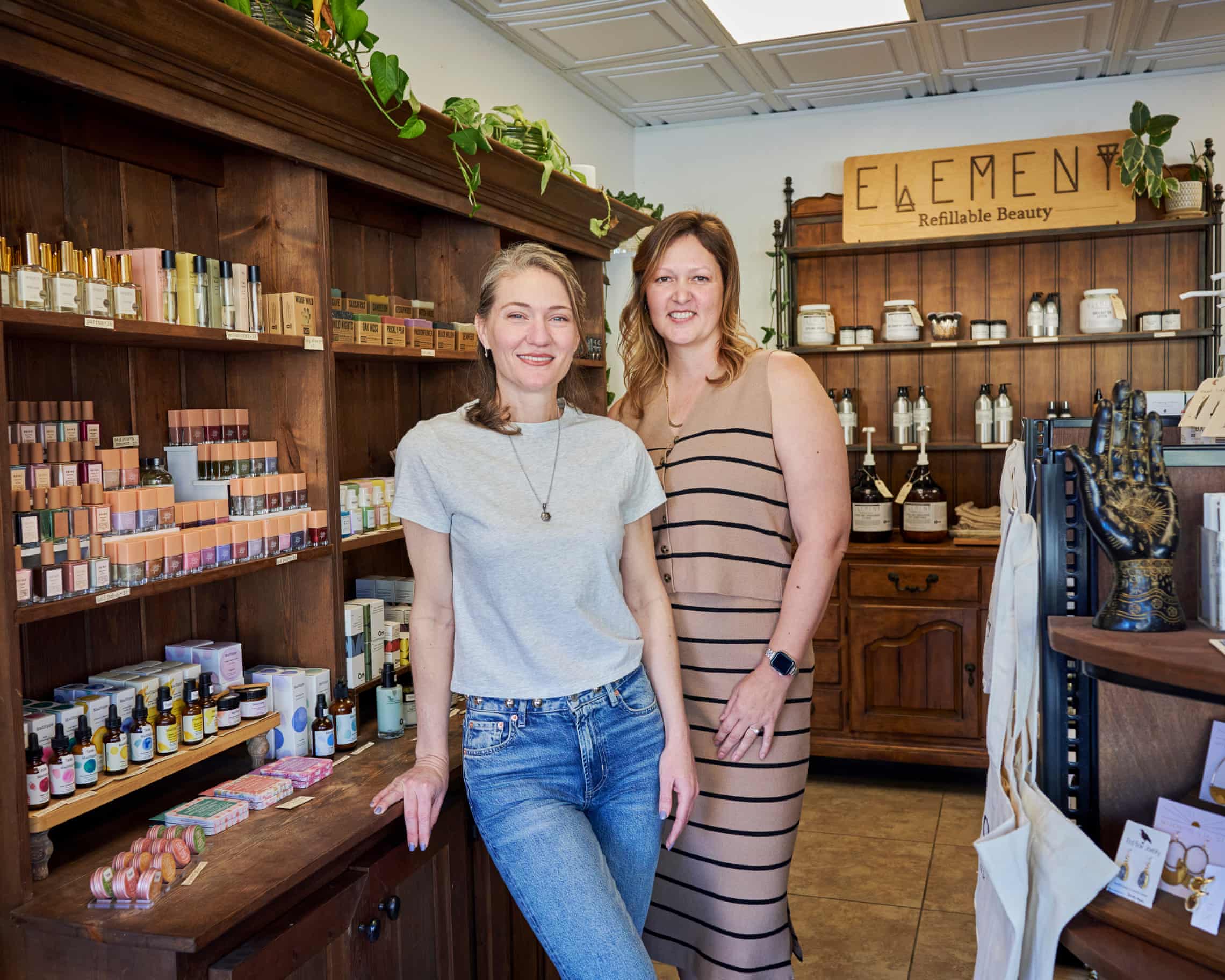
Photo: John Francis Peters/The Guardian.
Easton Basjec and Melissa Parker, founders of Scisters Salon & Apothecary in San Diego, California, on 18 March 2026. Together, they’re showing how salons can help the environment rather than contribute to waste.

My hairdresser is very thoughtful in her daily life about health and the environment. Of course she knows that there are an awful lot of unhealthful chemicals in the salon business. I wonder if the owner of her workplace would be up for making a switch like the San Diego salon in today’s story did.

Michaela Haas writes at the Guardian, “The first thing you notice when you walk into Scisters Salon & Apothecary is what isn’t there. No wall of glossy plastic bottles. … No sharp chemical tang or aerosol haze. The only trash can is a tiny basket that mostly collects coffee cups and gum wrappers clients bring from home.

“Instead, the shelves of this southern California salon are lined with large refill containers of shampoo and conditioner, houseplants dot the space, hair clippings are swept away for compost, and the air carries a trace of bergamot and vanilla.

” ‘It’s the smell people comment on straight away,’ says co-founder Melissa Parker. ‘They walk in and say: “It smells good in here.” ‘ …

“Parker and her co-founder Easton Basjec opened Scisters 15 years ago in a strip mall in La Mesa, about 9 miles east of San Diego. Since then, they’ve built it into one of the region’s most prominent low-waste salons, diverting, they say, up to 99% of its refuse from landfills.

“The beauty sector is a dirty business. Salons in North America send an estimated 63,000 lbs of hair to landfills every day, along with hundreds of tons of used foil and leftover hair dyes, according to Green Circle Salons, a Canadian recycling and recovery organization. On top of that, many products used in salons contain chemicals like formaldehyde and lye that carry potential health risks.

“But Parker and Bajsec have staked their business on the idea that beauty doesn’t have to come at the expense of the planet – or the people in the salon.

“The two business partners, both native to San Diego’s East county, met while working at another salon before attending business school together at a local community college. In 2010, they opened their own seven-chair salon and named it Scisters in a nod to their close friendship.

“For years, the business – which has seven employees and serves up to 22 customers a day – operated much like any other boutique salon, carrying more than 150 products from a large corporate brand and offering the full range of services. …

“The turning point came several years later, after Bajsec watched a documentary about the zero-waste movement and began questioning the beauty industry’s environmental footprint. Around the same time, Parker developed serious health problems that her doctors linked to prolonged exposure to salon chemicals.

“Several studies have found that hairdressers’ exposure to harmful chemicals such as formaldehyde, ammonia and sulfates puts them at a higher risk of asthma, skin conditions, reproductive illnesses and cancer. Eventually, a naturopath warned Parker she might have to stop working as a hairstylist, a prospect she found ‘terrifying.’

“But rather than walk away from the beauty business altogether, Parker and Bajsec set out to transform their salon.

“First they took a hard look at the services they provided and products they carried. They stopped offering perms because the treatments release formaldehyde, a carcinogen. And they decided to move away from the big-name shampoos and conditioners they’d been selling. …

” ‘We knew that if we switched to products that didn’t perform as well, we risked losing clients,’ Parker says.

“The pair enrolled in online formulation design courses and developed their own line. The process took years, Bajsec says. ‘Stability testing, packaging, preservatives – we had no idea how complex it was.’

“Element, which they launched in 2019, is made in a California lab and sold in refillable glass and aluminum containers. It boasts recognizable ingredients such as organic aloe, wheat protein and castor oil. Parker and Bajsec encourage customers to use the salon’s ‘jar library’ – a collection of donated and sanitized pasta sauce or salsa jars – to purchase refills. …

“ ‘I spoke with the local waste company and convinced them to accept hair scraps for composting,’ Bajsec says. … She and Parker started washing and recycling foils rather than sending them to the dump. Instead of waxing, Scisters began to offer sugaring – a hair-removal technique using a compostable paste made from sugar, water and lemon. … In the bathroom, customers use washable cloths rather than paper towels to dry their hands. Parker and Bajsec also rethought their energy use, switching to LED lights and installing Ecoheads sprayers for their shampoo bowls. …

“They found that some compromises are unavoidable. Scisters still offers hair bleaching, which releases ammonia, a chemical linked to respiratory and gastrointestinal irritation. … They mitigate the fume’s potential harms with ‘industrial air filtration, open doors, and air-purifying plants such as snake plants. …

“Parker and Bajsec ship the plastic waste they do produce – about two boxes a year, they say – along with excess hair dyes and broken stylist tools, to Green Circle Salons for specialized processing. Bajsec said they pay Green Circle $200 per box of waste – which she said she’s happy to do for the peace of mind knowing they’re not going straight to the dump.

“Though the transition to reducing their waste – namely developing the Element line – required an initial upfront investment, Parker says it has paid off. ‘Overall, it’s actually less expensive….

” ‘Going green has been the greatest thing we’ve done for our business financially,’ Parker says. ‘We accidentally created a point of differentiation.’

“Denise Baden, a professor of sustainable business at the University of Southampton … who has been working with salon owners for more than a decade to help them incorporate sustainable practices, says hairdressers are uniquely positioned to influence their communities. ‘The practices they model in the salon and the message they give to their clients about how to adopt ‘greener’ hair practice in their homes have the potential to make a world of difference.’ ”

It’s a big step, and probably one that needs the whole staff on board, but I imagine that there are customers who would seek out such salons.

More at the Guardian, here.

Read Full Post »

2019-02-26-hijab

Photo: Gabrielle Emanuel/WGBH News
Shamso Ahmed has opened the first salon in Massachusetts specifically catering to Muslim women who wear hijabs, a religious head covering.

For some Muslim women, as for some Orthodox Jewish women, covering their hair in public is a religious obligation. Even though no one sees their hair when they are outside, when they are at home or among other women, they want it to look nice. Getting a good haircut at a salon can be a challenge, though.

As a young Virginia woman in a 2013 PRI story said, “There’s a JC Penney that has a hair salon nearby and they kind of stick you in a back storage room, and it’s okay, you still get a haircut, but it’s not the greatest atmosphere and you do kind of feel like you’re being shoved in a corner. It’s nice when they have the real chairs, especially when you’re going to pay that much for a haircut.”

Luckily in Boston, there’s a salon specifically for hijab-wearing women. Gabrielle Emanuel has the story,

“For most people, going to a beauty salon and getting a haircut is routine. But for Muslim women in Massachusetts who cover their hair for religious reasons, it can be a real challenge. At a traditional hair salon, they risk men seeing them without their headscarves on.

“But that is now changing. Massachusetts’ first salon and spa established specifically for Muslim women opened. … Shamso Ahmed is the woman behind the new business. She says she’s been dreaming about this since she was a young girl.

“At the age of 10, Shamso Ahmed fled the civil war in Somalia and arrived in Boston with her family. Two years later, she started wearing a hijab, a Muslim head covering, and that’s when she came up with the idea of opening a salon.

“ ‘I envisioned this huge, big salon that had all the services you could think of,’ remembered Ahmed. She wanted a place where ‘women felt safe.’

“Now, some two decades later, Ahmed has a degree in accounting and training in cosmetology. And she has a salon. While it’s not huge, the storefront is decked out. …

“In a neighborhood peppered with beauty shops, what makes Shamso Hair Studio and Spa unique is not the silver and black décor — or even the henna body art or the hammam steam spa — it is who is allowed in and who is not.

“Ahmed says the space is carefully designed to be female-only. At the door there’s a camera and a code required. The windows are frosted so people walking past can’t see in.

“For Muslim women who wear hijabs, Ahmed says it’s long been hard to find a place to get your hair done. … She said some women go to a salon and befriend a stylist, asking them to come to their home. Others ask to go to a salon after it’s closed for the day or they get their hair done in a backroom. Still others rely on female relatives.

“When Ahmed isn’t working on her other business, a translation service, she has often worked as a stylist going from house to house. Now, Ahmed is hoping her clients and others will come to her salon. …

“Ahmed said there’s been a lot of enthusiasm in the Muslim community, and people came from other states just to attend the opening. ‘Maine, Rhode Island, New York, New Hampshire,’ she ticked off the places. ‘Some of them came from Ohio, Virginia, Maryland, DC.’ …

“For Ahmed, this isn’t just a childhood dream she’s fulfilling. She said she’s also living out her mother’s dream, who owned a small business in Somalia before war broke out.”

More at PRI, here. There are a couple similar salons in Virginia. Read about them here.

Read Full Post »

A concept called Rapid Bus Transit is getting increased attention, I hear, even though so far in the United States, having a designated lane doesn’t seem to make much difference. When I take Boston’s Silver Line to go to the SoWa art galleries, it acts like an ordinary bus — stuck in traffic and arriving in clumps. (In NY City, in the old days, we used to say, Why are buses like bananas? Answer: Because they are green and yellow and come in bunches.)

I do like taking the Silver Line to the airport, though.

Will Doig at Salon.com writes: “When it comes to improving mass transit, there’s a lot of low-hanging fruit on the humble city bus. The vital connective tissue of multi-modal transit systems, the bus could be an efficient — nay, elegant — solution to cities’ mobility woes if only we made it so. …

“Making people like the bus when not liking the bus is practically an American pastime essentially means making the bus act and feel more like a train. Trains show up roughly when they’re supposed to. Buses take forever, then arrive two at a time. Trains boast better design, speed, shelters, schedules and easier-to-follow routes. When people say they don’t like the bus but they do like the train, what they really mean is they like those perks the train offers. But there’s no reason bus systems can’t simply incorporate most of them. That’s the goal of bus rapid transit.” Doig has more at Salon.

Photograph: Duncan Allen at world.nycsubway.org

Read Full Post »

The online magazine Salon has a story this month about New Guinea tribe members taking up Facebook.

Anthropologist and filmmaker Jonnie Hughes writes, “Ping!  The other day, I got a Facebook friend request in my in box. … Intrigued, I opened it up, to find that this was no ordinary future friend (from the past) – it was a man I’d met while making a film about a tribe from the Sepik Valley in Papua New Guinea. It was a man who was born and raised in a remote hunter-gatherer society, where, to this day, the women spend their time searching out wild sago palms in the swamps to pulp into flour for pancakes, and the men hunt monstrous saltwater crocodiles in tea-colored jungle rivers at night with nothing more than spears. My new Facebook friend no longer joins these hunts – he’s an elder and has managed to find some income in the embryonic Sepik tourist industry …

“I’ve long since ceased to view the cultures of the Sepik tribes with the romantic and naive preconceptions that we in the West routinely assign to hunter-gatherer societies. I know, from having lived with these people in their magnificent A-frame stilt houses, that Sepik tribes are as modern a group of people as any of us – people who, like you and me, must constantly interrogate and adapt the culture they have inherited so that it best suits the changing world about them.  But even I was astonished to discover that a community that only recently learned that arrows could fly better if they had feathers on their shafts was now into Facebook.” Read more here.

This lead came from ArtsJournal.com.


Read Full Post »