Feeds:
Posts
Comments

Posts Tagged ‘zero waste’

Photo: John Francis Peters/The Guardian.
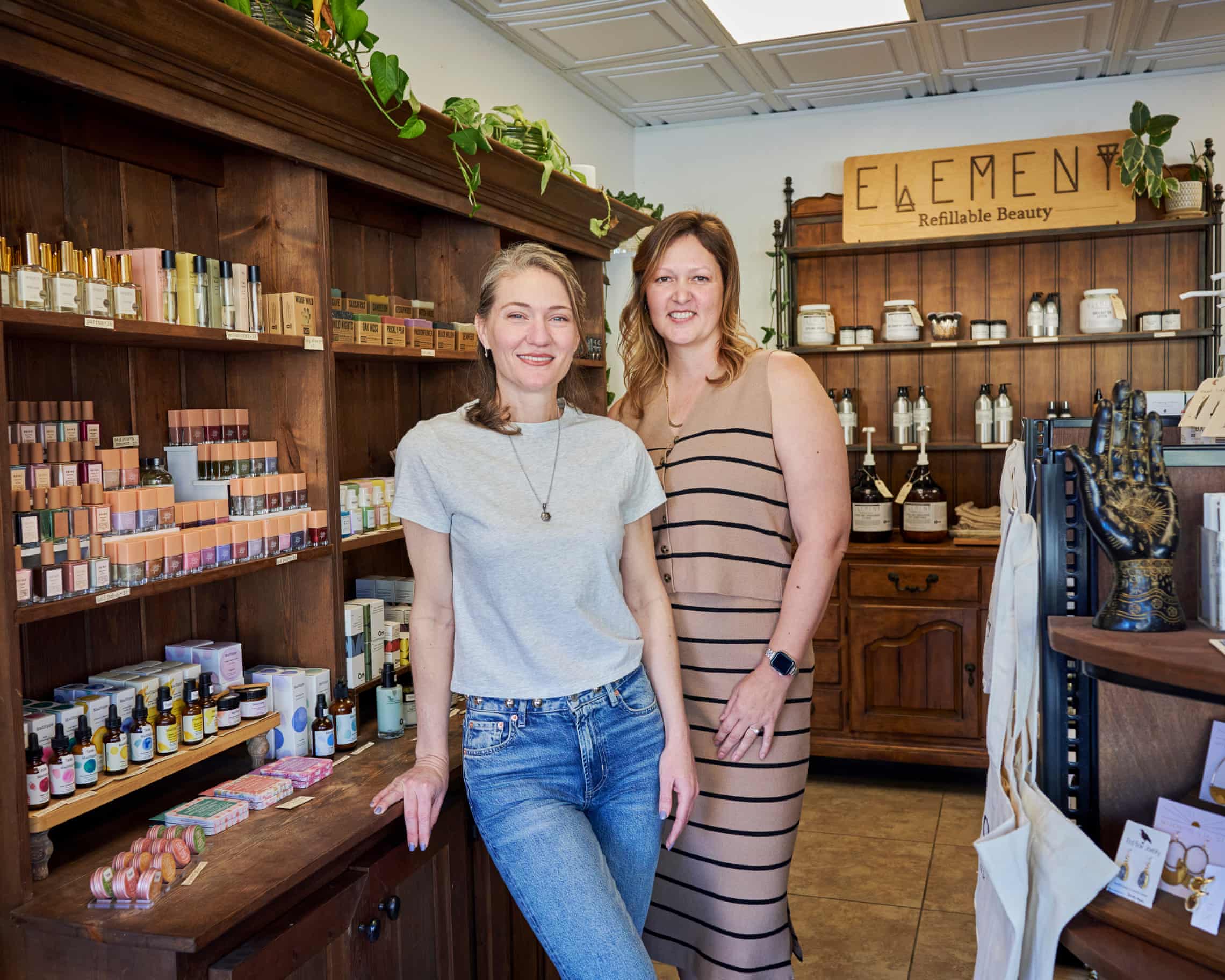
Easton Basjec and Melissa Parker, founders of Scisters Salon & Apothecary in San Diego, California, on 18 March 2026. Together, they’re showing how salons can help the environment rather than contribute to waste.

My hairdresser is very thoughtful in her daily life about health and the environment. Of course she knows that there are an awful lot of unhealthful chemicals in the salon business. I wonder if the owner of her workplace would be up for making a switch like the San Diego salon in today’s story did.

Michaela Haas writes at the Guardian, “The first thing you notice when you walk into Scisters Salon & Apothecary is what isn’t there. No wall of glossy plastic bottles. … No sharp chemical tang or aerosol haze. The only trash can is a tiny basket that mostly collects coffee cups and gum wrappers clients bring from home.

“Instead, the shelves of this southern California salon are lined with large refill containers of shampoo and conditioner, houseplants dot the space, hair clippings are swept away for compost, and the air carries a trace of bergamot and vanilla.

” ‘It’s the smell people comment on straight away,’ says co-founder Melissa Parker. ‘They walk in and say: “It smells good in here.” ‘ …

“Parker and her co-founder Easton Basjec opened Scisters 15 years ago in a strip mall in La Mesa, about 9 miles east of San Diego. Since then, they’ve built it into one of the region’s most prominent low-waste salons, diverting, they say, up to 99% of its refuse from landfills.

“The beauty sector is a dirty business. Salons in North America send an estimated 63,000 lbs of hair to landfills every day, along with hundreds of tons of used foil and leftover hair dyes, according to Green Circle Salons, a Canadian recycling and recovery organization. On top of that, many products used in salons contain chemicals like formaldehyde and lye that carry potential health risks.

“But Parker and Bajsec have staked their business on the idea that beauty doesn’t have to come at the expense of the planet – or the people in the salon.

“The two business partners, both native to San Diego’s East county, met while working at another salon before attending business school together at a local community college. In 2010, they opened their own seven-chair salon and named it Scisters in a nod to their close friendship.

“For years, the business – which has seven employees and serves up to 22 customers a day – operated much like any other boutique salon, carrying more than 150 products from a large corporate brand and offering the full range of services. …

“The turning point came several years later, after Bajsec watched a documentary about the zero-waste movement and began questioning the beauty industry’s environmental footprint. Around the same time, Parker developed serious health problems that her doctors linked to prolonged exposure to salon chemicals.

“Several studies have found that hairdressers’ exposure to harmful chemicals such as formaldehyde, ammonia and sulfates puts them at a higher risk of asthma, skin conditions, reproductive illnesses and cancer. Eventually, a naturopath warned Parker she might have to stop working as a hairstylist, a prospect she found ‘terrifying.’

“But rather than walk away from the beauty business altogether, Parker and Bajsec set out to transform their salon.

“First they took a hard look at the services they provided and products they carried. They stopped offering perms because the treatments release formaldehyde, a carcinogen. And they decided to move away from the big-name shampoos and conditioners they’d been selling. …

” ‘We knew that if we switched to products that didn’t perform as well, we risked losing clients,’ Parker says.

“The pair enrolled in online formulation design courses and developed their own line. The process took years, Bajsec says. ‘Stability testing, packaging, preservatives – we had no idea how complex it was.’

“Element, which they launched in 2019, is made in a California lab and sold in refillable glass and aluminum containers. It boasts recognizable ingredients such as organic aloe, wheat protein and castor oil. Parker and Bajsec encourage customers to use the salon’s ‘jar library’ – a collection of donated and sanitized pasta sauce or salsa jars – to purchase refills. …

“ ‘I spoke with the local waste company and convinced them to accept hair scraps for composting,’ Bajsec says. … She and Parker started washing and recycling foils rather than sending them to the dump. Instead of waxing, Scisters began to offer sugaring – a hair-removal technique using a compostable paste made from sugar, water and lemon. … In the bathroom, customers use washable cloths rather than paper towels to dry their hands. Parker and Bajsec also rethought their energy use, switching to LED lights and installing Ecoheads sprayers for their shampoo bowls. …

“They found that some compromises are unavoidable. Scisters still offers hair bleaching, which releases ammonia, a chemical linked to respiratory and gastrointestinal irritation. … They mitigate the fume’s potential harms with ‘industrial air filtration, open doors, and air-purifying plants such as snake plants. …

“Parker and Bajsec ship the plastic waste they do produce – about two boxes a year, they say – along with excess hair dyes and broken stylist tools, to Green Circle Salons for specialized processing. Bajsec said they pay Green Circle $200 per box of waste – which she said she’s happy to do for the peace of mind knowing they’re not going straight to the dump.

“Though the transition to reducing their waste – namely developing the Element line – required an initial upfront investment, Parker says it has paid off. ‘Overall, it’s actually less expensive….

” ‘Going green has been the greatest thing we’ve done for our business financially,’ Parker says. ‘We accidentally created a point of differentiation.’

“Denise Baden, a professor of sustainable business at the University of Southampton … who has been working with salon owners for more than a decade to help them incorporate sustainable practices, says hairdressers are uniquely positioned to influence their communities. ‘The practices they model in the salon and the message they give to their clients about how to adopt ‘greener’ hair practice in their homes have the potential to make a world of difference.’ ”

It’s a big step, and probably one that needs the whole staff on board, but I imagine that there are customers who would seek out such salons.

More at the Guardian, here.

Read Full Post »

Photo: Yano via Wikimedia.
Kamikatsu, Japan, has worked for years to become a zero-waste town.

Here’s an update on an ambitious Japanese town I wrote about here a few years ago. It’s Kamikatsu, where the residents are still working hard at creating a completely sustainable way of life.

Michelle Ye Hee Lee and Julia Mio Inuma have a report at the Washington Post. “Tucked away in the mountains of Japan’s Shikoku island, a town of about 1,500 residents is on an ambitious path toward a zero-waste life.

“In 2003, Kamikatsu became the first municipality in Japan to make a zero-waste declaration. Since then, the town has transformed its open-air burning practices for waste disposal into a system of buying, consuming and discarding with the goal of reaching carbon neutrality. Now, the town estimates it is more than 80 percent of its way toward meeting that goal by 2030.

“But even for a town its size, carbon and waste neutrality is a high bar. And with more than half of its residents over 65 years old, the rural community is rapidly shrinking. The town is working with manufacturers to encourage them to use more recyclable materials, which would help reduce waste and burning. …

“The Zero Waste Center is the town’s recycling facility, where residents can sort their garbage into 45 categories — there are nine ways to sort paper products alone — before they toss the rest into a pile for the incinerators. …

“The town offers an incentive system in which people can collect recycling points in exchange for eco-friendly products. There are signs depicting what new items will be made out of those recycled items, and how much money the town is saving by working with recycling companies rather than burning the trash. …

“ ‘When residents cooperate, the money used for recycling is reduced at the same time, so you can see the merit to cooperating,’ said Momona Otsuka, the 24-year-old chief environmental officer of the center.

“Two things are key to creating a culture of widespread recycling, she said: policies, such as the 1997 Japanese law that gave towns and cities authority to recycle waste, and the cooperation of residents.

“Attached to the Zero Waste Center is a thrift shop where residents can drop off items they don’t want anymore, and others can take them free. All they need to do is weigh the item they take from the shop and log the weight in a ledger so the shop can keep track of the volume of reused items.

In January alone, about 985 pounds’ worth of items were rehomed — from unused batteries and sake glasses to furniture, maternity clothing and toys. The number is displayed inside the shop. …

“Rise and Win Brewing Co. brews two types of zero-waste craft beer, made of farm crops that would otherwise be thrown out because they are too misshapen to be sold publicly. … For years, the brewery tried to find an efficient way to donate leftover grain from brewing beer. Composting took a long time, and delivering fertilizer to farmers was a lot of work. So last year, they developed a way to convert used grain into liquid fertilizer, which is then used to grow barley for beer. …

“Hotel Why opened in 2020 as a part of the Zero Waste Center facility, which is constructed in the shape of a question mark to depict the question: Why do we create so much waste? The hotel feels like a secluded cabin in the woods, and at night, the stars resemble a planetarium.

“Each guest is given six bins to sort garbage during their stay. The sleek decorations are all reused materials, including a patchwork quilt made of denim scraps, and a wall display made of ropes. The furniture is salvaged from showroom models.

“The hotel emphasizes using just what you need. At check-in, guests cut individual bars of soap so they get just the amount they need for their stay. Coffee beans are ground based on the number of cups the guest wants, so that nothing goes to waste.

“Kamikatsu residents and businesses work to minimize as much food waste as possible. For example, at Cafe Polestar, there was one dish available for lunch to reduce waste: curry made with local vegetables.

“Even the leaf used to decorate their dishes was produced locally, from a company called Irodori, which has been selling products made from Kamikatsu’s lush forestry since 1986. There are 154 families in town involved with the project, mainly women aged 70 and older who can pick leaves to create intricate designs. The leaves are then sold to high-end spas, hotels and restaurants in Japan and other Asian countries, to create sustainable decorations.

“ ‘Our business helps people realize that there are valuable items even in mundane everyday things around them,’ said Tomoji Yokoishi, Irodori’s chief executive.”

More at the Post, here, where you can also read about the town’s ride-share system and its roughly 40 drivers, including the mayor, who use “a handful of cars so they can drive residents or visitors.”

I loved so many of the ideas and like to imagine towns everywhere coming up with their own unique ones.

Read Full Post »

My friend Jeanne has been investigating more-sustainable living and has experimented with producing zero waste. I’m impressed. My small efforts have been almost completely undermined by the pandemic and all the plastic containers that come with takeout — takeout being both a break from cooking and support for our local restaurants.

Even the folks at Plastic Free Hackney, an inspiring effort in an English town, admit that it’s all harder during a pandemic. Still, idealists soldier on and will eventually triumph.

Jessica Wolfrom writes at the Washington Post, ” ‘It was kind of like a slow-moving coup on my part,’ said Anna [Marino], 32, a former seller on the website Etsy, who started researching the meat industry and the zero-waste movement. Even though they were only a family of four — [Anna and Justin] have two children, ages 6 and 3 — they knew they needed to change their lives.

“Paper towels and single-use napkins were the first to go. Then went the plastic. But as they traded traditional products for more eco-friendly items, they quickly realized that their reliance on online shopping was another problem.

“ ‘It almost defeats the purpose,’ said Justin, 43, who previously worked in cybersecurity. ‘I’m ordering something to save the planet, but in order for it to get here, it’s creating a pretty nasty carbon footprint. … And so, we were like, well, there needs to be a store around here.’

“Enter Mason & Greens, the Washington region’s first zero-waste store. … The airy shop is equal parts organic grocer and minimalist boutique, selling items such as package-free shampoo bars, organic produce and drip-irrigated olive oil. Hanging plants and shelves lined with stainless steel containers and books titled ‘All You Need Is Less’ offer shoppers a glimpse into the world of low-waste living. …

“ ‘You know it’s a movement when you don’t know everything that’s going on,’ said Gary Liss, vice president of Zero Waste USA, a nonprofit organization dedicated to reducing waste, who described the growing interest in low-waste living as a sea change in the relationship between people and things.

“Americans throw away about five pounds of trash per person per day, according to the Environmental Protection Agency — 12 percent of which is plastics. … Scientists estimate that up to 91 percent of plastic is never recycled, leaving the rest to burn in incinerators, clog landfills or degrade in the oceans. Scientists have even found microplastics in air, water and food. …

“The coronavirus pandemic has only increased reliance on disposable plastics. Billions of masks and gloves made from plastics and used by health-care workers, first responders and essential workers are being discarded every month, studies show. …

“Mason & Greens, which is based in part on the bulk model, makes a point of avoiding plastics at nearly every turn. Beans and grains come in gravity dispensers. Produce is package-free. Pomberry Kombucha and pinot noir stream from a tap. The spices are self-serve.

“Customers aren’t required to bring their own bags or refillable containers, but the couple said many customers do. The shop employs a tare system that logs the weight of an empty container and then calculates the price of products by the ounce. …

“The couple welcomes newcomers into their waste-free world, but Anna routinely castigates vendors for their packaging practices — she is not above shaming suppliers who send items wrapped in plastic. … ‘I have to go through so much to get a product into the store that’s zero-waste or low-waste.’

“But living a waste-free life might soon become easier. As consumers demand more sustainable options, brands large and small are shifting to make sustainability central to their strategy. Major companies such as Unilever have pledged to halve the use of virgin plastics in packaging by 2025. Walmart, Target, CVS and other retailers are working to develop an environmentally friendly alternative to the plastic bag. And other companies are starting circular delivery services — an updated version of the 1950s milkman — where groceries and goods are packaged in reusable containers that are returned empty.”

Signing up for the guy who brings milk in reusable bottles is one way I’ve actually gotten better at controlling waste in the pandemic. Thanks to my daughter-in-law, I got in under the wire with the dairy farm as other people started lining up for deliveries, too.

Read about a variety of zero-waste shops and the blogger who fit all the waste she produced over four years into a 16-ounce Mason jar at the Washington Post, here.

Read Full Post »

Photos: Sonia Narang for WHYY
Kamikatsu has become a hub for workshops on recycling. Employees from the Osaka branch of the Patagonia clothing store traveled here to learn waste-reduction techniques. Recyclables are sorted into 45 bins.

The other day I was reminiscing with my husband about the first time we took our recyclables to a voluntary recycling station outside Philadelphia. It stands out in my mind because John was a brand new baby in the car seat and the young man who assisted us said, “Oh, what a tiny baby,” and I was indignant because I thought John had gotten really big in his first three weeks!

Today most municipalities offer or demand curbside recycling, but if you think we are advanced in this department, consider Kamikatsu, Japan.

Sonia Narang reports at Philadelphia’s WHYY, “It’s not yet 8 a.m., and the recycling center in the town of Kamikatsu is already bustling. Locals arrive in a steady stream, unloading bags full of bottles, cans, and paper into dozens of clearly-labeled bins — all neatly lined up in rows.

“Kamikatsu is a rural town of about 2,000 people in the forested mountains of Japan’s Shikoku island.

“The town’s waste collection center runs a tight ship. Each resident gets a thick booklet of recycling guidelines.

“At the collection center, everything is carefully sorted and arranged with the help of staff. There are a whopping 45 different categories of recyclables, and the town recycles 80 percent of its trash.

“Akira Sakano heads up the town’s Zero Waste Academy, a non-profit organization that manages the recycling program. …

“ ‘We have newspapers, cardboard, scrap papers, shredded papers, paper containers, paper containers with aluminum packaging on back, paper cups, hard paper tubes, other papers,’ she says. …

“The town of Kamikatsu adopted a ‘zero waste’ policy in 2003. Before that, the town used to burn all its trash in incinerators. …

“When waste decomposes in landfills, it releases methane, one of the most potent greenhouse gases. A large amount of that methane leaks into the atmosphere, heating up the planet. …

“Zero waste has become a buzzword, and cities around the world are pledging to drastically reduce waste. But, in Japan — where land is scarce and there’s limited space for landfills — aggressive recycling has been a way of life for years.

“In addition to helping the environment, Sakano says recycling also has an economic benefit for the town. Incinerating trash can be expensive. …

“There’s no garbage truck service here. Almost everyone has to bring their trash into the waste collection center, and only about 20 percent ends up in the dumpster.

“For older residents who can’t drive themselves to the recycling center, the town does send a pick-up truck. Kazuyuki Kiyohara, who works for the town, also drives the truck around. He’s really concerned about using the earth’s resources wisely, and super enthusiastic in his personal life about recycling. He’s got 14 separate bins at home. …

“Everyone has to wash and dry all their food packaging. Many locals say that’s the most annoying part of the town’s trash policy.

“Back at the recycling center, I catch Daichi Hyakuno as he unloads bags of juice cans, plastics, and … dirty diapers. He moved here from Osaka a few years ago.

“ ‘At first, I was quite confused because the categorization was so detailed,’ he says. ‘It was easier in Osaka, since all I had to do was separate trash into burnables and non-burnables.’ … He’s not a big fan, but understands his social responsibilities. …

“Personally, I got better at recycling when it was practically mandatory. Fifteen years ago, when I lived in rural Japan, all the residents in my town had to write our names in big black letters on clear trash bags.

“It made me feel conscious about what I threw away: If I left even one bottle in there, the town wouldn’t pick up the trash, and everyone would see my bag left out there on the curb. …

“The town is small, but Kamikatsu is gaining international attention. Now outsiders are traveling here to take workshops at the academy.

“On the day I visit, folks from a Japanese branch of the outdoor clothing company Patagonia are here to learn.” More at WHYY, here.

Now who’s going to teach this town about composting so it can burn even less?

Hat tip: @morinotsuma, One More Voice, on twitter.

Once every two months, the town of Kamikatsu in Japan sends a truck to pick up bags of recyclables from elderly residents who are unable to drive to the recycling center.

Read Full Post »