Feeds:
Posts
Comments

Posts Tagged ‘fire’

Photo: David Swanson/AFP/Getty Images.
The hillside along the Pacific Coast Highway burns in front of the driveway to the Getty Villa in the Pacific Palisades neighborhood in Los Angeles on Jan. 7.  

Planning, courage, and commitment saved California’s Getty Museum in the last big conflagration, but how long can it escape what few others did?

Kelsey Ables at the Washington Post explained how the famous art collection was protected in January.

“As wildfires ravaged greater Los Angeles … the J. Paul Getty Museum faced encroaching flames on two fronts. Blazes nearly surrounded the Getty Villa in Pacific Palisades, coming within six feet of its walls. Days later, ominous red clouds were visible from the Getty Center in Brentwood, hovering on the horizon like a warning.

“The fire at the Villa was the closest flames had ever come to either building. But through it all, the institution made no evacuation plans. On the most intense nights at each location, a team of more than a dozen people at the Villa and 28 at the Center waited it out, and the museums’ vaunted artworks — the ancient sculptures, the Gentileschis, the Manets and Monets — remained inside.

“This was no gamble, though. Those familiar with the Getty describe it as a place one would evacuate to, rather than from.

“With the fire about a mile away from the Center on Jan. 10, a security staff member suggested to J. Paul Getty Trust chief executive Katherine Fleming that she might want to leave. ‘I was thinking, “I actually feel really good here,” ‘ she said in an interview. ‘This feels like a very safe place to be.’

“That is by design. … As the fires have killed more than 20 and razed swaths of the Los Angeles region, the Getty — with its more than $8 billion endowment — has emerged as a beacon of fire preparedness as well as a symbol of the defenses that wealth can build.

“From its grounds to the museum’s core, the $1.3 billion Getty Center, which was designed by architect Richard Meier and opened in 1997, was built to resist flames. …

“High on a hilltop, the campus has sprawling plazas made of fire-resistant travertine imported from Italy. Open spaces surround imposing, elevated buildings that boast walls constructed from reinforced concrete or fire-protected steel. The roofs are covered with stone aggregate, which is fire-resistant. Inside, the buildings are equipped with special doors that prevent flames from traveling. Temperature and humidity are closely monitored during red-flag warnings.

“Outside, the grounds are routinely cleared; the plants, selected for their drought-resistant qualities, are pruned regularly to prevent them from becoming fuel. During a previous fire, the museum said: ‘There is no need to evacuate the art or archives, because they are already in the safest place possible.’

“ ‘It’s very much like a fortress,’ said [Todd Cronan, an L.A. native and art history professor at Emory University in Atlanta], who briefly lived at the Center as a fellow. …

“To Cronan, though, the Getty’s unassailable features say ‘more about privatization and their … endowment than anything else,’ he wrote [by email].

“While the Getty stresses that it does not hire private firefighters or seek special treatment, it maintains its own water tanks — including a 1 million gallon tank at the Center — year-round. …

“When the Villa emerged largely unscathed last week, the museum in a press release credited its own ‘extensive efforts to clear brush from the surrounding area,’ noting that it also stores water on-site and that the grounds were irrigated ahead of the blaze. …

“Fleming, the CEO, said they were confident in their preparations but described a nail-biting evening watching the fire move closer as 15 staff members remained on-site. … The next day, with staff unharmed and the Villa still standing, Fleming found a strange calm in the collections. The galleries were ‘cleaner than an operating room.’ “

More at the Post, here.

Update April 4, 2025. The Getty is selling bonds to raise money for more protection. Article here.

Read Full Post »

Photo: Alan Devall/Reuters.
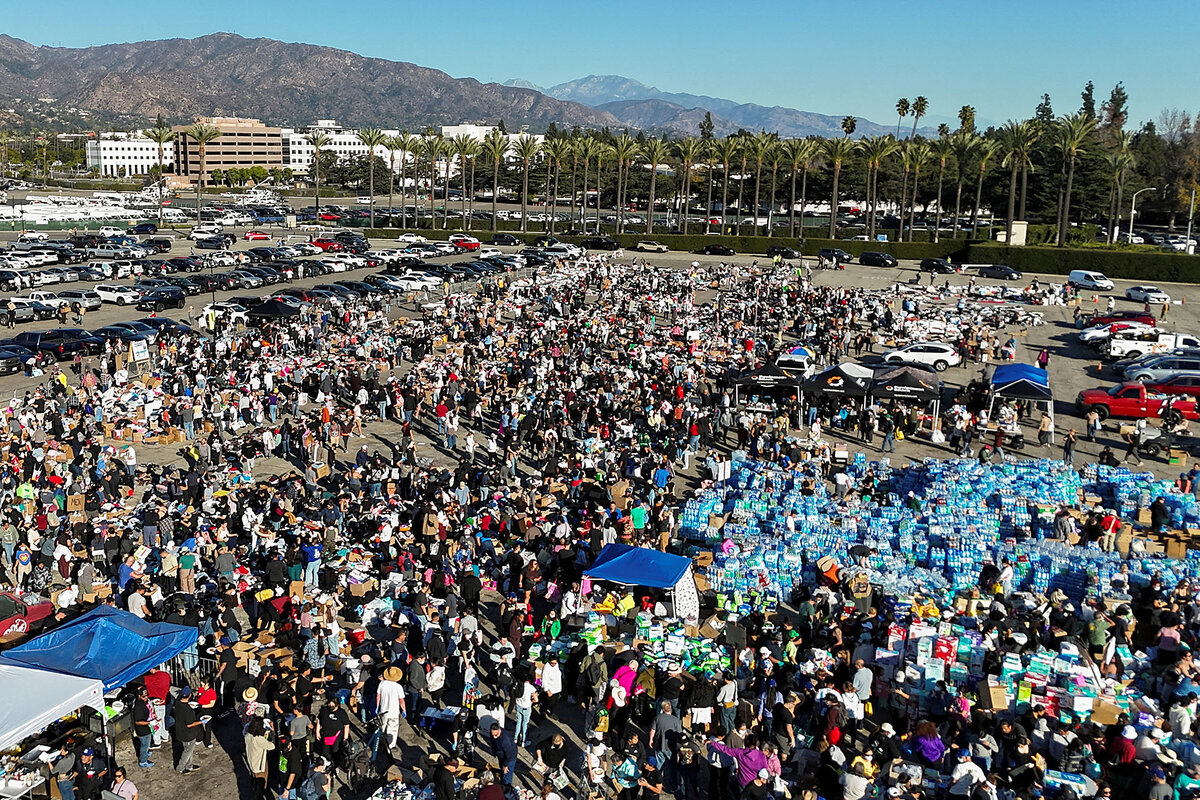
A drone view shows volunteers with people affected by the Palisades wildfires, at a donation center in Arcadia, California, Jan. 12, 2025.

If you ever feel like your world is run by people without hearts, do what Mister Rogers’ mother advised when he was a little boy: “Look for the helpers.” As long as there are a few willing helpers, all things are possible.

Consider the volunteers in the recent California wildfires. At the Christian Science Monitor, Ali Martin wrote in January about people stepping up, even those whose lives had also been damaged.

The story started with a family’s pet goat. “Coco the goat is nestled in a soft bed between two cars in the parking lot of El Camino Real Charter High School on the western edge of Los Angeles’ San Fernando Valley. Other wildfire evacuation shelters wouldn’t allow the 10-year-old house goat to stay with her family – the animal shelters board pets on their own, in kennels – but breaking up wasn’t an option for her owner, Maji Anir. …

“She is quietly out of the way, is no bother, and offers a drop of levity in a sea of stress – most people who take notice stop to pet her, spirits lifted. Workers are letting her stay.

“Mr. Anir and his family had just two hours to evacuate as the fire approached their home in Malibu – not enough time to get everything they needed. They pulled away Tuesday evening as the sun was setting. By morning the house was gone, along with all of their neighbors’. …

“Even in this besieged region, ruin is bending toward resilience. And from the staff to random visitors and those sheltering, a common theme is kindness. …

“El Camino is a well-appointed charter school. … Classes for the school’s 3,500 students were scheduled to start back up in mid-January. Now, with the Palisades Fire burning out of control on the other side of a mountain ridge, the campus is a gathering place for those needing refuge – and the people volunteering to help.

“Kate Delos Reyes was supposed to be in a residential program for mental health treatment. The program in Santa Monica was canceled as fires swept through the nearby Pacific Palisades.

“She’s seen fires before, when she worked at a rehab center in another Southern California mountain range. Remembering that stress, she drove to the evacuation center at El Camino to lend whatever help they might need. ‘Kindness is free, you know.’ …

“Eddie Včelíková is fielding a stream of texts from her friends while she scrolls through social media. She is taking in photos of her childhood home in Altadena; St. Mark’s Episcopal Church, which she attended every Sunday; her schools – all of it destroyed.

“Altadena, an unincorporated town in northern LA County, welcomed Black homebuyers in the mid-1900s, when redlining kept them out of other neighborhoods. As the area developed along the southwestern base of the San Gabriel Mountains, so did the diversity of its middle-class bedrock. Last week, the Eaton fire, which is still burning, swept through much of the small community and leveled entire blocks.

“When she saw video of the burned-out park where she played every weekend as a child, Ms. Včelíková says she broke. She found her way to the shelter. ‘I’m just out here volunteering to stay busy because it’s the only thing I think that’ll keep me from going insane.’ …

“She’s tried to get back into her old neighborhood, but National Guard troops are blocking every route – protecting vacant homes from looting. On Sunday, she attended a virtual church service hosted by St. Mark’s. The church may be gone, but its spirit is not. …

“[Soon] not even the shelter itself is safe. The Kenneth Fire has broken out in late afternoon on a ridge overlooking this edge of the San Fernando Valley. … This refuge is shutting down. Most of the evacuees are heading 20 miles east to another shelter at the Westwood Recreation Center.

“Leslie and Megan Walsh are making space in their packed trunk for a small suitcase. They’ve just met a young woman who needs a ride to Westwood, and they’ve offered to take her.

“They’re from San Diego; they know what LA is going through. In 2003, fires swept through parts of their city, and they had to flee. Their neighborhood lost 300 homes. Now, with Megan living in LA, the family wanted to help however they could.

“Leslie and her daughter drove to LA with a car full of animal supplies – pet food and beds, mostly – to donate. But their first stop, a shelter in Agoura Hills, was evacuated, so they came here. Now this one’s evacuating. …

“The Walshes headed back to San Diego with their supplies. Over the next couple of days, Megan ran a donation drive among their San Diego neighbors. She and her parents returned to LA Sunday with a U-Haul truck and two more cars filled with clothing, toiletries, pet food, sleeping bags, air mattresses, and more. …

“Back at El Camino high school on Thursday, in the hours before the Kenneth Fire erupted, first responders had pulled into a corner parking lot to take a break and grab a meal. The shelter was overflowing with food donations, so school administrators redirected the potluck to feed firefighters and police officers.

“Administrative Director Jason Camp says the support for first responders was driven by an outpouring in the community. … He notes the number of people – emergency responders, volunteers, local officials – who are managing their own fears and losses from the widespread devastation. Nobody is untouched.

“Some people who are displaced or lost their homes want to be part of the solution and ‘to help somebody through the pain and maybe together they can get through it,’ he says. ‘It’s refreshing to see that not everything’s in total chaos. The heart is still there.’ ”

More at the Monitor, here.

Read Full Post »

Photo: Patrick Zachmann/Magnum Photos.
The real miracle: Reconstructing the intricate wood frame of Notre Dame’s roof.

When the unthinkable happens to a beloved cultural icon, what’s next? In the days and weeks after the great fire of Notre Dame Cathedral broke hearts around the world, plans began to take shape.

Joshua Hammer writes at GQ, “Some time after six in the evening on April 15, 2019, Rémi Fromont was sitting at the Brasserie Saint-Malo, a lively café in Montparnasse, Paris, when his phone rang.

“ ‘Notre-Dame is on fire,’ ” said a friend on the other end of the line. … Fromont leapt out of his chair, got on his bike, and pedaled north toward the cathedral. …

“About an hour after his arrival, Fromont, with thousands of Parisians at the scene and millions watching around the world, looked on as the 750-ton spire, made of 1,230 oak beams, blazed, teetered, snapped like a matchstick, and crashed through the roof. Spectators broke into tears of disbelief and horror. …

“The day after the fire, French president Emmanuel Macron made a promise: Notre-Dame would rise again in the next five years.  …

“None of the many priceless paintings, sculptures, and windows that filled the church’s interior — though they were stained by smoke and singed by fire — had been wrecked beyond repair. …

“The roof frame was a different story. Known in French as the charpente, it was an ingenious assemblage of triangular-shaped trusses, each one consisting of horizontal and vertical beams and diagonal rafters designed to support the heavy roof cover and distribute the weight over the walls beneath it. Built from thousands of pieces of wood and assembled without nails, it was a singular achievement, one of the oldest surviving all-wood structures in the world. …

“During World War I, German artillery shells had reduced the cathedral in Reims, another Gothic masterpiece, to charred wood and rubble. In 1919, the architect Henri Deneux launched the restoration, reconstructing the church’s roof with reinforced concrete, a decision that was controversial at the time.

“Fromont had not warmed to Deneux’s approach. He believed that the roof’s charpente could be rebuilt exactly as the medieval carpenters had done it. The approach was not without risks — Fromont had told me, ‘Wood burns. I’m not going to say the opposite’ — but certain measures could be put into place to mitigate its vulnerability.  …

“The roof’s charpente was perhaps [Notre Dame’s medieval woodworkers’] greatest creation. Yet Fromont told me that, until recently, it had never been the subject of serious scholarly study. …

“In 2012, Fromont, then a 35-year-old scholar at Paris’s École de Chaillot, decided to address that absence. For his advanced degree, Fromont proposed spending a year surveying every inch of the charpente. When they were at last granted permission, he and his partner on the project, Cédric Trentesaux, entered the cathedral’s south transept and climbed a winding staircase into the triangular south gable. There they squeezed through an aperture and entered a medieval realm barely visited in over 800 years. …

“The two men emerged from the project with the most extensive blueprint of the 800-year-old structure that had ever been created. ‘It wasn’t a lot, but it was enough,’ Fromont said. …

“There was some skepticism that the charpente could be re-created in its original glory, but Fromont found an ally in François Calame, France’s leading apostle of traditional carpentry. In the early 1990s, as a young carpenter, Calame had visited Maramures‚ a remote region in western Romania. Isolated from a fast-changing world during Nicolae Ceausescu’s 24-year dictatorship, artisans there had kept the old ways of carpentry alive.

“Like in Romania, traditional French axmen used hand tools: the hache de grossière, a long-handled, narrow-bladed axe used to remove large amounts of wood, and the doloire, a broad-bladed, short-handled axe designed for precision chipping following the grain of the wood. It’s slow and physical work: Squaring lumber by hand can take much more time than doing it with buzz saws. For that reason, by the 20th century, axes had all but disappeared as a construction tool. Yet their proponents extol the end result: more pliable, stronger beams, and imperfections that reflect the extensive labor and love of craft. ‘This is a kind of magical work because you feel the material,’ Fromont told me. ‘You smell it and touch it.’ ”

Read what happened next in Paris. The long and fascinating article is at GQ, here. No firewall.

Read Full Post »

Photo: Harris & Ewing/Library of Congress Prints and Photographs.
Frances Perkins, Secretary of Labor under President Roosevelt.

I once read a fascinating biography of Frances Perkins, Secretary of Labor under President Franklin Delano Roosevelt. In the book, biographer Kirstin Downey set out to prove that Perkins was both the conscience of FDR and The Woman Behind the New Deal. (My take on the book is here.)

Recently, at the Guardian, Michael Sainato reported that President Biden had been asked by members of Congress and the National Park Conservation Association to create a monument to Perkins.

“Perkins, who served three terms under Franklin Delano Roosevelt from 1933 to 1945,” Sainato writes, “was the first woman to be appointed to a presidential cabinet and the longest-serving secretary of labor in US history.

“In 1911, Perkins was a witness to the Triangle Shirtwaist factory fire in New York City, which killed 146 people, mostly young women, and was one of the deadliest industrial disasters in US history. The tragedy greatly affected Perkins and helped inspire her labor activism in the subsequent decades.

“She said of her position: ‘I came to Washington to work for God, FDR and the millions of forgotten, plain common workingmen.’

“As secretary of labor, Perkins was one of the driving forces behind Roosevelt’s New Deal policies and pushed for many longstanding labor policies including a 40-hour work week, a federal minimum wage, unemployment compensation, worker’s compensation, the abolition of child labor, and social security. ‘The New Deal began on March 25, 1911. The day that the Triangle factory burned,’ Perkins said.”

At Goodreads, I observed that, according to biographer Kirstin Downey, Perkins “was the main person pushing the New Deal. Roosevelt, who was more cautious and political, trusted her and listened to her while many others in his circle came and went. She was unfailingly hardworking and skilled at understanding people and working with everyone, although in her first few months in Washington, she made some missteps that caused her trouble later.

“Her career didn’t start in Washington, though. She was focused on working people and their needs from college days, taking a teaching job in Chicago and spending all her spare time at Hull House, where she made lasting connections. When she lived in New York City, she was active in the rights of working women and child laborers. Greatly influenced by seeing the appalling Triangle Shirtwaist Factory fire after failing to get reforms, she worked harder than ever on workplace safety. She was the right hand of NY Governor Al Smith for some years and then the right hand of FDR when he succeeded Smith as governor.

“Perkins had a variety of roles in Washington over several decades but her biggest influence is seen in initiatives that got people working in the Depression and improved workers’ rights and workplace safety. …

“Downey wrote at the book’s end: ‘The secret of Frances’s success was that she had done what she did selflessly, without hope of personal gain or public recognition, for those who would come afterward. It was a perpetuation of the Hull House tradition of the old teaching the young how to advocate for the yet unborn. …

” ‘Factory and office occupancy codes, fire escapes and other fire-prevention mechanisms are her legacy. About 44 million people collect Social Security checks each month; millions receive unemployment and worker’s compensation or the minimum wage; others get to go home after an eight-hour day because of the Fair Labor Standards Act [all of which she shepherded]. Very few know the woman responsible for their benefits.’ “

By the way, although there are comparatively few monuments to women in the US, cities are trying to get up to speed. In New York alone, there are statues to Women’s Rights Pioneers, Joan of Arc, Harriet Tubman, Eleanor Roosevelt, women veterans, Gertrude Stein, and one coming soon of Shirley Chisholm, a Black woman who ran against Richard Nixon, and more. Click here for great photos.

More at the Guardian, here. No firewall, but if you click here, you can help support the Guardian journalism.

Read Full Post »

Photo: Trilogy Captain’s Log.
“Lahaina Strong Paddle Out” expresses the determination of young Hawaiian climate activists after the fires in Maui.

I am so relieved to see young people taking charge of some of the issues that have messed up our planet. They focus on goals and don’t get distracted by the usual specious arguments for not upsetting the apple cart or for taking more time. Good things do happen when you don’t realize your goal is “impossible.”

Consider these young people in Hawaii.

Dharna Noor and Lois Beckett write at the Guardian, “Hawaii officials have announced a ‘groundbreaking’ legal settlement with a group of young climate activists, which they said will force the state’s department of transportation to move more aggressively towards a zero-emission transportation system.

“ ‘You have a constitutional right to fight for life-sustaining climate policy and you have mobilized our people in this case,’ Josh Green, the Hawaii governor, told the 13 young plaintiffs in the case, saying he hoped the settlement would inspire similar action across the country.

“Under what legal experts called a ‘historic’ settlement, announced [in June], Hawaii officials will release a roadmap ‘to fully decarbonize the state’s transportation systems, taking all actions necessary to achieve zero emissions no later than 2045 for ground transportation, sea and inter-island air transportation,’ Andrea Rodgers, one of the attorneys representing the plaintiffs in the case, said at a press conference with the governor.

“ ‘This is an extraordinary, unprecedented victory for the youth plaintiffs,’ Michael Gerrard, the faculty director of the Sabin Center for Climate Change Law at Columbia University, told the Guardian.

“While Hawaii has long embraced a progressive climate change agenda, with 2045 as a target year for decarbonization, the new settlement is ‘as big a deal as everyone said it is,’ said Denise Antolini, an emeritus professor of law at the University of Hawaii Law School, who has followed climate change litigation for decades. …

“The June 2022 lawsuit, Navahine F v Hawaii Department of Transportation, was filed by 13 young people who claimed the state’s pro-fossil fuel transportation policies violate their state constitutional rights. By prioritizing projects like highway expansion instead of efforts to electrify transit and promote walking and biking, the complaint says, the state created ‘untenable levels of greenhouse gas emissions.’ As a result, state officials harmed the plaintiffs’ ability to ‘live healthful lives in Hawaii.’ …

“It named the Hawaii Department of Transportation and its director, as well as the state of Hawaii and its former governor David Ige, as defendants.

“The plaintiffs, most of whom are Indigenous, alleged that by contributing to the climate crisis, the state hastened the ‘decline and disappearance of Hawaii’s natural and cultural heritage.’ When the case was filed, the plaintiffs were between the ages of nine and 18. …

“Navahine, whose name is on the lawsuit, is a 16-year-old Native Hawaiian whose family has been farming the land ‘for 10 generations.’ Drought, flooding and sea level rise were all having immediate effects on her family’s crops, she said. ‘Seeing the effects, how we were struggling to make any money for our farm, kind of pushed me to this case,’ she said.

“Officials said the legal settlement brings together activists with all three branches of the state’s government to focus on meeting climate change goals, including mobilizing the judicial branch. The court will oversee the settlement agreement through 2045 or until the state reaches its zero emission goals, Rodgers said.”

More at the Guardian, here. No paywall. Donations sought.

Read Full Post »

Photo: Sabine Glaubitz/dpa/picture alliance.
Notre Dame’s spire is visible once again following the partial removal of scaffolding.

After the Notre Dame cathedral in Paris burned, there were many suggestions for rebuilding it with lots of modern features, but tradition mostly won out. Ancient craft processes and materials were used whenever possible. People from all over pitched in.

Stefan Dege writes at DW, “The fire was still raging at the Notre Dame Cathedral on April 15, 2019, when French President Emmanuel Macron vowed to renovate and reconstruct the medieval monument within five years. Since then, work on the Gothic Episcopal church has been in full swing and is apparently on schedule.

” ‘We are meeting deadlines and budget,’ Philippe Jost, the head of reconstruction efforts, told a French Senate committee in late March. …

“The cathedral is officially scheduled to reopen on December 8, 2024. Though it will not be ready in time for the Summer Olympic in Paris, as was initially desired, visitors to the French capital can once again see Notre Dame’s towering spire following the recent removal of the surrounding scaffolding. The lead roof is also currently being installed. Fire-prevention features, such as a sprinkler system and compartmentalized sections, are also part of restoration efforts. …

“Exactly five years have passed since the fire, which partially destroyed the historic building. The Paris fire department fought for four hours before it was able to confine the fire to the wooden roof truss. The west facade with the main towers, the walls of the nave, the buttresses and large parts of the ceiling vault remained stable, along with the side aisles and choir ambulatories. Heat, smoke, soot and extinguishing water affected the church furnishings, but here, too, there was no major damage. …

“The extent of the destruction was not as great as initially feared. ‘Thank God not all the vaults collapsed,’ German cathedral expert Barbara Schock-Werner told DW at the time. Only three vaults fell in the end, and there was a hole in the choir. …

“French donors alone pledged €850 million ($915 million) to help restore the landmark. But money and expertise also came from Germany, with Schock-Werner taking over the coordination of German aid.

Cologne Cathedral’s construction lodge restored four stained glass windows that had been severely damaged by flames and heat. The four clerestory windows with abstract forms are the work of the French glass painter Jacques Le Chevallier (1896-1987), and were produced in the 1960s.

“In the glass workshop in Cologne, they were first freed from toxic lead dust in a decontamination chamber. The restorers then cleaned the window panes, glued cracks in the glass, soldered fractures in the lead mesh, renewed the edge lead and re-cemented the outer sides of the window panels. …

“As dramatic as the fire was, a discovery by French researchers at the fire site was just as sensational: iron clamps hold the stones of the structure together. Dating and metallurgical analyses revealed that these iron reinforcements date back to the first construction phase of the church in the 12th century. This may make Notre Dame the world’s oldest church building with such iron reinforcement.

“But more importantly, the mystery of why the nave was able to reach this height in the first place has also been solved. When construction began in 1163, Notre Dame — with its nave soaring to a height of more than 32 meters (about 105 feet) — was soon the tallest building of the time, thanks to a combination of architectural refinements. The five-nave floor plan, the cross-ribbed vaulting with thin struts and the open buttress arches on the outside of the nave, which transferred the load of the structure from the walls, made the enormous height possible. …

“In a stroke of luck, the cathedral’s showstoppers — the statues of the 12 apostles and four evangelists that architect Eugene Viollet-le-Duc grouped around the ridge turret he designed in the 19th century — survived the fire unscathed because they had been removed from the roof shortly beforehand for restoration.

“Some 2,000 oak trees were cut down for the reconstruction of the medieval roof truss. To work the trunks into beams, the craftsmen used special axes with the cathedral’s facade engraved on the blade. These can be seen in a special exhibition in the Paris Museum of Architecture. The show also details the painstaking work that was required to reinstall stones and wood in their original places to make the reconstruction as true to the original as possible.”

More at DW, here. No firewall.

Read Full Post »

Photo: Landon Speers/Guardian.
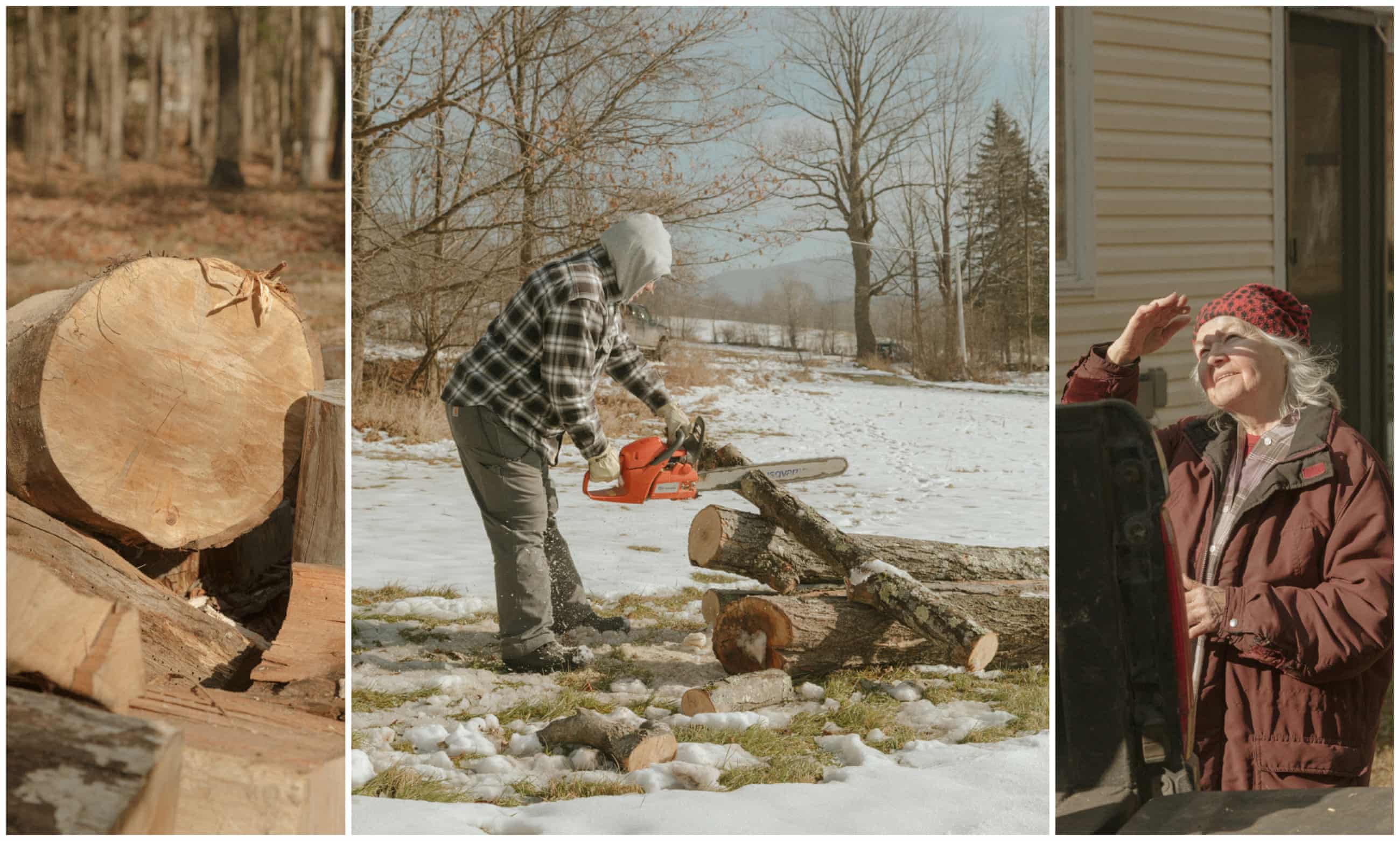
A Woodstock, New York, woodsman who prefers to be anonymous, cuts logs in his yard to deliver to neighbors.

Some people do good deeds and seek no credit. At the Guardian, David Wallis wrote early this year about one of those people.

“On a chilly morning in Woodstock, New York, frozen dew turns lawns a glistening white as puffs of smoke from chimneys float across the road.

“ ‘Winter is here,’ declares the woodsman, a broad-shouldered man in a black-and-gray checked wool shirt and navy denim Carhartt overalls as he sharpens his orange chainsaw. … The woodsman, who requested anonymity, is an accomplished director, writer and producer with several popular film and TV credits on his IMDb page. But he now devotes much of his time to supplying his struggling – and sometimes freezing – neighbors with free firewood. …

‘Many people are suffering,’ said the woodsman. ‘So many more than I imagined. Quietly, just secretly, really suffering.’

“The numbers back him up. Almost half of the children in the local public school district are economically disadvantaged, meaning that they or their families receive government anti-poverty aid such as supplemental nutrition assistance program (Snap) or disability funds. Affordable housing is in short supply: there are only a handful of long-term rentals on Zillow in the 12498 zip code with an average price of nearly $4,000 per month.

“A cord (128 cubic feet) of firewood, about enough fuel for a month or two, costs between $250 and $350 in Ulster county – up from about $200 before Covid. … In the world’s wealthiest nation, some people freeze to death inside their homes. … For many Americans, warmth is just another unattainable luxury.

“The woodsman has been an active activist for several years, helping refugees in Mexico stay in safe houses, distributing free masks during Covid and organizing voter registration drives with the Comedy Resistance, a non-profit organization.

“He moved to upstate New York from Los Angeles a few years ago to look after his mother, who had cancer and then Covid. He stocked a paying stand, which operated on the honor system, outside his mother’s house with bundles of wood; she donated the proceeds to local charities. But some of the bundles of wood vanished. The thefts distressed the woodsman, who recalled that a friend ‘suggested that I put a sign out on the stand that says if you if you need wood to heat your home, but you don’t have the resources, just ask me and I will deliver.’

“That conversation sparked the free firewood program. Two local librarians, Hollie Ferrara of the Woodstock Library and Elizabeth Potter of the Phoenicia Library, voluntarily spread the word about the grassroots initiative.

“ ‘Most people who work here can’t afford to live here,’ said Ferrara. ‘But there are still outlying folks who have been in their homes for a long time who basically have just about just enough money to live on and that’s about it.’ She acknowledged that librarians like her routinely act as unofficial social workers. …

“Residuals from the woodsman’s entertainment career defray some of his expenses. But Potter solicits donations for the charity from the community. Some benefactors leave gift cards for gasoline and stash them under a rock on her porch, or drop off oil for chainsaws.

“She first called on the woodsman during a power outage, a regular occurrence in upstate New York, two winters ago. An older couple had burned through their ‘last stick of wood.’ Within hours, the woodsman came to the rescue. ‘They said they and their spouse were huddled under the blankets upstairs, the fire long gone out, freezing cold, when they saw headlights in their drive and the soul-warming sound of wood being thrown on to the gravel. He got them through until the power was restored.’

“The woodsman considers his volunteerism a cheap form of therapy. ‘I’m sort of a quiet guy,’ he said. Giving away wood ‘does draw me out, pushes me out. When you interact with people, and I listen a lot, you do you learn their stories. And I’m moved by every one of them.’

“He often monitors his clients’ firewood reserves and notices that he is receiving requests for help earlier this winter than last, a sign, he believes, of increasing economic struggle. …

“When I visited him, he decided to check in with repeat customers who live about 20 minutes away from his wood lot. When driving on country roads, he eyed passing wood piles and offered reviews at 40 miles per hour. … He inspected a pile of logs strewn on the land to ensure they were not rotted. We then chatted in the house with Tom and Malley Heinlein, who had asked him to cut and split their wood. …

“Tom, the family’s main breadwinner, is gaunt and slowly recovering from Mycobacterium chelonae, a severe bacterial infection, that sapped his strength and swelled his body. ‘We’ve been happily living our independent little quirky life for all this time,’ Malley said wistfully. ‘And then all of a sudden, something trips you up.’ ” More at the Guardian, here. No paywall.

I have to say, I laughed out loud reading that, when the woodsman was a child, his mother boycotted grapes to help the United Farm Workers. I did that, too. Don’t know if there’s a direct connection, but both Suzanne and John do various kinds of good works now.

Read Full Post »

Photo: Felipe Milanez via Wikimedia.
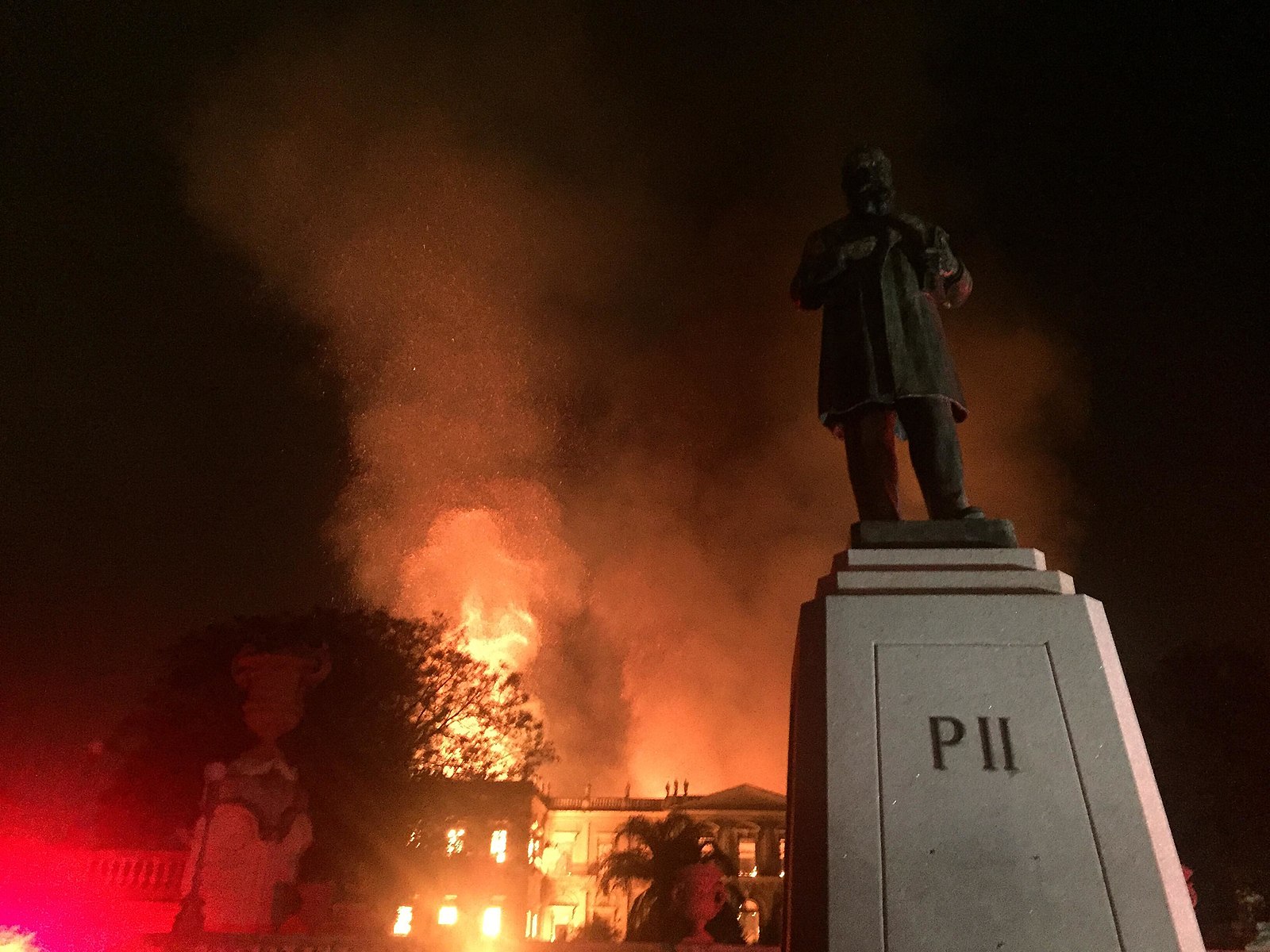
Fire at the National Museum of Brazil, in Rio de Janeiro, on 2 September 2018.

Do you remember reading about the disastrous fire at Brazil’s national museum? It was before Covid. Many irreplaceable artifacts were destroyed. I recall, for example, that the curator of entomology at the University of Texas, Austin, was devastated by the loss of that museum’s priceless insect collection.

Also lost were indigenous artifacts. But since that part of the collection had been created without tribes’ input, the rebuilding is a chance to make something better.

Mariana Lenharo and Meghie Rodrigues report at the New York Times, “In the evening of Sunday, Sept. 2, 2018, the National Museum of Brazil in Rio de Janeiro was closed, and its hallways were empty. Silent activity, however, coursed within its walls. Electricity hummed through wires connected to computers; climate-controlled storage and three air-conditioning units connected, improperly, to a single circuit breaker in the ground-floor auditorium. When one unit most likely received a surge of electricity it couldn’t handle, the overburdened system sparked. The museum’s smoke-detector system was not set. There were no sprinklers or fire doors, and a flame bloomed.

Seeing the news, staff members rushed to the building and pleaded with firefighters to let them enter and rescue something — anything. …

“Much of what was lost or severely damaged was irreplaceable: the mummy of an Ancient Egyptian priestess, a 110-million-year-old fossilized turtle, a vast collection of butterflies, the oldest known human remains in Latin America.

“The fire also obliterated an enormous assemblage of artifacts representing the cultural history of Brazil’s Indigenous populations. Masks, vases, weapons, mortars and elaborately feathered ceremonial capes dating back at least a century from the Ticuna, the Kadiwéu, the Bororo, the Tukano — at least 130 peoples in all — were gone. Researchers worked to salvage what they could from the ashes. Astonishingly, a few ceramic vases kept their original paint. One Karajá animal sculpture was found almost intact. But most ‘were fragments, scraps that would no longer be recognized by the people who made them,’ says João Pacheco de Oliveira, the head of the museum’s ethnology and ethnography division. When Ananda Machado, a social historian at the Federal University of Roraima, told members of the Wapichana people about the fire, they were devastated. ‘To them, these objects were much more than material,’ she said; they carried with them the strength of the people who made them. …

“In 2018, after 40 years with the museum, Oliveira planned to retire. But the fire pushed those plans aside. Even while mourning the tragedy, he saw possibility. Yes, the ethnographic collection was in some ways unparalleled, but he had long been vexed by what was missing from it. Many objects were collected by European travelers in the 19th and early 20th centuries who didn’t grasp the purpose that the objects served. A pot or a cape might have been chosen simply because it seemed beautiful or peculiar to a Western eye. As a curator, he found this lack of cultural context deeply frustrating.

“As an anthropologist, Oliveira was even more troubled. Since the 1970s, he has spent long periods with the Ticuna in northern Brazil trying to understand them on their own terms and to communicate their culture to a wider world. The museum was an important vehicle for his aims, but the institution came with its own inglorious history. As with other 19th-century museums, the National Museum was a repository of items plucked, purchased or plundered from Indigenous communities and had presented the people themselves as curiosities, papier-mâché figures in dioramas alongside taxidermied animals. And sometimes worse. …

“With no building to return to, Oliveira met with his team members on park benches and in cafes and explained his vision for a new collection. Indigenous people would be consulted not only about what items would go into the museum but also on how they should be identified, stored and exhibited. One of the first people he turned to was a former student named Tonico Benites.

“Benites grew up in Mato Grosso do Sul in midwestern Brazil on a reserve for the Guarani-Kaiowá, one of the country’s 305 surviving Indigenous groups. His parents never learned to read and write, but he finished high school and went on to study for a degree in education, picking up work on the side as an interpreter for anthropologists. Drawn to the questions the researchers asked, he applied to a master’s program in social anthropology offered at the museum.

“Benites’s first visit to the museum in 2006 was also his first day as a student there. Entering the ethnographic exhibition area, he saw a collection of spears and arrows and then rounded a corner. He froze, sickened. Covering an entire wall was an outsize reproduction of a woodcut from a 1557 book by the German explorer Hans Staden. The account of Staden’s captivity by the Tupinambá was immensely popular in its day, and some scholars now assert that its sensational depictions of cannibalism were used to justify European conquest of Indigenous peoples. …

“Benites raised his concerns with Oliveira, who was his research adviser. Oliveira sympathized but suggested that Benites use his research to change people’s minds. The image was removed months later, but almost a decade would pass before Benites, who had just finished his anthropology Ph.D. — the first Indigenous person to do so at the museum — began research for what he hoped would be a Guarani-Kaiowá exhibition. The fire decimated his plans. …

“The absence of Indigenous perspectives in exhibitions about Indigenous people has been acknowledged, if rarely remedied, at natural-history museums. … Unlike Indigenous groups in other countries, those in Brazil have traditionally maintained a sense of ownership over the museum, which was conceived as a museum of the nation’s history as well as of natural history, Oliveira says. Even the Wapichana, so distraught by the loss of their heritage, have committed to working with curators. Had there been arguments over ownership of older objects, the fire, in its indiscriminate destruction, made them moot. The National Museum has a unique opportunity, says Mariana Françozo, an associate professor of museum studies at Leiden University in the Netherlands. Museums in Europe would find it difficult to build a collection entirely based on collaboration, she says, ‘because they still have the old collections that carry the weight of colonialism.’ ”

More at the Times, here.

Read Full Post »

Photo: Stephanie LeBlanc
Germany has offered to cover the costs of restoring Notre Dame’s upper windows.

Since the horrendous fire at the Notre Dame Cathedral in Paris, lots of ideas for rebuilding have been put forth and numerous groups have volunteered assistance.

This post is about two of those offers: from German glass makers and from Carpenters Without Borders. I’m glad I’m not the one who has to choose among all the ideas. People get emotional about Notre Dame.

In an article at the Art Newspaper, Catherine Hickley wrote, “A year after the devastating fire at Notre-Dame cathedral in Paris, Germany has put forward concrete proposals for its role in the reconstruction including funds from the government and donors and expertise in stained glass and cathedral restoration.

“A fund-raising campaign launched in Germany a day after the fire has raised more than [$51,000 as of April 15] according to a statement issued by Armin Laschet, the prime minister of the state of North Rhine-Westphalia, and Culture Minister Monika Grütters.

‘The reconstruction of Notre-Dame offers an opportunity to become a European symbol of hope,’ Laschet said. ‘For me this reconstruction is also a symbol of German-French friendship.’ …

“The exact scope and nature of Germany’s contribution will be determined in the coming months on the basis of studies on the ground, the statement said, adding that three glass workshops at German cathedrals have the extensive expertise and experience necessary to undertake the restoration of the clerestory windows. Germany would cover the costs of restoring the upper windows, Grütters said.” More.

Meanwhile, in a France24 article, we learn of woodworkers hoping to be allowed to use their traditional techniques in the rebuilding.

“Armed with axes and hand saws, the team of 25 craftsmen and women, who belong to a collective called Carpenters Without Borders, managed to build one of the 25 trusses that made up the wooden roof of Notre-Dame that they say is identical to the original.

” ‘It is a demonstration of traditional techniques on one of the trusses of the framework of the nave of Notre-Dame that serves to show how viable these techniques are from an economic point of view on the one hand and from a technical point of view on the other,’ researcher Frédéric Epaud told AFP.

“Known as ‘the forest’ and built out of vast oak beams, the 800-year-old intricate wooden lattice of Notre-Dame’s knave was completely destroyed in last year’s fire.

“Since then debate has raged over how it should be rebuilt. Some have argued that reconstructing the original roof is impossible as sufficiently old and large enough oak trees no longer exist in France.

“Modern alternatives, such as concrete and steel have been suggested. But Carpenters Without Borders say their work proves the roof can be rebuilt in its original form without huge expense.

” ‘We, in less than a week, with 25 professional carpenters, have entirely built one of the trusses of the nave of Notre-Dame as it was before the fire. One truss, one week,’ the group’s founder and ethnologist at France’s Ministry of Culture, François Calame, told AFP.” More.

An early concept for reconstruction, featuring a glass roof and gardens, is among the many already turned down, and the goal now is to put the cathedral back the way it was. See the Washington Post.

Read Full Post »

shutterstock_1372207001

Photo: Shutterstock
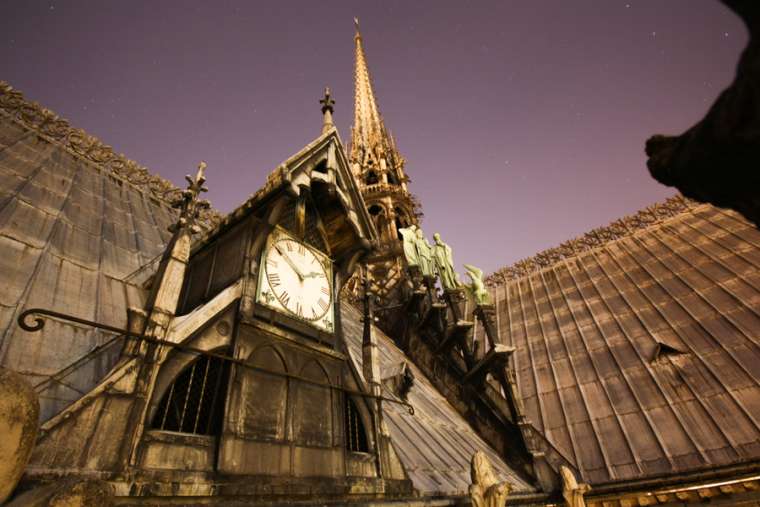
The original clock at the Cathedrale Notre-Dame de Paris was destroyed by a conflagration in April.

What is lost can often be found — or a decent replica created. That is the message of a recent story about the clock destroyed by the fire at Notre-Dame Cathedral in Paris. After I read it, I felt curious about the clock expert who realized that a different church had an almost identical clock in storage. So I looked him up. Such discoveries are not ordinarily stumbled on by people with no expertise.

The Catholic News Agency, in an item widely shared last June, reported, “A clock nearly identical to the one destroyed in the fire at Cathedrale Notre-Dame de Paris has been found in storage. The duplicate was found at the Church of the Holy Trinity in Paris, in what is being called a ‘miraculous discovery.’ …

“The original clock was located near the cathedral spire, which collapsed during the April 15 fire. It was feared there would be no way to rebuild the clock, as there were no surviving drawings of its mechanism or any digital records of how the clock was made.

“The timepiece’s near-twin was found by clockmaker Jean-Baptiste Viot, during a storage inventory at Holy Trinity. Viot called the find ‘incredible.’ …

“The Church of the Holy Trinity’s original clock was replaced by an electronic model about 50 years ago. The old clock was then put in storage, and was discovered behind a wooden board amid statues and furniture in a small storage room.”

Said Olivier Chandez, who was responsible for maintaining the clock at Notre-Dame, ” ‘If we only had the photos, we would have had to extrapolate. … But with this model, we have all the dimensions.’

“While the clocks are very similar, Chandez said that there are enough differences to prevent restorers from simply inserting Holy Trinity’s clock into the refurbished Notre-Dame.”

Here is some of the information I found on the shard-eyed Jean-Baptiste Viot [J-B Viot].

Born in 1967, he “began his training in watch repair at the Public Watch Making School of Paris in September 1983. After graduating, he went to Switzerland to continue his studies at the Technical School of the Vallée de Joux. … The federal certificate he obtained in June 1988 enabled him to pursue his training with the International Museum of Watchmaking of Chaux de Fonds … resulting, after two further years of study, in a degree in watch restoration. …

“In June 1998, J-B VIOT was hired by Breguet 7 place Vendôme, giving him the chance to return to watch restoration in Paris. Indeed, working on original Breguet movements from the historical period 1775-1840 gave him the opportunity to study this great master from the past. …

“Following the purchase of the firm by the biggest Swiss watchmaking group (Groupe Swatch), J-B decided to devote himself entirely to the restoration of antique watches and clocks.” More here.

I like to imagine how Viot felt when he saw what Trinity had at a time that all Paris was mourning the cathedral.

Read Full Post »