Feeds:
Posts
Comments

Posts Tagged ‘folk art’

Photo: Suzanne and John’s Mom.
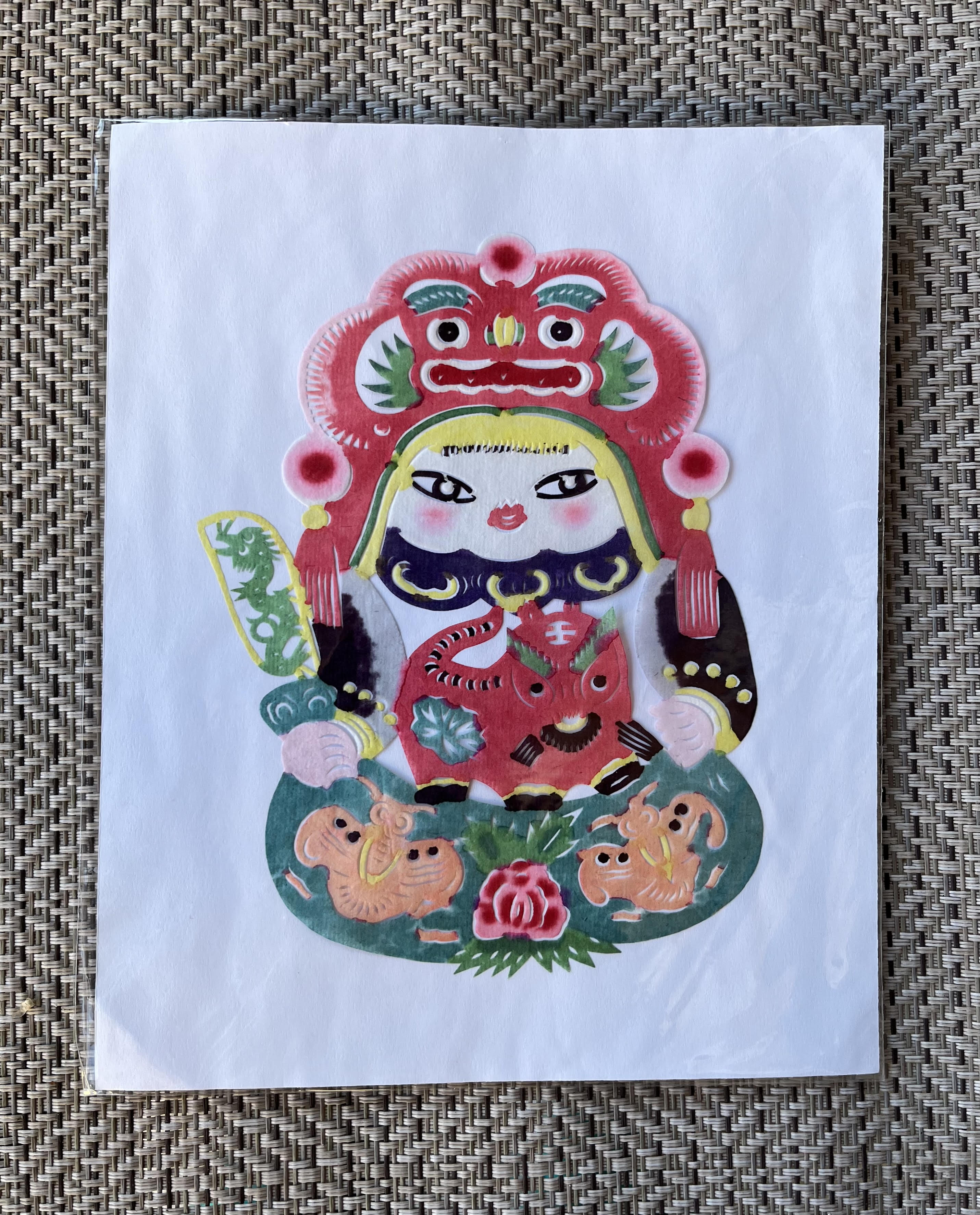
I’ve had this Chinese paper cut-out for years. I no longer remember where it came from.

Happy Year of the Dragon! The Wood Dragon to be specific. (In case you’re wondering, the other Chinese zodiac dragons are Water, Metal, Earth, and Fire.)

As China and much of the world celebrate the traditions of Lunar New Year, I want to share an article about a woman in China who is keeping another ancient tradition alive — paper cutting.

Ann Scott Tyson reports at the Christian Science Monitor, “With uncanny precision and attention to form, Yu Zeling snips away at the thin red paper. Her scissors seem to glide magically into place. After several minutes, she unfolds her creation: a bold and smiling Chinese zodiac pig.

“An award-winning master of the ancient Chinese folk art of paper cutting, Ms. Yu fills her studio with cutouts of animals, people, and scenes so vivid that they seem to leap from the walls. Rich with symbolism, her art embodies village life in Ansai, a rural district in Shaanxi province on China’s rugged Loess Plateau. Ansai is a center of paper cutting – recognized in 2009 by UNESCO as an Intangible Cultural Heritage of Humanity. …

“Ms. Yu and others are working to keep the folk art alive, even as it evolves away from its roots as adornment for farmhouses and local celebrations. Indeed, the Ansai native is serving as a rare bridge between the most skilled paper-cut artists of the 1980s – a golden era in paper cutting – and a new generation of heirs. …

“Growing up in a hamlet deep in an Ansai valley, surrounded by terraced fields, Ms. Yu came to paper cutting in the late 1970s as naturally as she breathed the earthy air. ‘We were very poor, and when it was time to celebrate the [Lunar] New Year, we all put paper-cuts in the windows,’ she says, recalling the holiday at her childhood home – a cave dug from a hillside – where her family of 10 eked out a living growing corn, beans, and sorghum. …

“The art originated in China in the centuries after paper was invented in A.D. 105. … Full of auspicious symbols from peasant life, the decorations heralded good weather, many offspring, long life, wealth, and happiness. …

“Just as Ms. Yu was beginning to learn paper cutting, after she left elementary school in 1978 at the age of 12, China’s shift toward market economics and social opening began allowing for a revival of traditional culture. Using discarded newspaper, Ms. Yu first practiced cutting the image of a Chinese national flag that she saw in a school textbook. She says she ‘cut it 100 times’ before she was satisfied. Then her aunt took over, introducing her to increasingly complicated traditional motifs. …

“Meanwhile, a research scholar named Chen Shanqiao began trekking from Ansai’s county seat into the hills and valleys to rural villages, rediscovering the true meanings embedded in the paper-cuts. Their power astonished him. In the mid-1980s, he recruited a few older village women who were masters in the craft to come teach at Ansai’s Cultural Center.

“Ms. Yu married farmer Jiang Zhicheng, who admired her passion and skill. Inspired, Mr. Jiang took a few of his wife’s works to the local market in 1987, but he couldn’t sell them. So he went farther, riding his bicycle more than 25 miles to Ansai’s Cultural Center. Seeing the fine pieces, Mr. Chen immediately bought the paper-cuts and invited Ms. Yu to come train with the master artists. …

“After years of training, Ms. Yu became a master in her own right, winning one award after another. Her works are on display in museums. But she’s humble about her achievements. ‘I was, and still am, a farmer,’ she says with a smile. … ‘I make paper-cuts based on life,’ she says. ‘Here in northern Shaanxi, we feed the pigs and till the land and care for the children.’

“Hoping to carry on and grow the folk art, Ms. Yu volunteers to teach at free community training sessions. Paper cutting is also taught in Ansai’s public schools. … As Chinese villages empty out and rural rituals fade, Ms. Yu is aware of the need to go beyond perpetuating traditions and embrace new paper-cut experiments. …

“The most elaborate paper-cut in her studio is a large and ornate circular design that weaves together layer upon layer of significance: In the center, a snake (man) encircles a rabbit (woman), symbolizing marriage. Surrounding them is a ring of pomegranates (the seeds of which represent many children), peaches (the Chinese name for ‘peach’ is also the word for ‘longevity’), and Buddha’s hands (a kind of citrus fruit representing bliss). A final outer rim, resembling a woven flower basket, also signifies longevity.”

More at the Monitor, here. Check out photos of the cutting process. No firewall.
Read Full Post »

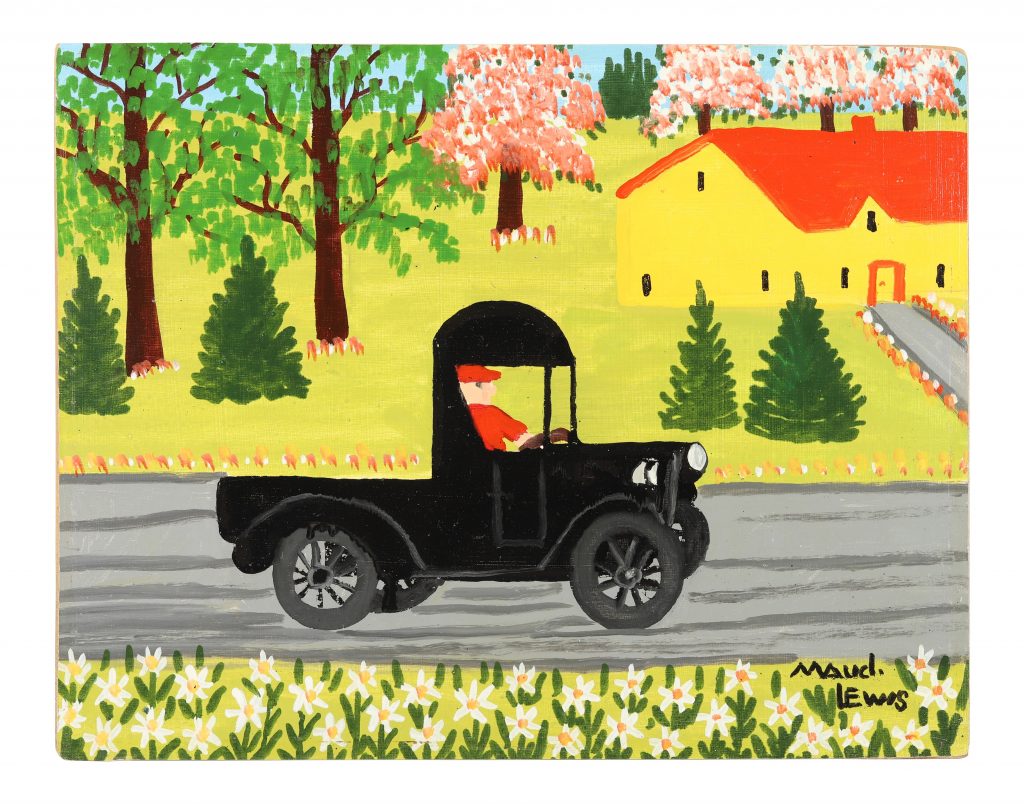
Art: Maud Lewis via Artnet.
The Maud Lewis painting “Black Truck” was once traded for grilled cheese sandwiches. Recently, it fetched 10 times its estimate at auction.

Maud Lewis was a self-taught folk artist in Canada, the kind of person no one takes seriously until they burst onto the world stage. Something similar happened to one of her paintings, “Black Truck.”

Sydney Page reports at the Washington Post, “Like clockwork, John Kinnear and his wife, Audrey, would go to the same restaurant each afternoon and sit at the table by the circular window. Kinnear would order only one thing: a grilled cheese sandwich.

“ ‘I could not convince Mr. Kinnear to have anything else,’ said Irene Demas, 69, who owned the Mediterranean restaurant The Villa with her husband Tony in Ontario for about a decade in the 1970s.

“The sandwich, priced at $1.95, was made with fresh bread from a local Italian bakery, aged cheddar cheese and a substantial smear of butter to make it perfectly crispy — exactly how Kinnear liked it.

“Kinnear, an artist, lived around the corner from The Villa, and he and his wife, both in their 50s, made it their regular hangout for several years in the early 1970s. The Kinnears, who are no longer alive, developed a close friendship with the Demases.

“ ‘My husband made a deal with them to trade food for art,’ said Demas, adding that Kinnear would often show up for lunch clutching a painting or two under his arm. ‘We needed art for our walls, and he needed to eat every day.’

“Demas said their arrangement with Kinnear wasn’t unusual back then.

“ ‘In the ’70s, it was different. We didn’t think so much about ourselves; we thought about our neighbors and how we could help each other out,’ she said. ‘They were very generous, and in return we did what we could for them.’

“Still, Demas and her husband, who is now 90, never imagined that a painting Kinnear traded them for a simple sandwich would one day be worth a small fortune.

“While Kinnear mainly brought his own work to the restaurant, he once arrived with several colorful paintings by an artist from Nova Scotia named Maud Lewis. …

“Lewis was a poor painter in Eastern Canada who could barely afford supplies, and she had suffered from crippling rheumatoid arthritis since she was a teen. Kinnear read about her in a 1965 newspaper article with the headline ‘The Little Old Lady Who Painted Pretty Pictures.’

“As a fellow artist, Kinnear was touched by her story and began sending her supplies, including brushes and paints. In exchange for his kindness, Lewis gave Kinnear several paintings. She typically sold her artwork at the side of the road for $10 per piece.

“Demas said the paintings — which Kinnear propped up on chairs in the restaurant that day — had a playful quality that intrigued her.

“ ‘I had never seen anything like that,’ she said. One in particular, featuring a black truck, ‘just jumped out at me.’ …

“The Demases had no idea that Lewis, who died in 1970, would become one of Canada’s foremost folk artists, despite never achieving wealth or prominence in her lifetime.

“Alan Deacon, an expert on Lewis’s work who authenticates her paintings, said her art skyrocketed in value after her death. …

“About a year ago, as the couple downsized their home, they decided to appraise a few items — including the black truck painting and the letters that authenticated Kinnear’s relationship with Lewis. …

“First, the Demases offered the artwork to their two children, both of whom urged their parents to sell it and enjoy the profits in their retirement. The couple decided it was time to part with the painting. …

“In a virtual auction on May 14, the painting sold for $272,548 — more than 10 times its assessed value. The letters fetched more than $54,500.

“ ‘I was just speechless,’ said Demas.

“Ethan Miller, chief executive officer at the auction house, was also stunned.

“ ‘Off the charts is an understatement,’ he said. ‘I think everybody saw in this painting exactly what Maud intended, which is brightness, optimism and fun. …

“ ‘Just given the heaviness of this era that we’ve managed to survive, suddenly someone mentions a grilled cheese sandwich and a celebrated artist that has overcome physical adversity,’ Miller said. ‘All of those things combined is as irresistible as a grilled cheese sandwich.’

“The buyer, a Canadian man who asked to stay anonymous to protect his privacy, said that was precisely what propelled him to purchase the painting. … ‘I’m not an art collector by any means.’

“The evening before the auction, he and his wife watched the 2016 film Maudie, which chronicles Lewis’s life. After learning her story of resilience, he wanted the piece.”

More at the Post, here. And if you have never seen the lovely Sally Hawkins film about the artist, Maudie, please check it out here.

Read Full Post »

Photo: Luba Petrusha via Wikimedia.
A mix of traditional Ukrainian, diasporan and original pysanky (Ukrainian Easter eggs).

Today’s story shows how artists help a country’s culture survive.

Katya Zabelski writes at Hyperallergic, “Last year, when I was writing my dissertation on the history of Ukrainian folk [art], my research found a repeated pattern: Despite long histories of suppression, erasure, and destruction, Ukrainian people often used folk art as a tool of resistance and a symbol of hope and preservation.

“During the Soviet era, artists found sly ways to incorporate folk art into their work, despite the possibility of serious consequences. During the Euromaidan revolution [of 2013], vyshyvankas (traditional Ukrainian embroidered shirts) became extremely popular and are now a part of daily fashion. …

“Now, over 100 days since the war began, there is a resurgence of Ukrainian folk art symbols throughout media, art, and everyday Ukrainian life. And for the first time, the international community is using Ukrainian folk art to show solidarity with the Ukrainian people. …

Pysanky are one of the most recognizable Ukrainian folk art forms. The decorative eggs are an indigenous art associated with Carpatho-Rusyn women in Western Ukraine; they were often planted in the ground to encourage fertility and growth. The legend goes that the fate of the world depended on the pysanka.

Each year, an evil monster, chained to a mountain cliff, sent his henchmen to see how many [decorated eggs] were created in the land. If the number of pysanky was high, then the monster’s chains would tighten up.

“If the number of pysanky went down, then the monster would be unleashed to sow destruction. As long as Ukrainians continue to create pysanky, the world continues to exist. 

“Sofika Zielyk, a Ukrainian ethnographer and pysanka artist, has organized the exhibition The Pysanka: A Symbol of Hope at the Ukrainian Institute of America in New York. … Once the war is over, the eggs will be taken to Ukraine and planted in the soil, to help rebuild and fertilize Ukraine, in line with the ancient tradition. …

“Olya Haydamaka is a Kyiv-based illustrator whose work is influenced by traditional clothing. As a response to the Russian invasion, Haydamaka has created multiple illustrations of women in traditional clothing acting as protectors and healers of Ukraine. In ‘Чернігів. Сильне коріння. (Chernihiv. Strong Roots.)’ (2022), Haydamka responds to the particularly brutal attacks on Chernihiv in northern Ukraine. The woman wears a traditional embroidered vyshyvanka with exaggerated embroidered sleeves, along with a traditional red coral namysto (necklace). The iconic St. Catherine’s Church levitates in the air, with deep red roots dangling under it. This piece not only highlights Ukrainian folk clothing but also elevates the clothes to be otherworldly and ‘healing.’ …

“Danylo Movchan, a contemporary painter from Kyiv, created ‘Struggle’ (2022) in response to news that 25 paintings by Maria Pryimachenko, Ukraine’s most loved folk artist, had been destroyed. In this work, Movchan painted a Pryimachenko-inspired creature in yellow and blue, with a tongue that attacks a dark figure to the right of the composition. …

“It was not just Ukrainian artists who were impacted by the destruction of Pryimachenko’s works. The international community has also used her illustrations to show solidarity with the Ukrainian people. The group Justice Murals, which uses the medium of murals to inspire change and action, partnered with the Ukrainian Institute to project Pryimachenko works on buildings in California. Murals featuring Pryimachenko’s work were showcased in Oakland and San Francisco, with a text that read: ‘Art bombed by Putin. Boycott Russia.’ 

“The international music community is also seeking inspiration from Ukrainian folk art. Florence Welch of Florence and the Machine has recently released a new music video entitled ‘Free,’ featuring the British actor Bill Nighy. In parts of the video, Nighy and Welsh can be seen seated in front of a backdrop of petrykivka-style flowers, painted by Ukrainian artist Katerina Konovalova. At the end of the music video, Florence Welsh makes the connection between the title, the Ukrainian folk art paintings, and the war by dedicating the song to ‘the spirit, creativity, and perseverance of our brave Ukrainian friends.’ ” 

More at Hyperallergic, here. No firewall, but memberships welcomed.

Read Full Post »

Whatever kind of art you make, I have a question for you. What matters most to you: being in the moment of making? Or the aftermath? And if you feel satisfaction in pleasing someone else with your art or joy in selling it, are those experiences all part of the making or entirely separate things?

See what the late folk artist Helen LaFrance had to say about the relative importance to her.

Penelope Green wrote the New York Times obit on the artist. “Helen LaFrance, a self-taught artist whose vibrant and intimate ‘memory paintings’ of scenes from her childhood in rural Kentucky brought her renown late in life, died on Nov. 22 at a nursing home in Mayfield, Ky. She was 101. …

“In glowing colors and sharp brush strokes, Ms. LaFrance painted church picnics and river baptisms; tobacco barns; backyard gardens with geese and children racing through them; kitchens with bushels of apples and jars of preserves shining like stained-glass windows. Her exuberant scenes of rural life invited comparisons to the work of Grandma Moses, Horace Pippin and other regional painters who drew from their memories to tell stories about a vanished time and place.

‘It’s just a way of reliving it all again,’ Ms. LaFrance told a television interviewer in 2010. The next year she told another interviewer, ‘If I do something somebody likes, well, I’m satisfied because somebody liked what I did, but I don’t think it’s important.’

“The author Kathy Moses Shelton, who, with the gallerist Bruce Shelton wrote ‘Helen LaFrance: Folk Art Memories’ (2011), called Ms. LaFrance ‘an American treasure.’ …

“Ms. Moses Shelton said in a phone interview. ‘She grew up under Jim Crow. She was 10 when the Great Depression hit. Her art doesn’t reflect the pain of that era. … Instead what comes through is joy, and the values of family and work. Her family owned and farmed their own land when sharecropping was the norm, and they were self-sufficient and lived in dignity. Her blend of personal experience, Black American culture and heritage, and her skill all come into play to make her work unlike anybody else’s.’ …

“Helen LaFrance Orr was born on Nov. 2, 1919, in Graves County, Ky., the second of four daughters. Her parents, James Franklin Orr and Lillie May (Ligon) Orr, known as Bud and Hon, grew tobacco and corn.

“Helen did not attend much school. Her parents instructed her in reading and math, and her mother taught her to paint, guiding her hand and helping her mix colors from dandelions, berries and Bluette laundry detergent. She and her sisters worked in the family fields; Helen drew after her chores were done. She recalled loving the smell of the crayons her mother would bring her.

“Ms. LaFrance spent most of her life no more than 10 miles from her birthplace. She worked in a tobacco barn and in a hospital as a cook. She made custom whiskey decanters for a local ceramics company and worked as a retoucher in a photography studio. She owned property, commercial spaces and land.” To read more of the story and to see more art by LaFrance, click here.

And speaking of outstanding, self-taught artists, I never lose an opportunity to point people to a special children’s book about WWI soldier Horace Pippin, here. You will love it.

Read Full Post »

William H. Johnson: <i>Swing Low, Sweet Chariot</i>, 28 5/8 x 26 1/2 inches, circa 1944

Art: William H. Johnson
This beautiful interpretation of the traditional spiritual “Swing Low, Sweet Chariot” was created by “outsider” artist William Johnson around 1944. Owned by the Smithsonian American Art Museum in Washington, D.C., it is traveling with an exhibition to Atlanta and Los Angeles.

Do you know the traditional African American spiritual “Swing Low, Sweet Chariot”? I love the simple and inspiring visualization of it that artist William H. Johnson painted in 1944 or thereabout. I love the humble dresses and the darling shoes and socks of the angels coming in a chariot to carry him to heaven. I love how the first angel has her hand raised in welcome and how you can see the Jordan River in the background.

I looked over Jordan, and what did I see?
(Coming for to carry me home)
A band of angels coming after me
(Coming for to carry me home)

This painting is provided as an example of “outsider art” in the New York Review of Books.

Sanford Schwartz writes, “In recent decades, a tale unfolding within the larger story of contemporary art has been our gradually learning more about, and our trying to place, outsider artists.

“Problems begin at once, with the label. It is a description that many remain ambivalent about, and often believe should be put in quotation marks, to indicate its tentativeness. The situation somewhat echoes the moment, beginning in the 1920s and 1930s, when folk art was first being taken out of attics and looked at anew, and commentators were not sure whether that term — or the labels ‘self-taught,’ ‘naive,’ or ‘primitive,’ among others — was the appropriate one or would merely suffice.

“ ‘Self-taught,’ though imprecise in its way — it has been said, for example, that most of the significant painters of the nineteenth century were essentially self-trained — has remained interchangeable with ‘folk art’ for many commentators. It is sometimes used interchangeably with ‘outsider,’ too. It strikes far less the note of a judgment from above.

“Yet ‘outsider’ catches better the quality often evident in the work of such creators of being a surprising, or possibly strange, one-of-a-kind accomplishment. Put roughly, an outsider artist is a figure who makes a body of work while operating in relative isolation, unaware of, or indifferent to, developments in the work of professional artists — though this isn’t always the case and it doesn’t mean that such a person is unaware of being an artist. Nor should it suggest that an outsider artist is a sporadic creator. Many are mightily prolific.

“An outsider artist might be someone who resolutely, and perhaps eccentrically, wants to live and work only on her or his terms. An outsider artist might be someone who has been institutionalized, or who suffers some physical impairment, which keeps the person at a remove from others. …

“Simply to give a sense of the range of such figures I would mention Bill Traylor, who was born a slave and was discovered in 1939 working out of a booth on a street in Montgomery, Alabama. His gift was for finding the most precise and elegant way to place his silhouette-flat human and animal figures on otherwise empty pages. Twisting, running, growling, and gesticulating, his characters, although not part of some larger atmosphere, seem nevertheless to conjure a vast rural universe.

“The Czech Miroslav Tichý, on the other hand, who made some of his cameras out of wood, tape, and cardboard, gave photography, in shots made mostly in the 1960s and 1970s of the women of his town — going swimming, waiting for a bus, walking away — a new dimension. He showed how offhand and blurry a photograph can be and still be evocative.”

Lots more here. The exhibition “Outliers and American Vanguard Art” can be seen at the High Museum of Art in Atlanta, Georgia, until September 30, after which it will visit the Los Angeles County Museum of Art from November 18, 2018 to March 18, 2019. If you see it, could you let me know?

Read Full Post »

There can be unexpected ramifications to keeping cats, as art forgers described in Science magazine discovered to their regret.

In an article on how experts check the authenticity of a putative Velázquez or a painting found along with mummies, Lizzie Wade writes, Investigations into the artist responsible for more modern works often have a specific goal: To figure out if the work in question is a forgery.

“Bonnie Magness-Gardine manages the Art Theft Program at the Federal Bureau of Investigation in Washington, D.C. For many years, she and other investigators had seen innumerable forgeries of the work of Clementine Hunter, a self-taught and incredibly prolific African-American painter from Louisiana.

“Many people tried to copy her distinctive folk-art style, but only two regularly succeeded: William Toye and his wife Beryl Ann Toye, a couple from New Orleans. They were so good at imitating Hunter’s style that ‘they got away with this for years,’ Magness-Gardine says.

“In 2009, the Federal Bureau of Investigation finally gathered enough evidence to confiscate the Toyes’ supposed Hunter collection, and during the raid they noticed that ‘they lived in a very modest house with approximately 30 cats,’ Magness-Gardine says.

“When forensic investigators analyzed the seized works, they found cat hair embedded in the paint — a characteristic not shared by Hunter’s authentic work. ‘That’s essentially what brought them down,’ Magness-Gardine says. William Toye pled guilty to art fraud in 2011.”

More here.

Art: Clementine Hunter/ Bridgeman Images
Picking Cotton, 1950s (oil on board), Minneapolis Institute of Art, The Ethel Morrison Van Derlip Fund. Hunter is a favorite of would-be forgers.

Read Full Post »