Feeds:
Posts
Comments

Posts Tagged ‘folk music’

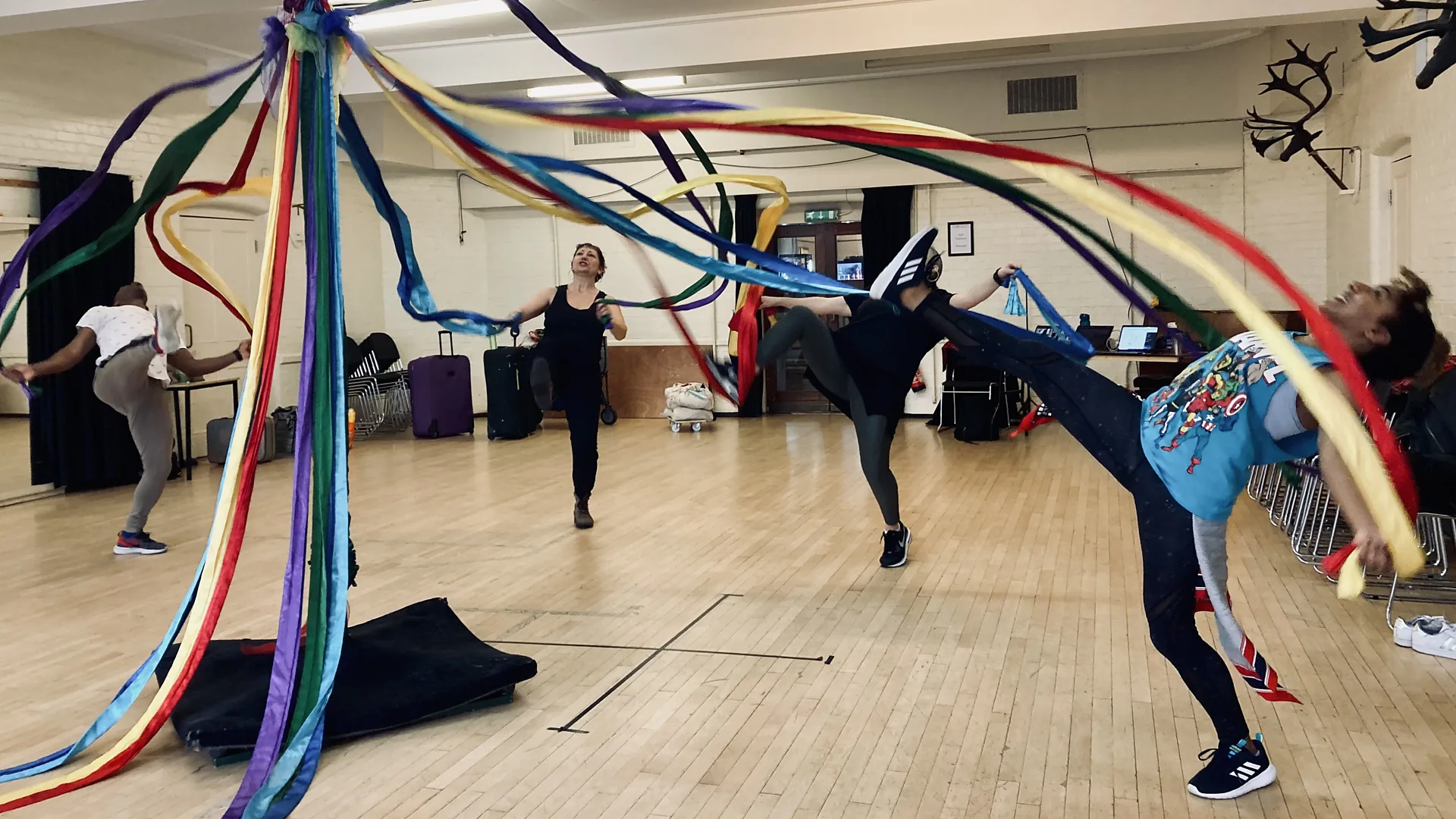
Photo: Zoey Goto.
UK’s Folk Dance Remixed combines traditions like May Day music with contemporary street dance styles.

On May Day, I was telling Diana that I had just received a surprise May Basket from my college’s local club. I have left May baskets of my own off and on since childhood, loving people’s puzzlement. Now it was time for me to wonder who I should thank.

That reminded Diana that for years she went to New York City’s Riverside Park on numerous May firsts to see the Morris dancers perform.

Nowadays, May 1 is associated with the international labor movement, and that’s a fine thing, too. But I am usually conscious of a different, more ancient celebration underneath it all.

Today’s story is about reimagining traditions like the Morris dancing of May Day for a new age.

Zoey Goto wrote at the BBC, “Camden’s Cecil Sharp House has been questioning the very notion of what traditional British music means in the multicultural 21st Century.

” ‘Hip-hop is the folk dance of today,’ said Natasha Khamjani, breathing heavily. They’re both social dances created for crowd participation, both also existing on the fringes of the mainstream, she added. Khamjani was taking a quick break during a rehearsal of a high-energy performance blending Bollywood moves and English country dancing with the unmistakable bounce of hip-hop moves.

“In an unexpected twist, Khamjani and her troupe were also dancing under a rainbow of swirling maypole ribbons – a sight more commonly associated with English village fetes rather than a basement in inner-city London. …

“For Khamjani, artistic director of Folk Dance Remixed, a collective putting a global spin on old-time English dances, a natural synergy exists. These are the dances of the people, bubbling up from the streets, pubs, village greens, dance halls and international communities that birthed them, Khamjani explained. An easy fit between age-old English country dances and house music exists, she pointed out. ‘It sounds weird but the steps are basically the same,’ she laughed. …

“Remixing maypole dancing is just one of the myriad ways that English folk culture is currently having a reboot, thanks to a new wave of switched-on folkies diversifying the scene. At the heart of this progressive movement is the Cecil Sharp House, a music venue and folk arts centre that’s home to the English Folk Dance and Song Society (EFDSS) and where Folk Dance Remixed perform regularly.

“Named after Cecil Sharp, a folk music enthusiast who roamed the countryside of England and the US South collecting folk music and dances in the early 20th Century, this temple to vernacular culture threw open its Arts and Crafts-style doors in 1930. …

“Over the last few years, the EFDSS has ramped up its outreach efforts to engage new audiences, mixing diverse cultural traditions to create new interpretations of ‘Englishness.’ Projects have included teaming up with musician Kuljit Bhamra, pioneer of the British Bhangra sound, an upbeat musical style that mixes traditional Punjabi beats with Western pop, to uncover similarities between 18th-Century traditional Kentish jigs and Bhangra music. There have been sea shanty lessons with rap verses taught to schoolchildren; and feminist-themed pop-up events, including a recording of the podcast Thank Folk for Feminism at the house.

“Certain projects have undeniably chimed easier than others. Take for example Queer Folk’s Queer Ceilidh parties hosted at Cecil Sharp House, where evenings of LGBTQ ceilidh dancing and drag acts have proved a sell-out success. …

“Joining me in the main hall at the Cecil Sharp House beneath a whimsical mural of folkloric creatures and abstract dancing figures, Katy Spicer, the chief executive and artistic director at EFDSS, pointed out that it is, however, a work in progress making the English folk scene truly inclusive. ‘In terms of diversity, ethnicity has been the hardest challenge’ she said. …

” ‘There was perhaps a tunnel vision back then and histories not recorded, which no one questioned until recently. We’re working to set the record straight,’ Spicer said, as a group of teenagers, part of the National Youth Folk Ensemble, shuffled onstage to tune violins ready for the evening’s show. ‘Particularly when you have English in your title, you have to address what it means to be English and whose England is it?’ …

“Exploring some of these overlooked histories and racial crosscurrents is Cohen Braithwaite-Kilcoyne, a singer, musician and rising star of the folk scene, who in 2021 collaborated with the EFDSS on the Black Singers and Folk Ballads project. The work explored links between English folk and music-making among enslaved people in former British colonies in the US Southern states and the Caribbean.

” ‘I’d always been aware that there are songs and ballads that crop up across English folk music traditions and the music of Black America and the Caribbean, but perhaps hadn’t quite realised the extent of the shared repertoire,’ he told me. ‘These songs started life in Britain and migrated with the people to the Americas. It seemed that there was a certain amount of cultural exchange between the white colonizers and Black enslaved people,’ he said of his research, which unearthed examples of similar storytelling and melodies across the three traditions. ‘But the very nature of folk song means that as it’s passed along orally, you get an evolution.’

“Often still viewed as a relic from a dusty, bygone era, folk has also long struggled to attract a younger, hipper crowd. But things look set to change.”

More at the BBC, here. No firewall.
Read Full Post »

Photo: EllaJenkins.com.
Ella Jenkins is the best selling individual artist in the history of Smithsonian Folkways Recordings. She introduced children to music from around the world and never talked down to them.

Today we learn about a folksinger whose unorthodox approach revolutionized music for children. Her name is Ella Jenkins.

Laurel Graeber writes at the New York Times, “When Ella Jenkins began recording young people’s music in the 1950s and ’60s, her albums featured tracks that many of that era’s parents and teachers would probably never have dreamed of playing for children: a love chant from North Africa. A Mexican hand-clapping song. A Maori Indian battle chant. And even ‘Another Man Done Gone,’ an American chain-gang lament whose lyrics she changed [into] a freedom cry.

“ ‘She found this way of introducing children to sometimes very difficult topics and material, but with a kind of gentleness,’ said Gayle Wald, a professor of American studies at George Washington University and the author of a forthcoming biography of Jenkins. ‘She never lied to them. She certainly never talked down to them.’

“Jenkins’s unorthodox approach became a huge success: … A champion of diversity long before the term became popular, Jenkins helped revolutionize music for the young, purposefully encouraging Black children. In addition to introducing global material, which she often recorded with children’s choruses, she wrote original, interactive compositions like ‘You’ll Sing a Song and I’ll Sing a Song,’ now part of the Library of Congress’s National Recording Registry. …

“You might think that Jenkins, [100], would now want to relax. … What she would really like to do — although her fragile health prevents it — is to perform again herself. ‘I want to get well and get back on the job, where I’m working with other people, working with children,’ she said. ‘I work with them, and they work with me. I enjoy work.’

“Jenkins’s efforts, which comprise more than 40 recordings, began on Chicago’s South Side, where she grew up. Although never formally trained as a musician, she learned harmonica from her Uncle Flood and absorbed a variety of musical traditions through neighborhood moves and jobs as a camp counselor. After graduating from what was then known as San Francisco State College, she directed teen programs at the Chicago Y.W.C.A., which helped cement her love for children. Her street performances led to an offer to do young people’s music segments on local television, a debut that would be followed years later by appearances on shows like Sesame Street and Mister Rogers’ Neighborhood.

“ ‘Her curiosity is so insatiable,’ said Tim Ferrin, a Chicago filmmaker who is completing a documentary, Ella Jenkins: We’ll Sing a Song Together. He added, ‘I think she saw herself as a conduit, as somebody who could then share that enthusiasm, share that understanding.’

“Often called ‘the first lady of children’s music,’ Jenkins captivated her listeners because she presented music not as lessons but as play. A charismatic performer whose accompaniment often consisted of only a baritone ukulele and some percussion, she encouraged her young audiences not to sit still but to get up and move. Using a signature call-and-response technique that she adapted from African tradition and artists like Cab Calloway, she engaged her listeners in a musical conversation, even if they didn’t understand what they were singing.

“ ‘She made it very immediate and not exotic,’ said Tony Seeger, an ethnomusicologist and the founding director of Smithsonian Folkways. … At a Chicago convention of the National Association for the Education of Young Children in the 1990s, he recalled, so many members tried to crowd into a Jenkins concert that the organizers shut the doors. Those excluded responded with frenzied knocking.

“ ‘It was astounding, her popularity, and also the insistence with which these preschool teachers were pounding on the door,’ Seeger said, chuckling in a video interview. ‘I mean, you don’t think that they would do that sort of thing. But they did.’ ”

More at the Times, here.

Read Full Post »

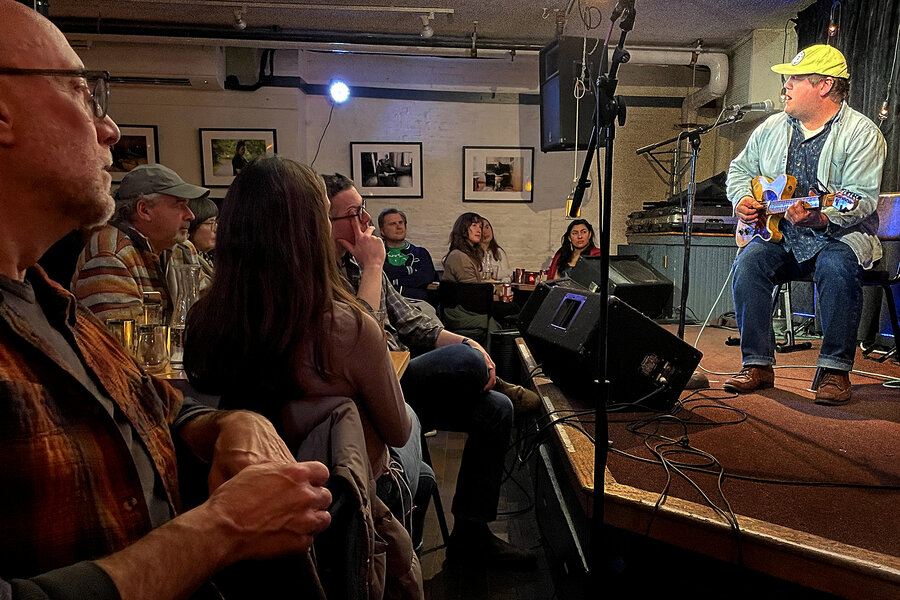
Photo: Melanie Stetson Freeman/CSM Staff.
Folk musician Jake Xerxes Fussell performs at Club Passim, one of his favorite venues, in Cambridge, Massachusetts.

My son has a goofy impression of who I was in the 1960s. He describes some kind of hippy personality, which I never had. I was more of a folkie — in the sense that I loved folk music and followed that crowd, went to those concerts.

I don’t think folk music has been cool with young people for many years, but I was interested to read at the Christian Science Monitor about one young musician who is keeping it alive and moving it forward. Simon Montlake has the story.

“In the summer of 1993, Fred Fussell, a folklorist and museum curator in Columbus, Georgia, packed his family van for a monthlong road trip to document the crafts and traditions of Native American tribes. He brought along his son, Jake, who had just finished fourth grade and was riding shotgun, where he kept a daily tally of roadkill.

“That summer, the Fussells visited artisans from Native communities in Oklahoma, Texas, and Louisiana, those whose forebears had been expelled from the Southeast in the 1800s but kept alive their spiritual ties to the land. Jake took charge of a Sony tape recorder. He taped his father’s interviews, learning to ‘sit back and shut up’ while people talked, which ‘is the key to good documentation,’ says the elder Mr. Fussell.

“His young son also recorded performances, which included music. … Jake liked vernacular arts and crafts, and he showed an early talent for drawing. But what lit his fire were the songs he heard at folk festivals his father put on in Georgia, songs that had been passed down from generation to generation and performed like the oral traditions of Homeric verse. …

“ ‘I always knew I would play music because music was the thing that was a constant source of joy,’ the younger Mr. Fussell says today.

“His family’s circle of friends included musicians, from blues singers to bluegrass pickers, and veteran collectors of traditional songs who never stopped looking for more. … From this unusual upbringing, Jake Xerxes Fussell has emerged as one of the most singular interpreters of folk music and all its tributaries. …

“ ‘He’s a real-deal folk singer. And there’re not very many of those,’ says Eli Smith, organizer of the Brooklyn Folk Festival. …

“From spirituals and jigs to fiddle tunes and sea chanteys, folk music is part of America’s cultural bedrock. It has long braided commercial music – from the folk revivalists of the 1950s and 1960s, who include Pete Seeger and Bob Dylan. …

“Some traditional songs arrived with the European migrants who brought their fiddles and hymnbooks to Appalachia and other regions. Others sprang from the Black experience of enslavement and freedom. …

“Mr. Fussell draws on that inheritance to create music that sounds both contemporary and timeless. His creative process carries him down rabbit holes of archival research and experimentation with musical motifs, even while tinkering on his guitar at home or on tour.

“He adds melodies when none exist and transposes verses, acting as both a caretaker and a remodeler of songs. …

“He started as a toddler on pots and pans, banging out rhythms at home. Then he got a drum kit and was ‘immediately good,’ says Coulter Fussell, his older sister. … From drums, Mr. Fussell moved to the upright bass, which he learned at school from a teacher who played in a bluegrass band. When he was 13 years old, his teacher asked him to take over as the bassist at a weekly gig at a barbecue restaurant.

“ ‘Everybody went there on a Friday night,’ says Ms. Fussell, who is now a quilter in Water Valley, Mississippi. ‘The band would play, and it was these scruffy grown men and then little Jake up there.’ …

“He was also listening to rock and hip-hop on the radio and going to shows, including of Georgia’s R.E.M., whose lead singer, Michael Stipe, had studied drawing with Mr. Rosenbaum at the University of Georgia. But rock bands lacked the raw passion and poetry of the traditional songs he heard growing up. ‘None of that stuff really spoke to me in any real deep way,’ he says. 

“Mr. Fussell also fell hard for the music of Mr. Dylan, whom Mr. Rosenbaum had known in Greenwich Village in the early 1960s. But it was another local musician and family friend, Precious Bryant, who would influence Mr. Fussell’s rhythmic guitar picking and give him a taste of life on the road.

“Since Ms. Bryant, a country-blues artist, didn’t drive, it was Mr. Fussell’s mother, Cathy, who would drive her to shows. Her eager son began to take that role once he got a driver’s license. He would also visit Ms. Bryant at her rural trailer home, bringing along his guitar. ‘She would play, and I would play along,’ Mr. Fussell says. 

“ ‘Jake always liked older people. He liked listening to older people. He liked hanging around with older people,’ says his mother, a retired English teacher and quilter.”

Lots more at the Monitor, here. No paywall. Tiny Dest Concert at YouTube here.

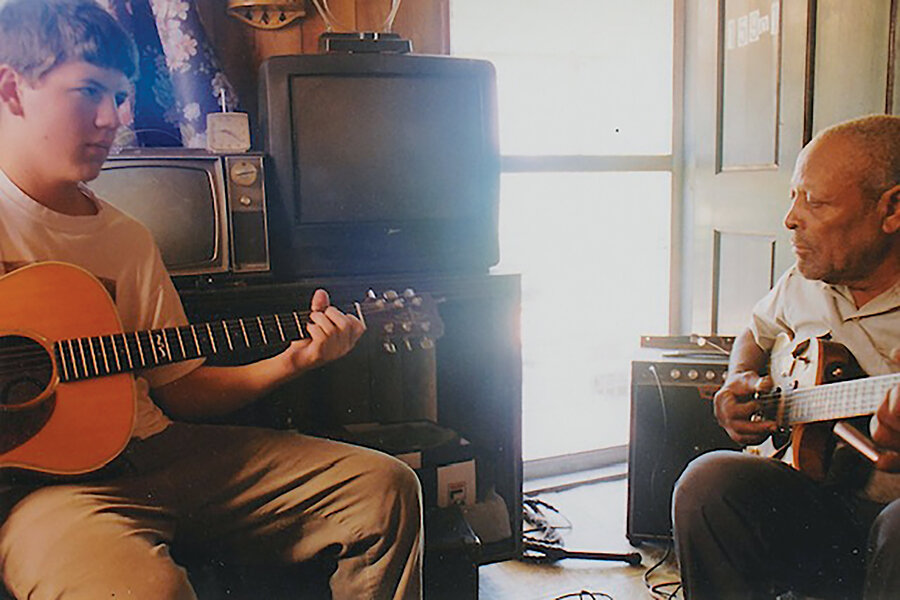
Photo: Jake Xerxes Fussell
As a youngster, Jake Xerxes Fussell soaked up the wisdom of older generations. Here he is jamming with George Daniel, a blues musician, in Macon County, Alabama, around 1996.

Read Full Post »

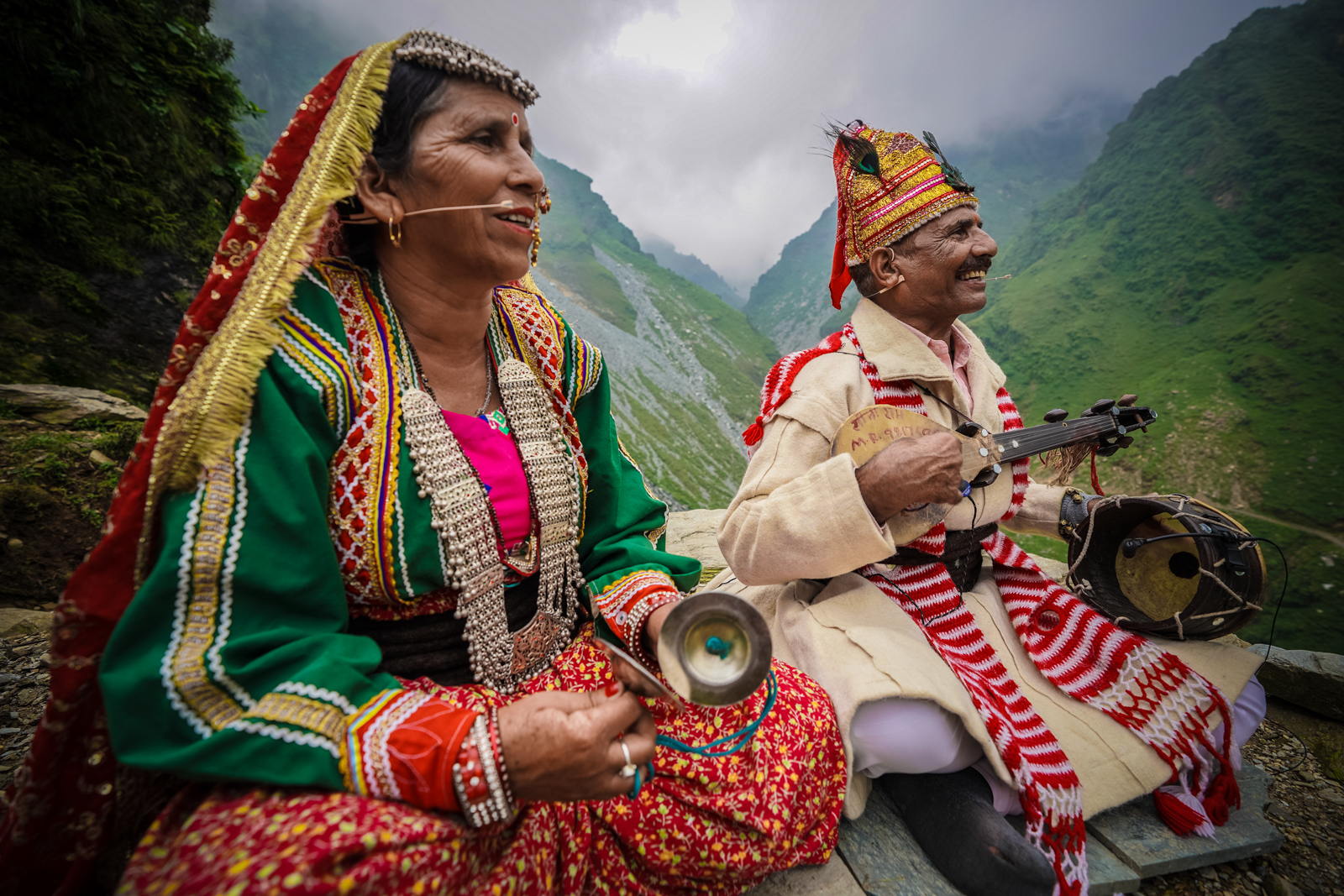
Photo: Ozy.
Thirty-year-old Abhinav Agrawal is helping India’s rural folk musicians survive and thrive. He uses a backpack studio developed by Latin Grammy winner Gael Hedding to go where the musicians are.

If there’s a moral to today’s story, it might be, “Stay close to your interests, to things you love.” Young Abhinav Agrawal loved India’s rural folk music.

As Tania Bhattacharya reported at Ozy in fall 2020, “In 2016, Abhinav Agrawal set off to Rajasthan to record folk musicians on the go and set them up with CDs, a website, videos and business cards free of cost so they can market themselves.

“His first find was Dapu Khan of the Merasi heritage community in Jaisalmer. But after Agrawal returned home to New Delhi, he couldn’t contact Khan. ‘We suddenly saw an article in the paper that claimed he had died as a result of communal violence,’ says Agrawal. Heartbroken, the musician-entrepreneur headed to Jaisalmer to look for Khan’s son, who began to cry the moment they met.

“As Agrawal consoled him, Khan’s son was surprised to hear his father had died. ‘But he’s in Germany, performing!’ The tears were of joy and gratitude, and Agrawal’s experiment of empowerment had succeeded.

“India’s countless folk communities are in dire need of funding and technical and creative upskilling to revitalize themselves in an increasingly globalized world. Live and festival-centric performances, which is all these musicians have known through generations, barely bring in money, and an online presence has become mandatory for creative mileage. Many music traditions are dying out, with practitioners taking up menial labor to make ends meet. And the pandemic has dealt a fatal blow, with performances off the table for the foreseeable future.

“Cue 28-year-old Agrawal, whose passion for folk music birthed the nonprofit Anahad Foundation in 2012, and the creation of the BackPack Studio that remains one of a kind in India. Developed by Latin Grammy winner Gael Hedding for Anahad, the portable recording studio is a high-quality wireless recorder with 12 mics that can run on battery for three days and shoot 4K videos. It’s designed to meet rural Indian challenges such as lack of electricity and the unwillingness on the part of musicians to leave their hometowns (and daily livelihoods) to travel to studios in cities.

“Anahad, meaning ‘limitless,’ is also aimed at preserving India’s oral folk traditions, and has extensively covered artists from Himachal Pradesh, Jharkhand, Karnataka, Punjab and Rajasthan — helping 6,000 artists in all.

“Born and raised outside New Delhi in the historic city of Bulandshahr, Agrawal is a trained classical vocalist and tabla player, and was heavily influenced by folk songs. Much of the region’s traditional music revolves around nature and seasons, and Agrawal ‘felt closer to nature through music.’ Growing up, his town was very green, but rapid urbanization adversely impacted its scenic beauty.

‘When components of nature like the trees and birds began to disappear, the tradition of singing songs about them also began to die,’ Agrawal adds.

“With architects for parents, Agrawal also studied architecture but combined his love for nature and heritage by exploring the connection between music and urban spaces, because ‘architecture is frozen music.’ He formed an open music society, experimented with folk songs and set off on lengthy train journeys recording traveling artists and burning CDs for them. ‘All I had was a laptop, mic and sound card,’ says Agrawal. ‘But an interesting pattern emerged — these artists began to sell out their CDs.’

“He formed Anahad soon after, but the reality of running a nonprofit in India proved daunting. ‘I realized I needed business knowledge,’ says Agrawal. He headed to Berklee College of Music for an advanced degree, writing a thesis on how to design a music-based nonprofit in India.

“His organization now attacks all elements of a musician’s life, from approaching event promoters to legal tutorials. The idea has always been to empower these musicians toward dignified livelihoods as opposed to giving them handouts, which is unsustainable. Many singers have broken down in tears listening to their playbacks because they couldn’t believe how beautiful they sound. …

“Having raised some $400,000 over the years from the likes of Google as well as author and philanthropist Sudha Murthy, Anahad is now developing its own music distribution system via an app that will allow artists to earn through streaming. …

“ ‘His compassion for artists is beautiful, with no sense of envy despite being a musician himself,’ says partner and Anahad managing director Shuchi Roy. ‘At the same time, he is very tactical in thought.’ Roy, who is a lawyer and has practiced in India’s Supreme Court, handles all copyright and intellectual property issues for the nonprofit.

“Like a musical score, Agrawal’s journey has had its highs and lows — his music society’s first-ever recording that is yet to be released because the lead singer died a week after recording; dealing with depression after returning to India from Berklee in 2016; and making it to Forbes’ 30 Under 30 list last year. ‘Whenever I’m frustrated with work, I play my music and instantly feel better,’ he says. ‘Now I carry my guitar everywhere.’ ”

More at Ozy, here. There’s music on Spotify, here.

Read Full Post »

nahkofinal2

Photo: Michael Pierce
Nahko & Medicine for the People performs at the Four Corners Folk Festival in 2018. Recently, a local radio station agreed to take ownership of the festival.

There’s an Allen Ginsberg poem I love to the effect that sometimes things mysteriously appear just when they are needed. I thought of that poem when I read about a small radio station in Colorado’s Four Corners area taking on live shows it never imagined it could afford.

Braeden Waddell wrote about this at Current last summer.

“Public radio station KSUT in Ignacio, Colo., will assume ownership of two annual music festivals Sept. 30 as part of an agreement with local nonprofit organization FolkWest.

“No money will change hands as part of the arrangement. KSUT Executive Director Tami Graham said that the transfer of the Four Corners Folk Festival and the Pagosa Folk N’ Bluegrass Festival, both three-day events held in Pagosa Springs, Colo., was ‘an incredible donation’ to the station.

“The organizations had developed a relationship through a partnership of more than two decades, with KSUT sponsoring FolkWest in exchange for live studio sessions featuring artists playing for the festivals.

“ ‘My biggest goal with the acquisition of the festivals is just to maintain a really high level of production quality and a great experience for the musicians as well as the attendees,’ Graham said. …

“The decision was made after FolkWest Executive Director Crista Munro took on a new position heading the Sisters Folk Festival in Sisters, Ore. …

“ ‘It was a bittersweet moment for me, knowing that my chapter at the helm of FolkWest would be ending,’ Munro said in a post on KSUT’s website. ‘KSUT always seemed like a natural choice to take over our events. They do an amazing job with everything they produce, and Tami Graham brings a ton of live music production experience to the table.’ …

“Munro told Current that KSUT ‘believed in the vision’ she and her husband had for the festivals. ‘If it were anyone else taking this on, I would be a lot more nervous,’ she said. …

“In an interview with the Colorado Bluegrass Music Society, Munro said that the Folk N’ Bluegrass festival brings in about 2,000 attendees per day and the Four Corners Folk Festival draws nearly double that. …

“KSUT does not plan to make any ‘significant changes’ to the festivals but does aim to expand FolkWest’s Pagosa Folk N’ Bluegrass Jam Camps, which provide three days of music classes for adults and children.

“ ‘There’s a lot of grant funding available for music education … to support bringing in world-class stringed instrument musicians, for example, that want to want to teach and work with adults and youth,’ said Graham. … ‘This is just a perfect fit.’ ”

More here.

Read Full Post »

This is the story of how a song saved a cultural center in the Catskills.

Dennis Gaffney writes for the NY Times that at a recent celebration of success,  “Jay Ungar, a fiddler wearing a black vest and hiking boots, and his wife, Molly Mason, playing guitar, stood on a stage in a barnlike performance hall that did not exist a year ago. ‘Can you stand to hear this tune one more time?’ he asked the audience. …

“The tune is ‘Ashokan Farewell,’ the bittersweet lament familiar to millions as the theme song that the filmmaker Ken Burns used for the emotional crescendos of his Civil War series. But most do not know that Mr. Ungar’s moving hymn helped save the Catskill place that inspired the song, resulting in the Ashokan Center, a $7.25 million campus here dedicated to traditional music, Catskill history, environmental education, and local arts and crafts. …

“Many still assume that Mr. Ungar wrote ‘Ashokan Farewell’ with the Civil War in mind. But he wrote it on a September morning in 1982, after the end of his third Ashokan summer music and dance camp on this property, which the State University of New York at New Paltz owned and had used since 1967 as a field campus for environmental education.

“ ‘I left on a cloud of utopian euphoria,’ Mr. Ungar said of that summer. ‘You try to keep it alive, but it evaporates.’ ”

The song went on to have a life of its own, and Ungar even performed it at the White House. NY Gov. Pataki had heard it, too, and when a dismayed Unger contacted him about the pending sale of the Ashokan Center in Olivebridge,  the governor took action.

Soon a lot of people were on board, with the wistful song always at the heart of their efforts.

Writes Gaffney, “Mr. Ungar has come to believe that his song, like a traditional hymn, evokes much more than loss. In the mid-1990s, he got an e-mail from a man in Africa who said he was driving in his car when he heard ‘Ashokan Farewell’ on the radio. ‘He started crying uncontrollably and he had to pull off the road,’ Mr. Ungar recalled. ‘He said that in his culture, after the age of 10, men don’t cry, but he needed to cry.’ ”

More.

Photo: Nathaniel Brooks for The New York Times
Jay Ungar and Molly Mason playing “Ashokan Farewell” at the Ashokan Center.

Read Full Post »

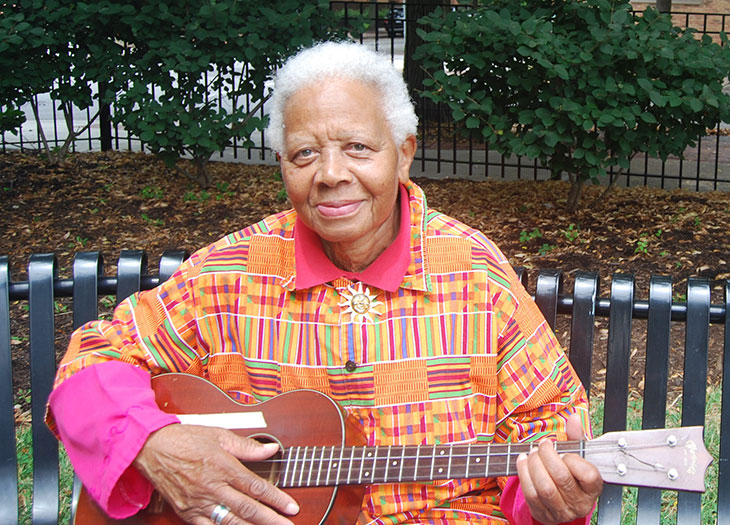
A 91-year-old Hindu gentleman has joined the tai chi chuan class I take Saturday mornings. His wife brings him a little after we have started, and he walks slowly between the wall of mirrors and the line of practicing students to sit in a folding metal chair, where the teacher explains the upper-body part of the exercises so he can join in. Age has not kept him from that.

After today’s class, I was driving home and heard Susan Stamberg interview Marian McPartland, 94, here, on National Public Radio. A fantastic jazz pianist, McPartland recorded her last Marian McPartland’s Piano Jazz show only two years ago — after 33 years — but continues as artistic director. She is also the subject of a documentary called In Good Time that highlights the day in August 1958 when she was part of a famous photo of jazz greats in Harlem, below.

Speaking of nonagenarians, folksinger and activist Pete Seeger, 93, showed up on Colbert recently. At first I thought he was not answering a question and was wandering, but it soon became clear he was unfurling a story in his own way and that it would end precisely on point.

Seeger still splits logs to heat his house with wood. And his banjo playing hasn’t aged a bit.

Photograph: Art Kane/Art Kane Archives

Read Full Post »

The bimonthly magazine called the Utne Reader likes to showcase alternative and contrarian views on the news. Here’s a sort of hands-across-the world story about taking bluegrass music to Afghanistan.

“My name is Peyton Tochterman. I’m a musician from the Blue Ridge Mountains of Virginia. I make my living writing, teaching and performing American Folk music—the music that tells stories in notes, chords and verse about who we are and what we Americans are all about. And I’m now in war-torn Afghanistan. …

“In little more than a week we have already met thousands of Afghans and found them to be kind, generous, hospitable, talented and honorable. They take great pride in their heritage and culture, but they also have a thirst for American Folk Music, for the stories we tell, our instruments and the way we play. The Afghan musicians with whom we played are some of the best in the world and were eager to share their masterful techniques and songs.

“Some might ask, ‘What difference can a folk singer from the Blue Ridge Mountains make in a tortured place like Afghanistan?’ It’s a valid question—partly answered by one of the State Department officers who said our visit did ‘more for diplomacy between Afghanistan and the United States than any diplomat had done, more then any road that was built, or any power plant that was constructed in the last year.’ ” Read more.

Photograph of Peyton Tochterman: The Utne Reader

Read Full Post »