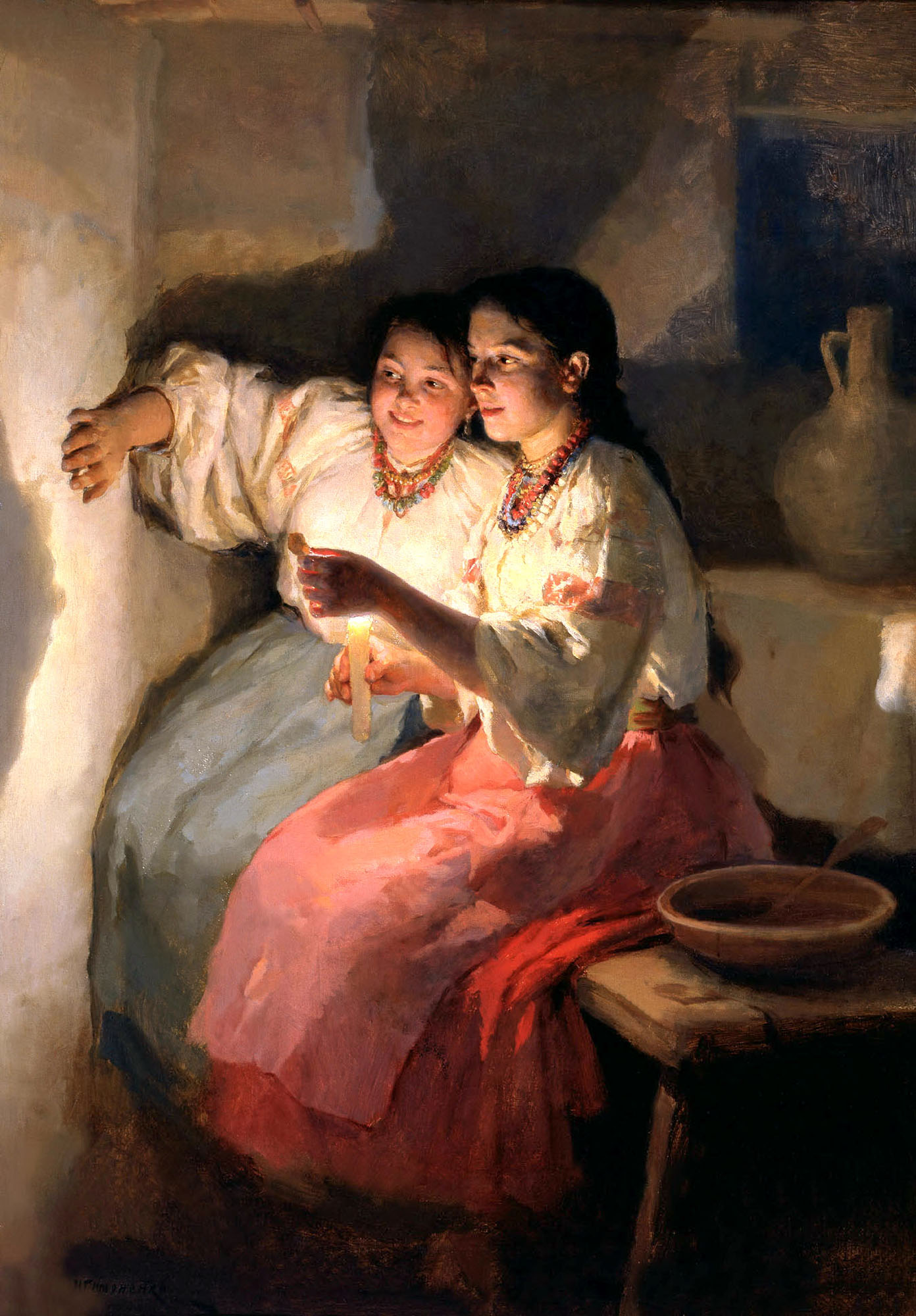
Photo: Ivan Honchar Museum.
Witchy arts are part of Ukrainian folklore. The girls in the painting above (Divination by Mykola Pymonenko, 1888) are trying to predict the future.
Somehow, even in wartime, artists’ imaginations keep creating. Today’s story is about a new Ukrainian play that has captured the country’s attention.
Ashley Westerman at National Public Radio [NPR] tells us that “even though the plot takes place centuries ago, the play’s takeaways and parallels to today resonate with Ukrainians.”
Here are excerpts from the NPR transcript.
“Westerman: In the early days of Russia’s full-scale invasion of Ukraine, a video surfaced online – a woman shouting at a Russian soldier sitting atop a tank. …
‘Do you even know where you are? You’re in Konotop,’ shouted the woman off-screen. ‘Every second woman here is a witch.’ …
“The video went viral in Ukraine, not just because of the woman’s defiance, but also because Konotop, a city in the country’s far northeast, is a place associated with witches. ‘Witches are a part of Ukrainian culture and Ukrainian tradition,’ says Khrystyna Fedorak, so you can rely on something having to do with witches going viral. This is one of the reasons the play Fedorak is currently starring in at the Ivan Franko Theater in the capital, Kyiv, has become a summer blockbuster. Fedorak plays the witch in the dark musical comedy The Witch Of Konotop.
“Based on the 1833 satirical fiction by Ukrainian writer Hryhorii Kvitka-Osnovianenko, this story leans hard on the stereotype that Ukrainian literature is full of sadness and tragedy. Taking place in the 1600s, the audience follows the main character, Zabryokha, a Cossack military leader in Konotop, pursuing the lovely Olena, but she rejects his proposal. She loves someone else. In this scene, Pistryak, Zabryokha’s cunning assistant, tries to confuse Olena’s love interest by accusing him of crimes he didn’t commit. …
“Then, in a twist of events that sounds a lot like today, Zabryokha receives an order to join a military campaign to help the Cossacks fend off an overreaching Tsarist Russia.
” ‘They order us,’ Pistryak says, ‘to take our Cossacks in Konotop to join the main army. There may be drills, or there may be war.’
“But Zabryokha refuses to go, saying he needs to stay in Konotop to root out the witch problem — the root, he says, of everyone’s problems. What ensues is a string of ridiculous, funny and very human moments. Spells are cast, couples are wed and, of course, there’s a witch hunt, meaning a swim test. If you’re not a witch, you drown. If you are a witch, you don’t.
“All with a larger threat looming over everything — Russia. But while that might be the most obvious takeaway from The Witch Of Konotop, the cast has some of their own ideas.
“Kateryna Artemenko: Don’t kill women (laughter). Don’t mess with women. …
“Westerman: Artemenko plays one of the townswomen mistaken for a witch. …
“Artemenko: The main message is about people who — they’re trying to fool their destiny, but destiny will find them.
“Westerman: Nazar Zadniprovskiy, who plays the ill-fated Cossack commander, views this play as a lesson in avoiding responsibility. … Zadniprovskyi says many people see a parallel with Ukrainian men dodging conscription today. …
“As the play ends and the theater’s mustard-yellow felt curtain drops to a thunderous applause, producer Polina Lytvynova and I ask a few audience members what parallels they drew. Olha Vasylevska is from Kharkiv, the northeastern Ukrainian city currently fending off an intense Russian offensive. She thinks the play is about love.
“Olha Vasylevska: (Through interpreter.) If the love is true, it doesn’t need any outside assistance … but if the love is not true, nobody and nothing can help it, even the witch.
“Westerman: Markian Halabala, from Kyiv, says the message he took away is that you shouldn’t interfere in God’s will.
“Markian Halabala: (Through interpreter.) This is like Putin. He interfered in natural Ukraine’s way of independence. And Russians, they try to stop and prevent, like, [the] natural way of Ukrainian history with this war.
“Westerman: Critics say the many takeaways The Witch Of Konotop offers its audiences is one reason it’s been so popular. … But another reason is the overall push to celebrate Ukrainian culture and literature. Putin has repeatedly said victory, to him, means nothing short of Ukraine losing not just their sovereignty, but also their identity.”
Finally, Westerman spoke to Mykhailo Kukuyuk, who plays Pistryak. He speaks of the value of his country’s arts: “What are we fighting for? it’s the details, the sparks, that make us alive.” He adds that, while it’s sometimes difficult to block out the events happening outside of this theater, it’s an honor to perform for his country.
More at NPR, here.



 Suzanne's Mom's Blog