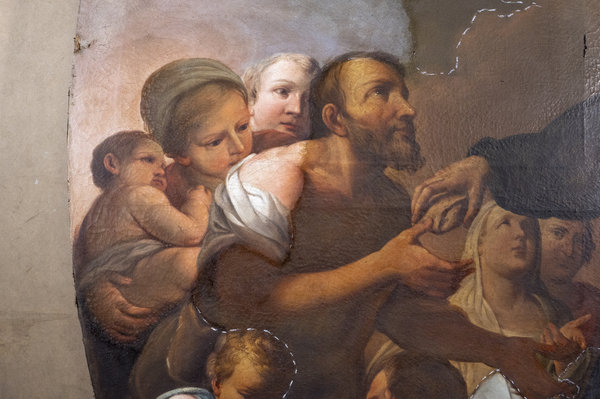
Restoration experts are working on Violante Ferroni’s painting Saint John of God Feeds the Poor.
An arts foundation in Italy asks, Where are the female Renaissance artists? Although many women who might have pursued some kind of art were probably bent over a tub of suds, there are others who created but are forgotten.
Sylvia Poggioli reported at National Public Radio’s “Weekend Edition” about new efforts to right centuries of wrong.
“Florence is one of the main stops on any art lover’s European itinerary. At the Uffizi Galleries, visitors can have their fill of works by Renaissance masters Leonardo da Vinci, Michelangelo and Raphael. Of course, none of these artists are women.
“In 2009, a new nonprofit foundation in Florence started to investigate why.
” ‘I started going into museum storages and attics and checking what was actually there, what works by women,’ says Linda Falcone, the director of Advancing Women Artists.
‘It was something that had never been done before because no one had ever before asked the question, “Where are the women?” ‘
“In the years since, AWA has shed light on a forgotten part of the art world, identifying some 2,000 works by women artists that had been gathering dust in Italy’s public museums and in damp churches. It has also financed the restoration of 70 works spanning the 16th to the 20th centuries.
“The organization was founded by Jane Fortune, an American philanthropist who died in 2018. Fortune was an intrepid art detective whom Florentines nicknamed ‘Indiana Jane’ in homage to her native state and her Renaissance treasure hunting skills. …
“During the Renaissance, Falcone says, ‘Women didn’t have citizenship. They couldn’t produce art as a profession. They couldn’t issue invoices. They couldn’t study anatomy.’ …
“A few Italian women were able to study painting in their fathers’ studios — most notably Artemisia Gentileschi, daughter of the 17th century painter Orazio Gentileschi. AWA is responsible for restoring David and Bathsheba, one of her paintings that was found after being hidden in a Florentine palazzo’s attic for 3-1/2 centuries.
“The group also rediscovered a 21-ft.-long canvas depicting 13 life-size males — the only known Last Supper painted by a woman. It is by the 16th century Dominican nun Plautilla Nelli — whose workshop was inside a convent in Florence. …
“Says [Falcone], ‘Nelli actually chooses sort of the key moment in which Christ announces his betrayal. And you have all of the apostles feeling the emotion of that very serious news. And so she is able to do a study of their responses, of their psychological responses.’ And, unlike most Last Suppers by male artists, Nelli puts food on the table, says Falcone.
‘She has lettuce, she has salt cellars, a lot of wine, bread for every apostle and knives and forks and beans and lamb — she did a Last Supper were people were meant to eat, first of all.’
“[Unlike] male artists of the time, Nelli signed her canvas — adding the words ‘pray for the paintress.’
“The nun’s works were prized by Florentines during the 16th century because they were believed to be imbued with spirituality. Her contemporary, the art historian Giorgio Vasari, wrote that she ‘would have done marvelous things if, like men, she had been able to study and to devote herself to drawing and copying living and natural things.’ …
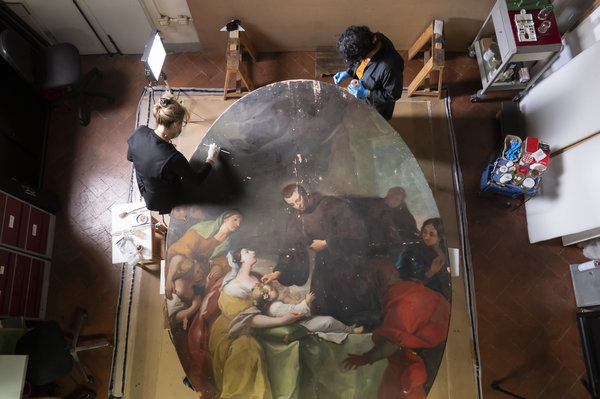
“With backing from Advancing Women Artists, [art restorer Elizabeth Wicks] is currently restoring two large works by Violante Ferroni, an 18th century child prodigy of whom little is known today. …
“At the time, female artists were usually limited to painting still-lifes and small portraits. But while still in her 20s, Ferroni was awarded a prestigious commission by Florence’s San Giovanni di Dio hospital to paint two ovals — each of them 8-by-11 1/2 feet — with spiritual scenes to help heal the ill. The subject was usually reserved for men. …
“Falcone says that through restoration work, documentation and exhibits, AWA has contributed to a growing worldwide interest in and awareness of art by women. Yet the organization recently announced it is shutting down next June because it does not have sufficient funds to expand.”
More at NPR, here.
Photo: Francesco Cacchiani/AWA
Restoration expert Elizabeth Wicks and the nonprofit Advancing Women Artists have recently been restoring works by Violante Ferroni, a forgotten 18th century woman.

 Suzanne's Mom's Blog