Feeds:
Posts
Comments

Posts Tagged ‘fossil fuel’

Photo: Marek Lumi via Unsplash.
Barcelona, 2023.

How do you get people to change behavior? Even if they know something is good for the world and good for themselves (driving less, for instance), how do you get them to do it? Often people won’t change until they feel the reality of disaster.

But as Andrew Kersley reports at Wired magazine, “people hate the idea of car-free cities — until they live in one.” He notes that one of the best ways to get them started is “from the ground up.” Read on.

“London had a problem,” he begins. “In 2016, more than 2 million of the city’s residents—roughly a quarter of its population — lived in areas with illegal levels of air pollution; areas that also contained nearly 500 of the city’s schools. That same air pollution was prematurely killing as many as 36,000 people a year. Much of it was coming from transport: a quarter of the city’s carbon emissions were from moving people and goods, with three-quarters of that emitted by road traffic.

“But in the years since, carbon emissions have fallen. There’s also been a 94 percent reduction in the number of people living in areas with illegal levels of nitrogen dioxide, a pollutant that causes lung damage. The reason? London has spent years and millions of pounds reducing the number of motorists in the city.

“It’s far from alone. From Oslo to Hamburg and Ljubljana to Helsinki, cities across Europe have started working to reduce their road traffic in an effort to curb air pollution and climate change.

“But while it’s certainly having an impact (Ljubljana, one of the earliest places to transition away from cars, has seen sizable reductions in carbon emissions and air pollution), going car-free is a lot harder than it seems. Not only has it led to politicians and urban planners facing death threats and being doxxed, it has forced them to rethink the entire basis of city life.

“London’s car-reduction policies come in a variety of forms. There are charges for dirtier vehicles and for driving into the city center. Road layouts in residential areas have been redesigned, with one-way systems and bollards, barriers, and planters used to reduce through-traffic (creating what are known as ‘low-traffic neighborhoods’ — or LTNs). And schemes to get more people cycling and using public transport have been introduced. The city has avoided the kind of outright car bans seen elsewhere in Europe, such as in Copenhagen, but nevertheless things have changed.

“ ‘The level of traffic reduction is transformative, and it’s throughout the whole day,’ says Claire Holland, leader of the council in Lambeth, a borough in south London. Lambeth now sees 25,000 fewer daily car journeys than before its LTN scheme was put in place in 2020, even after adjusting for the impact of the pandemic. Meanwhile, there was a 40 percent increase in cycling and similar rises in walking and scooting over that same period.

“What seems to work best is a carrot-and-stick approach — creating positive reasons to take a bus or to cycle rather than just making driving harder. ‘In crowded urban areas, you can’t just make buses better if those buses are still always stuck in car traffic,’ says Rachel Aldred, professor of transport at the University of Westminster and director of its Active Travel Academy. ‘The academic evidence suggests that a mixture of positive and negative characteristics is more effective than either on their own.’ …

“Urban driving doesn’t make up the majority of a country’s car use, but the kind of short journeys taken when driving in the city are some of the most obviously wasteful, making cities an ideal place to start if you’re looking to get people out from behind the wheel. That, and the fact that many city residents are already car-less (just 40 percent of people in Lambeth own cars, for example) and that cities tend to have better public transport alternatives than elsewhere. …

“But as effective as policies to end or reduce urban car use have been, they’ve almost universally faced huge opposition. When Oslo proposed in 2017 that its city center should be car-free, the backlash saw the idea branded as a ‘Berlin Wall against motorists.’ The plan ended up being downgraded into a less ambitious scheme consisting of smaller changes, like removing car parking and building cycle lanes to try to lower the number of vehicles.

“In London, the introduction of LTNs has also led to a massive backlash. In the east London borough of Hackney, one councilor and his family were sent death threats due to their support for the programme. Bollards were regularly graffitied, while pro-LTN activists were accused of ‘social cleansing.’ It was suggested that low-traffic areas would drive up house prices and leave the only affordable accommodation on unprotected roads. ‘It became very intimidating,’ says Holland. ‘I had my address tweeted out twice, with sort of veiled threats from people who didn’t even live in the borough saying that we knew they knew where I lived.’ …

“Any attempts to reduce urban car use tend to do better when designed from the bottom up. Barcelona’s superblocks program, which takes sets of nine blocks within its grid system and limits cars to the roads around the outside of the set (as well as reducing speed limits and removing on-street parking) was shaped by having resident input on every stage of the process, from design to implementation. Early indicators suggest the policy has been wildly popular with residents, has seen nitrogen dioxide air pollution fall by 25 percent in some areas, and will prevent an estimated 667 premature deaths each year, saving an estimated 1.7 billion euros.” More at Wired, here.

What local policies for helping you use your car less would you welcome?

Read Full Post »

Photo: Sterling College, Flickr, CC BY-S.
Solar panels and sunflowers, the national flower of Ukraine. Solar energy and renewables can help keep oil tyrants from invading other countries.

One of the challenges Ukrainian allies have had in fighting back against Putin’s war is that so many of them have been dependent on Russian oil.

Bobby Bascomb at Public Radio International’s Living on Earth interviews environmentalist Bill McKibben on ways to get serious about renewables and free ourselves from the power of the fossil fuel industry.

“BOBBY BASCOMB: The horrors of Russia’s war in Ukraine are funded in large part by fossil fuels that it sells to the tune of half a billion dollars every day. Nearly half the federal budget for Russia comes from oil and gas revenue and the European Union is their biggest customer. … But the EU recently unveiled a plan to cut Russian gas imports by two-thirds this year and eliminate imports entirely by 2027.

“To help speed that phase out the Biden White House is reportedly considering a plan to use the Defense Production Act to rapidly manufacture and send electric heat pumps to European homes, many of which are currently heated by Russian gas. This idea to make Heat Pumps for Peace was first raised by writer and activist Bill McKibben, who co-founded 350.org and Third Act. … So first remind us, what exactly is a heat pump? …

“BILL MCKIBBEN: Think of it as an almost reversible air conditioner, made often by the same people. It takes ambient heat from the air, and uses that to heat the inside of your house, and does it pretty well, down to quite cold temperatures, because it turns out there remains some latent heat in the air even on a cold day. It’s wonderful technology because it’s able to produce heat with far, far less emissions than if you were running the gas furnace or the oil furnace in the basement. It runs off electricity, which means that the cleaner you get the grid, the cleaner the emissions result. And in the case of the current war in the Ukraine, it’s particularly significant because deployed in sufficient number across Europe, it would rob Vladimir Putin of his longtime weapon, the threat to turn off the gas supply to Western Europe. …

“What you really want, of course, is to connect them to a grid that gets steadily, steadily cleaner. … Not just in order to save the planet’s climate, though that would certainly be nice. But also because [fossil fuel] is the fuel of choice for autocrats.

“BASCOMB: Well, why push for heat pumps then and not say, expanded rooftop solar, for instance?

“MCKIBBEN: That works too, go to work on any of these things. In fact, some of the things are super easy. There’s a lot of spare capacity in the US, apparently, for producing insulation right now. And anybody who’s spent time say, in a British house knows that insulation was not a big feature of a lot of the housing stock. So let’s get bundles of that across the ocean as fast as we can. The point is that if we’re able to make use, say, of the Defense Production Act, which every president since the Korean War has used, and which both Trump and Biden used to speed up vaccine production, then we can take advantage of this spare capacity and get some of this stuff over to Europe before next October, when I would predict it’s going to start getting cold again. …

“BASCOMB: Well, how quickly can manufacturers ramp up production of heat pumps on the massive scale that would be needed to quickly phase Europe off of gas?

“MCKIBBEN: Well, the people that I’ve talked to in the federal government think that it can happen pretty fast, that there’s spare capacity at the big air conditioner manufacturers, companies like Carrier or Trane, that would allow them to start pretty quickly putting this stuff into operation — and that talking about the course of the next six months for getting a lot of these installed is not crazy. But again: heat pumps, insulation, whatever we can think of that help reduce the power of Vladimir Putin’s energy weapon. …

“BASCOMB: I looked into getting heat pumps in my house here in New Hampshire a couple years ago; we put up solar panels at the time and considered heat pumps to go along with them. But it was basically going to double the cost of our solar installation. What kinds of policies can be put in place to help bring down those costs, so they’re more affordable for many Americans?

“MCKIBBEN: Well, first of all, this is precisely, you know, one of the advantages of getting the government involved quickly in doing this. Once you start building things en masse, you get better at it, and they get cheaper, and more and more people know how to install them. And that’s already happening. You know, we have them installed here in [Vermont]. The local contractors are increasingly conversant with the technology. But that needs, as you say, to spread out fast. … There’s no way that we’re going to do what the IPCC has asked and cut emissions in half by 2030 if everybody’s still got a gas furnace blazing away in the basement.

“BASCOMB: Well, heat pumps are basically air conditioning systems in reverse, as you mentioned earlier, so they provide heat in the winter, and they cool homes in the summer. Around 5% of European homes currently have air conditioning. So to what extent can heat pumps [have] the added benefit of helping Europe prepare for the extreme heat waves that are going to be coming with climate change? …

“MCKIBBEN: A very significant point. It’s not just Europe, either. I mean, the demand for air conditioning is going to grow exponentially as this century goes on. And it’s going to grow most in the hottest and poorest places. Countries like India are forecast a huge growth in air conditioner usage. … Efficient, good technology like this is desperately needed around the world.”

More at Living on Earth, here. No firewall.

Read Full Post »

gettyimages-510594876-19f88f4c460b1a2c1af5df525f58bc94a9eb24d1-s600-c85

Photo: John Greim/LightRocket via Getty Images
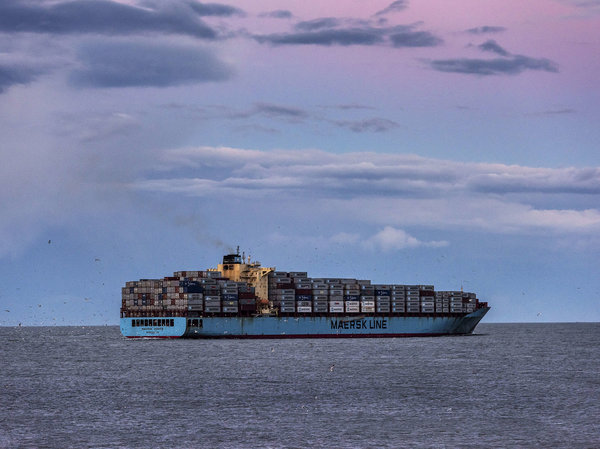
The world’s largest container-shipping company, Maersk, has promised to make its operations zero carbon by 2050. Doing so will require using new fuels, such as hydrogen.

Would you pay more for goods delivered on ships that don’t use fossil fuels? Many people can’t afford to pay more, so sometimes the idea of cutting our dependency on oil and coal seems impossible. Fortunately — because they don’t know what’s impossible — young people are leading the charge.

But even corporations are starting to think it would be to their advantage to go carbon free. Maersk, the world’s largest container-shipping company, based in Denmark, is one such corporation. And there are others.

As Rebecca Hersher reported at National Public Radio (NPR), “The global shipping industry is enormous — thousands of ships carry billions of dollars of goods each year across nearly every ocean on the planet.

“Those ships run mostly on a particularly dirty type of fuel known as heavy fuel oil, or bunker fuel. It’s thick and sooty, and when it burns, it emits sulfur and particulate matter that can cause respiratory illness. It also emits greenhouse gases, including carbon dioxide and methane, which trap heat in the atmosphere and cause global warming.

” ‘If shipping was a country, it would be the sixth-largest polluter in the world,’ says Nerijus Poskus of the shipping technology company Flexport. ‘About 3% of global emissions are released by ocean freight shipping.’

“The industry is growing so steadily, he says, that it’s projected to produce more than 15% of global greenhouse gas emissions by midcentury if ships continue to burn the same fuel, which is a real possibility considering that most cargo ships are designed to last at least 30 years.

“Yet there are signs that the status quo is changing and that a new fuel could make cargo ships among the cleanest transportation methods on Earth. …

“The international body that helps create global shipping regulations has clamped down on emissions of some air-polluting substances when ships are in or near ports. The new regulations, which started going into effect in 2012 and which decrease limits dramatically in January 2020, require ships to significantly cut the amount of sulfur pollution they emit when they’re near land. For the U.S., the regulations apply anywhere within 200 miles of its coastline. …

“Additional increasingly stringent emissions standards are planned for the next two decades. The largest container-shipping company in the world, Maersk, announced in 2018 that it intends to make its operations carbon free by 2050, though it’s still unclear how the company would achieve that goal.

“What is clear is that success will require new ships, new engines and — above all else — a new fuel. … Research at the U.S. Energy Department’s Sandia National Laboratories suggests that of [liquefied natural gas and hydrogen], hydrogen is the most promising.

“Using hydrogen to generate electricity is very clean. Hydrogen fuel cells combine hydrogen with oxygen and create electricity and water. The electricity can be used to turn a propeller, for example. The exhaust from fuel cells is moist air — with no greenhouse gases. …

“Leonard Klebanoff, a researcher at Sandia … and his then-research partner, Joe Pratt, started systematically analyzing whether current ships could be retrofitted to run using hydrogen fuel cells instead of fossil fuels.

“Pratt says the project started when a San Francisco Bay ferry operator asked the Energy Department whether it was possible to switch his fleet over to hydrogen power. … The answer, they found, was yes.

“The main issue was about size. For each unit of energy, liquid hydrogen is about four times larger by volume than conventional diesel … but ‘the efficiency of a fuel cell is about twice as much as a diesel engine,’ Klebanoff says. …

“When they analyzed the entire system, Klebanoff and Pratt found that it would be possible to retrofit most types of existing vessels to run on hydrogen and even easier to construct a new ship powered by fuel cells.”

Read more at NPR, here.

Read Full Post »

Once again, Sweden is ahead of the curve, as it tests two versions of an electric road. The idea is to move away from fossil fuels and creative a more sustainable energy future.

Green Car Congress is a website that covered the story in June.

“Sweden inaugurated a test stretch of electric road on the E16 in Sandviken, thus becoming one of the first countries to conduct tests with electric power for heavy transports on public roads.

“The test stretch on the E16 is two kilometers long. The technology is similar to light rail, with contact lines 5.4 meters over the roadway. The truck has a pantograph on the roof that feeds 750 VDC to the truck’s hybrid electric system. The current conductor can connect automatically at speeds up to 90 km/h (56 mph). The test stretch is equipped with posts 60 meters apart that hold up the electric lines over one of the lanes.

“At a rest area, there is a transformer for low-voltage direct current of the same type as in the light rail network. Other traffic on the road will not be affected. …

“An electrified road is one in which the electricity supply for vehicle propulsion is continuously supplied in order to keep the vehicle moving and to avoid recharging requirements. …

“The technologies for electric roads have developed rapidly over the last few years, and are now mature enough that some of them can be tested. Last year, the Swedish Transport Administration, in consultation with Vinnova [Sweden’s innovation agency for sustainable growth] and the Swedish Energy Agency, decided to give support to two test facilities. The two systems differ as to how electric power is transferred to the heavy vehicles.

  • The test on the E16 in Sandviken is being carried out by Region Gävleborg, and involves a pantograph on the roof of the truck cab feeding the current down to a hybrid electric motor in the truck.
  • Outside Arlanda, the eRoadArlanda consortium company will test a technology that involves an electric rail in the roadway charging the vehicle during its trip. …

“The tests will continue up through 2018. They will provide knowledge of how electric roads work in practice, and whether the technology can be used in the future. The experiment is based on the Government’s goal of energy efficiency and a fossil fuel-free vehicle fleet by 2030, and will contribute to strengthening Sweden’s competitiveness.”

More here.

 Photo: Green Car Congress

Read Full Post »

Suzanne’s Mom was asked to review Revolution, a film by the young environmentalist, biologist, diver, and Sharkwater filmmaker Rob Stewart.

Encompassing gorgeous deep-sea photography, scientific climate-change testimony, a representative of the drowning country of Seychelles, and many youth demonstrations, the documentary forces you to think about what the burning of fossil fuels is doing to the oceans and what it means for the future of the planet. It also gives you the sense that anyone can do something about it — take up a camera, make a poster, or write a letter that makes a change.

The film is infused with a sense of youth, of young people saying, “Enough!” I particularly loved the moment early on when Stewart, who had read only two books on filmmaking, is flubbing his lines in front of Darwin’s Arch. What comes across in addition to the humorous inexperience is a feeling of energy, optimism, and determination.

The film has many engaging details about sea life that Stewart can’t resist throwing in, like how the endangered pygmy seahorse, which camouflages itself to look like coral, “mates for life — and the guy gets pregnant!”

He talks about how the burning of fossil fuels creates too much carbon dioxide, which is absorbed by the ocean and is harmful to anything that needs to grow a skeleton, which is pretty much everything but nasty, poisonous creatures that flourish in the muck where corals died, like the flamboyant cuttlefish. Coral expert Charlie Veron comments that at the same rate of ocean acidification caused by too much CO2, there will be no coral reefs in 50 years.

Stewart also looks at the island nation Madagascar, sole home of lemurs, explaining that endangered tropical forests are responsible for 1/4 of the world’s species and 1/3 of our oxygen. Madagascar scientist Serge Rajaobelina says that population growth on the island and the burning of the trees for development has meant the loss of 80 percent of the forest in 40 years, more than in 55 million years.

The movie goes on to cover perhaps a few too many youth protests, including one in which an inspired, tree-planting young boy says, “We have found we have to save our own future,” and is later arrested in tears.

But then we get to see that children and young adults are actually having an impact.

A sixth-grade class in Saipan writes letters to the Saipan government against killing sharks for shark fin soup, and the government signs a law preventing the practice. In fact, we are told, since the first Stewart film, China, the main adherent of shark-fin soup, has dropped the practice by 70 percent, and 100 countries have banned it.

The upbeat Saipan children who comment on their successful advocacy embody the truth of my favorite Pete Seeger line, “one and one and 50 make a million.” Says one, “Maybe the world might not end because of what we are doing.”

Watch the Revolution trailer here.

[We do not accept gifts here, so the DVD that the film company sends me for screening and reviewing will be forwarded to Save the Bay, RI.]

The late Rob Stewart. The filmmaker did not come up from a dive 1/31/17 near Key Largo.
rob_stewart_memdf

Read Full Post »

No matter how much you like your routine or how pleasant your surroundings, sometimes you just have to get up and go out. Today I needed a change of scene so, in spite of the freezing temperatures and high wind, I went to look at some art.

The Design Museum is not far from my office, and the folks there come up with lots of good projects. I blogged here about their Street Seats, an array of public benches designed by creative people from around the world.

This being Design Week in Boston, I decided to check out the exhibit space they are using in a new apartment building called 315 on A, a lovely renovation of an 18th century warehouse for coffee.

The new exhibit is called Green Patriot Posters and features handsome posters from professionals as well as the pretty impressive results of a school poster contest on the conservation theme.

Many of the posters explicitly reference WW II posters. You know: “Loose lips sink ships” and all that. Here, the posters urge viewers to pursue a more sustainable way of life and fight global warming. More.

Be sure to check the poster over the left shoulder of the woman speaker in this video. That was my favorite in the show because it made me laugh out loud. I think you can see a Paul Bunyan figure with an ax. He is looking at the tree he was going to cut with an uncertain expression as the tree is growing out of his foot.


Read Full Post »