Feeds:
Posts
Comments

Posts Tagged ‘foster care’

Photo: Melanie Stetson Freeman/CSM.
More Than Words bookshop in Massachusetts uses 100% of its proceeds for training and educating young people ages 16 to 24 in professional skills and goal setting.

My husband and I first encountered the bookshop More Than Words on a movie night. We had been to dinner at one of the many cool restaurants in Waltham, Massachusetts, and were just walking around looking in shop windows until it was time for the movie.

Jacob Posner has written about it at the Christian Science Monitor.

“Jarris Charley says he didn’t believe in jobs when he was growing up on the line between Boston’s Roxbury and Dorchester neighborhoods. The people he knew who had legitimate jobs, including his mom, didn’t find much success. Everyone in his community lived check-to-check and paid rent. The drug dealers were the ones with money.

“ ‘So I was invested in the streets: drugs, guns, robberies. That’s just what I was caught up into at a young age,’ he says. He ended up in juvenile detention at age 15, and in prison for robbery at 23.

“Near the end of a five-year prison term, a second chance arrived. An old manager from a job-training program called More Than Words visited, and asked him, ‘Jarris, why don’t you just come back?’

“More Than Words is a bookstore, but one that does much more than sell bestsellers. The program serves young people ages 16 to 24 who face the highest barriers to building stable lives. Participants face homelessness, are in the foster care system, are out of school, or are involved in the legal system. It gives them job skills, but graduates like Mr. Charley say that the sense of belonging and acceptance – that they matter – is the most valuable thing they take from the program.

“ ‘I like to say we’re in the mattering business,’ says founder Jodi Rosenbaum.

“More Than Words’ support goes beyond job training. There’s a paid ‘on-ramp’ of six to 12 weeks in which the program helps with everything from housing and food costs to making sure participants have suitable work attire. Youth development managers offer support in a range of areas, including future employment, housing, transportation, financial planning, and navigating the legal system. After graduation, young people can access career services and bridge funding for tuition, rent, and child care so they can further their education and training.

“ ‘None of this works if that all doesn’t hang together, right? Like a job training program means nothing if you don’t know where you’re sleeping at night or if you have court the next day, and you don’t have people helping you plan and figure that out,’ says Ms. Rosenbaum.

“More Than Words has grown significantly in its two decades of existence. It started with a 150-square-foot office space where young people sold donated books online. Today, it operates three storefronts in the Boston area. It served around 318 young people last year, who sorted about 4.5 million donated books and earned over $3.8 million in net revenue. Almost all More Than Words graduates go on to earn a high school diploma or equivalent degree, according to the organization’s data. …

“ ‘A lot of people feel that they don’t have a lot going for them or they don’t have a lot of potential,’ says Mr. Charley. ‘We speak life into them.’ That was the case for him.

“For the past three years, he’s been mentoring young people at More Than Words. He works in career services, helping young people in the area that tripped him up the most: getting that first good job after graduating from the program.

“Ms. Rosenbaum founded More Than Words in 2004. She had worked as a public school teacher and for the child welfare system, and became disenchanted with government systems. … Ms. Rosenbaum found that the process of selling a book online had therapeutic value. It has clear steps leading toward a positive outcome: Pick up the book from where it was donated, find out how much it’s worth, package the book, ship it, and then watch money come in. …

“More Than Words Boston, where Mr. Charley works, is located on a street just off Interstate 93 in a postindustrial part of South Boston. … Inside, it’s tidy and spacious. In the front, wooden tables carry rattan cross-body bags and socks with giraffes and penguins. All the merchandise is made by businesses that address social issues as part of their mission. …

“[Mr. Charley] had attended Lexington Minuteman High School. He says there were limited spots at the vocational high school for people from his part of the city. Mr. Charley says he’s grateful for the experience, but felt like he was only appreciated for his athletic prowess. …

“ ‘You don’t think a Black person sees that?’ he adds.

“He left school near the end of his sophomore year after an event involving his cousin, he says. Arrest and juvenile detention followed. Then he found his way to More Than Words.

“ ‘He was the first white man I trusted,’ says Mr. Charley about one of his managers. He always asked when he didn’t understand part of Mr. Charley’s experience – instead of just spouting advice. …

“One of Mr. Charley’s goals is to help his mentees understand their behavior and, ultimately, figure out how to stop doing things that get them into trouble.

“Back when Chris Anderson joined More Than Words, around 2005, he worked directly with Ms. Rosenbaum. He was at a group home in Watertown when he first encountered her.

“ ‘Jodi just kind of walked in one time and we’re all sitting in the living room and she kind of just stood up and said, “Does anybody want a job?” ‘ he says.

“He found ‘a sense of belonging’ while helping Ms. Rosenbaum start her business. Participants were stubborn, got in trouble at school, and didn’t do what they were supposed to do. ‘No matter what, she just kept trying to realign you to get onto that path,’ he says. …

“Today, Mr. Anderson, now in his 30s, is a chief operations officer for a technology company, a father, and sits on the board of More Than Words. And he’s still close with Ms. Rosenbaum.”

More at the Monitor, here.
Read Full Post »

Photo: Uncommon Threads.
Uncommon Threads in Lawrence, Mass., helps “low-income women see and feel their true potential by using clothing and image as tools for building self-esteem.

Some time ago, Grace told me about the Lend a Hand Society, whichprovides emergency financial assistance to low-income families, individuals, seniors and disabled people primarily in the Greater Boston area.” It’s been filling a gap for generations now, and as you can imagine, has been especially needed during the pandemic.

A local nonprofit doing similar work but with a narrower focus is Uncommon Threads in Lawrence, Mass. Liz Neisloss at GBH television reported on the gap that the founder identified almost by accident.

“It’s not hard to find organizations that offer free or low-cost clothing,” says Neisloss, “but Susan Kanoff has created a boutique that uses clothes to transform not only the way women look, but how they feel.

“A social worker by training, Kanoff made her living helping low-income families move out of poverty. In her spare time, she channeled her love of fashion as a private stylist and style blogger. When her style clients began asking her where to best donate their old clothes, she had an idea.

“ ‘I started taking them into my social work office,’ said Kanoff, who lives in Methuen. ‘I had racks set up and (if) one of my clients was having a bad day, we’d put an outfit together; going on a job interview, we’d put an outfit together. And I started to realize how powerful these clothes were and how really important they were to a woman’s self-esteem.’

“Partnering with Family Services of the Merrimack Valley, she opened the non-profit Uncommon Threads [in 2017]. … In late 2019, the retailer Timberland helped fund the renovation of a larger space with dressing rooms, a sitting area in shades of beige and dark blue and a on the entry-way wall a message that reads: ‘Self Confidence is the Best Outfit.’

‘Our main goal is dignity and respect,’ said Kanoff. ‘We want women to feel like they’re in, they’re shopping in a beautiful place versus getting a handout.’

“Kanoff, who previously worked for the North Andover Housing Authority running the family self sufficiency program to help lift people out of poverty, works with a more than a dozen social service agencies who must refer women to be able to shop at the store. Retailers and the public donate clothing.

” ‘We could dress a woman who was maybe a victim of domestic violence and is ashamed to go to their kid’s school conference,’ said Kanoff. ‘Whatever it takes to get that woman to feel strong and powerful through the way she looks.’ …

“Women first meet with an Uncommon Threads volunteer to talk about their clothing needs, as well as their work or life goals. Clients can get up to four outfits and two pairs of shoes in one visit – but they can also get some items not commonly found in donation shops: bras, underwear, pyjamas and even matching jewelry. The meeting looks like one with a personal shopper at a pricey store, but costs just ten-dollars — a fee that can also be waived. Otherwise, the clothes are free.

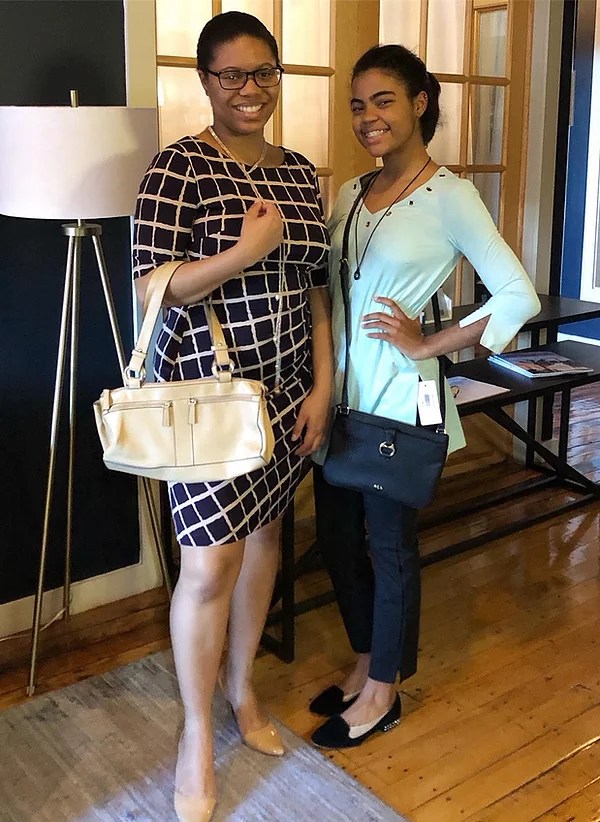
“[Volunteer] Jen Marin sat down for a ‘styling session’ with 19-year-old JJ Ortiz. Shuttled around between group homes and foster care since she was 12, Ortiz said she struggled to find clothes that fit her as she grew and became self-conscious about her weight.

“ ‘I was kind of uncomfortable in my skin, who I was, how I would like show myself, like my clothes wasn’t the best,’ Ortiz said, ‘But they didn’t see that. They saw me for who I am.’

“Marin helped Ortiz try on a jeans jacket and then moved around to take a look. …

“Another volunteer stepped in to put a necklace over Ortiz’ head. Ortiz smiled, ‘I look so pretty,’ she said.

“With shopping finished, Ortiz stayed to sit in on a workshop called ‘Feminine Rocket Fuel.’ She took careful notes as motivational speaker Rosie Dalton explained to the gathering of clients how to use obstacles as ‘fuel’ to move forward.”

More at GBH, here, and at Uncommon Threads, here.

Are there similar services in your part of the world? But will clothes needed for work be different post-Covid? And finally, what are the chances that low-income people can start getting paid enough not to need charitable services in the future?

Read Full Post »

David Karas writes at the Christian Science Monitor, “When Danielle Gletow adopted her daughter Mia, she began to learn about the American foster care system – and the challenges faced by more than 100,000 children and young adults who are part of it.

“Determined to do something to help them, Ms. Gletow made it her mission not only to educate others about the challenges these children and teens face, but also to give people an easy way to lend a helping hand.

“That’s how One Simple Wish was born.

“Founded in 2008 out of Gletow’s home office, One Simple Wish is a nonprofit organization that connects foster children and vulnerable families with potential donors who grant their wishes online or at the organization’s Ewing, N.J.-based ‘Wish Shop.’

“The wishes, which typically cost from $5 to $100 to grant, encompass everything from a desire for a musical instrument to a movie ticket, new clothes, or horseback riding lessons. …

“To date, Gletow has seen more than 2,800 wishes granted by her organization. And while each is special, Gletow enjoys remembering some of the first wishes that she herself helped to grant. …

“When Sarah, a girl who had grown up in foster care, was graduating from basic training in the US Army, Gletow was able to help arrange for her caseworker to fly to South Carolina. … Sarah was the only student who didn’t have family coming to the graduation, Gletow says. ‘She had no way to pay for [her caseworker] to come.’ ”

Read more.

Suzanne’s friend Liz has been something like a Big Sister and Legal
Guardian for many years to a girl in foster care who is now a young woman. Liz says that the transition out of foster care is an especially vulnerable period, as young people are thrilled to be “free” but still need the kinds of support that young adults with families have.

Photograph: Ann Hermes/The Christian Science Monitor
Danielle Gletow, founder of One Simple Wish, stands next to a wall of thank-you notes.

Read Full Post »

I subscribe to a listserv out of Harvard called Innovators Insights. It culls public-policy articles from all over. When you sign up, you pick general topics you want to hear about. (I can explain more if you ask.)

Today I received a link to a story about a new program in California to help foster children who have to change schools a lot. It sounds like a reasonable idea although I imagine some people might object to being in databases.

“Sacramento County, California, is now employing a database for foster youth to ensure that they can transition to new schools with fewer problems. Foster Focus tracks students’ grades, credits, course schedules, residential history, educational plans, the identity of their social worker, and other data so that students are no longer placed in the wrong grade level or in classes they have already completed when they enroll in a new school. The county has also developed another database that compiles foster home addresses, making it easier for social workers to place students in residences near their schools. Agencies across the country are soliciting the county’s advice as they seek to replicate these databases.” Read more here.

In a related story, U.S. Congressman James Langevin (Rhode Island) has been working to pass a federal law to prevent identity theft of foster youth. It is a serious issue as their personal information passes through many hands. I wonder if a database like the one in California makes this less of a problem by having everything in one place.

Read Full Post »

Not long ago, I talked to Suzanne’s friend Liz about her long and deep support for a girl who was struggling through the foster-care system in California. She expressed the view that kids who “age out” of foster care still need support. Maybe they reject anything that smacks of the government programs at first, but the possibility of more advice and assistance should be revisited after a year or so, Liz said. That’s because the young people are mostly without the networks and connections that their peers can turn to as they move into adulthood.

So I was interested to read in the Boston Globe last week that there is at least one small support program for a few graduates of foster care. It’s an internship program on Capitol Hill in Washington, DC.

About a decade ago a staffer working on Capitol Hill took note of a particular group of interns. “The interns, all former foster children, had aged out of the system and made their way through college. Now they were in Washington, on Capitol Hill, working at the seat of power and, Lindsay Ellenbogen noticed, not always having the resources to succeed.

“They had a willingness to learn — often they arrived early, stayed late, and were eager to take on any task, even if it was just making copies or answering phones. But many had never been far from their homes. Few had ever spent time around politics or politicians. And when they asked questions about how to write a news release or listen in on a committee meeting, staffers were often too busy to show them the ropes.

“ ‘When you’re on Capitol Hill, you’re living three days before noon, so you can’t really stop and help somebody,’ said Ellenbogen, who worked as a Capitol Hill staffer alongside the former foster youth.

“Now, nine years later, Ellenbogen is supervising another group of former foster children and making sure they have an easier transition into the world of a Washington intern. Last year, Ellenbogen, who had worked as a Capitol Hill staffer for 10 years, joined the advisory board of the
Congressional Coalition on Adoption Institute’s Foster Youth Internship program.”

Now she has time to answer the interns’ questions and help them find the resources they need. Read more here.

Read Full Post »