Feeds:
Posts
Comments

Posts Tagged ‘frescoes’

Photo: Isabelle de Pommereau.
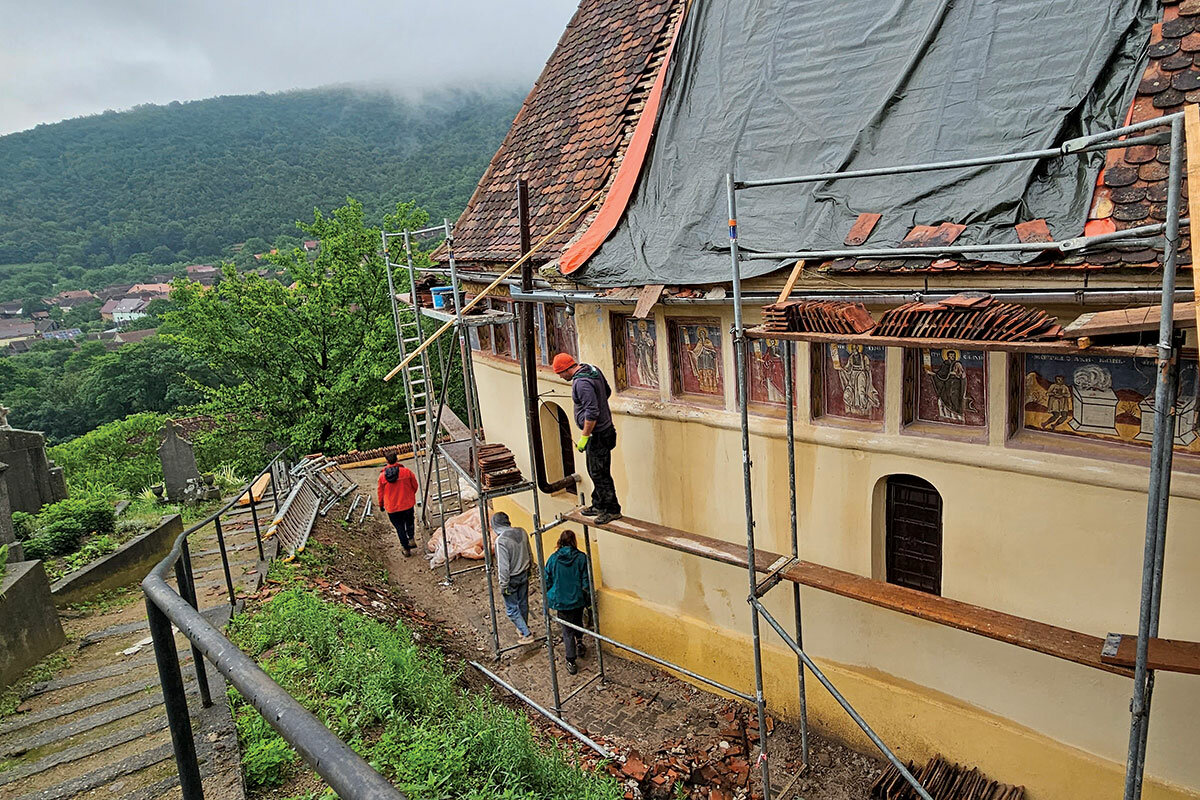
Eugen Vaida and an Ambulance for Monuments team repair the Church of St. Nicholas the Hierarch in Fântânele, Romania.

Today’s story is all about the Power of One. That is, one who organizes many. The setting is a post-Communist country that is struggling to build its economy and has little left over for preserving cultural monuments.

Isabelle de Pommereau writes at the Christian Science Monitor, “It is midday on a damp Friday. Eugen Vaida guides his team into the final phase of re-tiling the roof of a church, at the crest of a forested hill in this mountainous Transylvanian village.

“Village craftspeople and students from the city meticulously lay tiles on the roof timbers of the 18th-century Romanian Orthodox Church of St. Nicholas of the Hierarch. From the scaffolding, students respectfully and attentively watch Nicolae Gabriel Lungu, who is descended from a Romani family who all knew this skill. Soon an older woman summons the crew to share in a platter of clătite, thin cheese-filled crepes.

“Once bustling with families and culture, Mr. Vaida’s home region had become a string of largely empty villages surrounding abandoned stone churches. But now, watching this group interact, he has newfound hope. The repair by his group, Ambulance for Monuments, will help safeguard the church’s stunning outer frescoes. And the impact will ripple far beyond the building itself. 

“ ‘People are starting to understand the value of heritage,’ Mr. Vaida says. For the past seven years, he’s been driving around the country with a van equipped with tools and volunteers in a race against time to rescue endangered historic buildings. He has helped save more than 55 historical structures on the verge of collapse, from medieval churches and fortification walls to old watermills and UNESCO World Heritage Sites. He does so by impressing preservation methods and mindsets onto local communities. 

“ ‘I wanted to reconnect the members of the community to their roots, make them aware that those buildings are part of their cultural identity, and show them how they can continue the work we do,’ he says.

“Mr. Vaida offers a ‘best-practice example of how, with not so much effort, you can save the identity of Romania as a country,’ says Ciprian Stefan, director of the ASTRA Museum, Europe’s largest open-air ethnographic museum, in Sibiu.

“Romania’s rich cultural legacy of painted churches and fortified villages was shaped over centuries. But close to 600 historic monuments are in an acute state of degradation, victims of years of dictatorship, poor legislation, and plain neglect, experts say.

“Mr. Vaida experienced the destruction in a very personal way. He grew up playing with Romani and Hungarian friends, as well as the German Saxons who had literally built the region. When the 1989 collapse of communist dictatorship flung Romania’s doors wide open, half a million people left. The mass exodus tore the Romanian soul apart – and fractured Mr. Vaida’s own identity. Ambulance for Monuments is an attempt to reclaim both his identity and that of his country. …

“He, too, left for the city, to get an education, and he became a successful architect in Bucharest. But six years into the job, he quit to return home. The big city was not his future; his home village was.

“He soon discovered that many village craftspeople who had passed on their know-how from generation to generation had left for Western Europe. … Mr. Vaida wanted to use his architectural skills to save his region’s extraordinary architectural and cultural heritage. He started by teaching children about local history. …

“In 2016, he launched Ambulance for Monuments in hopes of connecting architectural students, craftspeople, and communities around a new effort to restore decaying historic buildings. …

“Volunteer students get hands-on practice in historical restoration; local craftspeople get jobs; and communities help house and feed the teams, and donate the material. … ‘It’s going from grassroots up, from down to up,’ says Mr. Vaida. …

” ‘He doesn’t go to villagers to ask for anything, but he goes there to give something,’ says Mr. Stefan. ‘The community stays in the shadows at first. When they see Eugen comes with material and manpower to restore their church, they say, “Let’s help him,” and, little by little, they come and help with housing, with food.’ …

“The task of rescuing Romania’s cultural legacy is huge, but Mr. Vaida sees signs of progress. … ‘People are moving back to the villages of their grandparents, because they feel they belong there,’ he says. ‘They are rediscovering old houses, their heritage, their villages, and are getting involved in the preservation of this type of living.’ ”

More at the Monitor, here. No paywall. Subscriptions solicited.
Read Full Post »

Photo: Loren King.
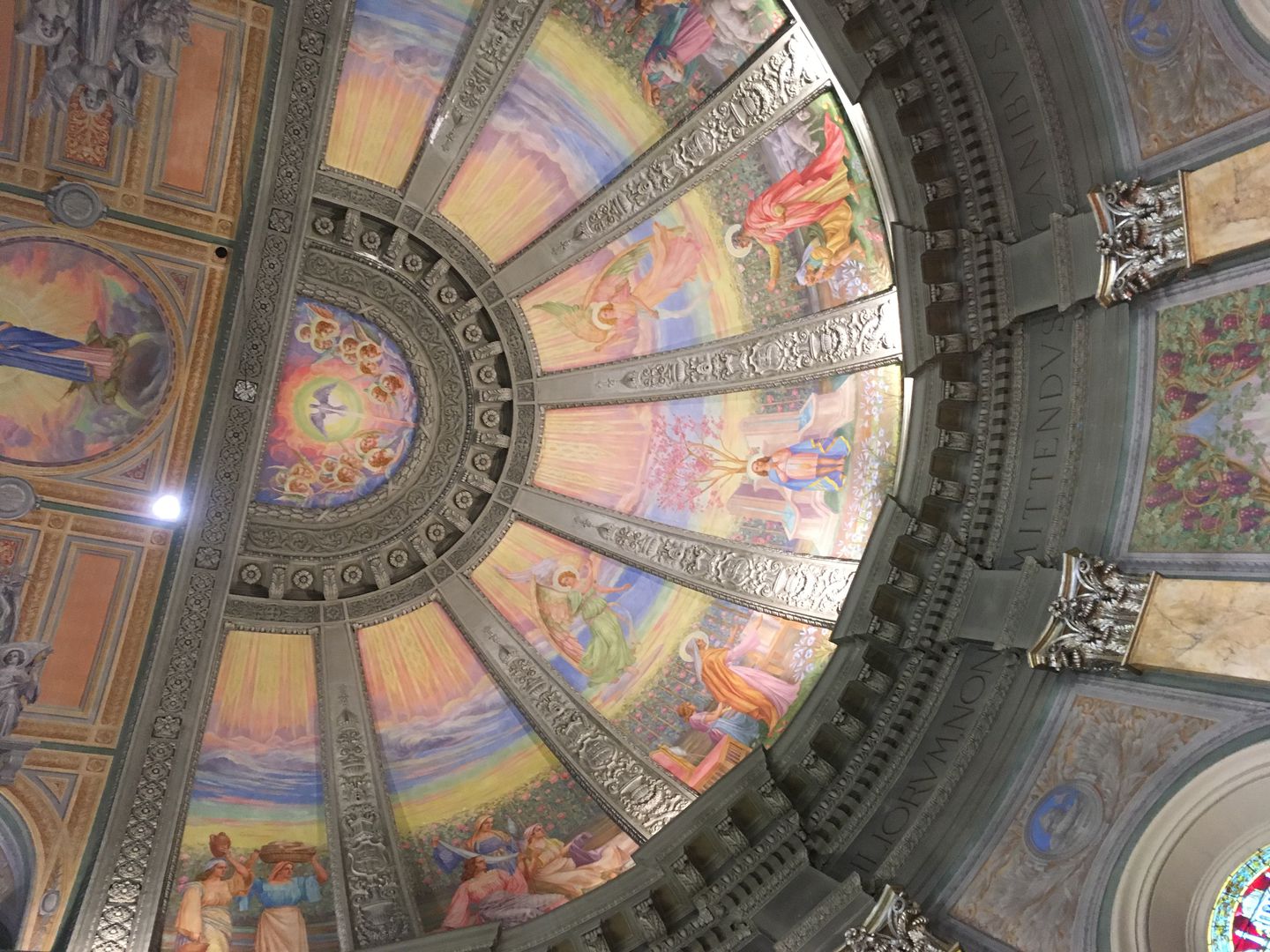
Art at St. Ann Art and Cultural Center, Woonsocket, Rhode Island.

For my first issue of a certain Boston Fed magazine in 2005, I was a bit panicked about learning the ropes of editing a new field. I managed to line up an article on a troubling change in bankruptcy law from Elizabeth Warren. And through my friend Nancy L, I talked to a guy who knew everyone in the community development field in the region and who put me in touch with Joe Garlick at the Woonsocket Neighborhood Development Corporation (now NeighborWorks) in Rhode Island.

And so it was that I got a memorable tour of initiatives benefiting residents of this former industrial town, where the rivers once ran with clothing dyes.

Today I learn that I better go back to Woonsocket and check out a particular church, now a cultural center.

Amanda Milkovits reports at the Boston Globe, “Swing open the heavy doors of this twin-spired former Roman Catholic church on an ordinary city street some Sunday afternoon, and enter a museum that takes your breath away.

“Elegant and intricate fresco murals soar across the barreled ceiling and along the walls of the nave, above the sanctuary and alcoves, and the choir loft. Scenes from Bible stories, and religious figures, saints and sinners, angels and devils, nearly glow from the frescoes’ warm pastel colors, painted in the style of the Italian High Renaissance.

“Years ago, Yankee Magazine dubbed St. Ann Arts and Cultural Center as the Sistine Chapel of America, and that’s no exaggeration. The former church, which is actually larger than the Sistine Chapel in Rome, is home to the largest collection of fresco paintings in North America.

“Its place here in this working-class city on the northern edge of Rhode Island, away from the tourist meccas of Providence and Newport, can make visitors feel as if they’ve discovered an incredible treasure.

“ ‘That’s why we say it’s the best-kept secret, and the worst-kept secret, too,’ said Joe Petrucci, a docent and volunteer. ‘Because it’s a wonderful gem, but not a lot of people know about it.’

“Along with the stunning frescoes, there’s the rich color and depth of 40 stained-glass windows made by artisans in Chartres, France, and the hand-carved marble altar and the marble stonework imported from Carrara, Italy. Outside, the church’s twin 165-foot cupola towers resemble those of the Shrine of Sainte-Anne-de-Beaupré outside Québec City, and have been an integral part of Woonsocket’s skyline for a century.

“But for the keepers of St. Ann, what makes the former church so distinctive to the city of Woonsocket is how an artist immortalized its residents in the frescoes.

“Guido Nincheri, an Italian-born artist considered the Michelangelo of North America, painted these ordinary people into his extraordinary artwork. The mill workers, the mischievous children, and those lost in World War II, and other residents were models for the 475 faces painted into the frescoes.

“ ‘Aside from the incredible, amazing art and the architecture, the stained glass and the marble work, my favorite part is the story of how it came to be. It’s a part of my heritage,’ said Dominique Doiron, St. Ann’s executive director and Woonsocket native, who was a parishioner until the church closed in 2000. ‘Especially in such a time of turmoil, to be able to look at something and go, What if we all just got along? Look at the great things that we can accomplish together.’

“Roll back the calendar more than a century, back when Woonsocket was nicknamed ‘Le Petit Canada’ for its large population of French-Canadians, who’d arrived in the city to work in the mills. This church on Cumberland Street, which opened in 1918, was the second French-Canadian parish in the city.

“The church was the social hub for its hardworking parishioners, and there were seven Masses on Sundays, standing room only, Doiron said. Though they were poor, the parishioners pooled together their own meager funds for the construction of their church, and later, for its beautification. …

“While the architecture was beautiful, there wasn’t enough money to complete the interior, so the gray stucco cement walls weren’t plastered. That would turn out to be a lucky accident.

“In 1925, the 35th anniversary of the founding of the parish, the parishioners raised money again to install 40 stained-glass windows, made in Chartres, France.

“During the Great Depression, the priest leading St. Ann’s still wanted to do something about those plain walls. the Rev. Ernest Morin visited different churches throughout Rhode Island for ideas, and ended up at St. Matthew Church in Central Falls, where Nincheri was painting.

“Nincheri had been knighted by Pope Pius XI as one of the great artists of the Roman Catholic Church and would win four papal awards for his work. He’d studied the Old Masters style in Florence and apprenticed in stained glass in Montreal.

“Nincheri had immigrated to Canada and later moved to Rhode Island, where he was working on churches and public projects. Morin invited him to visit St. Ann’s.

“ ‘As soon as he walks into the building, the first thing Nincheri notices is, Oh my God, the walls and ceilings aren’t plastered,’ Doiron said. ‘Now, he’s getting excited, because this is a rare opportunity to do the fresco style.’ …

“The technique, which reached its height in the Italian Renaissance, requires that an artist is both careful and quick, because there is no room for error.

“At this, Nincheri was a master. He explained the possibilities to Morin, how Michelangelo had painted the frescoes in the Sistine Chapel in Rome, and he could do the same here, at this busy Woonsocket church. They settled on a contract for $25,000 in 1940. …

“Nincheri told a reporter for the Woonsocket Call newspaper that St. Ann’s would be ‘America’s most beautiful church.’

“As Nincheri began the work, he studied the faces of people in the community. … ‘All of the faces were people of the parish and people of the city of Woonsocket at the time. He would always be on the lookout for a face that would fit a particular subject, and he would invite them to sit for him,’ Doiron said. ‘And what we now have here is a scrapbook, a pictorial history of who we now call the “Greatest Generation.” ‘ ” More at the Globe, here.

See also my 2018 post on a Sistine Chapel replica in Mexico, here.

Read Full Post »

Photo: Angelika Porst.
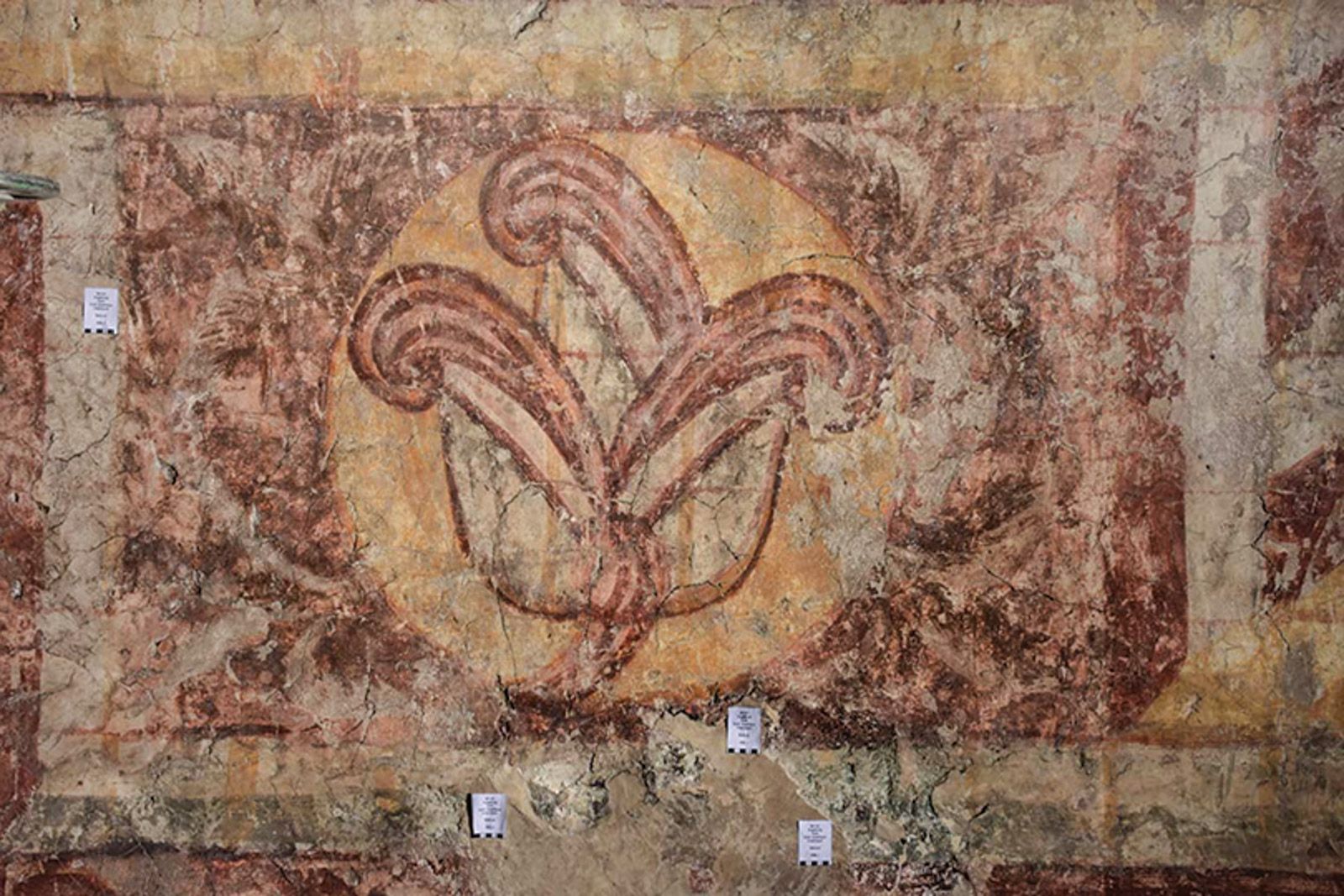
New examinations of John the Baptist wall paintings in Augsburg cathedral date them to more than 1,000 years ago
. Above, a decorative detail of the frescoes in the southern transept, which were only revealed in the 1930s.

A word to the wise for artists who hope their work will still be enjoyed in 1,000 years: try frescoes. The Oxford dictionary describes a fresco as “a painting done rapidly in watercolor on wet plaster on a wall or ceiling, so that the colors penetrate the plaster and become fixed as it dries.”

So even though watercolor is transient, plaster holds it.

Catherine Hickley reports at the Art Newspaper, “A series of frescoes showing the life and death of John the Baptist in the cathedral of the Bavarian city of Augsburg have been recently dated to the first decade of the 11th century, ranking them among the oldest wall paintings in a medieval church north of the Alps.

“The frescoes, located high in the southern transept of the church, were whitewashed over and forgotten until the 1930s, when they were uncovered. But it was not until conservation work began on the roof structure in 2009 that they could be proven to date back to the construction of the cathedral more than 1,000 years ago.

Dendrochronological tests revealed that wood in the masonry dated from AD1000, contradicting the previously held dating of the cathedral to around AD1065. The new dating ‘fits with what we know about a massive destruction in 994,’ says Birgit Neuhäuser, a spokeswoman for the Bavarian State Office for Heritage Protection.

“ ‘The oldest frescoes are the first layer above the masonry, and are therefore part of the original decor of the church,’ Neuhäuser says. ‘We can assume that in the case of an important Episcopal church, the frescoes would have been painted soon after the construction, so soon after AD1000.’

“In artistic style, the frescoes bear a strong resemblance to the tenth-century wall paintings at the Church of St George on the island of Reichenau on Lake Constance, near Germany’s border with Switzerland. The island owes its Unesco World Heritage status [read about a World Heritage site I visited, here] in part to the frescoes. Apart from the Reichenau church frescoes, the Augsburg paintings are the biggest preserved frescoes of their era in the German-speaking countries, says Mathias Pfeil, the head of the Bavarian State Office for Heritage Protection. …

“Given the height of the frescoes in the church, there is no need for special conservation measures in the long term, according to Neuhäuser. ‘They are not under any particular stress’ from the humidity or heat generated by visitors’ traffic, she says. ‘After cleaning and conservation, they are in a stable and sustainable condition.’

“The team plans to examine the roof area and the northern transept of the church for further fresco remnants. The research and conservation work is financed by the Beate and Hans Peter Autenrieth Foundation, the Siegfried and Elfriede Denzel Foundation and the Augsburg diocese.” More at the Art Newspaper, here.

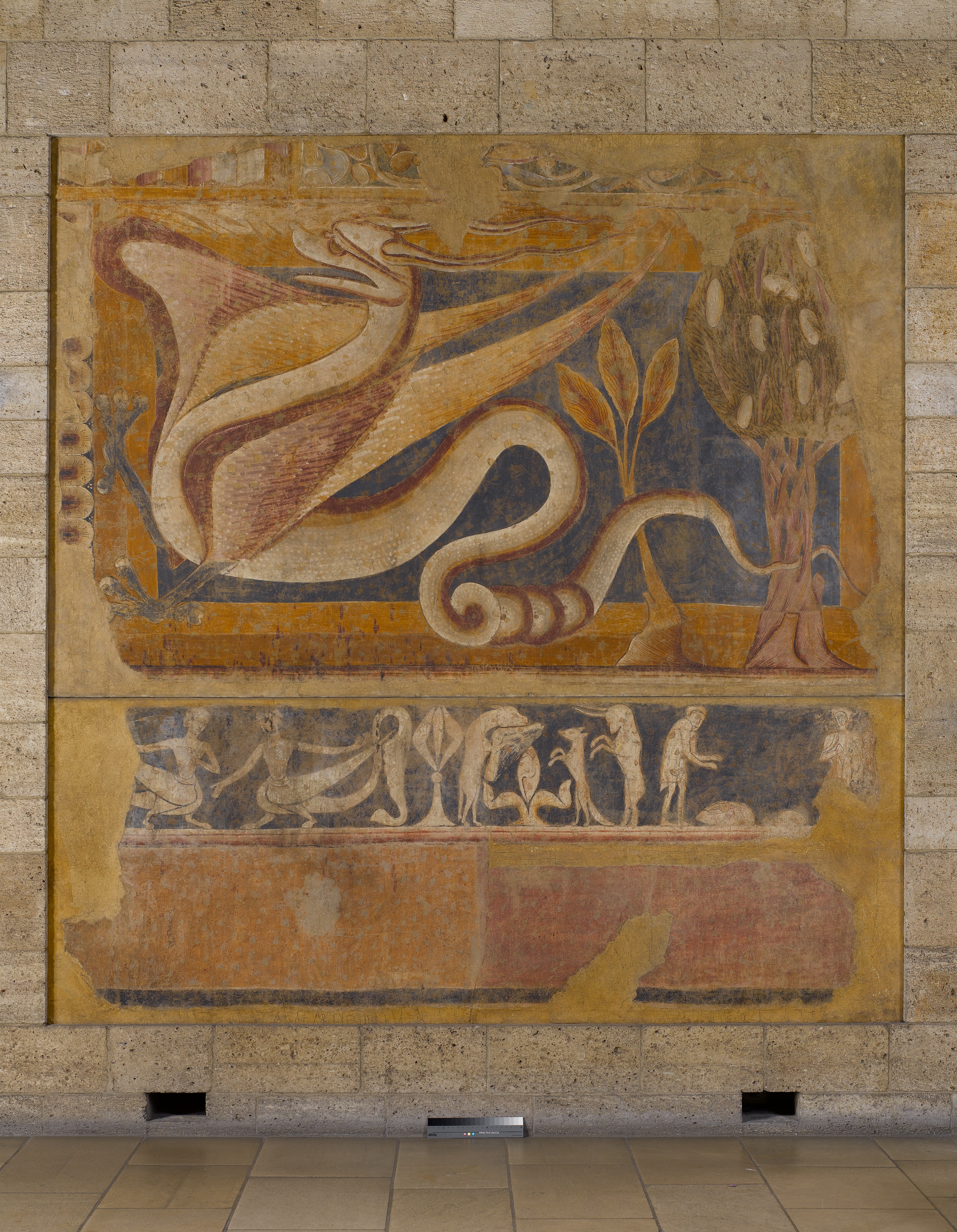
Have you ever seen any frescoes? I saw Leonardo da Vinci’s frequently restored Last Supper in Milan when I was a teen. I really liked doing a research project about the frescoes of Giotto in high school although I’m pretty sure I’ve never seen any Giottos except in pictures. Below, I’ve added a nice dragon fresco from the Cloisters. (I wrote about my 2019 visit there in this post.)

Twelfth Century Spanish fresco at the Met Cloisters in New York City.

Read Full Post »

Photos: Ciro Fusco / Pompeii Parco Archeologico
Frescoes in Pompeii’s newly discovered “Enchanted Garden” room. The ashes of Mount Vesuvius left the ancient city remarkably intact after the volcano erupted in 79 AD.

When my younger grandson told me about a volcano in Guadalupe, where Suzanne’s family spent the holiday, he hastened to reassure me that it didn’t erupt. He’s six, and a stickler for fact.

Whether young or old, we are all fascinated by the extraordinary power of volcanoes and the way they change the world very suddenly, sometimes with no warning at all.

The complete destruction of Pompeii by the volcano Vesuvius in Italy is one of the reasons eruptions have such a hold over the collective imagination.

Interestingly, Pompeii continues to yield previously unseen beauty to archaeologists even after all these years.

As Sarah Cascone reported in October at ArtNetNews, “Pompeii is the city that keeps on giving. More than two hundred and fifty years after the ancient Roman town was discovered buried under a heap of volcanic ash, the archeological finds show no sign of abating. Now, archaeologists for the Great Pompei Project have uncovered yet another impressive discovery: an ancient shrine, or lararium, covered in gorgeously preserved frescoes, in a 16-by-12-foot room containing an altar, a garden, and a small pool.

“The Italian media has dubbed the new room, which would have been partially covered by a tile roof, ‘the Enchanted Garden.’ The figures in the paintings include two serpents, a wild boar fighting unidentified creatures against a blood-red backdrop, and a mysterious man with the head of a dog that may have been inspired by the Egyptian god Anubis. In front of a painted peacock, strolling through the plants, there would have been a planted flower bed, extending the illusionistic decorative design into the real world.

“ ‘It is the first time that such complex decoration has been found in a space dedicated to worship inside a house,’ Massimo Osanna, the director of the Parco Archeologico di Pompei, told the Wall Street Journal, praising the find as exceptional.

“ ‘Every house had a lararium of some kind,’ Ingrid Rowland, a professor at the University of Notre Dame and the author of From Pompeii: The Afterlife of a Roman Town, told the New York Times. But ‘only the wealthiest people could have afforded a lararium inside a special chamber with a raised pool and sumptuous decorations.’

“After clearing out the volcanic rock fragments, or lapili, that had buried the room for almost two millennia, archaeologists found an altar decorated with eggs, a symbol of fertility. There are burnt remains, which archaeologists believe may have contained food offerings, such as eggs, figs, or nuts, to fertility deities. The altar is flanked by paintings of the Roman gods of household rituals. …

“New excavations are much more careful than the original explorations of the site, which began in 1748. Without modern technology and techniques to aid their excavations, early archaeologists could be quite destructive. The new discovery helps provide a better understanding of what the early excavations would have looked like when first uncovered. …

“Since 2011, Italy has been carrying out much-needed preservation and restoration work to preserve the UNESCO World Heritage Site. The Great Pompeii Project, an initiative aimed at stemming the deterioration of the ancient structures, had an initial budget of €105 million ($140 million). … The discovery of the ‘Enchanted Garden’ represents perhaps the project’s greatest success thus far.”

More here.

In Pompeii, a recently uncovered household shrine, or lararium, features two serpents among its beautifully preserved frescoes.

Read Full Post »

Photo: Yuri Cortez/AFP/Getty Images
Miguel Francisco Macias was inspired to replicate Michelangelo’s frescoes not just because it is a stunning work of art, but because he realized the Sistine Chapel ceiling has almost the same dimensions as his church in Mexico. It took 18 years.

Don’t you admire people with big ambitions who see an implausible project through to its conclusion? This designer sought to replicate the Sistine Chapel frescoes on the ceiling of his church in Mexico. He thought it might take six years.

Sarah Stocking writes at Lonely Planet, “For the last 18 years, a retired graphic designer has been quietly painting a replica of Michelangelo’s Sistine Chapel at his local church in Mexico City. Miguel Francisco Macias began his opus in an attempt to offer people who cannot travel a glimpse at one of the most shining examples of European art, Macias told Aljazeera.

“The project, which is now displayed on the ceiling at Perpetuo Socorro Church in Colonia Moctezuma, was largely self-funded with small donations from parishioners. Macias worked on the weekends with two assistants. The work was divided into 14 canvases each of which is 45-feet wide. Macias knew from the beginning that he would not be able to paint facing up, the way Michelangelo did, so he painted the canvases first and then affixed them to the ceiling afterwards.

“Macias said he was inspired to replicate Michelangelo’s frescoes not just because it is a stunning work of art, but because he realised the Sistine Chapel ceiling has almost the same dimensions as his local church, reported Splinter.

“The realisation came to Macias on a trip to Rome with a friend in 1999. The artist spent hours in the chapel admiring the frescos. ‘I stayed until the guard made me leave,’ Macias remembers. He also measured the length and width of the Sistine Chapel with footsteps. He wrote the dimensions on a small sheet of paper and presented his idea to the pastor on his return. …

“Macias didn’t think the project would take him nearly as long as it did. ‘I said it would be a maximum of six years,’ he told Newsbeezer. While the project suffered many setbacks, including falls, floods and robberies, none was so potentially insulting as when the Mexico City government used taxpayer money to temporarily recreate the Sistine Chapel in the Zocolo in 2016 ahead of a visit from the Pope.

“Although the community rallied behind Macias and wrote letters requesting that the Pope visit Macias’ work in progress in addition to the government’s pop-up, they didn’t get the holy visit they were hoping for. Macias didn’t let it bother him and kept a sign in his make-shift studio that read, ‘do not give up Miguelito.’ ”

More at Lonely Planet, here.

Read Full Post »