Feeds:
Posts
Comments

Posts Tagged ‘friend’

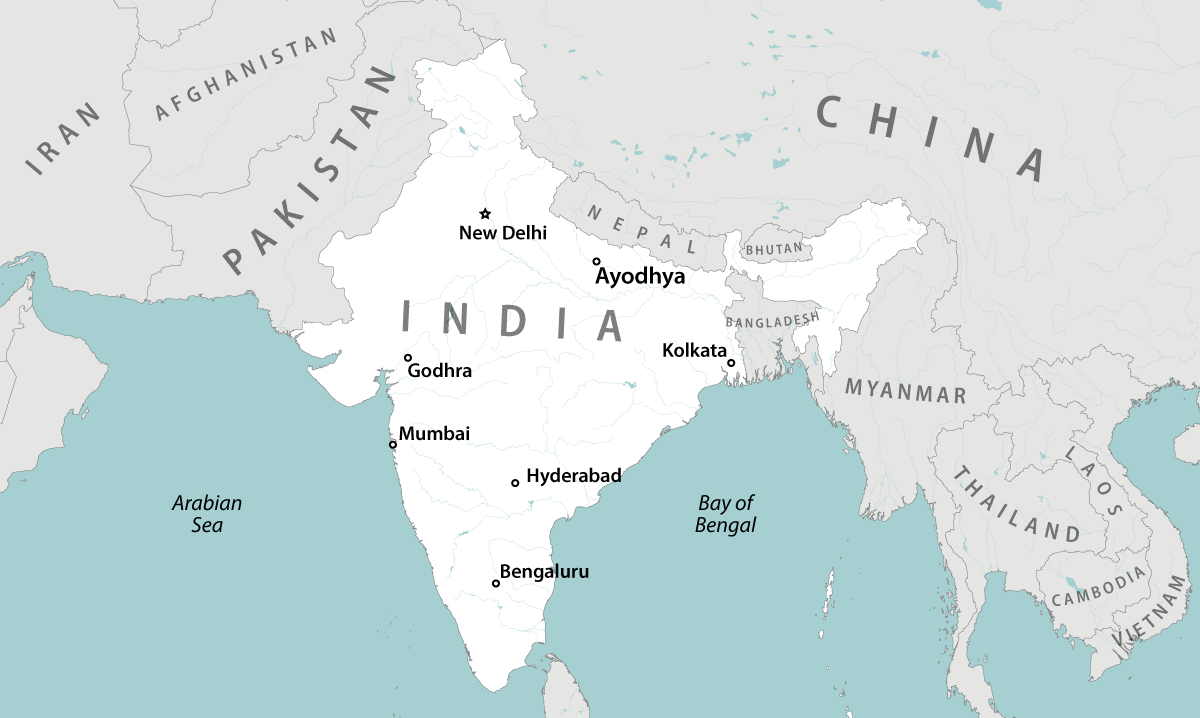
Map: Jacob Turcotte/CSM.
There are still people in India who appreciate having friends from other religions.

There is not much to celebrate about Hindu-Muslim relations in India these days, where the current power structure seems to have turned its back on peaceful coexistence. But trust the Christian Science Monitor to come up with a rare upbeat story! It’s about an interfaith friendship between Sadiq Ali, a Muslim, and Mahant Gyan Das, a Hindu, that has survived many political storms.

Shweta Desai  writes, “The light blue walls of Sadiq Ali’s living room are adorned with photos of Hindu seer Mahant Gyan Das. The two have been friends since the 1980s, when Mr. Ali was a volleyball player and Mr. Gyan Das a wrestler. They bonded over their shared love of sports, and Mr. Gyan Das regularly visited Mr. Ali’s family tailoring shop to get his tunics stitched. 

“About 20 years ago, their friendship took on a new meaning. Days of violent riots had rocked the nation and left more than 700 Muslims dead. It tore open old wounds in Ayodhya, a north Indian city where the Muslim community was still reeling from the destruction of the historic Babri mosque by a Hindu mob in 1992.  

“Sensing the need for an olive branch, Mr. Gyan Das, then head priest of the city’s historic Hanuman Garhi temple, invited 1,000 Muslims to the temple premises during Ramadan to break their daily fast. Mr. Ali helped host the feast, which still fills its organizers with pride and nostalgia – especially as Ayodhya is once again in the spotlight for Hindu-Muslim tensions.

“[Recently] Prime Minister Narendra Modi unveiled an opulent Hindu temple on the site where the Babri mosque once stood. 

“Like the mob which leveled the mosque, Mr. Modi and his supporters in the ruling Bharatiya Janata Party (BJP) claim that Babri was built over the birthplace of Hindu deity Ram, and the construction of the new Ram temple has become a rallying point for India’s growing Hindu nationalist movement. …

“In such polarized times, Mr. Gyan Das and Mr. Ali’s friendship offers a reminder of what Ayodhya could have – and perhaps still can – become: a symbol of multiculturalism and tolerance.

‘Ordinary people here want to live in peace,’ says Valay Singh, author of Ayodhya: City of Faith, City of Discord.

“He argues that the city’s reputation as India’s ‘ground zero’ of communal conflict overshadows its history as a heartland where different religious traditions have long intersected. In fact, he notes, the land for the Hanuman Garhi temple was donated to the region’s Hindu community by Muslim ruler Shuja-ud-Daula in the 18th century.

“ ‘It was a common tradition for the religious establishments to receive patronage from the Muslim rulers,’ he says. …

“[The] religious strife has deep roots – several weaving back toward Ayodhya. The destruction of the Babri mosque, for instance, came after decades of campaigning by right-wing Hindu groups, such as the Vishva Hindu Parishad (VHP), and led to months of communal violence across India. In Ayodhya, Muslims and their properties were singled out. Mr. Ali’s shop was plundered multiple times. …

“Indeed, the mosque’s demolition and resulting chaos left deep fissures between the Hindu majority and Muslim minority throughout the country. 

“Those rifts grew during the 2002 Gujarat riots, which were sparked by a deadly fire on a train carrying Hindu pilgrims from Ayodhya to Godhra, Gujarat. …The following year, Mr. Gyan Das approached Mr. Ali with his idea to organize an interfaith iftar fast-breaking meal at Hanuman Garhi.

“At first, the tailor was baffled. He reminded Ayodhya’s most influential seer that after breaking fast, Muslims must offer the namaz prayers. Will the Hindu seers accept prayers to Allah on the temple’s premises? Mr. Gyan Das was confident they would.

“In November 2003, with fanfare and high security, saffron-robed priests from several local temples welcomed their Muslim guests, serving them fruits and yogurt. Around sunset, calls of ‘Allahu Akbar!’ mingled with the sounds of conch shells and temple bells, as rows of Muslims bowed down to read the namaz. Both sides prayed together for peace and brotherhood to prevail across the country.

“The Muslim community reciprocated. After the iftar, hundreds of seers marched to Mr. Ali’s home to break the Hindu Ekadashi fast with seviyan, a traditional sweet prepared by Muslims on festive occasions. …

“The iftar [inspired] Yugal Kishore Shastri, one of few outspoken Hindu priests who have left the far-right and put their faith in the spirit of Indian secularism. Mr. Shastri says he split from the VHP after discovering that there was ‘no evidence of an ancient Ram temple under the mosque structure.’ …

“Although it’s getting harder for activists to cut through the vitriol and bring communities together … ‘There will always be a place for people who work for Hindu-Muslim peace,’ he says.”

More at the Monitor, here.
Read Full Post »

Photo: Twitter | @latifnaseer.
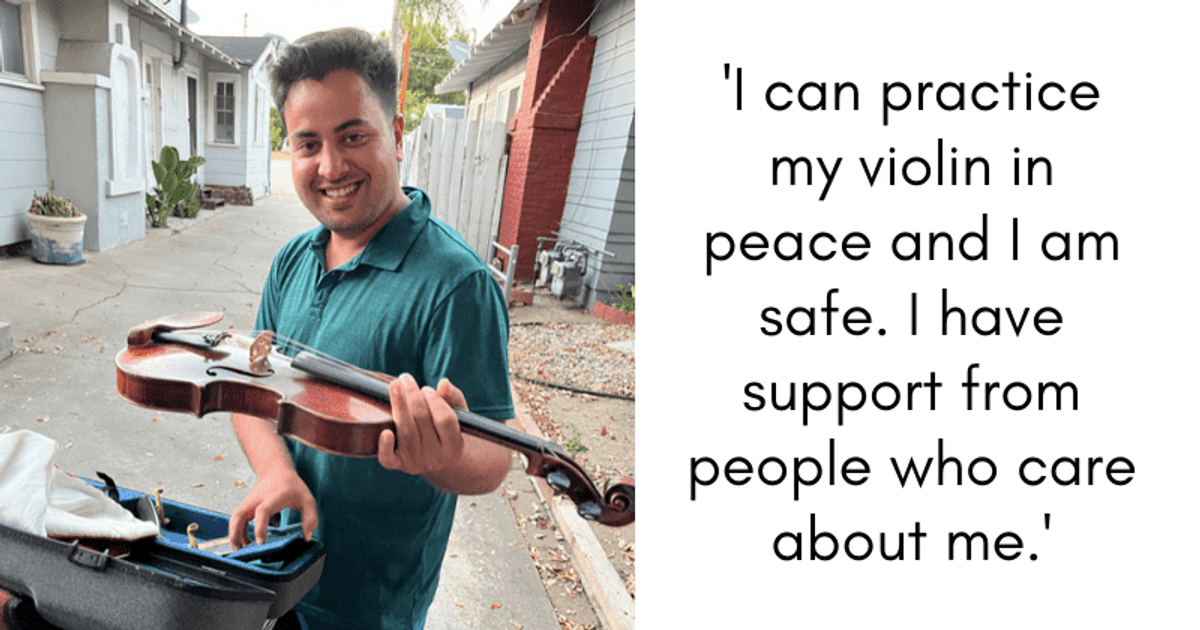
Ali Esmahilzada, an Afghan violinist, fled Kabul in 2022 amid the Taliban takeover. He arrived in Los Angeles without a violin. Latif Nasser delivered an antique violin from Jeremy Bloom and found a friend for life.

There are few positive stories about the aftermath of the abrupt 2022 US departure from Afghanistan. So, in sharing today’s article, I don’t want to minimize the suffering that continues there. For example, my friend Shagufa, the youngest of 11 children in a Herat family, was faced with getting her mother and all her sisters out, working with Marilyn Mosley Gordanier at Educate Girls Now. One of Shagufa’s sisters really had a target on her back, having trained as a police officer for the deposed government.

But at the Washington Post, we do find a nice story by Sydney Page about an Afghan who made it to the US.

“On a work trip in Upstate New York last May, Latif Nasser got an unexpected request from a colleague: ‘Can you hand-deliver an antique violin across the country?’ …

“The violin was going to an Afghan violinist who fled Kabul amid the Taliban takeover, and settled in Los Angeles with almost nothing but the clothes on his back. He left his violin behind.

“Nasser, [science journalist and co-host of Radiolab from] Los Angeles, agreed to help. The request came from Jeremy Bloom, a sound designer based in Brooklyn, who had heard about the struggling musician from a friend.

“Bloom happened to have a 110-year-old German-made violin collecting dust in his closet. He decided to offer it to the Afghan musician, who he knew would put it to good use.

“ ‘I was very lucky to be able to play that violin for a while, but I also felt guilty that it was sitting in a closet,’ said Bloom, adding that older violins are sometimes seen as more desirable than newer instruments. …

“The problem was, Bloom had no way of getting the violin to Los Angeles. ‘You do not want to ship an antique violin in the mail,’ he said, because he feared it would get damaged. …

“It took several weeks to get the instrument to the Afghan violinist, Ali Esmahilzada. ‘It felt like it took forever for us to coordinate,’ said Nasser, who — after several failed delivery attempts — became irritated when Esmahilzada asked if he could bring it to a mall. The musician didn’t seem eager to get the instrument, and Nasser began to wonder whether he even really wanted it.

“ ‘In a way, I was being protective of my friend Jeremy. … ‘This is the most beautiful gesture, giving someone this priceless violin for free.’

“After the mall plan didn’t work out, Nasser and Esmahilzada finally found a time to meet, and … it was immediately clear that ‘he wanted this violin so bad,’ Nasser said.

“Esmahilzada said he did not take his treasured violin with him when he left Afghanistan because he feared if the Taliban found his instrument at armed checkpoints throughout the city, they would ‘hurt me.’ …

“The Taliban has prohibited playing music in Afghanistan, and possessing an instrument is considered a crime. Esmahilzada, who has been playing the violin since he was 13, felt he had no choice but to flee his home country — and leave his family behind. ‘I was so scared.’ … He came to the United States on a Special Immigrant Visa with only a few belongings. …

“He was living in a small house with four Spanish-speaking roommates who he had trouble communicating with. He worked in the stockroom of a clothing store — which is why he asked Nasser to meet him at the mall. He ate eggs for every meal because it was the only thing he knew how to cook. …

“Nasser — whose parents immigrated to Canada in the early 1970s from Tanzania — empathized with Esmahilzada.

“ ‘It was so hard for my parents,’ said Nasser, explaining that kind strangers helped them get settled, and likewise, they went on to assist other immigrants.

“ ‘The more I heard his story and how deeply alone he was, I decided I could be that person for him,’ Nasser continued. … He invited Esmahilzada over to have dinner with his wife and two small children — which soon became a weekly invitation.

“ ‘It clearly meant a lot to him. He both needed it and was grateful for it,’ Nasser said. ‘It seemed like it was a gulp of water to a thirsty guy.’

“Nasser’s family started to feel like his own. … Life in America [had been so] difficult. He worked tirelessly to make a meager living, most of which he sent back to his family in Kabul. …

“Nasser and his wife helped him find an immigration lawyer, a laptop, some clothing and groceries. They also supported him as he sought a more stable job, and got himself a car. …

“For the first time in a long while, Esmahilzada said, he is hopeful about the future.

“ ‘I started from zero when I came to the United States,’ he said. ‘Now I’m happy. I have support from people who care about me. We have really kind people in the world.’ ”

More at the Post, here. To read without a firewall, click on Upworthy.

Read Full Post »

Photo: Caroline Hernandez/Unsplash.
Few things matter as much as a good friend.

I’m thinking a lot about friends today because one of my friends has been in the hospital more than a week, having had a serious fall. She lives alone and has health issues that cause her to fall. Her only family, a nephew, lives far away. So her health proxy (and good friend) designated four of us as her family. The ICU admits only family.

My friend has come out of her coma and ditched the ventilator, and we have been rejoicing over the smallest things: eyes opening, head nodding for answers to questions, the lifting of a hand.

Friends have always meant a lot to me (see post “Time with Friends Boosts Health“), and today’s article suggests one of the reasons why: they are good for my health. They certainly have been good for my friend’s health.

Sharon Barbour (@SharonBarbour on Twitter) reports at the BBC, “A new approach to helping people with depression is becoming more and more popular. ‘Social Prescribing’ sees GPs sending patients on trips to places like allotments (community gardens) rather than pharmacies. Healthcare professionals say it works, and reduces pressure on GPs and A&E [emergency rooms] too.

“Craig Denton, from Gateshead, has struggled with depression and loneliness for years. … He is one of more than eight million adults in England now taking antidepressants. But, in the North East, a new approach to helping people with depression is growing.

” ‘Social prescribing’ is part of a plan by health and council bosses to tackle what Gateshead’s director of public health described as ‘really shocking’ health outcomes in the region.

“It has seen Craig enjoy a day out at an allotment run by his GP’s surgery where he has dug and cleared, but also chatted with other people, and not been alone.

” ‘Instead of just sitting down in your house, where you can just dwell on things, you can use this as a distraction, meet new people,’ he said.

“Julie Bray, from Oxford Terrace and Rawling Road Medical Group in Gateshead, was one of the first NHS social prescribers in the country and said she was ‘really passionate’ about it. … ‘They build their confidence up, it reduces GP appointments, it reduces A&E appointments, and it just makes them connect with the community and be resilient.’

“The North East has among the highest rates of drug-related deaths, heart disease, liver disease and suicide in England.

“Rates of child poverty are double the England average in some areas with poverty underpinning much of the ill health. Social prescribing is only one part of a plan by the NHS, local councils, and community groups to make improvements by 2030.

“Alice Wiseman, Gateshead director of public health, said a report in 2020 showed that, while life expectancy across the UK had stalled, it had started getting shorter for those in the bottom 10% income bracket in the North East.

” ‘Nine of all 13 areas within this plan have a healthy life expectancy of less than 60 years,’ she said. ‘People aren’t even reaching retirement age without having a life-limiting illness. It is really shocking.’ …

“What is needed is ‘forming friendships and feeling as if they’ve valued, as if they’re worth something,’ she said.”

Tell me about the importance of your own friends. It may not be enough for serious depression, but as the saying goes about chicken soup, “It wouldn’t hurt.”

More at the BBC, here. No firewall.

Read Full Post »

Photo: Marcos Paulo Prado/unsplash.
A diary version of the chain letter, begun by Kyra Peralte
, comforted participants during the pandemic.

As things are gradually getting back to something resembling normal, people are taking stock of the past 14-plus months and recording how they got through them. A new kind of chain letter, first begun by Kyra Peralte, provided support to 115 strangers around the world.

Sydney Page writes at the Washington Post, “Kyra Peralte thought keeping a diary during the pandemic might help her sort out her tangled feelings. Then she decided to drop her journal in the mail and share it with a stranger.

“Peralte — a mother of two in Montclair, N.J. — started writing candidly last April about the challenges of juggling work, marriage and motherhood during a global crisis. Writing was cathartic, but Peralte, 44, wanted to know how other women were doing. Was she alone in her feelings or were other women experiencing the same overwhelming stress? She craved connection.

“So she made an unusual offer. She invited other women from near and far to fill the remaining lined pages of her black-and-white marbled composition notebook with their own pandemic tales.

‘I wanted an interaction that felt human, and it feels very human to read someone else’s writing,’ said Peralte, a children’s game designer.

“She dreamed up ‘The Traveling Diary’ — a simple notebook that would traverse the globe via snail mail, collecting handwritten stories and, ultimately, creating a community.

“A year later, seven marbled notebooks have circulated in various locations — from the United States to Australia, Canada to South Africa — and a growing group of strangers have formed an unexpected friendship as a result. So far, 115 women have signed up to participate.

“Peralte found her first contributor on a Zoom conference for entrepreneurs, during which she mentioned her diary idea. A woman from North Carolina immediately reached out and said she would like to write in the book.

“From there, Peralte wrote a Medium article, in an effort to recruit more women to get involved. Word spread, and she created a website so participants could easily add their names to the queue. Each person is allowed to keep the diary for up to three days and fill as many pages as they wish, with whatever writing or artwork they choose. Then, they are responsible for mailing it to the next person, whose address Peralte provides. …

“Amy Tingle, 52, sat down with the diary last September, in the wake of civil unrest and ongoing protests, and she decided to focus her entry on America’s racial reckoning.

“ ‘I couldn’t escape the sadness,’ said Tingle, who lives in Maine. ‘I remember being really disappointed in humanity.’ Writing in the communal diary, ‘was definitely a therapeutic thing during that time,’ she said. As an artist, she also included a collage of women, symbolizing the sense of friendship she felt with other participants. While writing her own thoughts was healing, she said, it was equally meaningful to read the words of other women who held the book before her. …

“Kirsty Nicol, 29, who lives in London, heard about the Traveling Diary through a friend. She received the journal two months ago, after it was shipped from New York City.

“ ‘It came to me at a challenging time during lockdown,’ she said. …

“Reading the entries allowed her to escape, transporting her into the lives of others and finding bits of wisdom they left. One woman from Australia had written: ‘Working with the setbacks. Not against them. Patience and gratitude. It’s a dance. Life is moving and we can stomp our feet in rejection, or we can gracefully embrace the mess, tidying as we go.’ …

“When Colleen Martin, 44, received the diary on her doorstep in Florham Park, N.J., last November, ‘I had just recently lost my brother,’ she said. … It helped her look for meaning and ‘the growth and development that occurs in terrible times.’ …

“ ‘It has really evolved into a community,’ Peralte said. She often hosts Zoom events so the women get the chance to get to know one another more, share stories they might have missed and connect more intimately. Some of the women, she said, have actually become close friends.”

More here.

Kyra Peralte, below, had the original idea to send a composition notebook with a diary entry to a stranger in April 2020, during the pandemic. “A year later,” says the Washington Post, “seven diaries have circulated, and 115 women have been part of the traveling diary.”

Read Full Post »

The New York Times Science section had a cute piece in January about surprising friendships among different species of animals. Perhaps you saw it.

Erica Goode reported, “Videos of unlikely animal pairs romping or snuggling have become so common that they are piquing the interest of some scientists, who say they invite more systematic study. Among other things, researchers say, the alliances could add to an understanding of how species communicate, what propels certain animals to connect across species lines and the degree to which some animals can adopt the behaviors of other species.

” ‘There’s no question that studying these relationships can give you some insight into the factors that go into normal relationships,’ said Gordon Burghardt, a professor in the departments of psychology and ecology and evolutionary biology at the University of Tennessee, who added that one video he liked to show students was of a small and persistent tortoise tussling over a ball with a Jack Russell terrier. …

“Until recently, any suggestion that interspecies relationships might be based simply on companionship would probably have been met with derision, dismissed as Pixar-like anthropomorphism. That has changed as research has gradually eroded some boundaries between homo sapiens and other animals. Other species, it turns out, share abilities once considered exclusive to humans, including some emotions, tool use, counting, certain aspects of language and even a moral sense. …

Barbara J. King, an anthropologist at the College of William and Mary, said that she hoped researchers would begin to collect examples of cross-species interactions to build a database that would merit scientific scrutiny. ‘I think we’re not even at the point of being able to extract patterns because the database is so small,’ she said, adding that the topic could also benefit from a rigorous definition of what constitutes a ‘friendship’ between members of different species.” More here.

Photo: Noah’s Ark Animal Sanctuary by way of Africa Geographic.

Read Full Post »

I am utterly tickled with the updated website for Suzanne’s birthstone-jewelry company Luna & Stella, the company that is behind this blog.

I really hope you will take a look — both for new products like stacking rings and a star pendant and for the wonderful pictures customers submitted showing warm  family and friend relationships.

Suzanne says, “We had so much fun with this contest we decided to keep it going. Send black & white vintage or recent family photos to contest@lunaandstella.com and you could win a $100 gift certificate if we use your photo on the site!”

Suzanne has given me such a free rein with this blog that it’s possible some readers don’t realize it’s a Luna & Stella blog. So I’m thrilled that the new website is up today. It gives me the opportunity to remind everyone that Mother’s Day is the second Sunday in May.

(One of the many perks of being a grandma is that I get a new Luna & Stella charm or ring every Mother’s Day that there’s a new baby in the family.)


Read Full Post »