
Feeds:
Posts
Comments

Posts Tagged ‘goat’

Photo: Alan Devall/Reuters.
A drone view shows volunteers with people affected by the Palisades wildfires, at a donation center in Arcadia, California, Jan. 12, 2025.

If you ever feel like your world is run by people without hearts, do what Mister Rogers’ mother advised when he was a little boy: “Look for the helpers.” As long as there are a few willing helpers, all things are possible.

Consider the volunteers in the recent California wildfires. At the Christian Science Monitor, Ali Martin wrote in January about people stepping up, even those whose lives had also been damaged.

The story started with a family’s pet goat. “Coco the goat is nestled in a soft bed between two cars in the parking lot of El Camino Real Charter High School on the western edge of Los Angeles’ San Fernando Valley. Other wildfire evacuation shelters wouldn’t allow the 10-year-old house goat to stay with her family – the animal shelters board pets on their own, in kennels – but breaking up wasn’t an option for her owner, Maji Anir. …

“She is quietly out of the way, is no bother, and offers a drop of levity in a sea of stress – most people who take notice stop to pet her, spirits lifted. Workers are letting her stay.

“Mr. Anir and his family had just two hours to evacuate as the fire approached their home in Malibu – not enough time to get everything they needed. They pulled away Tuesday evening as the sun was setting. By morning the house was gone, along with all of their neighbors’. …

“Even in this besieged region, ruin is bending toward resilience. And from the staff to random visitors and those sheltering, a common theme is kindness. …

“El Camino is a well-appointed charter school. … Classes for the school’s 3,500 students were scheduled to start back up in mid-January. Now, with the Palisades Fire burning out of control on the other side of a mountain ridge, the campus is a gathering place for those needing refuge – and the people volunteering to help.

“Kate Delos Reyes was supposed to be in a residential program for mental health treatment. The program in Santa Monica was canceled as fires swept through the nearby Pacific Palisades.

“She’s seen fires before, when she worked at a rehab center in another Southern California mountain range. Remembering that stress, she drove to the evacuation center at El Camino to lend whatever help they might need. ‘Kindness is free, you know.’ …

“Eddie Včelíková is fielding a stream of texts from her friends while she scrolls through social media. She is taking in photos of her childhood home in Altadena; St. Mark’s Episcopal Church, which she attended every Sunday; her schools – all of it destroyed.

“Altadena, an unincorporated town in northern LA County, welcomed Black homebuyers in the mid-1900s, when redlining kept them out of other neighborhoods. As the area developed along the southwestern base of the San Gabriel Mountains, so did the diversity of its middle-class bedrock. Last week, the Eaton fire, which is still burning, swept through much of the small community and leveled entire blocks.

“When she saw video of the burned-out park where she played every weekend as a child, Ms. Včelíková says she broke. She found her way to the shelter. ‘I’m just out here volunteering to stay busy because it’s the only thing I think that’ll keep me from going insane.’ …

“She’s tried to get back into her old neighborhood, but National Guard troops are blocking every route – protecting vacant homes from looting. On Sunday, she attended a virtual church service hosted by St. Mark’s. The church may be gone, but its spirit is not. …

“[Soon] not even the shelter itself is safe. The Kenneth Fire has broken out in late afternoon on a ridge overlooking this edge of the San Fernando Valley. … This refuge is shutting down. Most of the evacuees are heading 20 miles east to another shelter at the Westwood Recreation Center.

“Leslie and Megan Walsh are making space in their packed trunk for a small suitcase. They’ve just met a young woman who needs a ride to Westwood, and they’ve offered to take her.

“They’re from San Diego; they know what LA is going through. In 2003, fires swept through parts of their city, and they had to flee. Their neighborhood lost 300 homes. Now, with Megan living in LA, the family wanted to help however they could.

“Leslie and her daughter drove to LA with a car full of animal supplies – pet food and beds, mostly – to donate. But their first stop, a shelter in Agoura Hills, was evacuated, so they came here. Now this one’s evacuating. …

“The Walshes headed back to San Diego with their supplies. Over the next couple of days, Megan ran a donation drive among their San Diego neighbors. She and her parents returned to LA Sunday with a U-Haul truck and two more cars filled with clothing, toiletries, pet food, sleeping bags, air mattresses, and more. …

“Back at El Camino high school on Thursday, in the hours before the Kenneth Fire erupted, first responders had pulled into a corner parking lot to take a break and grab a meal. The shelter was overflowing with food donations, so school administrators redirected the potluck to feed firefighters and police officers.

“Administrative Director Jason Camp says the support for first responders was driven by an outpouring in the community. … He notes the number of people – emergency responders, volunteers, local officials – who are managing their own fears and losses from the widespread devastation. Nobody is untouched.

“Some people who are displaced or lost their homes want to be part of the solution and ‘to help somebody through the pain and maybe together they can get through it,’ he says. ‘It’s refreshing to see that not everything’s in total chaos. The heart is still there.’ ”

More at the Monitor, here.
Read Full Post »

Photo: Matt Smith.
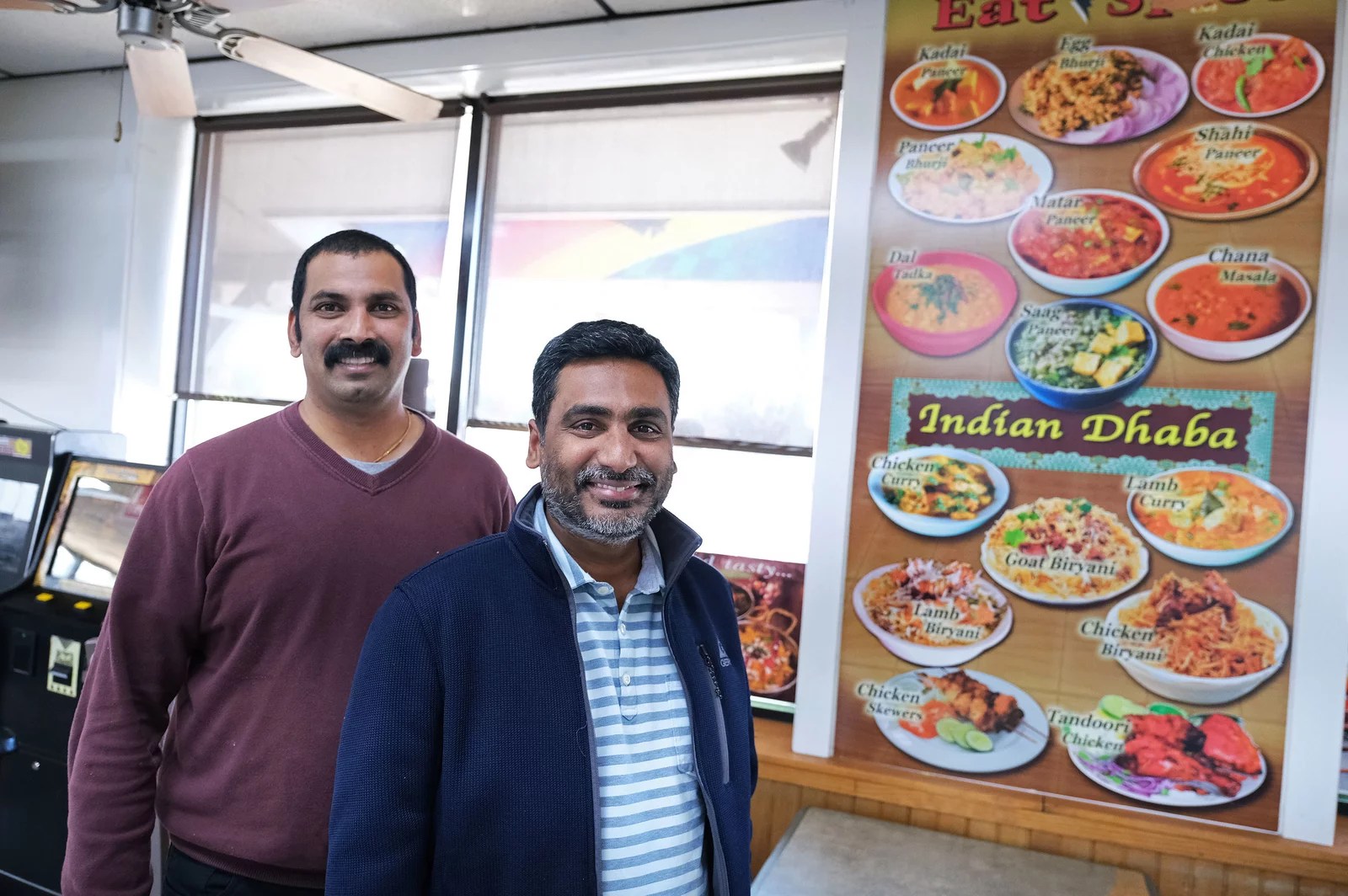
Co-owners Vamsi Yaramaka (left) and Raj Alturu stand inside Eat Spice in October 2019, in the truck stop on Route 534 off I-80 in White Haven, Pa. Indian and Mediterranean dishes like theirs can be hard to find on the road.

Whenever I want to share something I read about before Covid, I do a search to see if it is still relevant or if a featured company is still in business. That is how I learned that the truck stop National Public Radio reported on before lockdown — a restaurant that was catering to Sikh and Somali truck drivers — had been discovered by lots of other motorists.

Here’s what Laura Beshoff had to say about the restaurant in January 2020. “Truck driver Aman Singh, 30, must traverse the 660 miles from northeastern Pennsylvania to Louisville, Ky., on an overnight drive. Before he saddles up for the long haul, he settles into a booth at Eat Spice, a truck stop/Indian restaurant off I-80 in Luzerne County, Pa., with a plate of chicken curry and a stack of roti. …

“Eat Spice caters to a unique intersection: where rural America meets an increasingly diverse cadre of truckers looking for a taste of home as they jockey between warehouses and retail outlets.

“Located in White Haven, Pa., population 1,100, the truck stop has a clientele that’s more likely to hail from immigrant enclaves in Ohio and Michigan than the surrounding town, which is 96% white. Here, the cooler of live bait coexists with the carafe of homemade chai. In the fridge, there’s both Red Bull and mango lassi. Your choice.

“Sam Singh, 27, drives between Flint, Mich., and northern New Jersey every other day. He stops at Eat Spice for meals during nearly every 10- to 12-hour trip.

” ‘We like Eat Spice. Everything [is] Indian food,’ says Singh, listing his favorites. ‘Chicken biryani, goat biryani, chicken saag, butter chicken, egg bhurji, paneer something. Everything.’ …

“While the average trucker is a 46-year-old white male, a growing proportion of drivers younger than 35 are women, Latinx or from another country. Immigrants from northern and western India, such as Singh, have flocked to the trucking industry.

“Many of the early adopters follow Sikhism and came in the late 1980s after fleeing ethnic violence in India, according to Gurinder Singh Khalsa, a Sikh community activist in Indiana.

” ‘They came out of the country to save their lives,’ he said, often fleeing before being able to go to college or acquire job skills.

“Devout Sikhs may wear their hair long and wrapped in a turban, a look that was not always welcome on U.S. job sites, according to Khalsa. … So many turned to trucking. …

“Pay is another draw. Somali driver Farhan Warsame says he makes significantly more driving his own rig now than he did in his old job, working warehouses in Kentucky.

” ‘I make a week, the money I used to make before… [in] a whole month,’ he says. ‘I make $1,200.’ …

“Steve Emery, who’s white, is another regular at Eat Spice. The 62-year-old trucker wears a Van Halen T-shirt and stands by the counter. He’s hungry after hauling a load of retail clothing from Akron, Ohio, to New Jersey.

” ‘I kind of had a taste for tuna today, but they didn’t have it, so I went back to the old faithful,’ he says, selecting a meatball sub from the ‘American’ portion of the menu. Emery has tried the biryani and says he liked it, but chose his comfort foods this visit.

“Eat Spice owner Raj Alturu, who lives in Allentown, Pa., says he wants his business to be inclusive of everyone’s appetites. When he and his business partner, Vamsi Yaramaka, bought the restaurant/gas station/snack shop about seven years ago, it served sandwiches. …

” ‘We’re trying to update [the] menu when we get requests from customers,’ says Alturu. ‘Once people hit the road, it can be a day or two before they get home. … At least like once a day or once every two days, you want to have the food you are accustomed to.’

“Take the spaghetti chicken curry. It’s based on a Somali dish that a regular customer asked for. A few minutes later, that regular walks in. Yousuf Dahar, 31, lives in Hopkins, Minn., and was born in Ethiopia to Somali parents. …

“Sean Yazici, who lives in Indiana, is an immigrant who has embraced the classic trucker look. He sports a cowboy hat, boots and a belt buckle the size of a saucer. A first-timer at Eat Spice, he is excited about the shish kebab. ‘I’m from another country, Turkey,’ says Yazici. For him, finding Mediterranean food at a truck stop feels like hitting the lottery.”

More at NPR, here. Some 2021 reviews of the restaurant are here.

Read Full Post »

I got to see some pretty cute videos this week. Suzanne and Erik had just returned from taking the the kids on a trip to warmer climes, and my one-year-old granddaughter learned to speak “goat.” How great to be able to capture her conversation on a smartphone!

Goat, as you may know, consists of a one-word vocabulary delivered with varying degrees of urgency: “Baaaaaaa.”

I’m thinking she and her brother will relate to this June 2015 story about some baby goats in Maine.

From WPTV.com: “Winifred and Monty are three-week-old Nigerian dwarf goat siblings who love to play together on Sunflower Farm.

“In a few weeks they’ll be moving to a new home as pets and milking goats, so their current owners like to spoil them.

“On this particular cold day, they were treated to some new pajamas!

“They had no interest in going out in the rain though. They preferred to keep their new clothes pristine!” More here.

Read Full Post »

At some point in my childhood, family friends raised goats. It seemed exotic. The Gordon children drank goat’s milk. And we learned that goats will eat anything when my brother tried to pat a goat and lost his mitten.

In addition to mittens, goats eat weeds, and increasing numbers of individuals and groups are deciding to use goats instead of herbicides to control weeds.

Evan Allen writes in the Boston Globe, “According to the US Fish and Wildlife Service, the use of goats to control invasive species, already common out West, is becoming more common across the East Coast.

“Goats love woody shrubs and vines, making them ideal weed-whackers. Using goats cuts down on the need for herbicides, and, unlike tractors, goats don’t require diesel fuel to do their job. And nimble goats can easily maneuver across rocky or marshy surfaces that humans and machines can’t safely reach.

“ ‘Folks are looking for long-term means of control,’ said Eric Schrading, private lands coordinator at the Fish and Wildlife Service. ‘As the last 30-plus years have gone by, we’ve started to, maybe not abandon chemical control, but use that as only one tool in the toolbox.’ …

“In Wellesley, the goats were shuttled out to the Boulder Brook Reservation in a bright pink truck driven by a crew from the Goat Girls: Hope Crolius, owner of the Amherst-based business, and two of her goatherds.” Read more here.

For a video about goat weed control, check out this clip from Bear Creek Park in Colorado.

Read Full Post »