Feeds:
Posts
Comments

Posts Tagged ‘gown’

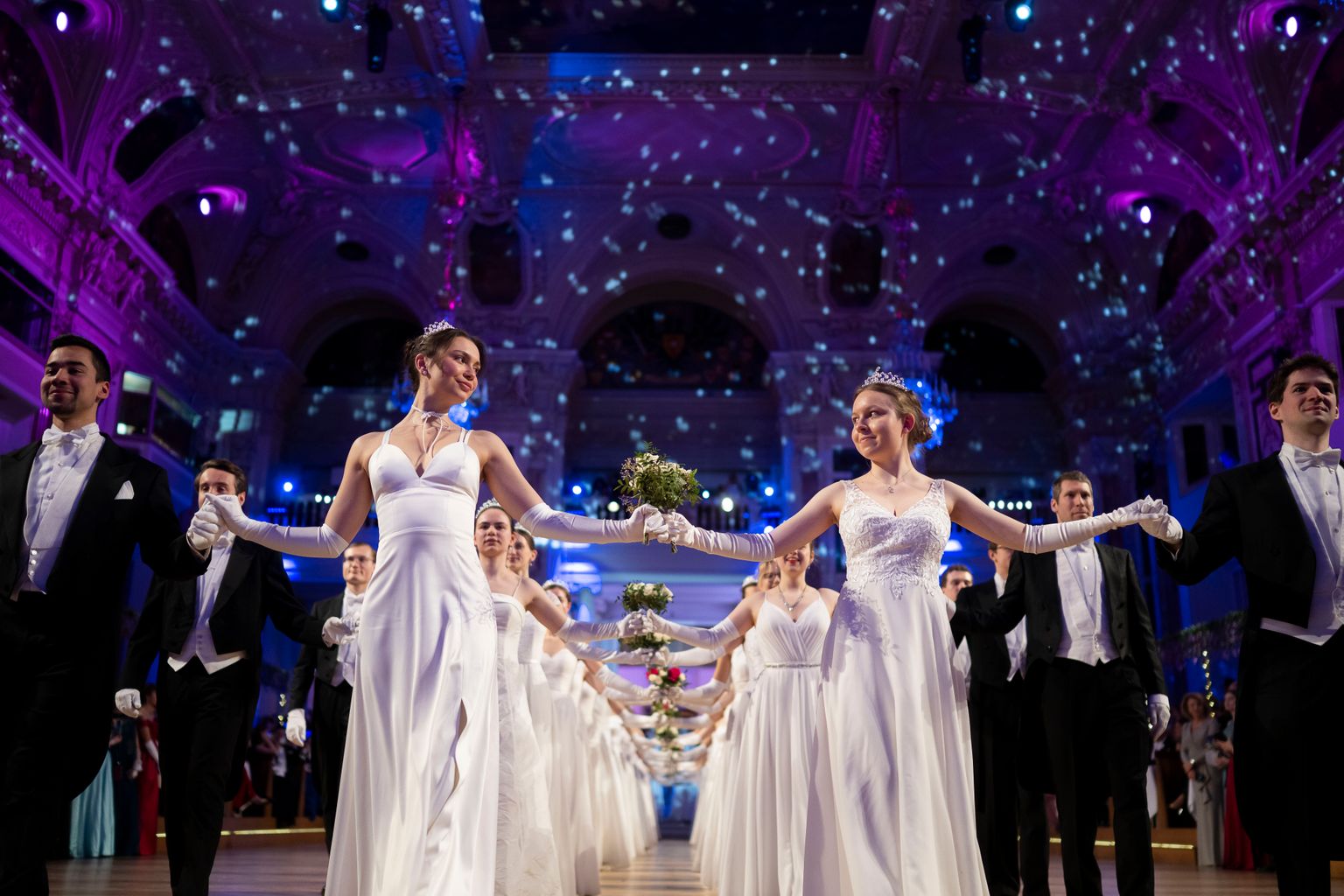
Photo: AP Photo/Denes Erdos.
Young people participate in the opening ceremony of the Lawyers’ Ball in Vienna, Austria, March 1, 2025.

Recently, we had Vienna on our minds because Erik and classmates from his high school in Wales were running a marathon there. Erik is a frequent marathoner and managed the course in under three hours, personal best.

Marathons are a longtime tradition in Vienna, but not as long as the activity in today’s story. It’s about the tradition of elegant balls.

Denes Erdos (along with AP journalist Stefanie Dazio in Berlin) submitted a report to the Associated Press.

“The aristocrats of the Habsburg royal court who danced in the first of Vienna’s famed balls in the 18th century could never have imagined how the hallmark of the Austrian capital’s social and cultural scene would evolve. Today, teenagers learn to waltz by watching YouTube videos while ladies shed their elbow-length gloves to better swipe on smartphones.

“More than 450 balls occur annually in Vienna, starting Nov. 11. … Professional guilds throughout the city host their own events, like the Ball of the Viennese Chimney Sweeps that marks the opening of the season.

“The sparkling balls are deeply rooted in Viennese culture, blending history with modern glamour, and the waltz remains an essential part. While the average ticket costs 395 euros ($427) — though VIP boxes at the Opera Ball can go for 25,500 euros ($27,539) — other events have lowered their prices to 40 euros ($43) to attract a wider audience.

“ ‘To be a part of this for me, as an Austrian person, is like taking part in Viennese culture,’ Leander Selmani, 19, said. ‘I was watching all these ball openings on YouTube and I said, “I want to be part of that.” ‘

“Besides YouTube, teens must learn the carefully choreographed dances for each ball’s opening ceremony from places like the Elmayer Dance School, which has been training dancers since 1919. In order to participate in an opening ceremony, dancers must first qualify through a strict regimen. Then they attend multiple lessons at a dance school and receive a stamped certificate of completion after each session. …

“Only once ‘Alles Walzer!’ (‘Let the waltz begin!’) has been declared can the rest of the crowd join in the dancing. This year, many balls honored the 200th anniversary of the birth of Viennese composer and violinist Johann Strauss II, known as the ‘waltz king.’

“While the waltz, the quadrille and other traditional dances are the heart of the Viennese balls, modern events now offer a diverse range of music and entertainment. Most venues feature multiple halls where guests can dance to various styles, including disco and contemporary beats. …

“Dress codes, however, have remained strictly enforced for centuries: gentlemen are required to wear tailcoats or tuxedos, and ladies must don evening gowns. Many attendees rent their attire from Lambert Hofer, a renowned costume workshop founded in 1862 that rents out hundreds of gowns each year.” More at AP via the Seattle Times, here.

Meanwhile in the US, you can take up ballroom dancing, but be prepared: the competition in the championships is fierce. My friend Ronnie’s sister wins them, but after years of work. About the latest competition, Ronnie tells Facebook, “I was in NY recently for the Fred Astaire Cross Country Dance Championships. My sister competed and is now 2025 Fred Astaire National Champion in American Smooth (tango, waltz, fox trot, Viennese waltz) Senior Division.” She is in her 80s.

Read Full Post »

Photo: Bonfire Visuals/Greenville Journal.
Beautiful gowns are part of the competitive ballroom-dancing experience.

Do you ever watch ballroom competitions on television and wonder where the women get their amazing gowns? At the Washington Post, Cathy Alter provides an answer — for those who can afford it. The gowns are pretty expensive.

“It could be any house in suburban Annandale, Va.,” writes Alter, “among the split-level Colonials with manicured boxwood shrubs — except, around back, past the statue of the red fox and down some steppingstones, there’s a sign on the basement door to greet visitors: ‘You’re about to enter a sparkle splash zone. Twirling encouraged.’

“Inside, Julie Wilson runs a business here in the family home, known by those who need to know as Encore Ballroom Couture. It’s considered the ballroom dance industry’s leading consignment and consignment-rental dress company. Competitive dancers come here from far and wide, as do the frocks. The abiding aesthetic is more is more: feathers, sequins, fringe, crystals. …

” ‘Dancing With the Stars’ is scheduled to return to ABC’s prime-time schedule with its 32nd season this fall (after a sidestep to Disney Plus for a season); Bravo, in its endless hunt for reality-based drama and conflict among ambitious women and certain men, concluded its first season this summer of ‘Dancing Queens.’ …

“Fans of these shows, or just of the scene itself, may wonder where the gowns come from, or where they go after they’ve been worn. A good place to start is here in Wilson’s basement empire.

“Wilson danced competitively for 20 years, which included a decade as an instructor. She was a pageant queen, too. (Ms. Virginia; Ms. Ireland USA.) The years went by, and her closets bulged with the glimmering evidence of moments in the spotlight. There was no place for the family to keep winter coats. Wilson remembers when her mother, Brenda, had enough: ‘She said, “Julie, you need to do something about this.” ‘

“Wilson, 44, says it was hard to part with her girls. (Gowns, in this community, are all female.) ‘I didn’t trust eBay to take care of my dresses,’ she says. Plus, the resale space for competitive ballroom dancing dresses was ‘a black hole.’

“Brenda Wilson, a retired OB/GYN nurse, and Julie, a government contractor, decided to open Encore, transforming the basement of the home they shared with husband and dad Walter into a dance destination. Chandeliers simulate the lighting of competition dance floors, white ostrich feathers are arranged in vases and a small refurbishing station stands ready for dresses that need a bit of first aid. Instead of nails and screws, small drawers contain a color spectrum of crystals.

“At first, Julie sold her own dresses. Then she sold her friends’ dresses. Fourteen years later, Encore has an inventory of around 450 dresses, consigned by dancers who retired, overhauled their image or whose closets needed some breathing room. Consignors get 60 percent of the sale price, which can be quite considerable; dresses here start around $4,000. Dress rentals begin at $300.

“One of the first girls Wilson resold that wasn’t her own belonged to Rose-Ann Lynch, a lieutenant colonel in the U.S. Marine Corps. … When Mike prepared to retire in 2005, Rose-Ann handed him a honey-do list, which included dance lessons. ‘I told him, “I don’t want you to lead if you don’t know where you’re going,” she says.

“The duo competed for the first time that same year and are currently the 23-time USA Dance Senior Amateur national champions, a category for people ages 55-64. Tight as drums, Mike and Rose-Ann make a compelling case that the fountain of youth can be found on the dance floor. A logistician by training, Mike possesses rational, chess-like strategies that come in handy on the dance floor. With multiple couples whirling and twirling at the same time, avoiding a collision is vital when the judges determine their final scores.

“Today, the Lynches have come to Encore Ballroom Couture in search of an American Smooth dress for Rose-Ann. A primer, for those who need one: Competitive ballroom dancing includes both American and International categories. American style includes Smooth (waltz, tango, fox trot, Viennese waltz) and Rhythm (cha-cha, rumba, swing, bolero, mambo); International is separated into Standard (waltz, tango, Viennese waltz, slow fox trot, quickstep) and Latin (cha-cha, samba, rumba, paso doble, jive).

“American Smooth and International Standard styles call for dresses with floats (think fluttery silks that move behind the dancer like wisps of steam), and Rhythm and Latin necessitate something shorter and sexier.

“In American Smooth, partners separate and dance side by side, a la Fred and Ginger, so dresses must look good both coming and going. In International Standard, the couples dance closely, so dresses need look amazing only from the back.

“If Rose-Ann finds a dress today, it will appear in one of the most important dance competitions of the year: the Amateur National Championship, next March in Pittsburgh. ‘I always like to be prepared for Nationals,’ she explains.” 

Yesterday I peeked in at a ballroom refresher class for folks in my retirement community. The couples looked pretty sedate. And there certainly weren’t any swirling gowns.

Nice photos and more than you ever wanted to know on this topic at the Post, here.

Read Full Post »