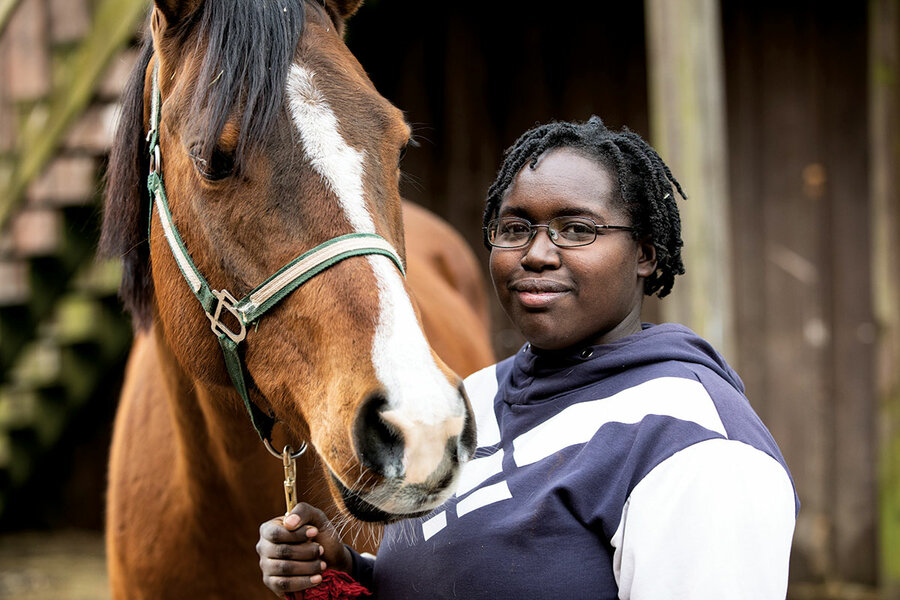
Photo: Melanie Stetson Freeman/CSM.
LaShawnda Phillips flourished thanks to the Ebony Horsewomen opportunity. She is now a barn manager for the program and is graduating from the University of Connecticut in animal science.
In Hartford, Connecticut, a remarkable woman called Patricia Kelly founded Ebony Horsewomen Inc. and soon expanded it to reach local children who never had exposure to the joy of horses. Sara Lang reports about her program at the Christian Science Monitor.
“A sleek chestnut stallion circles the edge of the indoor riding ring heading for a jump. The horse isn’t running quite fast enough and stumbles.
“ ‘That’s right, keep going. You got it,’ urges Patricia Kelly from just inside the door, encouraging both horse and trainer with hands on her hips, boots firmly planted.
“After some urging from the trainer in the center of the ring, the horse picks up the pace and clears the next jump effortlessly. Ms. Kelly, who runs this riding stable in Hartford, Connecticut, smiles and cheers. She’s been encouraging both horses and riders for decades.
“Ms. Kelly established Ebony Horsewomen Inc. in 1984 as a way to introduce the joys of horseback riding to women in the Hartford area. In the three decades since, EHI has grown to include 16 horses, 25 miles of well-maintained trails, stables, riding rings, public lessons, and advanced jumping and dressage team training. It has also drawn accolades for its leadership in equine therapy training – using horses to help riders heal from trauma.
“Through this work, Ms. Kelly is raising awareness around Black equestrians. People of color make up just 10% of the U.S. Equestrian Foundation, which oversees equine competition of all levels across the country.
“One challenge for underrepresented communities is access to stables and riding centers. EHI, situated within Hartford’s 693-acre Keney Park and accessible by public transportation, draws nearly 400 young people to its programs. And that’s not all. In January, EHI awarded its first annual Black Boots Award to recognize ‘the work, presence, and accolades of Black equestrians in the horse industry.’
“ ‘African Americans have been unsung individuals in the equestrian field,’ says Jeffrey Fletcher, president of the Ruby & Calvin Fletcher African American History Museum in Stratford, Connecticut, who co-sponsored the Black Boots Award. ‘She broke the glass ceiling.’ …
“Ms. Kelly and the work of EHI have been noticed across the country. In Connecticut, she was inducted into the Women’s Hall of Fame and earned the state’s African American Affairs woman of the year. She earned a community service award from the National Black Caucus of Local Elected Officials. And in Texas, she’s been inducted into halls of fame for both the National Cowboys of Color Museum and National Cowgirl Museum. …
“ ‘There is not the stuff out there on women of color,’ says Diane Vela, associate executive director of the National Cowgirl Museum. ‘It takes a champion like Patricia Kelly out there talking about it.’ …
“In March, EHI [opened] the Mary Fields Museum and Training Space, honoring the first African American woman to serve as a horseback-riding mail carrier for the U.S. Postal Service at the turn of the 20th century. ‘There’s someone everyone should know about,’ says Ms. Vela. ‘This incredible woman who protected these stagecoaches.’ …
“Ms. Kelly never set out to open an equestrian center, let alone one specially designed to help children and veterans recover from unseen wounds. After serving as a message decoder in the Marines during the Vietnam War, then practicing law and raising a family in Hartford, Ms. Kelly created Ebony Horsewomen to lead rides for Black women as a way to unwind and connect.
One day the riders encountered a group of children playing in a park. ‘Is that a real horse?’ one child asked.
“And in that moment, Ms. Kelly knew that her group would take on a bigger purpose. ‘It became quite apparent that what the kids needed was greater than what we needed,’ she says.
“At first, Ms. Kelly took horses and riding lessons out to children in different neighborhoods. Eventually, EHI purchased its first building in the park and gradually expanded its offerings.
“ ‘This is something that they might never have had the opportunity to experience,’ she says, ‘because, one, the equestrian sport is very, very expensive, and, two, it is never located in their community, and, three, they’re not operated by people of their culture. Until we came along.’ …
“Soon EHI went beyond horses to include a summer garden where students can learn to grow and cook with fresh produce, spend time reading, and undertake science experiments.
“One of those students was Fred Wright, who is now in charge of Keney Park’s equestrian rangers – and recipient of the 2023 Black Boots Award in the Equine Tradesmen category. He started in the program when he was 7 years old, with riding lessons, mentorship, reading classes, science classes, and horsemanship.
“Mr. Wright went on to attend Cornell University and its farrier program, where he learned how to trim a horse’s hoofs and nail on shoes. He now travels around the country as a farrier, in addition to looking after the EHI horses. …
“ ‘I always had the choice to go back home to … the gangs and the drugs and all that other stuff,’ he says. ‘As long as I’m here, I’m safe.’ …
“Students from every Hartford-area school have come through [EHI]. And thanks to her continually expanding efforts, Ms. Kelly has made EHI – and Hartford – a leader in access and opportunities for future equestrians from all backgrounds.
“ ‘It’s life altering,’ she says. ‘It changes your direction to something you didn’t even know existed.’ ”
More at the Monitor, here. No firewall.


 Suzanne's Mom's Blog