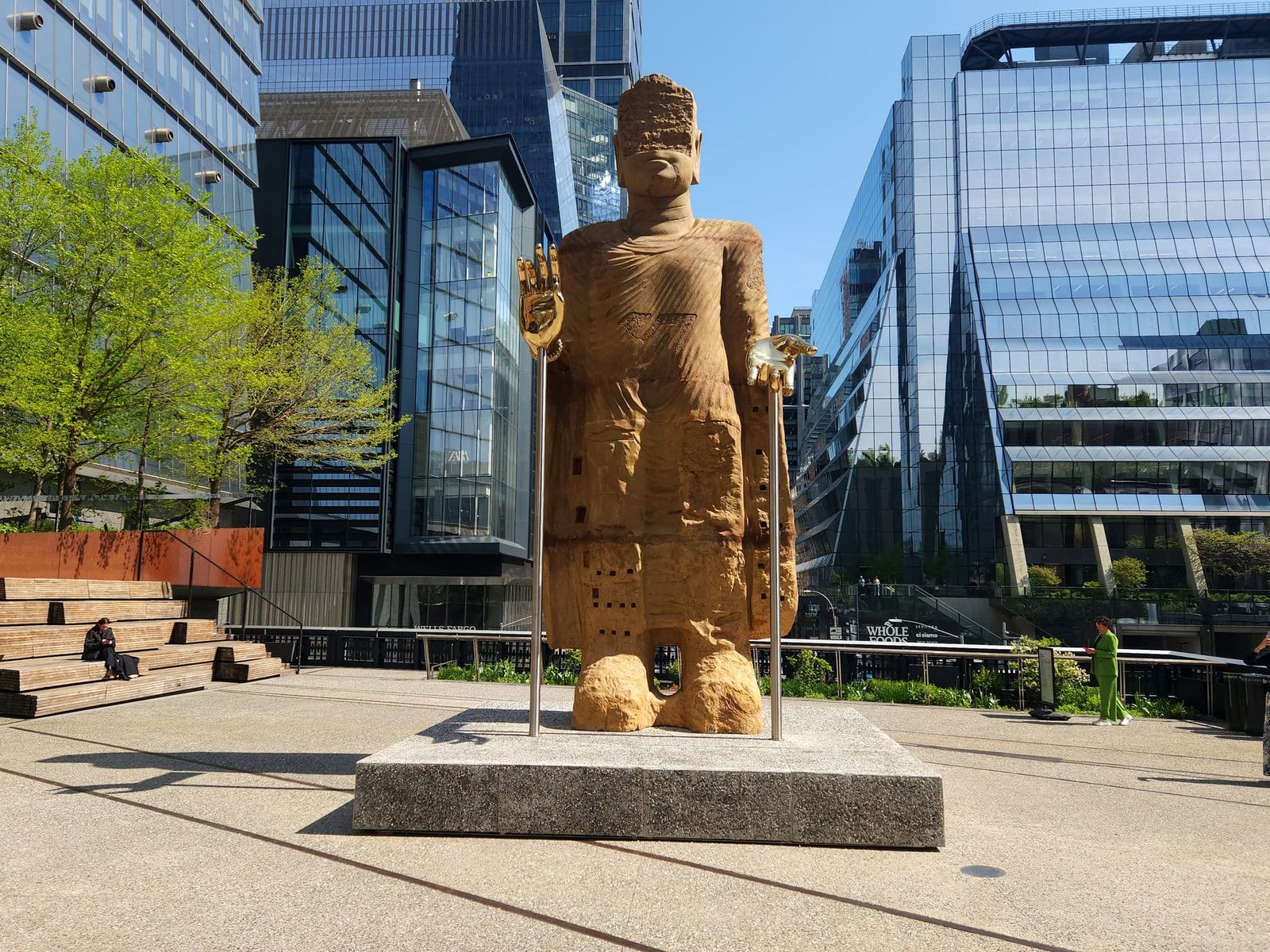
Photo: Rhea Nayyar/Hyperallergic.
Frontal view of Tuan Andrew Nguyen’s High Line commission “The Light That Shines Through the Universe” (2026) in New York City.
It’s always a tragedy when warfare destroys art. I remember how I felt for Buddhists when the Taliban destroyed the famous Bamiyan Buddhas in 2001 in Afghanistan.
Now, an exhibit honoring those statues has appeared on New York City’s beautiful elevated park, the High Line. Rhea Nayyar at Hyperallergic describes seeing it and what it signifies to her.
“Between the sea of sky-blue high-rise windows and the traffic funneling toward the Lincoln Tunnel, a large sandstone Buddha stands tall on the High Line, inviting Manhattan to embrace a moment of tranquility.
“Tuan Andrew Nguyen’s ‘The Light That Shines Through the Universe‘ (2026), the park’s fifth site-specific commission, was selected from nearly 60 proposals. It was recently installed at West 30th Street and 10th Avenue, and is on view through Spring 2027. The 27-foot-tall sculpture stands out from its contemporary surroundings not only because of its warmth and timeworn quality, but because it resurrects a critical piece of destroyed cultural heritage — the Bamiyan Buddhas.
“ ‘This sculpture creates a friction with the surroundings here in New York. It’s not sleek like everything else you can see here,’ High Line’s art director and chief curator Cecilia Alemani said to Hyperallergic. ‘It offers a hint to the public that temporality is not necessarily a straight line, that things can come back.’ …
“The Bamiyan Buddhas, enormous reliefs that dated back to around the 6th century, were hewn into a sandstone cliffside of the Bamiyan Valley in Afghanistan, a region along the Silk Road trade route that became a prominent Buddhist site. Of the two figures, the larger Buddha was affectionately referred to as ‘Salsal,’ which translates to ‘the light that shines through the universe.’ …
“Nguyen, who has recast or reinterpreted artillery associated with the Vietnam War throughout his practice, took the same approach to make the sculpture’s hands, which are disconnected from the sandstone body. He told Hyperallergic that he was able to source artillery brass from Afghanistan through a friend’s network across the Bamiyan region and bring it over the Pakistani border. There, he recast them into the shapes of mudras — symbolic hand gestures used extensively in Buddhist and Hindu iconography — before transporting them to Vietnam, where the sandstone was sourced and carved.
“Glinting from the sun overhead, the right hand invokes the Abhaya mudra, which signifies fearlessness, while the left hand connotes compassion and sincerity through the Varada mudra.
“Nguyen stated that his statue was not a replica of the lost cultural heritage, but rather an “echo.”
“ ‘ You keep a story, idea, or memory alive by retelling,’ he explained. ‘When I engage in this process of remaking, it’s like retelling the story. It gets translated through my hands and eyes.’
“Though it feels particularly timely because of the ever-evolving United States- and Israel-led violence in Iran, Alemani noted that Nguyen’s proposal had been selected a long time ago. ‘It’s a testimony to the strength of the artist’s voice that sometimes, the works we select become even more relevant when we install them,’ Alemani said.”
More at Hyperallergic, here.
Do you agree with the writer that the sculpture is telling us that history repeats itself? Do you have other reactions? I feel it’s also about humanity refusing to let good things be destroyed entirely.


