Feeds:
Posts
Comments

Posts Tagged ‘Hindu’

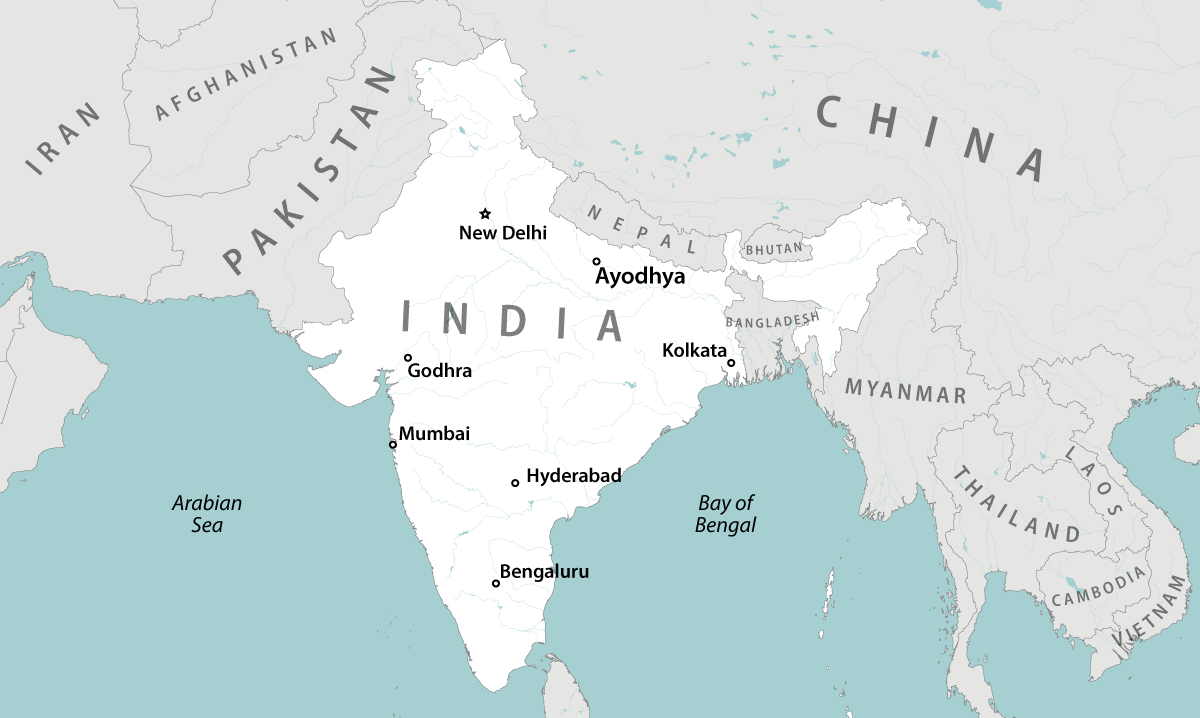
Map: Jacob Turcotte/CSM.
There are still people in India who appreciate having friends from other religions.

There is not much to celebrate about Hindu-Muslim relations in India these days, where the current power structure seems to have turned its back on peaceful coexistence. But trust the Christian Science Monitor to come up with a rare upbeat story! It’s about an interfaith friendship between Sadiq Ali, a Muslim, and Mahant Gyan Das, a Hindu, that has survived many political storms.

Shweta Desai  writes, “The light blue walls of Sadiq Ali’s living room are adorned with photos of Hindu seer Mahant Gyan Das. The two have been friends since the 1980s, when Mr. Ali was a volleyball player and Mr. Gyan Das a wrestler. They bonded over their shared love of sports, and Mr. Gyan Das regularly visited Mr. Ali’s family tailoring shop to get his tunics stitched. 

“About 20 years ago, their friendship took on a new meaning. Days of violent riots had rocked the nation and left more than 700 Muslims dead. It tore open old wounds in Ayodhya, a north Indian city where the Muslim community was still reeling from the destruction of the historic Babri mosque by a Hindu mob in 1992.  

“Sensing the need for an olive branch, Mr. Gyan Das, then head priest of the city’s historic Hanuman Garhi temple, invited 1,000 Muslims to the temple premises during Ramadan to break their daily fast. Mr. Ali helped host the feast, which still fills its organizers with pride and nostalgia – especially as Ayodhya is once again in the spotlight for Hindu-Muslim tensions.

“[Recently] Prime Minister Narendra Modi unveiled an opulent Hindu temple on the site where the Babri mosque once stood. 

“Like the mob which leveled the mosque, Mr. Modi and his supporters in the ruling Bharatiya Janata Party (BJP) claim that Babri was built over the birthplace of Hindu deity Ram, and the construction of the new Ram temple has become a rallying point for India’s growing Hindu nationalist movement. …

“In such polarized times, Mr. Gyan Das and Mr. Ali’s friendship offers a reminder of what Ayodhya could have – and perhaps still can – become: a symbol of multiculturalism and tolerance.

‘Ordinary people here want to live in peace,’ says Valay Singh, author of Ayodhya: City of Faith, City of Discord.

“He argues that the city’s reputation as India’s ‘ground zero’ of communal conflict overshadows its history as a heartland where different religious traditions have long intersected. In fact, he notes, the land for the Hanuman Garhi temple was donated to the region’s Hindu community by Muslim ruler Shuja-ud-Daula in the 18th century.

“ ‘It was a common tradition for the religious establishments to receive patronage from the Muslim rulers,’ he says. …

“[The] religious strife has deep roots – several weaving back toward Ayodhya. The destruction of the Babri mosque, for instance, came after decades of campaigning by right-wing Hindu groups, such as the Vishva Hindu Parishad (VHP), and led to months of communal violence across India. In Ayodhya, Muslims and their properties were singled out. Mr. Ali’s shop was plundered multiple times. …

“Indeed, the mosque’s demolition and resulting chaos left deep fissures between the Hindu majority and Muslim minority throughout the country. 

“Those rifts grew during the 2002 Gujarat riots, which were sparked by a deadly fire on a train carrying Hindu pilgrims from Ayodhya to Godhra, Gujarat. …The following year, Mr. Gyan Das approached Mr. Ali with his idea to organize an interfaith iftar fast-breaking meal at Hanuman Garhi.

“At first, the tailor was baffled. He reminded Ayodhya’s most influential seer that after breaking fast, Muslims must offer the namaz prayers. Will the Hindu seers accept prayers to Allah on the temple’s premises? Mr. Gyan Das was confident they would.

“In November 2003, with fanfare and high security, saffron-robed priests from several local temples welcomed their Muslim guests, serving them fruits and yogurt. Around sunset, calls of ‘Allahu Akbar!’ mingled with the sounds of conch shells and temple bells, as rows of Muslims bowed down to read the namaz. Both sides prayed together for peace and brotherhood to prevail across the country.

“The Muslim community reciprocated. After the iftar, hundreds of seers marched to Mr. Ali’s home to break the Hindu Ekadashi fast with seviyan, a traditional sweet prepared by Muslims on festive occasions. …

“The iftar [inspired] Yugal Kishore Shastri, one of few outspoken Hindu priests who have left the far-right and put their faith in the spirit of Indian secularism. Mr. Shastri says he split from the VHP after discovering that there was ‘no evidence of an ancient Ram temple under the mosque structure.’ …

“Although it’s getting harder for activists to cut through the vitriol and bring communities together … ‘There will always be a place for people who work for Hindu-Muslim peace,’ he says.”

More at the Monitor, here.
Read Full Post »

Photo: Deepa Bharath/AP.
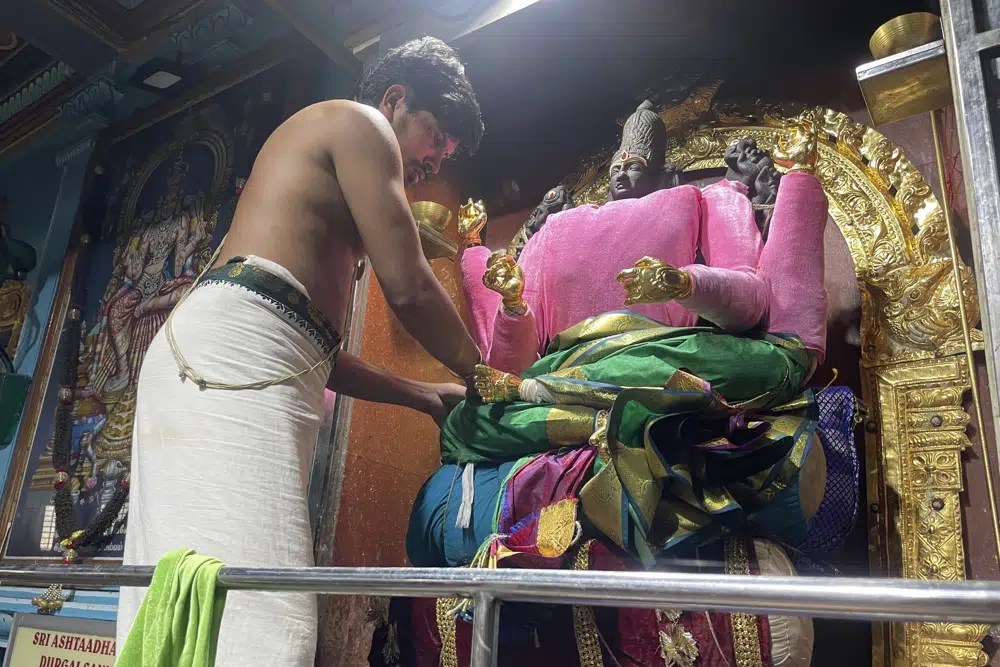
Deity decorator S. Goutham is seen at the altar of the goddess Durga at the Anantha Padmanabha Swamy Temple in Chennai, India, on Nov. 29, 2022. Goutham is a fifth-generation practitioner of this millennia-old spiritual art of decorating temple deities.

Isn’t it amazing how many kinds of jobs there are in the world? Today’s story from the Associated Press (AP) is about a young man whose family has had the job of decorating statues of local deities for five generations!

Deepa Bharath reports, “On a recent afternoon, 33-year-old S. Goutham was perched on a ladder at the altar of the goddess Durga at the Anantha Padmanabha Swamy Temple in Chennai, India. Goutham — his hand moving steadily — was pleating a green silk sari to adorn the deity. …

“A computer science graduate, Goutham quit his job nearly a decade ago to pursue his calling. He has since followed in the footsteps of his ancestors as a fifth-generation decorator of temple deities.

“In Hindu temples, idols are mostly made of materials such as black granite, white marble or five-metal alloys that have sacred significance. These deities are worshipped as physical, tangible representations of god (Brahman) who is believed to be infinite, omnipresent and beyond comprehension. Worship in a Hindu temple includes bathing these deities in milk, decorating them with colorful clothes, flowers, perfumes such as sandalwood, jewelry, and even weapons such as swords, clubs and tridents. Oil lamps are lit at the altar, and sacred chants and foods are offered to the gods.

Decorating the deities is a millennia-old practice that is described in the Hindu epic Ramayana, and Goutham has been learning the art since he was a toddler. He crafted his first formal decoration when he was 13. …

“Goutham said he became interested in decorating deities as a child because of his father.

“ ‘When you are little, your father is your hero,’ he said. ‘I wanted to be just like him.’ The first lesson Goutham got from his dad was about the weapons each god would hold. He heard stories about the power of each weapon and how gods would wield them.

“ ‘The personality of the deity and the story of the god or goddess could change depending on their weapons, the clothes they wear, the expression on their face or the position in which they are sitting or standing,’ he said. …

“There are rules about the types of materials that can be used on deities.

“ ‘The human body is made up of earth, water, fire, air and space, and everything you see naturally occurring on Earth is made of these elements,’ Goutham said. ‘To show this, we decorate deities using things that occur in nature and are a representation of these elements, like copper, cloth, coconut fibers and so on.’

“He says decorating a deity combines elements from art, dance and yoga, in terms of the hand gestures and postures the deities assume. Man-made materials such as plastic are prohibited. Goutham says he uses little pins to hold fabric together, but makes sure the pins don’t directly touch the idol. …

“[He] dreams of establishing an institution to train artists who can maintain the sacred tradition. While most deity decorators are men, he sees no reason why women cannot learn and practice it. ‘Everyone is equal under god,’ he said.

“Storytelling is an important part of what he does. One of his favorite installations depicts the friendship between Lord Krishna, an incarnation of Vishnu, and Kuchela.

“ ‘It shows Krishna washing the feet of Kuchela, a poor man, conveying the message that humility is a virtue — whether you are a human being or god,’ Goutham said.

“The term ‘idol worship’ may have negative connotations in some faiths. But for Hindus, deities — which are kept in temples, homes, shops and offices — serve as focal points ‘for to us channel our devotions, our actions and serve as a reminder of all the positive values that are associated with those deities,’ said Suhag Shukla, executive director of the Hindu American Foundation.

“Shukla says this form of worship is a way for her to connect with her ancestors. ‘As a second-generation Hindu American, I didn’t grow up with all these things around me where I could absorb through osmosis,’ she said. ‘But just knowing that I’m part of a tradition that has been passed down from generation to generation is personally powerful for me.’

“In U.S. Hindu temples, community members come together to help create the costumes for the deities, and it is an act of devotion, Shukla said.

“ ‘No one has to sit there and embroider a skirt or sari for a goddess, but they do it as a display of love,’ she said. ‘It’s humbling and empowering.’ ”

More at AP, here. No firewall.

Read Full Post »

real-kashmir-7-591a66101b34d7f508201129db96670cb2626d2a-s600-c85

Photo: Furkan Latif Khan/NPR
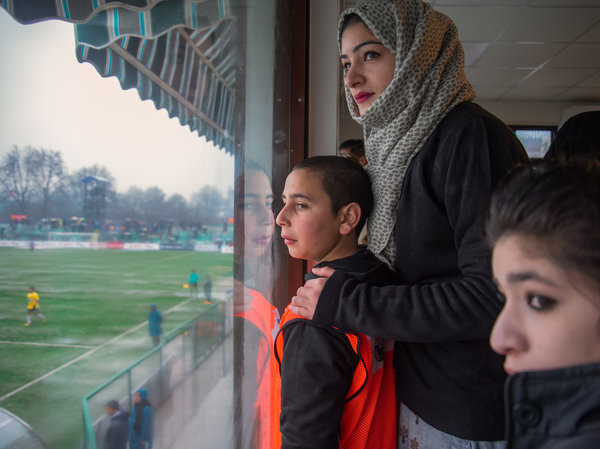
In wartorn Kashmir, there are Muslims and Hindus who who would rather play soccer than spend their lives fighting. Above, loyal Snow Leopards fans watch a game.

In every part of the world, no matter how troubled, there are always people who would rather play ball.

I have to blame the British colonial empire for leaving behind the seeds of war everywhere it went, chopping up countries without attention to the needs of the people living there. But thank goodness that human nature and the love of peace is strong! There are always some folks who have no interest in fighting.

Kashmir, created by Partition as the British left India, is an example of what I mean. Today, because of the way the country was divided, Kashmir knows constant war between Hindus and Muslims. Despite that, two friends, one Hindu and one Muslim, started something beautiful.

Lauren Frayer writes at National Public Radio (NPR), “They play soccer in a disputed Himalayan valley prone to car bombs, strikes and heavy snow. Soldiers with machine guns patrol their home stadium. Players sometimes have to arrive at practice three hours early to avoid police curfews. Their team is less than three years old, with a budget that’s one-tenth that of some of their competitors.

“[As of February 2019], Real Kashmir Football Club, from Indian-controlled Kashmir, [was] tantalizingly close to winning India’s top professional soccer title. They’ve been flitting back and forth between first, second and third place, and the season ends in early March.

” ‘We’re the only club in India that has sold-out stadiums at almost every game,’ says the team’s co-founder Shamim Mehraj. ‘What we have done is give people some hope in a place that has actually been taken down by conflict and violence for the past 60 years. It’s helping this place heal.’ …

“A natural disaster helped give birth to this soccer team. In 2014, the Kashmir Valley suffered devastating floods. Hundreds of people were killed. Schools were closed, and young people spilled out onto the streets of Mehraj’s hometown Srinagar, the summer capital of Jammu and Kashmir and one of the largest cities in the valley.

“One evening, Mehraj and a friend had an idea.

” ‘We used to go for evening walks. We would see a lot of kids hanging around doing nothing, and I had been a footballer myself. That’s when I thought, “Why don’t I get some balls and at least give these kids something to do?” ‘ recalls Mehraj, 38. He had played for his college team in New Delhi, and for his state in amateur soccer tournaments.

“Mehraj, who is Muslim, and his Hindu friend Sandeep Chattoo, 52, got friends and neighbors to pitch in and buy 1,000 soccer balls, which they handed out to flood victims. But why stop there? In March 2016, they started a team.

“They applied for the team to compete in India’s I-League 2nd Division — the pro soccer equivalent of baseball’s minor leagues. Mehraj and Chattoo invested their own money to pay players’ salaries. They also hired a Scottish former player, David Robertson, who had been coaching a professional soccer team in Phoenix, Arizona, to coach Real Kashmir, a.k.a. the ‘Snow Leopards.’

“Robertson had never been to India, and admits he probably couldn’t have placed Kashmir on a map.

” ‘All I ever saw was TV shows that showed it’s 90 degrees — it’s hot in India! But I arrived here and the next day, it was snowing,’ says Robertson, 50, now in his third season as Real Kashmir’s coach. ‘There was no Internet, the electricity was out, and I just thought, “I want to go home.” ‘

“Mehraj invited Robertson over to his family’s house, gave him a hot water bottle and some home-cooked Kashmiri food — and convinced him to stay. Since then, Robertson has recruited his own son, Mason Robertson, 24, to play for Real Kashmir. By the end of the 2017-2018 season, several Robertson relatives were in the stands at the team’s home stadium in Srinagar, to watch Real Kashmir win the 2nd Division title. …

“[By February, the team was] neck-and-neck with Chennai City FC and East Bengal FC for the top title in Indian professional soccer. …

” ‘I never did think we would go this far,’ Mehraj tells NPR, as he looks out over the turf at Real Kashmir’s home stadium. …

“Kashmir’s 21 percent unemployment rate triple that of the rest of India and militant groups recruit from the ranks of young, idle Kashmiri men. Soccer ‘keeps him away from that,’ says Ishfaq Hussain, 52, a former professional cricket player whose son Muhammad Hammad plays center-back for Real Kashmir. ‘He thinks always about when to play, when to practice. He’s got no time to join politics or go shouting or pelleting stones.’ …

“His teammates include fellow Kashmiris and recruits from Africa, Europe and across India — including Muslims, Hindus, Christians and atheists. Mehraj says he can’t manufacture T-shirts, stickers and banners fast enough to keep up with fans’ demand.”

More of the NPR story here. Follow the rankings here.

Read Full Post »

Image: Green Tara Protectress from Eight Fears; Tibet; 19th century; Pigments on Cloth; Rubin Museum of Art; Gift of Shelley and Donald Rubin. The Eight Fears are 1) water, (2) lions, (3) fire, (4) snakes, (5) elephants, (6) thieves, (7) false imprisonment and (8) ghosts.

When I was in New York this week visiting my sister, she suggested we go to the Rubin Museum on West 17th St. She told me that the museum, which opened in 2004, was notable not only for the founders’ Himalayan art collection but for its peaceful aura.

It really was a treat. Here’s what the website says about the current exhibit. “Gateway to Himalayan Art introduces visitors to the main forms, concepts, and meanings of Himalayan art represented in our collection. A large multimedia map orients the visitors and highlights cultural regions of a diverse Himalayan cultural sphere that includes parts of present day India, China, Nepal, Bhutan, and Mongolia. …

“In addition to sculptures and paintings, objects such as a stupa, prayer wheel, and ritual implements demonstrate that their patrons sought the accumulation of merit and hoped for wealth, long life, and spiritual gains, all to be fulfilled through the ritual use of these objects and commissioning works of art.

“Among the featured installations are a display that explains the process of Nepalese lost-wax metal casting and a presentation of the stages of Tibetan hanging scroll painting (thangka).”

At the base of the museum’s circular stair we encountered male and female lions with fire (I think) flaming from their mouths.

There was also an interactive table on which we were bidden to type our “intentions” (for the visit or perhaps for our lives). When we hit “enter,” our phrases whooshed up toward the ceiling, joining the flow of little star-like lights and other visitors’ “intentions” on the underside of the spiraling stairs. I typed “find light in shadow,” and my sister typed “experience peace.”

From the impressive collection we learned about the interconnection of Buddhist and Hindu culture and imagery. Among the highlights was a recreated Tibetan shrine where butter lamps were burning and visitors were enveloped in the deep, deep voices of monks chanting.

There were also two excellent art recreations, one showing how artisans make a sculpture (the museum hired contemporary artists in Nepal to create the different stages of the process to be displayed in a glass cabinet) and the other demonstrating the steps for making a painted cloth hanging, a thangka. At first my sister was puzzled by the hanging’s label because it said “2014,” and all the other labels had ancient dates!

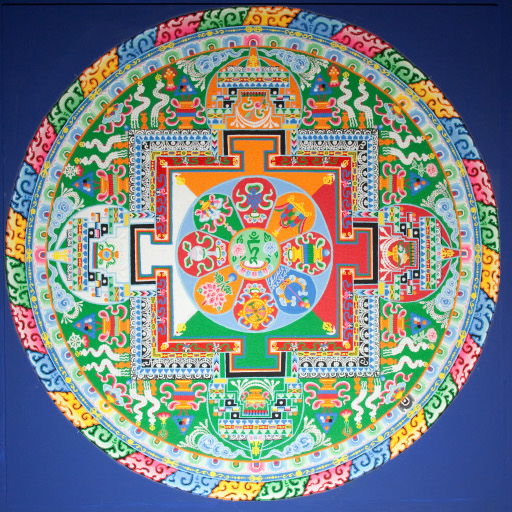
She, in turn, showed me an amazing thing that I had passed right by. It was a kind of virtual-reality video of what the houses of the Buddhist gods might look like, but the most amazing part came when the video swooped in on an aerial view. By George, a mandala! A mandala can be an aerial view of the houses of the gods. Probably other people know that, but I didn’t.

Here is a mandala that Melita showed me in process at MIT a few years ago. Colored sand was painstakingly dripped on a floor space by a visiting monk.

mg_8348sm

Read Full Post »