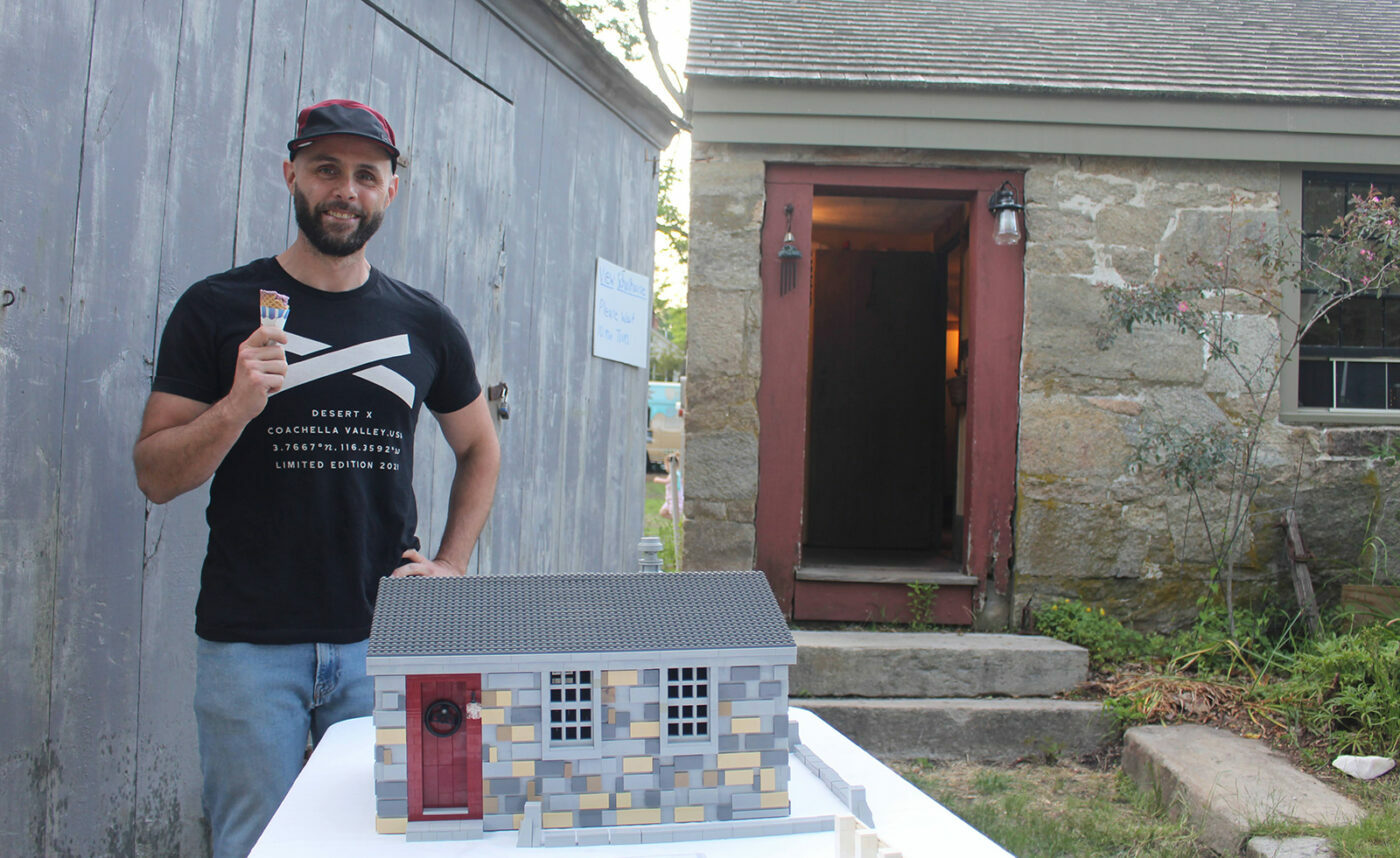
Photo: Colleen Cronin/ecoRI News.
Lego artist Andrew Grover stands with his creation and the schoolhouse its modeled after in Burrillville, Rhode Island.
Today’s story about preserving an old schoolhouse reminds me of a teacher I used to work with. She received her training in what was called a normal school. It was a long time ago. Like the schoolhouse in the article, her first school was heated by a wood stove. She had to arrive very early to start the fire and get the little school heated up enough for students.
In Burrillville, Rhode Island, there’s a little schoolhouse like that on a lovely piece of land, and local preservation advocates are using a conservation easement to protect it in perpetuity. To promote the idea of conservation easements in general, they have enlisted the help of a locally renowned Lego builder.
“Bright red doors, low-pitched roofs, masterful craftsmanship all describe two local houses,” Cronin reports. “Neither have bathrooms or full-time occupants, but they share a simple elegance and a story.
“One is the work of Pascoag masons nearly 200 years ago, and the other is the creation of Rhode Island Lego artist Andrew Grover this spring.
“Grover built a model of the former, what was once known as the Eagle Peak Schoolhouse, for the Burrillville Land Trust. The artwork is a part of an effort to bring awareness to a land conservation mechanism known as a conservation easement — a deed restriction that was placed on the old schoolhouse property by its owners to keep the building and the 25 or so acres surrounding it preserved in perpetuity.
“The conservation easement ‘is something that will ride with the land forever,’ Burrillville Land Trust president Paul Roselli told ecoRI News.
“Unlike selling or donating the land to a trust, municipality or the state, the owners still own the property when they place it in a conservation easement. They can sell it, pass it on to relatives or donate it, but based on the condition of the easement, they and any future owners must maintain the historic structure on the property and cannot further develop the land.
“The role of the Lego model, which was funded by the Rhode Island State Council on the Arts, is to get a conversation going about the property and how it is being saved for future generations. …
“Grover, known for his Lego models of some of Rhode Island’s most grandiose architecture, said the schoolhouse is the smallest structure he has recreated. The small size actually made his job a little harder than usual, because he had to make sure it’s simple beauty translated in the Lego medium and avoided making the model look like a box.
“He added texture to the mock stone façade to create depth and built a partial stone wall around the building. Grover said the construction was done over the course of several weeks, and consists of more than 1,000 pieces. …
“Grover got involved with the project and the land trust through his love of hiking. To the lifelong Rhode Islander, Burrillville is one of those rare parts of the state that still has rural charm, and hiking through it frequently, he started to realize how much of the town isn’t protected against development.
“ ‘There’s so much development pressure in the state that when you find an area like that it has to be treated like a gem,’ Grover said. …
“Carol Murphy and Roberta Lacey, the married couple who bought and rehabbed the schoolhouse, agree that the natural world needs protection, which was why they purchased the property in the first place. …
“Although they have made a few updates, including replacing the knob and tube electrical work that is a fire hazard and insurance nuisance, the couple has tried their best to return the building that once hosted the children of 19th-century quarry workers and farmers to its old glory.
“A wood stove sits at the center of the room, in front of one of the desks from the 1800s that belonged to the space when it was a classroom. The original blackboard sits in the little kitchen, which doesn’t have any appliances besides a sink.
“It was built in 1824 and its original use isn’t clear, according to Lacey, who is a member of the land trust. In the 1850s, it was donated for use as a school and operated as one until the Bridgeton School opened in the 1890s. …
“ ‘It’s a land that’s so precious to us,’ said Murphy, noting that every time she visits the old schoolhouse it takes her breath away.
“There are only a few outlets in the house and an outhouse in the back, so Lacey and Murphy don’t live there but enjoy it for recreational purposes. The Conservation Commission and Burrillville Land Trust have also held a few meetings there.
“Lacey said, ‘It’s like the honor of my life actually to be able to do this and try to preserve this property.’ ”
In New Shoreham, Rhode Island, an old house called Smilin’ Through (in remembrance of a song written there) has similar protection, but people can live in it. In my opinion, it’s a little dark inside for comfortable living, but the land around it is breathtaking.
More at ecoRI News, here.


 Suzanne's Mom's Blog