Feeds:
Posts
Comments

Posts Tagged ‘holocaust’

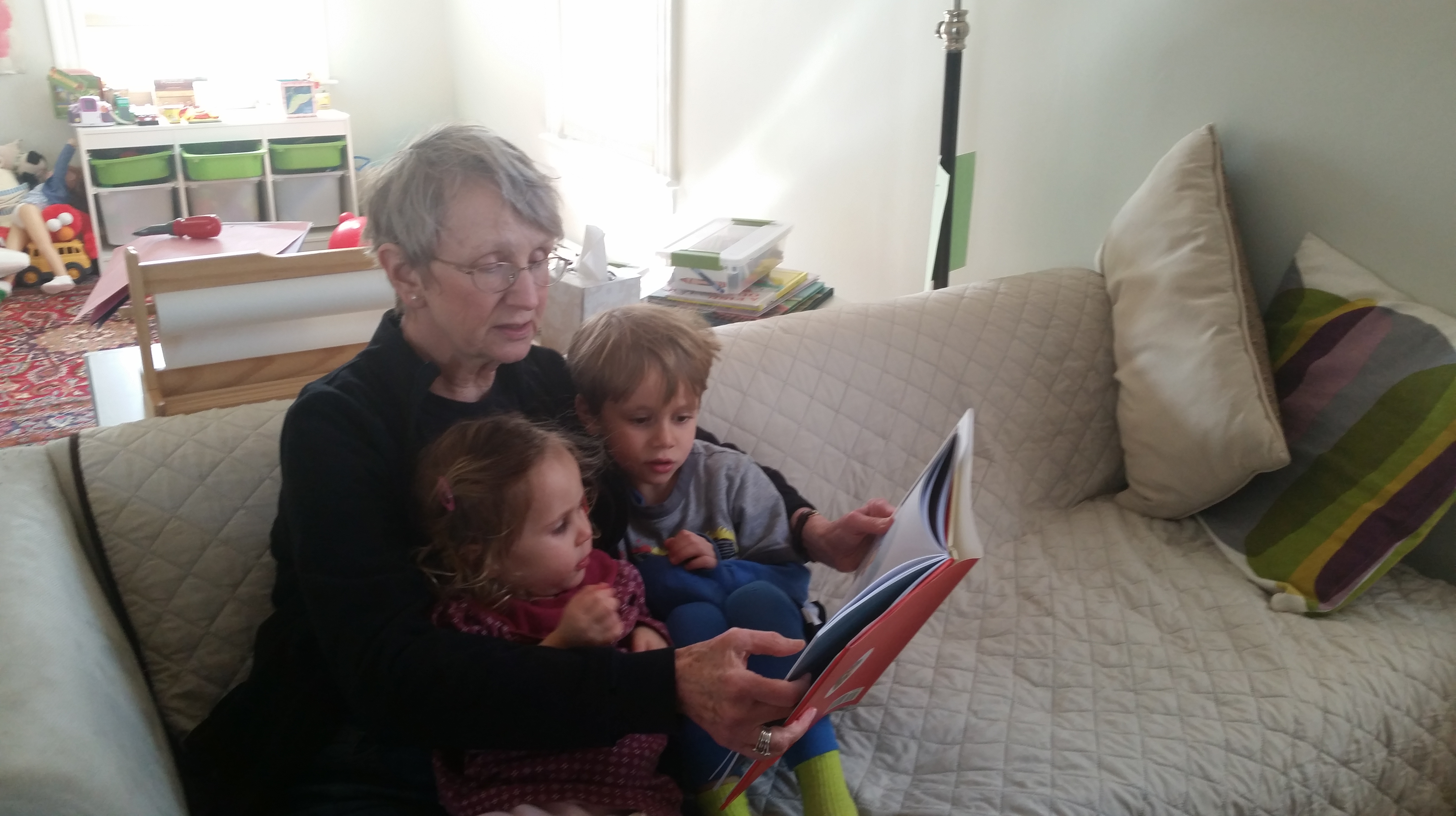
Photo: JRE.
Now almost 12 and 15, these two are good readers.

I recently learned about a group called Grandparents for Truth, organized in reaction to other groups pushing book bans in schools and threatening librarians.

I am not a member, but I think reading is important and I understand enough history to know what happens to countries that start with book bans, so I thought I would share the information.

Huda Hassan wrote at MSN.com in late 2024, “Last August, a retired special-education teacher named Holly Hall joined a rally of grandparents warring against book censorship in Temecula, a small Southern California town. Locals had gathered to oppose a school-board decision to ban a social-studies reader, Social Studies Alive!, for citing Harvey Milk — the first openly gay politician elected in the state. ‘The Harvey Milk reference was in the supplemental materials,’ 72-year-old Hall says, ‘which meant that it wouldn’t have even been mentioned in some classes.’

“The world of literature is currently ablaze with rapidly escalating book bans targeting narratives and histories about gender and sexual identity, race, class, and just about anyone deemed ‘other.’

“[In 2024] alone, 1,128 books have been challenged, according to the American Library Association, which documents ongoing censorship attempts across the nation. Florida is the state with the most banned books (3,135 bans, according to PEN America), and in the 2022–23 school year, there were book bans in 153 districts across 33 states, including Texas, Missouri, Utah, and Pennsylvania.

“Earlier this year, schools in Escambia County, Florida, removed 1,600 books on gender and race from school libraries and, through this process, even banned multiple dictionaries. In August, New College of Florida, a public liberal-arts college, disposed of hundreds of library books, emptying the school’s Gender and Diversity Center. Then, this fall, major publishers — including Simon & Schuster, Penguin Random House, and HarperCollins Publishers — filed a lawsuit against book-removal provisions in Florida (through HB 1069, a law introduced in 2023).

“When Hall, who taught in California for 40 years, spoke out at that rally in Temecula, she gave an impassioned speech about censorship in her state. ‘I addressed the dangers of banning books,’ she says. ‘It’s not 1933 Germany.’ Opponents attended the Temecula rally too, such as Moms for Liberty, a Florida-based parenting group formed in 2021 that’s pushing for banning books on race and what it calls ‘gender ideology.’ A few months prior, the same three school-board trustees Hall spoke against had voted to ban the school’s study of critical race theory the day they were sworn into office. This preemptive act confused many, as no courses on critical race theory had been offered at the school. …

“As parents across the country and groups like Moms for Liberty have joined the attacks on literature, grandparents like Hall are mobilizing in response, and they are afraid. ‘I am so concerned about my country, our freedom, and the world,’ Hall says.

“But she felt encouraged to speak in front of her peers and opponents last year because she knew she was not alone. She was invited to the rally by Grandparents for Truth, a national organization formed in the summer of 2023 to fight for the right to read. ‘A neighbor walked by and told me about the group. He had a sign in his yard,’ says Hall. …

“In Philadelphia, Ruth Littner, one of the earliest members to join Grandparents for Truth last summer, discovered the collective through her daughter, Alana Byrd, the national field director of People for the American Way. Like Hall, the pair are committed to countering book banning despite heckling or pushback from the police. ‘I am the daughter of two Holocaust survivors,’ Littner says on the phone from her home. ‘When Alana told me she had an initiative to fight this kind of authoritarianism, I jumped right on that. I was the first one to get the Grandparents for Truth T-shirt.’

More at MSN, here. No paywall.

Read Full Post »

Photo: Stiftung Jüdisches Museum Berlin/Jewish Museum Berlin/ Convolute 816/Curt Bloch collection
Het Onderwater Cabaret, 1943. The satirical magazine, now on exhibit in Berlin, was produced by a German Jew hiding in a Dutch attic during the war.

Both the New York Times and the Guardian reported recently that a German Jew, hiding like Anne Frank in a Dutch attic during WWII, produced an angry, humorous magazine because he could. His magazine was in the news thanks to an exhibit in Berlin.

Nina Siegal writes at the Times that many people hid in attics during the war but that Curt “Bloch’s experience was different because, in addition to sustenance and care, his helpers brought him pens, glue, newspapers and other printed materials that he used to produce a startling publication: his own weekly, satirical poetry magazine.

“From August 1943 until he was liberated in April 1945, Bloch produced 95 issues of Het Onderwater Cabaret, or the Underwater Cabaret. … Writing in both German and Dutch, [he] mocked Nazi propaganda, responded to war news and offered personal perspectives on wartime deprivations.”

Charlie English at the Guardian has more from the perspective of Bloch’s daughter, Simone, now 64.

“As the daughter of antiques dealers, Simone Bloch grew up in a New York house filled with rare and mysterious materials. The dining room was packed with precious volumes, including a collection of small, hand-written magazines, illustrated with collages in a dadaist or surrealist style.

“ ‘All of my parents’ books were kind of intimidating,’ Simone, now 64, says. ‘But this was weirder. It wasn’t something I would ever want to pick up.’

“She found them a little creepy, with their frequent images of Adolf Hitler and other wartime leaders. It was only many years later that Simone came to understand that these magazines represented her father’s resistance to the Holocaust.

“Born in Dortmund in 1908, Curt Bloch was the first in his family to go to university, studying law in the German capital, which at that time was the centre of the buzzing avant-garde cabaret scene. Curt was Jewish and objected to Hitler from the first. In 1933, when Hitler introduced a law banning Jews from civil service positions unless they had fought in the first world war, Bloch wrote a biting response to the authorities, declaring that, no, he hadn’t served in the war since he was only five when it had broken out. When the Gestapo came knocking, Curt was ready. He slipped out of a top floor window with some cash he’d hidden, and fled across the rooftops, eventually reaching Holland.

“But he wasn’t safe for long. The Germans invaded the Netherlands in 1940, and … Bloch took refuge in the crawlspace above the attic of a small suburban house in Enschede, on the German border. It was here that he began to produce the first issue of his magazine. He wrote in fountain pen, made collages from cuttings and stitched the pages together by hand. He called his volume the Underwater Cabaret in reference to the Dutch term for people in hiding, ‘divers,’ and to the favored form of political theatre in Weimar Berlin. Friends in the Dutch resistance helped circulate the Underwater Cabaret to 30 or so other ‘divers.’ They would bring the issue back a week later, by which time Bloch had prepared a new one.

“Alongside political commentaries, Bloch published highly personal writing. His mother Paula and little sister Hélène had followed him to the Netherlands, and had also gone into hiding. In May 1943 they were detained. … He devoted several poems to Hélène, one of which contained the lines: ‘Stay strong against the hatred, betrayal, and scorn / And when the war someday comes to an end / I will go looking for you.’

“Writing this kind of material was extremely dangerous. … Why take the risk? Simone believes it was a way for her father ‘to fight his own despair.’ It was a demonstration that, even in such circumstances, resistance was possible. ‘It’s getting away with something when you can’t get away with anything,’ Simone suggests. …

“In all, Bloch produced 95 magazines. The last issue is dated 3 April 1945. By that day Enschede had just been liberated, and Bloch could leave his hiding place. He travelled back to Amsterdam, where he met and married an Auschwitz survivor, Ruth Kan. In 1948 they emigrated to the US. …

“It was only recently, after years of research conducted in part by her daughter, Lucy, that Simone came to understand the full significance of the zine as a rare literary monument capturing a terrible period in history.”

More at the Times, here. And at the Guardian, here. Is it any wonder that today’s Germany is a loyal supporter of Israel? Unlike America, I suggest, Germany has reckoned with the weight of history.

All 95 copies of the Underwater Cabaret are on loan to the Jewish Museum Berlin, where an exhibition will run to 26 May.

Read Full Post »


Photo: Saul Gonzalez/PRI
Kalman Aron began sketching when he was 3 years old and had his first show at 7. Still working at 93, he said if he didn’t paint and draw every day, life would be too boring.

Links to some of the stories that I aim to blog about get squirreled away weeks in advance, and now I’m wishing I used this one in February before a certain artist died. Kalman Aron was 93 and was making art every day.

I heard about Aron from Saul Gonzalez at Public Radio International’s The World.

“When you step inside artist Kalman Aron’s modest apartment in Beverly Hills, a lifetime of creation surrounds you. The walls are covered in paintings and finished canvases are stacked on the floors, a dozen deep. The paintings range from portraits to landscapes to abstract works. They’re just a fraction of the roughly 2,000 pieces Aron says he’s created over the decades.

“Born in Riga, Latvia, in 1924, Aron started sketching when he was 3. At age 13, he won a competition to paint a portrait of the country’s prime minister. But then came the start of World War II; Germany invaded Latvia in 1941. … He was imprisoned in seven concentration and labor camps over the course of four years, not knowing if he’d be alive the next day.

“But Aron was able to survive when German soldiers discovered his skills as an artist. Camp guards and officers asked Aron to make small portraits of family members in exchange for scraps of bread. …

“After the war ended, Aron lived in a displaced persons camp in Austria and received a scholarship to attend Vienna’s Academy of Fine Arts.

“In 1949, with only $4 in his pocket, Aron immigrated to the United States with his first wife, settling in Los Angeles. After a stint painting pottery in a factory, Aron started getting work by painting portraits for the city’s wealthy, like the family of Susan Beilby Magee. …

“Magee says you can trace how Aron came to grips with the trauma of his wartime experiences by studying how his work changed over the decades in Los Angeles.

“ ‘At the beginning of his time in LA in the ’50s, [the paintings] are all gray,’ Magee says. “There is no sunlight or people, there is nothing. That was his interior landscape when he arrived. Thirty years later he paints the Hollywood Hills and they are beautiful, full of color.’ …

“Aron says his art has saved him more than once — first, during the Holocaust, and now that he’s 93, it’s kept him from something many people his age struggle with.

“ ‘Dying of boredom,’ Aron says. ‘I’m still talking. I’m still working. They die of boredom.’ ”

The story I heard at PRI is here. And this obit appeared in the Washington Post.

Read Full Post »

Members of a family separated for 77 years were recently reunited through the wonders of the Internet. Caitlin Gibson has the story at the Washington Post.

“The five women crowded together around the kitchen table in New Jersey, their eyes fixed on a laptop screen. It was 7 a.m., and none of them had slept well the night before; they were too anxious and excited for this moment. Jess Katz logged into Skype as her mother and three sisters watched.

“A face flickered into view: their cousin, the son of a long-missing uncle, the family they thought they had lost forever in the Holocaust.

“On the other side of the screen, on the other side of the world, Evgeny Belzhitsky sat with his daughter, his granddaughter and a translator in his home on Sakhalin Island, Russia.

The eight family members smiled at each other, speechless. Then, Katz recalls, they all started to cry. …

“More than 70 years had passed since Katz’s grandfather, Abram Belz, first tried to find his younger brother, Chaim. Abram last saw Chaim in 1939, the year their family was relocated along with thousands of other Polish Jews to the Piotrków Trybunalski ghetto at the start of World War II.

“The brothers died without seeing each other again, but on April 20 their families had been joyfully reunited. …

“ ‘My grandfather, because he was the oldest son, felt an obligation to stay,’ [Katz] says. ‘But it was important to their mom that Chaim try to escape.’

“With his mother’s help, Chaim slipped through a gap in the ghetto wall and fled across the border to the Soviet Union. The family knew he made it there, Katz says, because he sent letters and packages to his family. But then the letters and packages stopped coming. …

“In April, Katz — a tech-savvy 25-year-old who works for a software company in New York City and has blogged about her family’s Jewish roots — had extra time on her hands as she recovered from minor surgery at home. She decided to take up the search.

“After decades of tedious research and letter-writing, it took Katz two weeks to find Chaim’s son.

“It was a success born of an improbable alchemy: the serendipity of social media, the generosity of helpful strangers, and access to technology that allowed distant relatives to bridge thousands of miles, a 14-hour time difference and a language barrier.” Read the read the happy ending here.

Let’s hope that technology will also help the refugee families that are getting separated today. There is nothing in the world like the pull of family.

Photo: Jess Katz
The Katz and Belzhitsky families Skype together on Passover.

Read Full Post »