Feeds:
Posts
Comments

Posts Tagged ‘identity’

Photo: Chelsea Sheasley/Christian Science Monitor.
Diane Nicholls stands in the room where she teaches in Elmore, Vermont. The Elmore School is the state’s last one-room schoolhouse. Elmore residents are voting on whether to form their own independent school district to preserve the school.

Today is the day that residents of Elmore, Vermont, were scheduled to vote on whether or not to protect their one-room school. Although my own brief experience with a one-room school does not incline me to nostalgia, I understand why this community may be afraid to lose its identity in the larger district.

Chelsea Sheasley writes at the Christian Science Monitor, “Each morning before school starts and after recess, Diane Nicholls rings the bell atop the snug one-room schoolhouse where she teaches.

“ ‘I don’t feel like I’m living in the 19th-century, but it is charming,’ says Ms. Nicholls, who educates a group of 18 students in the Elmore School, Vermont’s last operating one-room schoolhouse.

“The Elmore School, a public school serving students in grades one through three, is a cherished tradition in the tiny town of Elmore, with a population of under 1,000. Generations of students have attended since the school opened in the 1850s. Now, townspeople are wrestling with how best to support it.

“Residents will vote March 1 on whether the town should withdraw from a joint school district with two other nearby towns in order to strike out on their own in hopes of preemptively preserving their schoolhouse. Concerns mounted after a district-commissioned report released in November 2020 proposed five cost-saving recommendations, with four out of the five options suggesting closing the Elmore School. 

“Behind the ballot effort are questions that also play out in other rural areas: How much does a school contribute to a community’s identity?

Is a local school such a crucial community hub that taxpayers are willing to pay higher costs to preserve it?

“ ‘It’s difficult to say what forms the identity of a community, but we know these institutions like the Elmore Store, the school, are part of it, and we defend them as a proxy for defending the community,’ says Trevor Braun, an Elmore resident and board member of the Elmore Community Trust, a nonprofit that recently raised $400,000 to ensure the town’s general store didn’t close. 

“March 1 won’t mark the first time residents will vote on whether to form an independent school district. In December 2021 the town voted not to leave the joint district, Lamoille South Unified Union (LSUU), amid concerns that taxes might rise and unknowns over what forming an independent school district means. But enough townspeople signed a petition to bring the question back to the Town Meeting this week. 

“Elmore … is located 14 miles north of Stowe, a popular ski destination and home of the Trapp Family Lodge, known for its connection to the relatives portrayed in ‘The Sound of Music.’

“Elmore consists of a short main drag with the school, the general store across the street, town hall, and one church. The population swells with seasonal summer residents. 

“On a recent February morning, students in the cozy Elmore School classroom practiced nonfiction writing. A first grade student wrote about chickens, while a few desks over a third grader wrote about her favorite animal, polar bears. Kids write and draw on paper, with iPads handy on their desks to research questions.  …

” ‘I remember my very first day here and I just really liked it,’ says Ruby, a third grader, who says that now, as one of the oldest kids, she appreciates that ‘you can have friends younger than you and help them, and it’s fun to see and help them develop their skills.’ 

“Jon Osborne, an Elmore parent whose two children now attend college, says the Elmore School provided his kids with a ‘phenomenal’ experience, including building a tight-knit group of friends who helped each other in the classroom. …

“The superintendent and school board of LSUU say they have no plans to close the Elmore School. The report that recommended closing was completed under a previous superintendent and done by an outside group without consideration of local culture, says LSUU superintendent Ryan Heraty. …

“ ‘That sense of independence, of local control, is very Vermont,’ says Mr. Heraty. 

“But even with the school district’s assurances, some residents are skeptical about putting the future of the treasured school in the hands of others. A recent kerfuffle with the United States Postal Service over halting service to the post office inside the Elmore Store raised townspeople’s hackles. In an effective show of civic activism, the town rallied elected leaders and pressured the USPS to reverse course. …

“If Elmore were to leave LSUU, it’s unclear what would come next. Residents don’t know if the state would allow the town to revert to a previous agreement where older Elmore kids were allowed to attend their school of choice in other towns. Or the state might force the town to fully operate their own independent school district. (Another small Vermont locale offers a cautionary tale: In 2021 the town of Ripton voted to leave its school district but is now negotiating rejoining after the state said the town had to provide all the related services, like payroll and transportation.) …

“Inside The Elmore Store, where residents pop in and out to pick up mail and exchange town news, Kate Gluckman and Mike Stanley are settling in after moving from Mississippi to run the store for the Elmore Community Trust. They are enjoying the warm welcome from locals. 

“Ms. Gluckman grew up in a neighboring Vermont town. The couple is still getting up to speed on the school independence vote. They were planning to listen to community members at a town forum and take their cues from the discussion. 

“ ‘I just want to support the community,’ says Mr. Stanley. ‘If it’s what’s best for the community, I will vote for it.’ ”

More at the Monitor, here. In case you’re wondering, my experience was this: I spent the first month of first grade attending a one-room school on the island where I had spent the summer. My mother arranged for me to have the desk near the only person I knew slightly, an older girl who walked me to school, but the big boy whose desk it was became angry and threatening. I refused to go back after lunch, but that was a problem because the reading group for my age was in the afternoon. I didn’t catch up in reading until late in second grade back home.
Read Full Post »

Saving a language, according to a recent article in Smithsonian magazine, involves more than learning to speak it. A language is an expression of a culture, a way of life, and speakers must appreciate all of that if the language is to survive.

Alia Wong writes about a married couple who have been putting in the work to see that both the Hawaiian language and the Hawaiian culture get passed down to new generations.

“Pelehonuamea Suganuma and Kekoa Harman were bright-eyed high schoolers in Honolulu when they first crossed paths, in the 1990s. The two were paired for a performance — a ho‘ike, as such shows are known in Hawaiian. Both teenagers had a passion for hula and mele (Hawaiian songs and chants), and they liked performing at the school they’d chosen to attend — Kamehameha High School, part of a 133-year-old private network that gave admissions preference to students of Hawaiian Polynesian ancestry. Still, one part of Hawaiian culture remained frustratingly out of reach for Pele and Kekoa: the language.

“Over many generations, the native tongue of the islands had been systematically eliminated from everyday life, and even the Kamehameha Schools weren’t able to bring it back. Part of it was a lack of interest — students seemed to prefer learning Japanese, Spanish or French. But more important, Hawaii’s educators generally hadn’t yet figured out how to teach Hawaiian vocabulary and grammar, or give eager youngsters like Pele and Kekoa opportunities to immerse themselves in Hawaiian speech.

“A few years later, Pele and Kekoa found themselves together again. Both of them enrolled in a brand-new Hawaiian language program at the University of Hawaii at Hilo. The two former schoolmates became part of a pioneering cohort that was innovating ways to bring Hawaiian back to life. They helped develop some of the first truly successful Hawaiian language programs throughout the state’s islands. Along the way, they started dating, got married and had four children, and raised them to speak fluent Hawaiian.

“Today, Pele teaches at a Hawaiian-language K-12 school and Kekoa teaches Hawaiian language and culture at the college they both attended. At home, their family speaks almost exclusively Hawaiian. The Harmans are proud of the revival they helped carry out in just one generation. But Unesco still lists the language as critically endangered, and there’s a long way to go before it’s spoken again as a part of everyday life. ‘There’s a false sense of security sometimes,’ says Pele, ‘that our language is coming back.’ …

“For centuries, Hawaiian had been an oral tongue — one steeped in mo‘olelo (story, legend, history). But after missionaries helped create a written version of the language, the local people took to it. They established more than 100 Hawaiian-language newspapers, according to some records. By 1834, more than 90 percent of Hawaiians were literate — up from virtually zero just 14 years earlier.

“Yet these strides in Hawaiian literacy were soon overtaken by efforts to erase Hawaiian culture altogether. American tycoons had also come to the islands, planting lucrative crops like sugar cane and coffee. …

“Outsiders helped to phase out the Hawaiian system of governance. They replaced traditional foods like taro with rice and imported wheat. They started issuing fines for performing hula, the ancient Hawaiian form of dance and expression. And as the 19th century was winding down, the Americans overthrew Queen Lili‘uokalani, Hawaii’s last monarch. They annexed the archipelago as a territory in 1898. By the time Hawaii became a state, in 1959, fewer than 2,000 people could speak Hawaiian fluently. …

“But there were still people left who remembered. Both Pele and Kekoa were close to their great-grandmothers — women born in the early 1900s, who spoke some Hawaiian, even though they were raised to think of their mother tongue as inferior to English. The great-grandmothers were the last members of each family to retain any fluency. …

“When Kekoa was a kid, his grandmother, who passed away a few years ago, used to take him to Hawaiian musical and hula performances. She’d make leis for tourist-targeted luaus, and he’d help her gather and string the flower garlands. ‘I loved going to those events,’ Kekoa says. …

“1997 was the year the Hawaiian legislature mandated a new program at the Hilo campus. It was called Ka Haka ‘Ula O Ke‘elikōlani, named after [a] woman from an ancient Hawaiian dynasty who was the governor of Hawaii during the mid-1800s. She was a defender of Hawaiian culture — although she came from a wealthy family and understood English, she lived in a traditional grass-roofed house and spoke only Hawaiian. The new program at Hilo had the motto O ka ‘ōlelo ke ka‘ā o ka Mauli: ‘Language is the fiber that binds us to our cultural identity.’

“Enrolling in this new program, Pele and Kekoa spoke Hawaiian as much as they could outside of class to become fluent. They ‘talked story’ with their professors in the hallways. Their teachers hosted little get-togethers every week. … At these gatherings, the students fumbled with the language over card games, with music in the background and snacks on the table. ‘That’s how we got comfortable,’ Pele says. …

“As the Harmans see it, Hawaiian will survive only if people value the culture around it. After all, Hawaiian doesn’t have the same marketing value as a massive international language like Spanish or Mandarin. Hawaiian is a language that describes local geographical features and captures an ancient worldview. … ‘Now we have a generation of Hawaiian speakers, but if we don’t also teach them [old Hawaiian] behaviors and beliefs, that fluency will only go so far,’ Kekoa says. ‘Hawaiian isn’t just a language but a way of life.’ ” More at Smithsonian, here.

And in a related article from today’s Associated Press, note that the Standing Rock Sioux tribe has prioritized Covid-19 vaccine for elderly speakers of Dakota and Lokata languages, here.

Read Full Post »

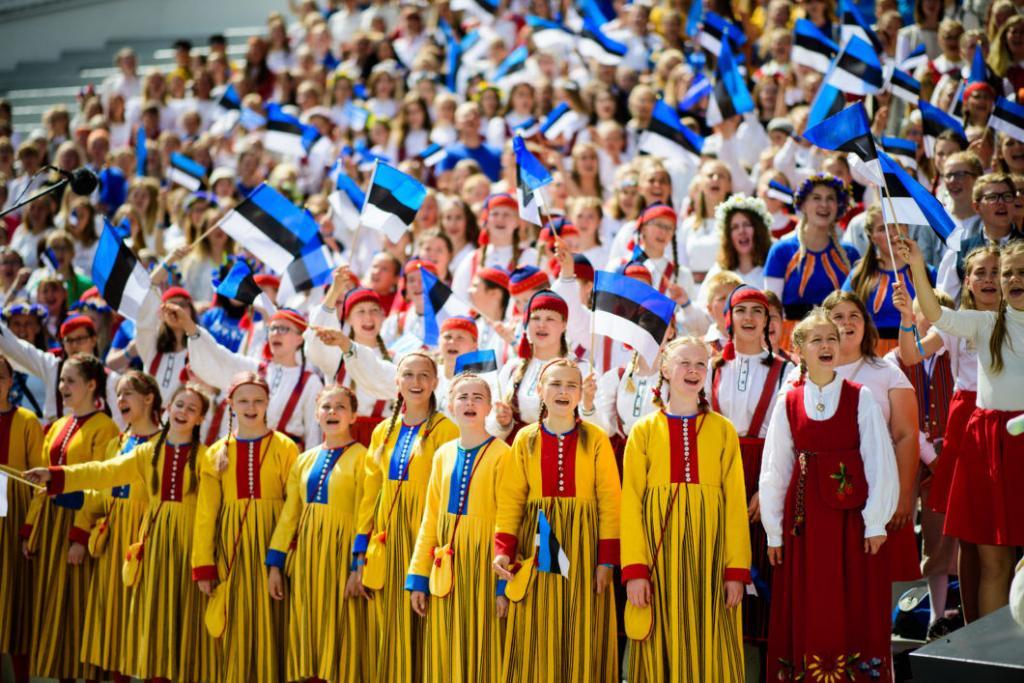
song-celebration-sven-zacek-ii-1024x683

Photo: estonianworld.com
The Estonian Song Celebration every five years brings together a huge choir of up to 30,000 people for a weekend in July.

How do you get 30,000 people to sing together and hit the same note at the same time? It’s not easy. But if any group of people can do it, it’s the Estonians. They’ve had a lot of practice.

Writes Estonian World, “The Estonian Song Celebration is a unique event, which every five years brings together a huge choir of up to 30,000 people for a weekend in July. Approximately 100,000 spectators enjoy the concerts and sing along to the most popular songs.

“The first Song Celebration was initiated in 1869 by newspaper publisher Johann Voldemar Jannsen and celebrated freedom and the 50th anniversary of the end of Estonian serfdom at the hands of the Russian tsar in 1819. The first singing event was held in Tartu, with 878 male singers and brass musicians. All the songs were in Estonian and Estonians – mostly peasants and farmers at the time – discovered the value of their own language and cultural heritage through singing. …

“After the Second World War, during the Soviet occupation of Estonia, the song celebrations again helped keep the national identity alive. In the summer of 1988, several hundred thousand people gathered at the Tallinn Song Festival Grounds and sang for freedom for many days and nights. Dubbed ‘The Singing Revolution,’ it indirectly led to Estonia’s independence once again in 1991.

“The 27th Song Celebration [features] 1,020 choirs, which include over 35,000 singers. The youngest participant is Emma Kannik (5) from Musamari Koorikool (Tallinn) and the oldest is Aino (90) from the New York Estonian Choir.

“The smallest choir of 12 singers is Kauksi Primary School Choir and the largest is the European Estonian Choir, with 123 singers. The latter is not the only expat choir – 25 Estonian choirs from abroad and 17 foreign choirs are performing at the celebration.

“The emotional celebration kicked off with a traditional parade on 6 July, during which the performers walked along a five-kilometre route from the Tallinn city centre to the Song Festival Grounds, where 82,000 people later watched them perform old and new Estonian choral songs and other classical pieces. …

“Tickets sold out on Sunday as 95,000 people came to Tallinn’s Song Festival Grounds for the second day of the 150th anniversary of the Song Celebration, Minu Arm (My Love). … There were more singers, more choirs, more tickets sold, and there had been more dancers than ever before at dance festival earlier in the week. The festival organisers said there were 1,020 choirs, 35,000 singers, and 11,500 dancers. …

“[Song Celebration’s artistic director, Peeter Perens] noted his ideas for the song celebration had been built on the Finno-Ugric culture, which the Estonia language comes from, and the European culture which brought the singing festivals to Estonia more than 150 years ago. The programme was created three years ago and since then more than 300 rehearsals took place. …

“[Marju Lauristin, professor emeritus at the University of Tartu,] discussed her research that shows that 48% of the Estonian population has, at some time in their lives, taken part in the song celebration and is one of the remaining activities that is enjoyed by the whole of society.

“Discussing the history of the song celebration, she said, ‘Through 150 years these people have the same memories, coming together in winter, through snow, in times when there were no cars, no internet, walking 10-15 kilometres to school or place where they would gather and have a singing society, all over the country.’ …

“Lauristin added that the atmosphere of the song celebration had changed over the years from one of bitterness during the Soviet occupation, to one of joy today.

“[Composer Riho Esko Maimets said] that the experience of being at the celebration felt ‘very selfless, [like you are] existing as one little particle in a great mass of your nation.’  More here.

I’m impressed that so many people can sing together. I gave up on our town’s Christmas tree carol singing because the people on one side of the tree were always at a different place in the song than the people on the other side. And that leader was trying to keep together fewer than 100 people, not 30,000!

Read Full Post »

wwasp4iub5cohnfzrupp4aleui

Photo: Jose F. Moreno / Inquirer Staff Photographer
In South Philadelphia, young Khmer women are earning to perform traditional Cambodian dance.

When one marginalized community taps into its roots and strengthens its identity, other ethnic groups may benefit, too. Consider this story about young Cambodian women in South Philadelphia and their how traditional dances are often performed for neighboring communities of color.

Bethany Ao reports at the Inquirer, “When Lanica Angpak started the organization Cambodian American Girls Empowering three years ago as a personal project, she visualized it as a safe space where young Cambodian women could talk about ‘taboo’ topics they didn’t feel comfortable discussing with their families.

“But when Angpak broached that idea with the women she was mentoring at the time, the group had an addendum: They wanted Angpak to teach them traditional Cambodian dance.

” ‘I was already teaching some of them,’ said Angpak, who learned how to dance from her mother. ‘But bringing it into this organization allowed us to build bridges through dance.’

“On a recent Sunday, the organization gathered at Bok Bar, a popular rooftop bar in South Philly with gorgeous views of the Philadelphia skyline, for a sunny afternoon workshop performance.

“The women slipped off their shoes and completed stretches that were harder than your average yoga pose. Eventually, they shifted into formation and performed a dance about a Cambodian celebration for young children. The dancers moved slowly, but their movements required just as much precision as ballet. Their mastery of balance was impressive, as was their flexibility. …

“Cambodian dance is a crucial part of storytelling in the country’s culture. It has existed for thousands of years and draws its roots from Indian mythology and religion. Every component of the dancer’s body is engaged during a performance, from their fingertips to their facial expressions. …

“The Philly area has the fourth largest Cambodian population in the United States — about 13,000, according to the most recent census — centered in South Philly. Angpak works closely with the Cambodian Association to help support the community here. Besides the performances, CAGE also holds dance workshops for females as young as 6 and as old as 72.

” ‘On average, we do about 14 performances a year, and we’ve already surpassed that number this year,’ Angpak said. ‘We prioritize public events.’ … The group particularly enjoys performing for organizations representing other communities of color.

“Angpak said dance is an alternative way of sharing between communities, an exchange of culture and art, of sorts. The organization charges on a sliding scale for performances. Workshops, including the one at Bok Bar next month, are free and open to the public.”

More at the Inquirer, here. And click here for my 2017 post about how Princess Norodom Buppha Devi, half-sister of Cambodia’s King, is working to reenergize the Royal Ballet of Cambodia. Perhaps some of these Philadelphia women and girls will get a chance to audition for that.

Photo: Jose F. Moreno / Inquirer Staff Photographer
A mother and daughter learn traditional Cambodian dance at the Bok Bar in South Philadelphia. Cambodian American Girls Empowering (CASE) helps women and girls preserve their heritage through traditional Cambodian dance.

pltyg5csarh53btkfol46pgw5a

Read Full Post »