Feeds:
Posts
Comments

Posts Tagged ‘improv’

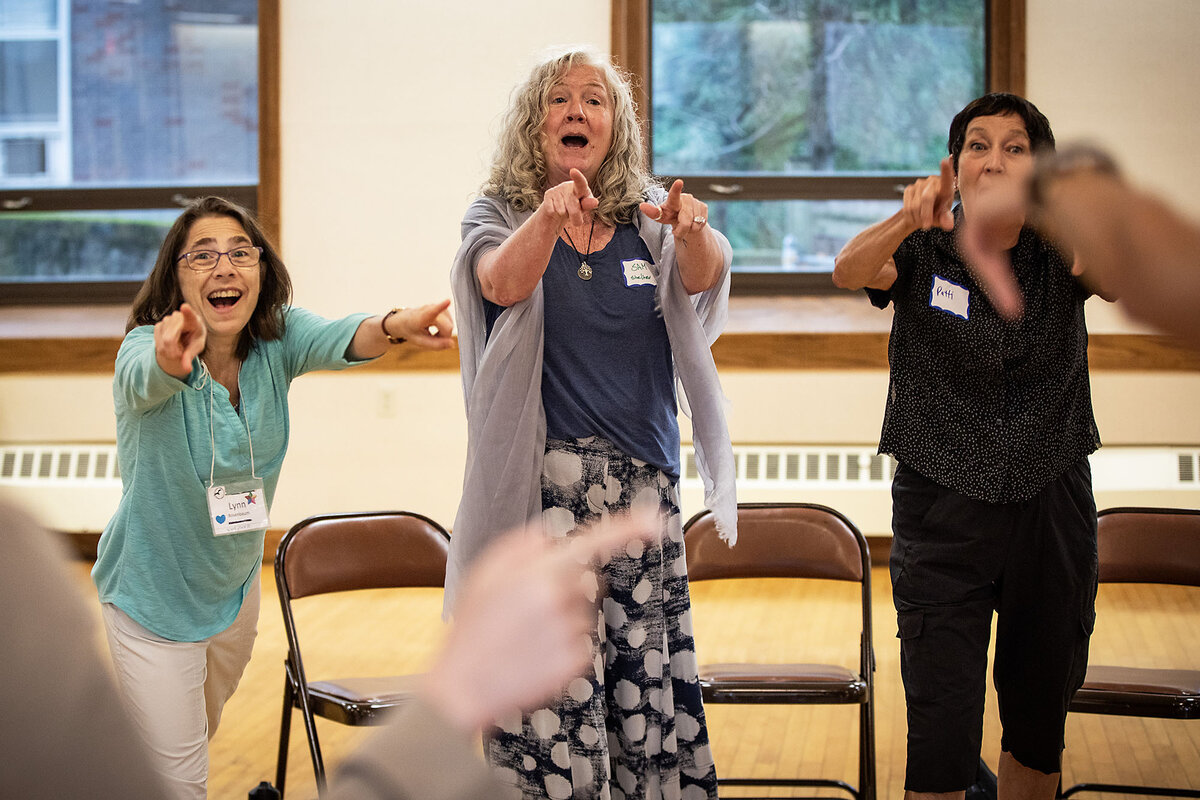
Photo: Melanie Stetson Freeman/CSM.
From left, Lynn Rosenbaum, Sam Whyte, and Patti Gurekian introduce themselves through song at a CircleSinging session at St. Mary Orthodox Church, Aug. 18, 2024, in Cambridge, Massachusetts.

Those of us worry a lot need to make a point of searching out joyful moments. Here’s one way that folks in Massachusetts fill their joy quotient: circle singing.

Oli Turner reports at the Christian Science Monitor, “The song coming from the St. Mary Orthodox Church meeting room in Cambridge, Massachusetts, has never been heard before. And it will never be heard again. 

“Fourteen singers stand in a circle of metal folding chairs, improvising an organic cacophony of harmonious and discordant sounds. Some tap their feet, sway, or bob their heads to the rhythm – but no two people engage with the music in quite the same way. 

“In CircleSinging, there’s no sheet music, no director, no pitch pipe. There’s an art to it, but not a pretentious one.

The singers have coalesced into an intergenerational network of friendship.

” ‘It’s really all about following. Following well,’ organizer Peter McLoughlin explains to the group between exercises. Mr. McLoughlin is not a teacher or a director. He gently sets the group in motion, and then blends into the circle as a participant. 

“ ‘Everybody’s welcome, and we’re not as concerned with whether you’re an excellent singer or you are an excellent harmonizer,’ he says before the rest of the singers arrive. 

“The Boston area’s CircleSinging community – tucked away in church meeting rooms in Cambridge, Arlington, Somerville, and the Jamaica Plain neighborhood – is part of an international network of CircleSingers who delight in the spontaneous art form. 

“The improvisational singing technique was developed by jazz musician Bobby McFerrin, best known for his 1988 hit song ‘Don’t Worry, Be Happy,’ the first a cappella song to go No. 1 on the Billboard Hot 100 chart. Mr. McFerrin’s vocal jam sessions relied on a call-and-response model, in which a leader improvises one vocal part at a time and other singers repeat those ‘loops.’ Any singer can volunteer to lead a composition.

“Cambridge organizer Mr. McLoughlin started the first of the four Boston-area circles in 2015 on Meetup.com, inspired by Mr. McFerrin’s ‘magnificent’ rendition of Psalm 23. The looping choruses and complex harmonies reminded him of the music surrounding his own Catholic upbringing. He was hooked.

“Mr. McLoughlin learned the technique from Mr. McFerrin himself, attending his weeklong workshops once a year for seven years. Then CircleSinging Boston was born in Mr. McLoughlin’s living room.

“Each of the four Boston groups, run by different organizers, holds two-hour meetings that prioritize openness. One Boston CircleSinger, Maureen Root, says her favorite exercise starts by singing a random word – not for its meaning, but for its sounds.

“ ‘So it’s like these different vibrations and things come out,’ Ms. Root says. ‘It’s almost like you’re bypassing the mental circuitry. … It gets me out of my self-conscious mind.’

“Some CircleSingers have no prior musical or singing experience, like Ms. Root, a retired medical technologist and yoga and meditation instructor of more than 30 years. …

“Less-experienced singers like Ms. Root share a circle with vocal professionals like Boston Children’s Chorus conductor Destiny Cooper, who moved to Boston after college, ‘knowing not a soul.’ In experimental CircleSinging, a far cry from her familiar structured choirs, she found belonging.

“ ‘Most of the members are significantly older than me, but nonetheless, I think that community was really important to give me a sense of home,’ Ms. Cooper says. Since joining the group about five years ago, she never missed a circle until the pandemic. …

“Arlington CircleSinging organizer Lynn Rosenbaum leads her meetups with all singers in mind.

“ ‘I tend to think of the arc of where we start and where we end, and bringing people along, building their confidence and their skills,’ says Ms. Rosenbaum, a seasoned improv singer herself. ‘There’s usually a big difference between the beginning and the end, especially for new people – in their level of comfort and how much they’re willing to take risks.’ …

“ ‘Singing together and playing together – I say “playing” as in “playfulness” – it just creates a connection among people,’ Ms. Rosenbaum says. ‘It’s a common denominator that we can all connect to.’ …

“ ‘[CircleSinging is] just this opportunity to express our full range of emotions and letting it out through our voices and our bodies,’ Ms. Rosenbaum explains. ‘There’s not always a lot of opportunities in everyday life to do that, so this creates a safe space for people to be silly and explore and take risks and express joy.’ ”

More at the Monitor, here.

Read Full Post »


Photo: True Story Theater
An Arlington, Mass., theater troupe performs the stories of ordinary people.

Recently, John told me about an unusual improvisational theater group that will perform your story. Called True Story Theater, it is affiliated with the worldwide Playback Theatre movement, which seeks to right wrongs experienced by minorities and marginalized groups by putting their actual words into plays to build understanding.

From the website: “True Story Theater is a nonprofit theater company that offers 50-75 improvisational performances and workshops a year for community groups, businesses, and individuals mostly in the greater Boston area. We work with hospitals, universities, corporations, religious communities, with teen leaders, cancer survivors, activists, philanthropists, business leaders …

“Our mission is to build empathy and respect in community through honoring all of our true stories.

“In performances, volunteers from the audience are helped to share what’s important in their lives. On the spot, actors then portray the heart of what they heard using music, movement, and dialogue. From this simple interaction, people laugh, cry, share fresh insights, and bond. … True Story Theater offers audiences fresh perspectives, deeper connections, and a renewed appreciation for our common humanity.”

The troupe says it employs many dramatic styles but is especially indebted to the technique of Playback Theatre, which “was founded in 1975 by Jonathan Fox and Jo Salas in New Paltz, NY. …

“Globally, Playback is often used to reach disenfranchised people and to build understanding where conflict had driven people apart. A few examples:

“Southern India: Groups of Dalit people have used Playback Theatre to assert their rights. Western Australia: Playback has helped landowners and Aboriginal people find common ground. Burundi: Hutu and Tutsi actors work together in a Playback troupe in a country healing civil war.”

Watch samples from performances here.

True Story Theater is also available to draw people out at weddings and other such events.

Read Full Post »

Prison improv classes organized by actress Sabra Williams and film director Tim Robbins correlate with lower recidivism, according to a recent article in New York magazine.

Writes reporter Mickey Rapkin, “You can imagine how this idea was received 10 years ago, but here’s the pitch: A tenacious British actress teams up with Oscar winner Tim Robbins to bring acting classes to maximum-security prisons.

“And not just any acting classes, but improv workshops that ask Crips and Bloods and convicted murderers and white supremacists to sit together, wear makeup and masks, and maybe even pretend to be women sometimes. The eight-week intensive is meant to help the incarcerated better handle their emotions. …

“People said, ‘Yeah, yeah, you want to give them crayons. You’ve got acting classes?’” recalls Robbins of the launch of the Actors Gang Prison Project. ‘We’re like, “No, … it’s about changing behavior.” ‘

“Fundraising was a slog. Correctional officers pushed back. And these actor-facilitators were dismissed as another merry band of liberals pushing what’s known in the Prison Industrial Complex as ‘hug-a-thug’ programming.

“Sabra Williams, the co-founder and executive director of the Prison Project — who also had a small part in Kristen Wiig’s Welcome to Me last year — remembers those early days. ‘There was so much opposition … A few haters thought we were giving inmates too much power. One spread rumors that I was having an inappropriate relationship with a student.’

“Yet, despite the haters, the Prison Project celebrated its 10th anniversary this year, and will expand to 10 California prisons in February 2017, just as some hard data has finally come in to prove the program’s merits.

“The recidivism rate in the state is more than 50 percent. But a recent preliminary study by the California Department of Corrections and Rehabilitation showed that, for inmates who completed the Prison Project, that number dropped to 10.6 percent. Critics will point to a sample size that’s too small to draw broad conclusions, and it’s a valid concern. But the provisional findings are encouraging.” More here.

I want so much to believe in this approach, but having recently read poet Jimmy Santiago Baca’s memoir of life in a maximum security prison in the late 1990s, I can’t help but wonder. I look forward to more data. My review of Baca’s A Place to Stand is at GoodReads.

Photo: Peter Merts
Sabra Williams, Tim Robbins, and inmates in an Actor’s Gang Prison Project class at the California Rehabilitation Center.

Read Full Post »

One thinks of Iran as repressive, and having watched the doomed 2009 revolution unfold on twitter, I believe it is. But Iranian theater people seem to be managing to squeeze in some fun.

I blogged before about the Tehran production in a taxi, here. Now Studio 360 has a story on what might be called extreme improvisation. I take that back. There’s a script. But the actor doesn’t get to see it in advance.

“Actors face stage fright all the time,” says Studio 360, a radio show. “But consider this scenario: you show up to perform a one-person show, and you’ve never seen the script. You don’t know what it’s about because you promised not to do any research. It’s your first performance, and the only one you’ll ever have. The theater’s artistic director hands you a fat manila envelope with a script. And go.

“Also, the audience will decide whether you drink a glass of water that appears to have been poisoned.

“This is the premise of White Rabbit, Red Rabbit, by Iranian playwright Nassim Soleimanpour. ‘I did not know what was in front of me inside that envelope,’ says actor Gwydion Suilebhan. ‘What if this script is going to require that I disrobe? Or insult my mother? Or be rude or self-debasing?’ …

“Soleimanpour pulls his strings from afar, because — although the play has been performed in Toronto, Berlin, San Francisco, Brisbane, Edinburgh, London, and now Washington, DC — he really is in a cage. He doesn’t have a passport and can’t leave Iran, so he has never seen his play performed. ‘Nassim has given up the kind of control that is customary for playwrights,’ says Suilebhan, of working with actors and directors to realize the play. ‘At the same time, because he has put all of these restrictions on how it is to be performed, he has seized certain kinds of control that playwrights normally do not have. So he is literally embodying the ideas of control and submission and manipulation that he’s baked into his script.’ ” More.

Photo of Iranian playwright Nassim Soleimanpour found at the HuffingtonPost

Read Full Post »

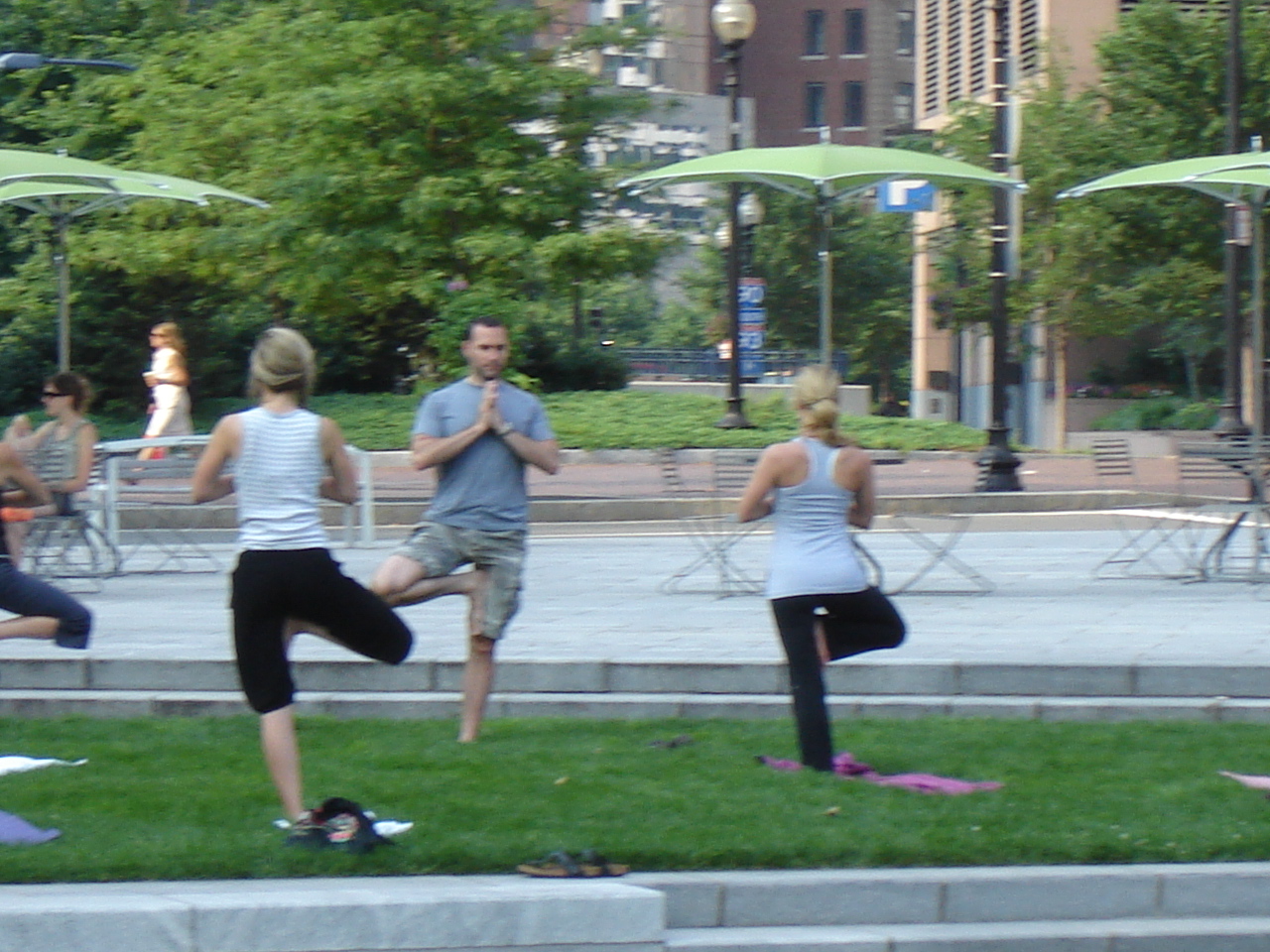
Before it got hot this morning, a yoga class was exercising at one end of the Greenway.

At the other end, carousel horses waited for riders.

Meanwhile in New York, an improv troupe approached a different carousel.

Read Full Post »