Feeds:
Posts
Comments

Posts Tagged ‘incarcerated’

Photo: Washington State Department of Corrections.
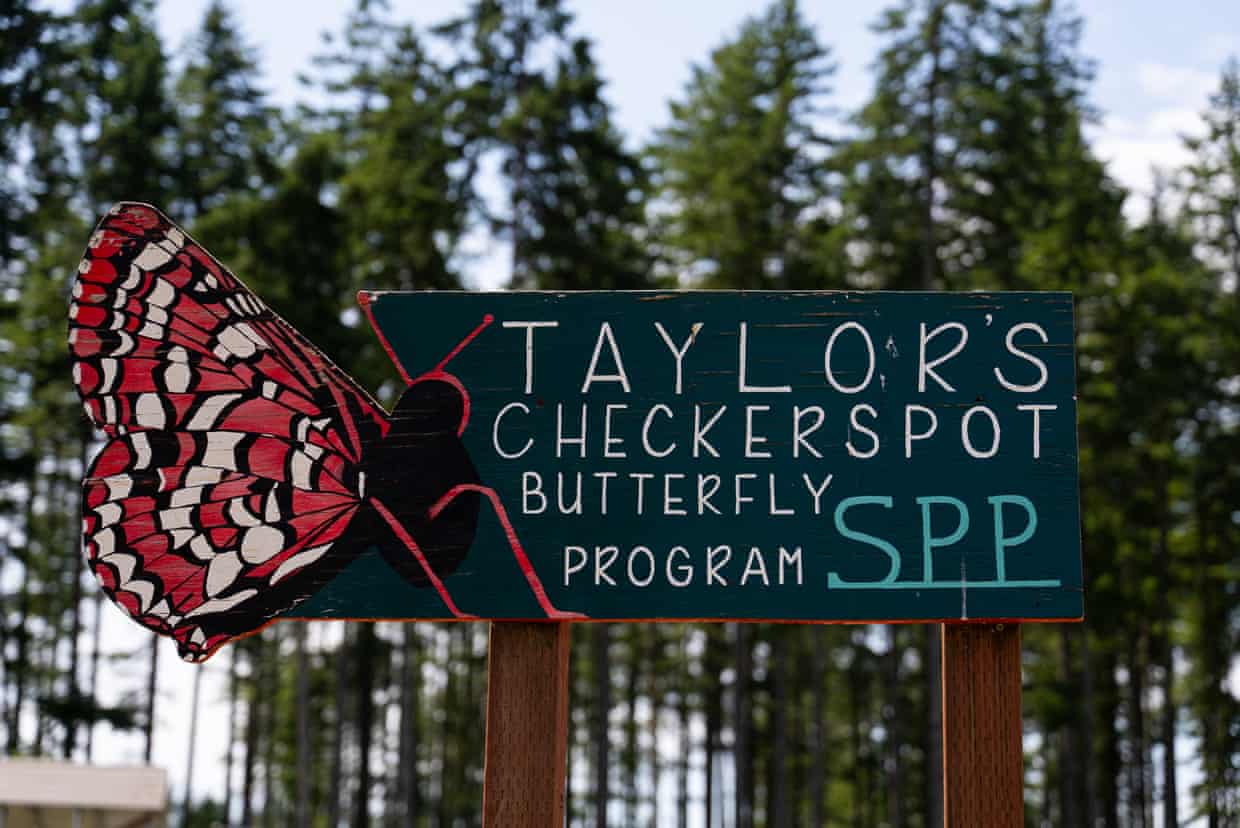
Last year, scientists working with a team of incarcerated women released more than 67,000 larvae of a beautiful, endangered butterfly.

Today’s story about incarcerated women helping scientists reminds me that you don’t have to be in prison to get satisfaction from working for a cause. These women are gaining confidence, self-esteem, and hope for a better future.

Andrew Buncombe reports at the Guardian, “Trista Egli was standing in a greenhouse, tearing up strips of plantain and preparing to feed them to butterfly larvae.

“Of the many things the team here has tried to tempt larvae of the Taylor’s checkerspot [with], it is the invasive English plantain they seem to love the most.

‘The big thing for me is being part of an effort to save an endangered species,’ says Egli, 36. ‘It is a big thrill.’

“Egli is one of seven women incarcerated at the Mission Creek correctional facility, located a two-hour drive from Seattle, who are part of a year-long program that takes captured butterflies, harvests their eggs, and oversees the growth of the larvae before they are released into the wild where they will turn into adults.

“Last year, scientists working with the team released more than 10,000 larvae. The adult butterflies live for just a handful of fabulous, wing-fluttering days. …

“Many of the women speak of their pride working on a project that feels like it is making a positive contribution to the world.

“Lynn Cheroff, 42, said she had been thrilled to talk about it with her two young children when they come to visit. When she telephones her mother about the work, her mother tells her she is proud. Another woman, Jennifer Teitzel, appreciates the sense of order and discipline the program demands and instills.

“Every detail about the eggs and larvae has to be collated and recorded. It is the women’s responsibility, and nobody else’s, seven days a week.

“[While] the program run by Washington state department of corrections (DOC) is part of an effort to prepare the women for life once their sentences are over and to smooth the path to work or college, there is no sugar-coating their predicament.

“Egli, who has three young children, is serving a nine-year sentence for a 2020 drunken hit and run that left a woman with permanent brain damage.

“ ‘I am paying the price for that every day. I can never go back and undo what happened,’ she says. ‘But I can try to make sure the rest of my life is about making the world a better place.’

“The program at Mission Creek has been operating for 10 years. Kelli Bush, the co-director of Sustainability in Prisons Project, a partnership between the DOC and the Evergreen State College in Olympia, says a crucial component are graduate students who visit to offer educational support.

“Bush says in addition to providing the women something to feel proud about as many deal with shame and guilt, the program also gives them confidence about their own capabilities. …

“She says, ‘It’s routine to hear people say “I didn’t think I was smart and I’m realizing I’m doing science.” … Pretty soon people find themselves reading peer-reviewed scientific journals and saying, “I can do this too.” ‘

“The Taylor’s butterfly’s preferred habitat is open grasslands and prairie. For thousands of years, such landscapes were created and maintained by active burning by Indigenous communities. Without such native stewardship, and with ever-increasing threats from developers and town planners, the amount of grassland has drastically diminished. …

“A favored place is Joint Base Lewis-McChord (JBLM), operated by the US army and situated 10 miles from Tacoma. Training with heavy artillery has long kept the prairie free of unwanted vegetation. Yet when the Taylor’s was added to the US Endangered Species Act list in 2013, it presented military officials with a challenge; how could they continue to make use of the base without harming a species now protected by federal law?

“Dan Calvert, of the Sentinel Landscape Partnership, a coalition of federal and state groups that works with landowners to promote sustainable land use around military installations, says JBLM contains ‘90% of the prairie habitat in western Washington.’ …

“One of the efforts to boost the numbers of Taylor’s checkerspot in locations off-base – and thereby allow the military to work unimpeded at the base – led to funding for the Mission Creek project by the Department of Defense (DoD). …

“The collaboration has helped boost the Taylor’s checkerspot. This year could be a record year for releases of adults. In 2024, the program released about 10,900 larvae.

“However, there’s a dark cloud looming over the program. Mission Creek is set to close in October because of budget cuts. There is a plan to transfer the women and the program to a prison at Gig Harbor, located 25 miles away, but there is some concern among current participants it could simply be cut entirely.

“Egli, who is set to become eligible for a work-release program under which she would serve the last 18 months of her sentence working outside the jail and returning to do what’s known as a DOC re-entry facility every night, says the program changed the person she was.”

More at the Guardian, here. No firewall. Donations support his valued news outlet.

Read Full Post »

Photo: Noam Brown.
Bending the Bars artists Kashdatt, Chuckie Lee and ZQ recording in the studio. 

Given that the US leads the world in numbers of people incarcerated (1,808,100), more than even China, that’s a lot of human beings we can’t just forget about. We need to find ways for them to be engaged in the world and not give up hope, for our own sakes as well as theirs.

Monica Uszerowicz writes at the Guardian about an experiment in Florida that was organized by inmate advocates and received no help from the system.

“In ‘Locked Down,’ a song by the San Diego-based poet and rapper, Chance, she sings with both foreboding and care: ‘Every day that you wake up you’re blessed / love every breath, ’cause you don’t know what’s next.’

“Chance wrote the song – originally a poem, its title a callback to Akon’s ‘Locked Up’ – while imprisoned in Phoenix, Arizona, during the beginning of the Covid pandemic and subsequent lockdown (‘six feet apart in a five-by-five,’ she raps in the same song, alluding to the virtual impossibility of social distancing in the American prison system). … She shared with me in a recent phone call, ‘It’s crazy how they maintained control and instilled fear within us. When you’re locked up, you ask yourself … are you going to be angry, or are you going to find what your calling and purpose is?’

” ‘Locked Down’ is also one of 16 tracks on Bending the Bars, a hip-hop album featuring original songs by artists formerly or currently incarcerated in Florida’s Broward county jails (with the exception of Chance, a Florida native). Bending the Bars was organized by the south Florida abolitionist organization Chip – the Community Hotline for Incarcerated People – which was initially founded to support inmates during the early days of Covid.

“Nicole Morse, a Chip co-founder and associate professor at the University of Maryland Baltimore County, says the organization began fielding calls in April 2020, primarily from Broward, the county just north of Miami-Dade; the calls were primarily about medical neglect, abuse and an atmosphere of abject fear. …

“In 2021, the data Chip had gathered was used to support a lawsuit filed by the American Civil Liberties Union of Florida and Disability Rights Florida on behalf of individuals suffering from Covid in the Broward county jail.

“Something more hopeful was emerging from those hotline calls, too: creativity. ‘People wanted to share their latest poetry or a song they were developing,’ Morse said. ‘Art was helping people survive an incredibly desperate time.’

“Noam Brown, a children’s musician and Chip committee member, began dreaming up the idea of an album. … Chip hoped to create a platform for the wealth of talent they continually encountered. The organization began fundraising, applying for grants and putting the word out that they were producing an album; Gary Field, an incarcerated organizer, writer and scholar, became the executive producer, helping to connect the artists with Chip.

“Musicians on the inside used two phones to record their songs – one as the microphone to record their vocals, the other to listen to the beat. ‘The challenges were phenomenal,’ Field shared in a phone call. ‘People couldn’t even talk to their families, never mind collaborate on something as complicated as producing a studio album. We were in the middle of a pandemic. There were four phones and 40 inmates trying to use them.’

“Spaces with two easily accessible phones were limited; the duration of any prison phone call is restricted. But Chip covered the costs of the calls, while Brown’s brother, Eitan, worked as the sound engineer, and the Grammy-winning children’s artists Alphabet Rockers helped create beats. Artists who were already out were able to spend time in the studio, including Chance, who returned to south Florida after her release.

“After reconnecting with a former classmate, the two attended a meeting for Chainless Change, a Lauderhill-based non-profit advocating for those affected by the criminal legal system. ‘It was divine – I don’t believe in accidents; I knew I was being called to go back to Florida’ Chance said. She began working with the group and helped organize a poetry event, where she met Field, Brown and Morse. She asked if they had room on the album for one more.

“The result is nearly an hour of uniquely south Floridian hip-hop and R&B, both of which are constellations of so many genres – Caribbean beats, southern bass, Deep City soul, Miami drill – poetic musings on love, loneliness and hope, and demands for systemic change to the draconian and brutal conditions of the Florida prison system. While Morse noted that the album’s sound quality was impaired by technical limitations, Bending the Bars is polished and clear, an accomplishment owed partly to its production and mostly to the ingenuity of its artists: singers, rappers and collaborators like J4, Corvette Cal and Chuckie Lee, all of whom alchemized the tracklist into a textural tapestry: playful, mournful, educational and intentionally dotted with prerecorded interjections from the prison phone line (‘you have one minute remaining’). 

“Field, whose song ‘Tearing Down Walls and Building Bridges’ closes the album, studied political science at Columbia University and received his master’s from Gulf Coast Bible College, and has contributed 2,000 pages of writing to the Massachusetts Institute of Technology civic media project Between the Bars. He knows, intimately, the significance of the writing process.

” ‘I remember, as an inmate back in 2010, what a profound sense of gratitude the opportunity to write gave me,’ he shared. …

“The system often censored mail or blocked phone calls during the recording process. … ‘We had to develop a set of strategies to overcome those barriers,’ they said. ‘The project was made without the cooperation of any prison or jail. Every strategy we came up with for how to get through to people … we can now share those strategies with loved ones of incarcerated folks who don’t have any additional privileged access.’ “

More at the Guardian, here.

Read Full Post »

Photo: A24.
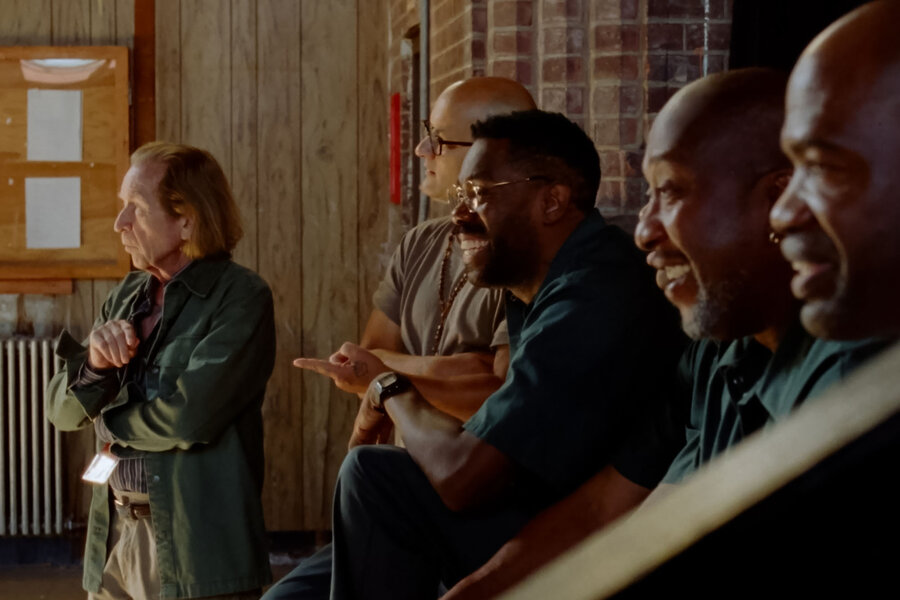
From left, Paul Raci, Sean San José, Colman Domingo, Sean “Dino” Johnson, and Mosi Eagle star in Sing Sing.

There are certain kinds of stories that always get my attention, and I’m grateful when other people find the same things interesting. Things like climate change, entrepreneurs, immigration, the kindness of strangers, housing, and life after prison. Just to name a few.

So you may be sure I liked today’s story about a theatrical production at a prison and the movie made about it.

Stephen Humphries writes at the Christian Science Monitor, “The world’s most unpredictable play only had one performance. It was staged inside a prison. The comedy, Breakin’ the Mummy’s Code, is about a man from ancient Egypt who embarks on a time travel adventure. Along the way, he encounters Robin Hood, Roman gladiators, cowboys, Hamlet, pirates, and – because why not? – Freddy Krueger from The Nightmare on Elm Street. It included a Shakespeare soliloquy – plus dance numbers. 

Breakin’ the Mummy’s Code was created by incarcerated men inside Sing Sing Correctional Facility in New York. It received a standing ovation in Cellblock B.

Now, a new movie explores the play’s legacy: the healing effect it had on its participants.

Sing Sing, directed by Greg Kwedar, reenacts the making of Breakin’ the Mummy’s Code. It even stars one of the play’s original actors. Already generating Oscar buzz, the movie … chronicles a budding friendship between two incarcerated men. Thematically, it’s about identity. The characters live in a hypermasculine environment that venerates bravado, toughness, and aggression. But the amateur actors come to discover that empathy, vulnerability, and tenderness are strengths, not weaknesses. The movie makes a case for the rehabilitative impact of arts programs inside prisons.

“ ‘I was a witness to it,’ says Mr. Kwedar, who taught an acting class in a prison with his creative partner, Clint Bentley, as part of their research. ‘I think the greatest teacher is what it’s like to step into another character and move in their shoes and step outside of yourself. That is a process of empathy’. … It gives you a prism to look at all the relationships in your life and to see perspective.’ …

“[Mr. Kwedar] spent seven years developing Sing Sing with Rehabilitation Through the Arts (RTA), the nonprofit that runs the theater program.

“There are dozens of similar theater projects across the United States. Perhaps the most well-known is Shakespeare Behind Bars. That program, which operates in three prisons in Kentucky and in one in Michigan, boasts a 6% recidivism rate for those who have participated in its productions. The Monitor was the first publication to write about that program. Then it became the subject of an award-winning 2005 documentary, Shakespeare Behind Bars

“ ‘Prisons function on shame and guilt,’ says Shakespeare Behind Bars founder Curt Tofteland, who has longtime collegial connections with the RTA. ‘But shame and guilt doesn’t change behavior. Why? Because shame and guilt doesn’t change thinking.’ …

“When change does happen, it’s a result of the actors exploring questions that the scripts raise, including ‘Who am I?’ 

“The two men at the heart of the story – John ‘Divine G’ Whitfield (played by Colman Domingo) and Clarence ‘Divine Eye’ Maclin (who portrays himself) – had to grapple with those existential questions. As the film unfolds, the audience learns that Mr. Maclin was one of the most feared men in the prison. Acting freed him to shed the gangster identity he’d clung to. The program helped him learn to express emotions. He even cried onstage. Now, he’s a natural performer on screen. …

“ ‘This is a movie about the landscape of the human face,’ says Mr. Kwedar. ‘It’s about drawing close to someone and looking them in the eyes and hearing their stories, and to know their names. And when you do that, it’s impossible to see that person as anything less than human.’

Sing Sing was filmed inside a recently decommissioned prison in New York. Its cast of established and first-time actors includes 13 RTA alumni. The production employed community-based filmmaking. For starters, it had a nonhierarchical pay structure. Everyone on set … was paid the same rate. …

“Last month, the director screened the movie inside the Sing Sing facility itself. He calls it the most profound theatrical experience of his life.”

More at the Monitor, here. No paywall. Subscriptions encouraged.

Read Full Post »

Photo: Lane Turner/Boston Globe.
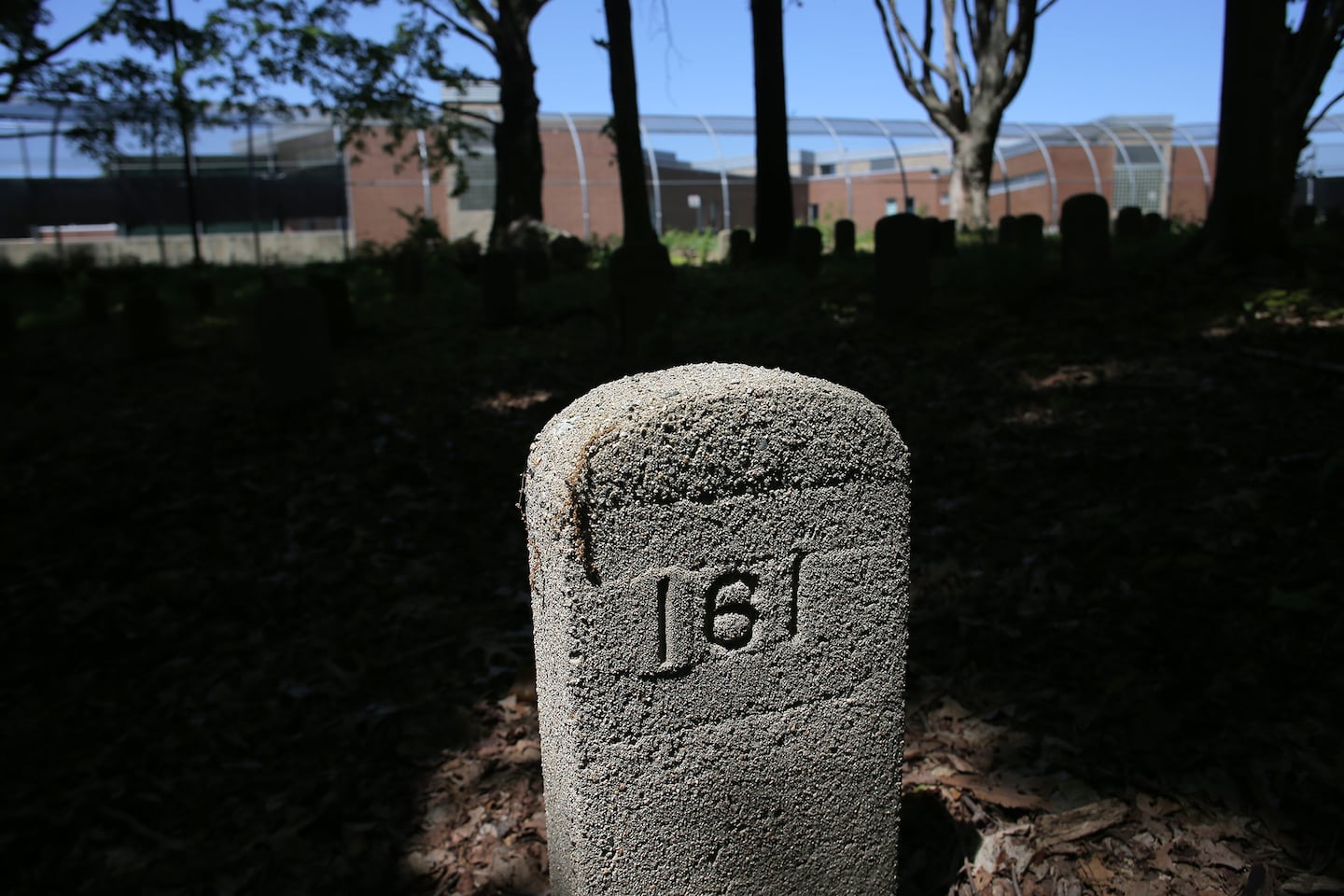
A numbered grave just outside the Rhode Island Training School Thomas C. Slater Youth Development Center in Cranston, Rhode Island. Teens incarcerated at the facility helped bring the paupers’ graveyard to light, writing obituaries for the forgotten.

Recently, I read a Victorian novel (The Three Clerks, Anthony Trollope) in which the notorious Dickens villain Bill Sykes was favorably compared to a villain who was born with every opportunity to live an upright life. Trollope’s point was that for a pauper raised in poverty with no access to education or higher things it might be considered understandable that he went bad and died in ignominy.

I’m thinking about this in connection with today’s story about how paupers’ graves raised the consciousness of some youths in trouble with the law today.

Amanda Milkovits wrote at the Boston Globe, “Sometimes, as they played basketball outside at the Rhode Island Training School, the teens would glance through the security fence to the woods and brush that shrouded rows of small stones.

“ ‘What are they?’ A 16-year-old boy incarcerated at the Training School remembered asking one of the staff members.

“Graves, he was told. The plain, numbered concrete headstones marked the burial sites of 1,049 people who died a century ago.

“Some had been residents of the state asylum. Some were teenagers who lived at the former Sockanosset Boys Training School. Some had spent their last years in the state poorhouse. Some were stillborn infants who were never given names, factory workers who fell on hard times, immigrants who sought a better life, only to die far from home.

“What they all had in common was poverty and no one to claim their bodies. From around 1915 until 1933, the state gave them a simple burial in this place, known as the State Farm Cemetery Annex, or Cranston Historical Cemetery No. 107. Prisoners made the concrete headstones, which were engraved with numbers instead of the names of those buried 6 feet below.

“ ‘I thought it was just a regular grave site, but I’d never seen a grave with a number before,’ another boy told the Globe. … ‘It’s sad. No one should just be a number.’

“For decades, the cemetery has been a lonely, quiet place, cut off from public access because it’s bordered by the state’s maximum security prison, Route 37, and the Training School. …

“John Scott, a senior community development training specialist at the Training School, had been interested in the cemetery since he first caught a glimpse of it in the 1990s. The teens’ curiosity made him wonder whether those on probation or who needed to perform community service could help restore the cemetery, even if only by clearing some of the brush.

“But Theresa Moore, president of T-Time Productions, saw potential for more. Her company designs educational curriculums with the goal of shining light on untold or little-known stories, and was already working with the Training School on its educational programs for incarcerated youths. …

“ ‘I’ve always looked for projects to enhance their lives,’ Moore said, ‘so when John mentioned it, I thought, “Why don’t we make it happen?” ‘

She called the project: ‘They Were More Than A Number.’

“Moore reached out to the leaders of the Rhode Island and Cranston historical cemeteries commissions, who were delighted to share their knowledge — they’d wanted to restore that cemetery for years, but could never get access. She contacted Secretary of State Gregg Amore, who assisted with resources at the state archives, giving the teens access to records from the state infirmary that include doctors’ notes, reports from the state institutions … and burial records. …

“The students started their research. Records and documents from the state archives, the drone footage, and other resources were used to help them put the history into context. Some materials, such as a video of Lorén Spears, executive director of the Tomaquag Museum, explaining the ‘pencil genocide’ of Indigenous people, were scanned into a Google drive for about 50 students and their teachers. …

” ‘At first, I didn’t really care,’ admitted one 16-year-old boy, ‘but I wouldn’t like it if I was just a number.’ …

“A 16-year-old boy said he chose No. 500, and learned it was the grave of a man named John Holland, who died in 1915. When he wrote Holland’s obituary, ‘It made me feel bad that they didn’t have names,’ he said. …

“One day in late May, the teens and the adults involved with the cemetery project met in person along the security fence at the Training School. The view through the fence was clear now. Brush and saplings and debris had been hauled away, and there were two new signs, marking the site as a state and city historical cemetery. The cemetery was serene, shaded by the old silver maples.

“As the teens in their dark blue uniforms listened, accompanied by their teachers, Scott, Moore, and volunteers from the Cranston Historical Cemeteries Commission thanked them for their work and told them it had meaning.

“John Hill, chairman of the Cranston Historical Cemeteries Commission, had read some of the obituaries written by the students.

“ ‘You’re giving them their names back,’ Hill told them. ‘You are making them human beings again.’ …

“Scott knew why the teens incarcerated at the Training School could relate. ‘If anyone can understand what it means to be a number,’ he said, ‘it’s our students.’”

Read this long, beautiful article at the Globe, here.

Read Full Post »

Photo: Joanna Detz/ecoRI News.
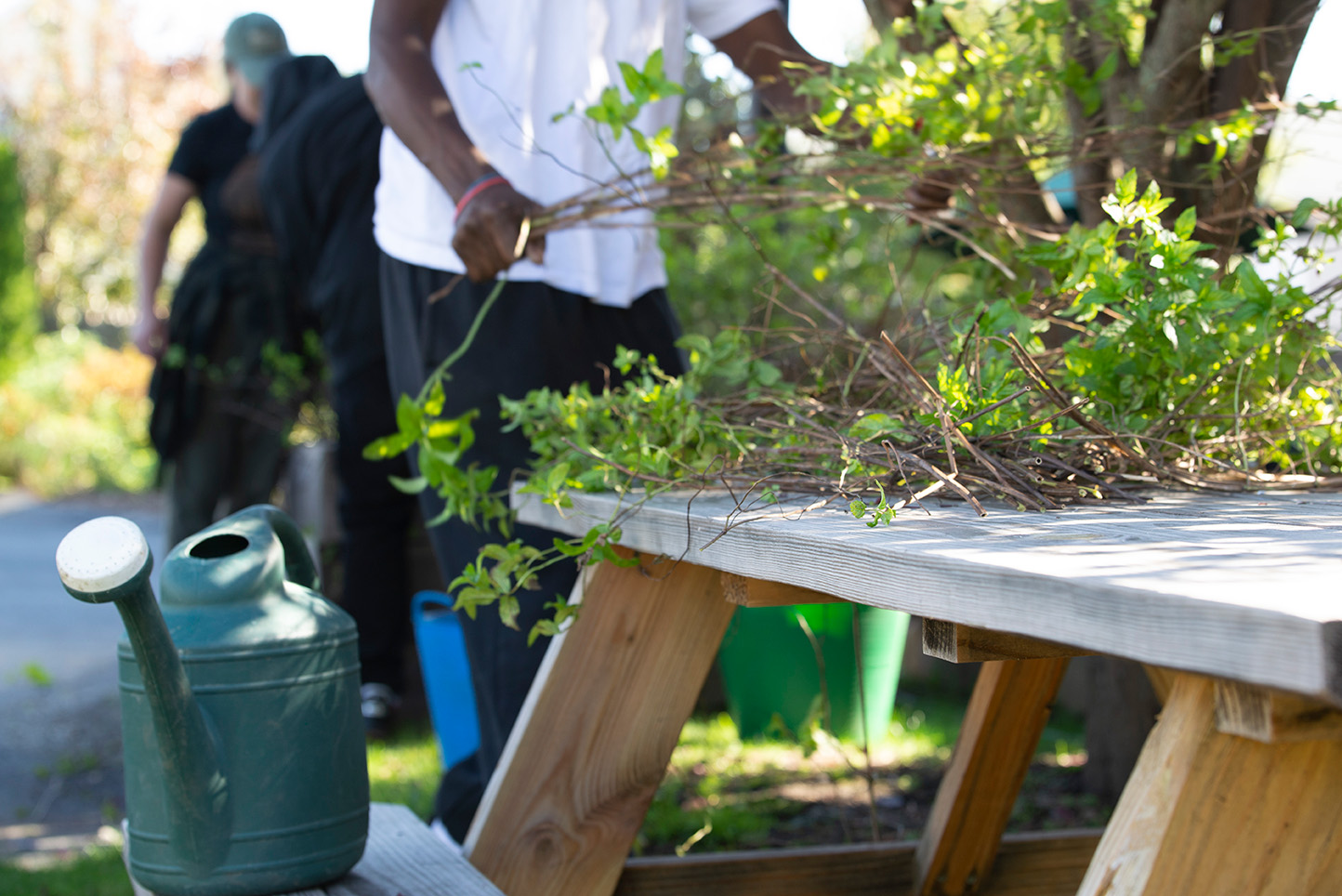
The Garden Time program in Rhode Island gives formerly incarcerated people a chance to prepare for reentry into society.

Today’s article about a program to help incarcerated people find work on the outside notes successes and failures. One of the featured participants, Anderson, ended up back in trouble with the law. Others have stuck with the hard work needed to move on.

Colleen Cronin wrote about the initiative at ecoRI News.

“The Green Jobs Reentry Training program run by Garden Time, a Providence-based nonprofit [is] an offshoot of a gardening program run by Garden Time at the Rhode Island Adult Correctional Institutions (ACI) since 2011, according to Kate Lacouture, founder and executive director. In addition to teaching incarcerated people about gardening, the ACI program also helps participants on an individual level with reentry needs when their sentences end.

“Lacouture called the ACI training a ‘pre-employment program,’ because Garden Time teaches gardening, horticulture, and other green industries and brings in employers from those fields to teach and get to know program participants. …

“When the pandemic hit, Garden Time started expanding its work outside the prison. Lacouture said the organization started a garden at Open Doors, a nonprofit focused on reentry in the city’s Silver Lake neighborhood. Working in that garden regularly planted the idea of a formal reentry and job training program for individuals who were out of prison and trying to integrate into the community, Lacouture said.

“Garden Time ran a shorter reentry training pilot program in fall 2021, and thanks to its success, it was funded by the state Department of Labor and Training as a Real Jobs Rhode Island program. This allowed Garden Time to expand the program from six to eight weeks, offer larger weekly stipends to participants ($400 a week), and provide lunch Monday through Thursday.

“For participants of the program who have just left prison, ‘it’s really nice to have a nice landing spot,’ Lacouture said.

“The program also provides students with Chromebook laptops, work boots, and other tools that participants might need on a job. They attend classes in a Manton Avenue classroom on topics such as arboriculture and nutrition, or receive hands-on training at various locations Monday through Friday. Friday mornings are spent at the Open Doors garden.

“During the last week of the program, the students participate in an internship, for which Garden Time pays.

“The internship ‘becomes like an extended job interview, like a chance for the person to prove themselves, a chance for the employer to be comfortable with it,’ Lacouture said. ‘Because a lot of times, you know, you ask an employer if they would hire formerly incarcerated people, and they don’t really know what that means. It sounds scary. They don’t know what that entails.’

“By the end of the program, those who graduate become official Providence tree keepers, receive an Occupational Safety and Health Administration (OSHA) certification for completing a 40-hour training, and hopefully find full-time positions in a green industry job, Lacouture said.

“Participants must attend most of the classes to complete the program, but on the first Friday of the 2022 session, one of Lacouture’s star students was missing.

“Attending classes can be difficult for anyone who has recently been released from prison or has a police record. Suspended or revoked licenses, little funds for car insurance or a car itself, and sporadic and mandatory parole meetings and other legal hearings can all complicate attendance.

“But Ace, who … met Lacouture inside the ACI, missed the first Friday class because of a cat.

“Ace had been working for Groundwork Rhode Island earlier that week, when he saw a stray cat and couldn’t help picking it up, Lacouture said, despite his allergy to cats. The contact caused Ace’s asthma to flare up, keeping him from Friday’s class. …

“Since Ace was released from the ACI, before COVID, he has accumulated cats, dogs, and tons of pepper plants, gotten married, and started his own landscaping business.

“He knows some of the other participants in the reentry program, living in temporary housing and lacking satisfying work, struggling to maintain their connections in the world outside prison walls, looked up to him.

“Even though his success might look easy and the way he speaks and presents himself might seem completely controlled, his journey has been long, he said. He speaks mostly light-heartedly about the past and his hijinks while also admitting to deep pain and trauma. …

“ ‘I’m always getting in trouble,’ Ace said.

“He can talk about growing up in Liberia and sneaking into a neighbor’s garden to snatch fruit in the same easy tone as he discusses the trials of his addiction. And he readily speaks about the therapist he sees regularly to help him with his addiction, as well as attending Alcoholics Anonymous meetings.

“To overcome some of his challenges, Ace said he has had to make adjustments. The green jobs program starts at 9 a.m., but Ace regularly gets there hours early. If he picks his wife up from work, often at 2, 3, or 4 o’clock in the morning, sometimes he chooses to stay up, so he knows he’ll be ready for the class, he said. …

“On an unusually cold Friday morning, John Kenny, owner of Big Train Farm in Cranston, visited Open Doors to talk to the reentry program participants about green farming practices and how they could start their own farms.

“The Farm Service Agency (FSA) within the U.S. Department of Agriculture offers several different loan programs and has targeted incentives for women and people of color.

“ ‘I’m not going to kid you,’ Kenny said, going on to explain that even with help, obtaining a loan and starting a farm isn’t easy. …

“Ace has tried to let a lot go. He knows he’s made mistakes, and he tries to make up for them. He knows his life has been unfair, but he tries not to think about it. On the other hand, injustice boils under Anderson’s skin when [the  57-year-old military veteran and former oil-platform builder] talks about the environmental hazards Black and brown Americans face and their connection to the cyclical criminal justice he and others have experienced.

“Two million people are currently incarcerated in the United States. Out of the 11 participants that arrived at the first day of the reentry program, most were men of color. Two people were white. There was only one woman in the class. The group reflects the larger pool of Americans who are or have been incarcerated. …

“Like many of the people who have been incarcerated around the country, several of the participants in Garden Time’s green jobs program were in prison for long periods or repeatedly throughout their lives.

“A 2021 study of people incarcerated in Rhode Island showed that by the 3-year post-release mark, 47% had been sentenced again to prison. Many of them had been charged again within the first six months of their release date. Education programs inside a prison, like Garden Time, can do a lot to prevent this.”

Read the rest of the long article at ecoRI News, here. No firewall at this nonprofit, but donations are welcome.

Read Full Post »

Photo: Pat Greenhouse/ Globe staff.
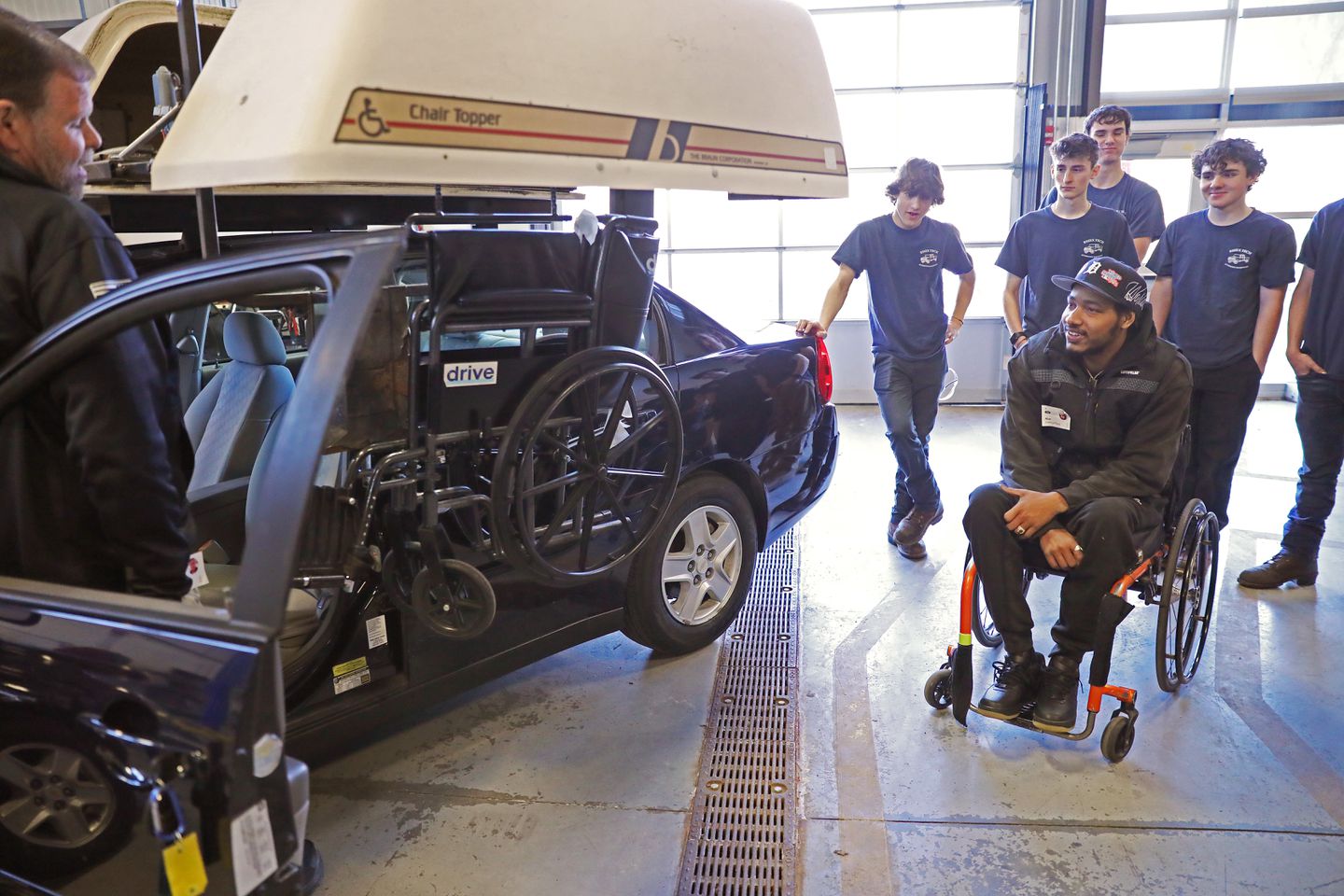
Donor Michael Solomon, left, demonstrates the use of the chair topper to store a folding wheelchair to car recipient Alan Mack of Quincy at Essex North Shore Agricultural & Technical School. It’s all in a day’s work for Second Chance Cars.

Dan Holin is a local nonprofit entrepreneur that I’ve worked with in connection with a couple different organizations. I met him in the early 2000s, when he was running the Jericho Road Project, and when he went to UTEC in Lowell, Mass., I wrote how he brought the joy of biking to teens who had been in trouble with the law, here.

Now the Boston Globe has caught up with Dan’s latest initiative, a longtime dream. He has really thought through all the pieces needed to make it work — the banks, the beneficiaries, the automotive high-school programs, the donors, etc.

Nancy Shohet West wrote, “Three years ago, Alan Mack was struggling to make ends meet as a laborer with the state Department of Recreation & Conservation when he was struck in the back by a bullet and left paralyzed. What followed was not only rigorous recuperation, but also a long stretch of being unemployed and homeless. …

“For a person in a wheelchair, the daily commute he had previously made by public transportation was nearly untenable: Typically an hour in duration and requiring several transfers from train to bus, not to mention relying on a system not known for its reliability even in the best of times.

“Fortunately, the social service organization that was helping Mack with his numerous challenges had one more idea for him: applying for a vehicle through Concord-based Second Chance Cars, which provides automobiles to low-income recipients who can demonstrate that owning a car would substantively help them to get a job, keep a current job, or advance within their field.

“Now Mack makes the 15-minute commute from home to work in his specially equipped car, which he said also will enable him to advance the music production business he recently started after entering an online bachelor’s degree program at Berklee College of Music. …

“Mack is one of about 70 beneficiaries to receive vehicles from Second Chance Cars, founded in 2019 by Concord resident Dan Holin. An Israeli-American citizen who served in the Israeli military and then pursued a career in nonprofit administration, Holin was motivated by several intersecting passions, including social outreach, cars, and entrepreneurship. He envisioned a nonprofit that would serve veterans and former prison inmates returning to society. His mission has since expanded to reach others, including legal immigrants and struggling families.

“Mentored by leaders of other nonprofits, Holin designed a business model whereby his organization provides donated cars to low-income workers for $900, paid for by the recipients in monthly installments of $75 over the course of a year.

“After talking with nearly 20 banks, Holin found two — City of Boston Credit Union and Metro Credit Union — willing to partner with Second Chance Cars by providing zero-interest loans along with free financial counseling to the recipients, with Holin serving as the guarantor. At the end of 12 months, the recipients have not only paid off the loans but also have improved their credit ratings.

“Stephanie Tetreault is the kind of person Holin envisioned helping. After battling a drug addiction and serving nearly 10 months in prison for larceny, she was determined to get her life back on track.

“Formerly living on the streets, by the fall of 2020 she had housing in Lowell and steady employment as a shift leader at Dunkin’, where she wanted to apply to be a manager. But that job required reliable transportation, and a car was something Tetreault had neither the cash nor the credit rating to obtain.

“Her case manager at Thrive Communities, which helps formerly incarcerated people transition back into society, told her about Holin’s organization.

” ‘I went through the application process and met with the board of directors of Second Chance Cars to tell them about my situation,’ recalled Tetreault, whose car was prepped at Greater Lawrence Technical School in Andover. ‘The whole process took just a few weeks, and then I had my car: a 2005 Toyota Prius. It’s been a blessing and a lifesaver.’

“Just as Tetreault hoped, Dunkin’ promoted her to a manager position, which she held for about 18 months. Empowered by her newfound independence, her ambitions grew.

“ ‘Because I had a car, I felt that I could pursue my larger goal of becoming an addiction counselor,’ Tetreault said. ‘I found a job in that field in May of 2022, and then enrolled in the addiction counseling certificate program at Middlesex Community College.’

“The benefits that Second Chance Cars provides reach more than just its recipients. The organization collaborates with five vocational high schools in Massachusetts — Essex Tech in Danvers, Greater Lawrence, Greater Lowell Technical in Tyngsborough, Minuteman High in Lexington, and Northeast Metropolitan Regional Vocational High in Wakefield — enlisting their automotive technology departments to fix any problems the donated cars might have before they are passed on to new owners.

“ ‘This is a great match for our program,’ said Jill Sawyer, director of Career, Technical and Agricultural Education at Essex Tech — more fully, Essex North Shore Agricultural & Technical School —whose automotive technology students worked on Mack’s car.

“ ‘Many of the cars our students work on belong to faculty members or people from the community who understandably need their vehicle repaired as quickly as possible.

‘With Second Chance Cars, we usually have a few weeks with a car, which gives the instructors more time to make it a learning experience.’

‘And then the students get to attend the reveal ceremony and learn about the person who is receiving the car, which is eye-opening for them.’

“ ‘It’s a win-win situation,’ agreed Donald Melanson, an auto tech instructor at Minuteman, whose students have worked on more than a dozen vehicles for Second Chance Cars. ‘A lot of the repairs the donated cars need are typical of those that the students will be doing once they get out in the trade. This is also giving them a chance to help the general public, and to see the kind of difference that they can make in someone’s life.’

“Josh Duquette found out about Second Chance Cars from a counselor at Veterans Inc., which provides services to veterans throughout New England. A divorced father of four living south of Boston, he couldn’t drive due to a combat-related disability after returning from a deployment in Kuwait and relied on a combination of ride-hailing services, public transportation, and favors from friends to get to his job as a special education paraprofessional in the North Attleborough school system.

“Once Duquette received medical clearance to begin driving again, Second Chance Cars found him a nine-year-old car with 115,000 miles on it. Students at Minuteman refurbished the interior, serviced the engine, and provided new parts. As a result of having his own transportation, Duquette was able to take a position teaching summer school in addition to his school year assignment.

“ ‘One of the biggest obstacles a lot of our veterans face in getting back to a meaningful lifestyle is transportation,’ said Bill Corcoran, a case manager with Veterans Inc. … ‘Second Chance Cars takes that barrier away, and it’s life-changing.’ ”

More at the Globe, here.

Read Full Post »

Photo: Stephen Humphries/Christian Science Monitor.
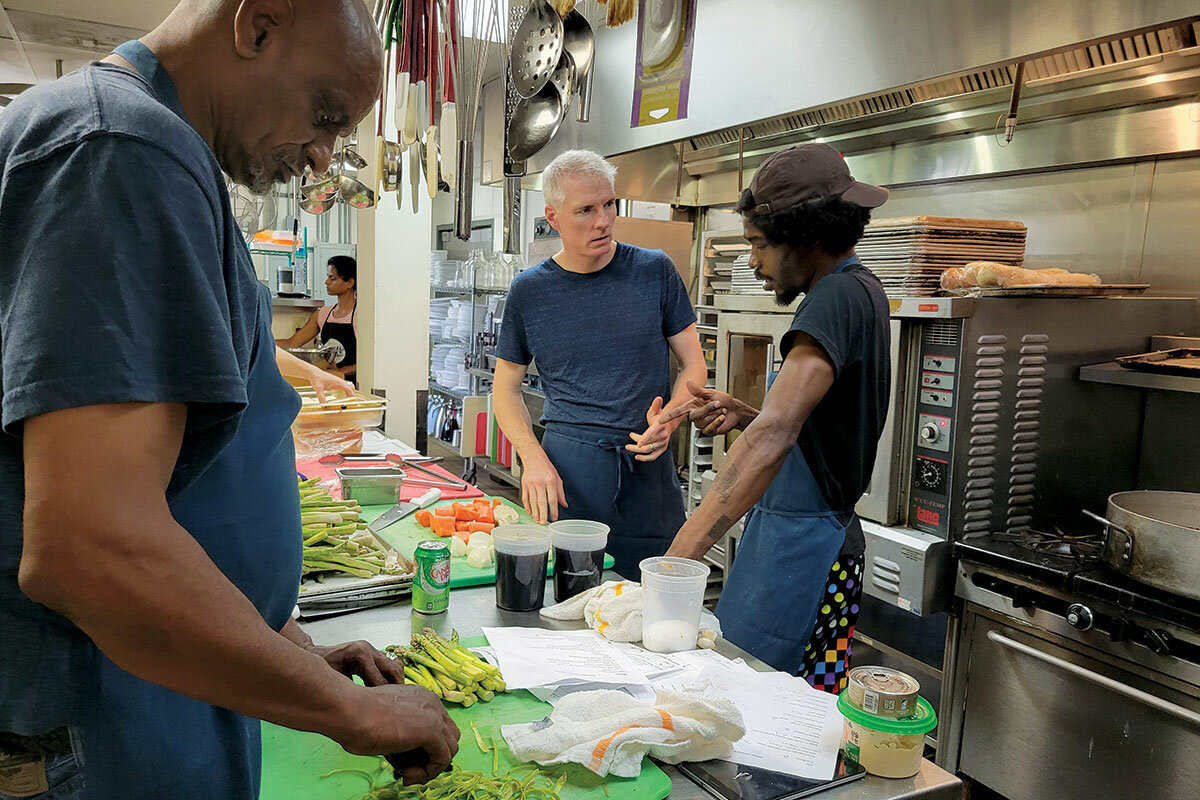
Chef Brandon Chrostowski (center) teaches trainees inside the kitchen for Edwins Too, one of his two French fine dining restaurants on the East Side of Cleveland.

When you take a wrong path in life, does it have to determine everything that happens later? At the Christian Science Monitor, Stephen Humphries writes about a chef who is making sure that some people are successful when they start over.

“Brandon Chrostowski is telling his origin story for probably the thousandth time. He’s pacing the stage of a local high school, holding his microphone with the confidence of a rock star. Mr. Chrostowski is a distinguished chef – he was a restaurateur semifinalist in the 2022 James Beard awards – and founder of a Cleveland restaurant with a philanthropic mission. Yet he’s ambivalent about all the acclaim. He’s tasted what it’s like to be stripped of dignity. At 18 he was arrested for fleeing and eluding the police. He and some friends had been in a car with drugs they intended to sell.

“ ‘I learned a lot of things. One, the dehumanization in the criminal justice system,’ he tells the students at Gilmour Academy. ‘Also, the idea of freedom. You don’t really know what freedom is until you lose it.’

“A lenient judge decided against sentencing him to prison. Mr. Chrostowski has never forgotten that he was fortunate not to serve a 5-to-10-year sentence. It’s the reason he launched Edwins Leadership & Restaurant Institute on Cleveland’s East Side. 

“What makes Edwins unique isn’t just its French cuisine, but its workers – they’re formerly incarcerated adults. Over six months, those in training learn skills for employment in the culinary world. More than that, Mr. Chrostowski tries to draw out a sense of self-worth in those who’ve served time by showing them how to attain excellence. 

‘The single hardest thing we have to do at Edwins is really build esteem in someone that has lost that, or that sense of humanity, through incarceration,’ says Mr. Chrostowski.

“Hours before giving his speech at the high school, Mr. Chrostowski strides into a kitchen where two trainees are singing along to a Bobby Womack tune on the radio. Tying a half apron around his waist, the chef quickly assesses a hunk of braised beef inside a pot as large as a bassinet. …

“As Mr. Chrostowski shares tips with Richie, he picks up a knife and demonstrates how to slice asparagus. In 2017, Edwins was the subject of an Oscar-nominated short documentary titled Knife Skills. …

“Abdul El-Amin enrolled in the program in June after being incarcerated for 20 years. ‘When you come here, it is sincere. You’re welcome. You can feel it,’ he says after his first two weeks of training. He adds, ‘I’m seeing so many other opportunities that I didn’t think about when I was incarcerated.’

“That’s not to say the program isn’t demanding. Over 2,000 people have trained at Edwins since its opening in 2013. Of those, only 600 have graduated because most drop out, often within the first two weeks. (They’re always welcome to reapply.) The program boasts a 95% employment rate for its alumni, and fewer than 1% of graduates are re-incarcerated. Star pupils have gone on to work in restaurants across America and even in France.

“ ‘[Mr. Chrostowski] really doesn’t care what walk of life you’re from, who you are, what you’ve done,’ says William Brown, a staff member at Cleveland’s Community Assessment & Treatment Services, a rehabilitation organization that enrolls promising individuals in the Edwins program. ‘He wants to see you succeed. And he will go the extra mile.’ 

“Mr. Chrostowski has a hectic daily schedule. During peak restaurant rush hours, the chef admits to hurling pans in frustration, but they’re not aimed at anyone. … He pursues the exacting standards he learned as an apprentice at restaurants such as Charlie Trotter’s in Chicago, Le Cirque in New York, and Lucas Carton in Paris. He rose fast. But he’s never forgotten his first break. In the late 1990s, a Detroit chef named George Kalergis took him in while he was still on parole. 

“Years later, Mr. Kalergis called from Detroit with bad news. A man named Quentin, who’d learned the rudiments of restaurant cooking alongside Mr. Chrostowski, had been stabbed to death. …

“ ‘I started to think, “How is it possible I’m here, and others are not?” ‘ says Mr. Chrostowski. … He wanted to help others, just as Chef Kalergis had helped him. But it took another decade of working in restaurants – including a move to Cleveland in 2008 – before he was able to raise the money to fulfill his vision.

“Mr. Chrostowski came up with the name, which is shorthand for ‘Education wins.’ Edwin is also the chef’s middle name. A few years after moving to Cleveland, he opened his restaurant in a historic, racially diverse area called Shaker Square. In 2020, he expanded by opening a second restaurant, Edwins Too, on the opposite side of the town’s leafy square. He’s also launched a French bakery and a butchery. The expansions have helped the area become a dining destination. 

“Just off the main street in Shaker Square, Mr. Chrostowski proudly shows off his latest project, which will become a child care center. ‘We’ve raised about $250,000 for a family center or day care,’ he says. ‘Free day care for staff and students, because 80% of our students with children don’t finish. It’s a big number and we want to change that.’

“The chef also wants to help outside Ohio. In April he traveled to his ancestral home of Poland to cook for refugees fleeing Ukraine. He’s also created a 30-hour curriculum and distributed it on 400,000 tablets to prisons in the United States. Dee and Jimmy Haslam, co-owners of the Cleveland Browns football team, will pay for transportation for anyone in the U.S. who completes the virtual instruction and applies to join the Edwins program.”

More at the Monitor, here.

Read Full Post »

Photo: Metro Arts
This
student is engaged in a restorative justice program that uses the arts to reach young offenders. Cecilia Olusola Tribble, Community Arts Coordinator of the Metro Nashville Arts Commission, says, “We have been able to work and watch miracles happen every day.”

My friend Diana was the first to explain to me the concept of restorative justice, and I wrote about it here. The idea is to bring a young perpetrator and his or her victim together, if the victim is willing, to learn about the effects of the crime and make restitution. When the process works, the young person turns aside from wrongdoing and keeps a clean record. Today I have a story about how the arts can be part of a restorative justice outreach to youth who are already incarcerated.

Cecilia Olusola Tribble writes at ArtsBlog, “The purpose of the Restorative Justice + the Arts program is to enable artists and arts organizations to provide dynamic program opportunities for youth and families who have interacted with the criminal justice system. Our aim is to equip teaching artists with the tools they need to bolster their practice in ways that lead youth toward productivity, resiliency, and well-being.

“In 2016, photographer and musician Nduka Onwuzurigbo heard about the transformation happening in the juvenile justice system and wanted to create a project with the youth in the detention center.

“Since her election in 2014, Judge Sheila Calloway has been restructuring the juvenile justice system in Metro Nashville/Davidson County to include resources to divert children and families in trouble, providing them creative paths toward a better, brighter, and more productive future. …

“[She] mobilized her team to make sure the children in the detention center were able to participate in the photography project. As that singular project was seeing success with the youth who were incarcerated and had a positive community response, Metro Arts in Nashville approached the judge about establishing an ongoing partnership. Since then, Metro Arts and the Juvenile Court in collaboration with the Oasis Center have been able to build the Restorative Justice + Arts program.

“It costs roughly $88,000 to incarcerate one youth for a year in Nashville. For the same amount of money, we have been able to pitch, build, and pilot the Restorative Justice + Arts program. …

“To start the program, Metro Arts held focus groups with our artist community, grantees, arts educators, and other stakeholders. … Next, Metro Arts spent time in the various departments in Juvenile Court. The focus in the court is in the process of shifting from solely emphasizing penalty to giving children and parents the tools to restore healthy relationships and communities. Judge Calloway has explained Restorative Justice in the following way:

‘Restorative Justice moves the conversation from “Who did the crime & what do they deserve?” to “Who has been harmed?”, “What are their needs?” [and] “Whose obligation is it to fix their harm?” ‘ …

“In FY 2018, the artists have been able to serve 424 youth who have been incarcerated, had other involvement with the court, or who are deemed at-risk due to poverty, school attendance, neighborhood crime, poor school performance, or living in an area where fresh food is scarce. …

“It is because of the partnership between multiple government agencies, youth-centered organizations, arts organizations, and artists that we have been able to work and watch miracles happen every day. We have witnessed youth leaving the detention center and seeking out their yoga and dance teacher. … We have watched the miracle where former gang members admit to shooting at each other, but theater and painting classes have bonded them together as brothers with arms entangled. Our hearts are full at experiencing young folks arguing with the characters of an August Wilson play to make a better choice. …

“This spark came from one artist who asked the question and made the difference.” One and one and 50 make a million. More here.

Read Full Post »

When people are serving time for a crime, how much better for society — both during their sentence and after they get out — if they have some useful work while inside.

Patricia Leigh Brown writes at Atlas Obscura, “Justin King spends most of his hours in a cinderblock dormitory room for minimum-security prisoners, sleeping on a metal bunk bed and being constantly monitored by surveillance cameras.

“But on a crisp California morning with coastal fog hanging on the hillsides, King, who is serving time for selling methamphetamines, and three of his fellow inmates at the Mendocino County jail huddle together in a 175-acre vineyard to pick plump sangiovese grapes. The only visible difference between the prisoners and the other field workers are the GPS tracking devices wrapped around their ankles.

” ‘Hey dude!’ King, 32, called out to his fellow inmate, Meliton Rangel, as King eyed a promising group of clusters wet with dew. ‘I hit clump city here!’

“The men’s enthusiasm for grapes with just the right sugar levels and tannins is a variation on the concept of work release, in which inmates deemed low security risks are employed by private companies. …

” ‘They’re hard workers,’ [Vineyard owner Martha] Barra says of her new employees, who wear “civilian” clothes in her magazine-esque vineyard. ‘They have to meet the same punctuality and performance requirements as everybody else.’ …

“The work is notoriously grueling: At first, Rangel, a stiff-legged 37, said he was going to quit. That changed when he received his first paycheck—his first one ever. ‘This has really helped me out,’ he says. ‘It feels very good to work.’ …

“In the Mendocino program last year, four of the six inmates who worked on the grape crew at Redwood Valley Vineyards have indeed stayed out of jail. Three now have full-time jobs. One now works at the vineyard full-time, rebounding from tough years of drug addiction and homelessness. …

” ‘There’s peace of mind out here,’ King says.”

More here.

Photo: Olivier Vanpé /Wikimedia Commons
Clusters of ripe and unripe Pinot noir grapes.

Read Full Post »