Feeds:
Posts
Comments

Posts Tagged ‘indigenous’

Photo: Peter Ellzey.
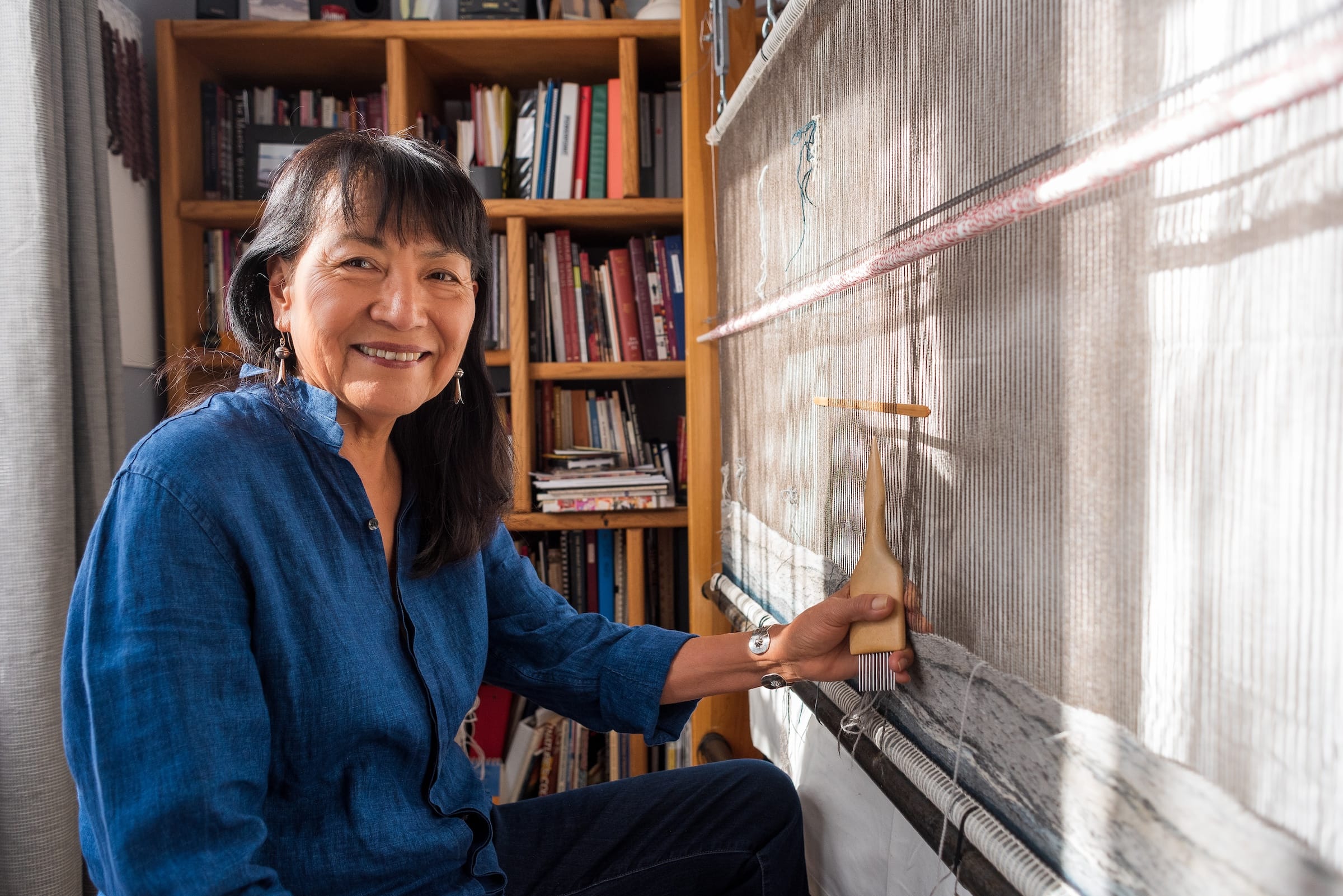
DY Begay in her weaving studio in Santa Fe, New Mexico, in 2022.

Traditions often gain strength and durability when the spirit behind them is reinterpreted through a new generation’s sensibilities. A case in point: the way the weaving and dyeing of Diné artist DY Begay has enriched a traditional Navajo craft.

Sháńdíín Brown and Zach Feuer at Hyperallergic recently interviewed the artist.

They write, “For over four decades, artist DY Begay expanded the expressive range of Diné (Navajo) weaving, transforming the form into a language that is entirely her own. She is a Diné Asdzą́ą́ (Navajo woman), born to the Tótsohnii (Big Water) clan and born for the Táchii’nii (Red Running into Water/Earth) clan. Her maternal grandfather is of the Tsénjíkiní (Cliff Dweller) clan and her paternal grandfather is of the Áshįįhí (Salt People) clan. 

“Begay is a fifth-generation weaver who was raised in Tsélání (Cottonwood) on the Navajo Nation, where her family’s sheep flock still resides. Rooted in Diné Bikéyah (Navajo homelands) — from the cliffs of Tsélání to the horizon of the Lukachukai Mountains — her work reflects the blended hues of sunsets, mesas, and mountain ranges, while her use of wool from her family’s flock and natural dyes binds her practice to the land she seeks to honor and protect.

“After graduating from Arizona State University in 1979, Begay moved to New Jersey and immersed herself in the fiber art world of New York City. She studied historic Diné textiles at the Museum of the American Indian, whose collections later became part of the Smithsonian’s National Museum of the American Indian (NMAI). Most of these pieces were created by Diné weavers whose names were not recorded, likely women. She also took inspiration from the work of artists such as Anni Albers, Sheila Hicks, and Lenore Tawney — all of whom trained in modern Western traditions yet studied Indigenous weaving practices. …

“When she returned to Tsélání in 1989, her grandmother, Desbáh Yazzie Nez (1908–2003), saw her weavings and urged her to develop her own compositional sensibility. Begay quickly gained recognition at the Heard Museum Guild Indian Fair and Market as well as the Santa Fe Indian Market, yet she felt restless in her practice. By 1994, that questioning crystallized into a breakthrough: She began developing color hatching, a method of creating subtle gradations and nuanced color interactions that transformed the solid, banded designs of conventional Diné weaving. …

“In August, Begay spoke with us over Zoom from her home in Santa Fe. The interview has been edited and condensed for clarity.

Sháńdíín Brown and Zach Feuer
“In Sublime Light: Tapestry Art of DY Begay, the first book dedicated to you and your recent retrospective at the NMAI, you write about watching your mother and grandmother weave in the hogan. …

DY Begay
 “I don’t remember the very first time I picked up weaving tools and set a loom on my own. I was very young. I do remember standing behind my mother’s loom, watching her pull colored yarns over and around the warps. Her fingers moved swiftly in and out, pressing the wefts into place. Within minutes, geometric shapes stacked and formed into the outline of a Ganado-style weaving. At that age — maybe four or five — I could not quite comprehend how those shapes came together. I was always perplexed and in awe. Everything happened so fast in front of me as her hands composed lines and rows of colored yarn. 

“I grew up surrounded by weavers: my maternal grandmother, my mother, and my aunts. Someone was always at the loom, often positioned in a very central place inside the hogan. And we lived in the hogan when I was growing up, and everybody else did too.

“I watched my mother create stepped patterns with hand-dyed yarns, moving with precision and grace. Teaching came through showing. It was a physical action. The word that I always remember, and is still used today, is kót’é — ‘like this.’ My mother said ‘kót’é, kót’é.’ …

SB & ZF
“Do you remember the moment when you first began weaving yourself — whether your family set up a loom for you or you started working on theirs?

DB
“I was very curious. I tried to hold my mother’s tools, but they were too big for my hands. … Eventually, she allowed me to sit with her once in a while and said ‘kót’é, kót’é.’ I began to get used to the natural action of tapping with the combs. I was about eight years old when I had my own loom. I don’t remember its size. My mother prepared the warp and I used leftover yarn from her bin. I do remember finishing my first weaving, maybe two colors. It was pretty decent for a first attempt. It was a good learning situation because my mother was there. She would sometimes unweave certain parts and we would go on. …

“Most finished weavings, maybe two by three or three by three feet, and some saddle blankets, were taken by my father and my grandfather to the local trading posts to exchange for food, fabric, or whatever was needed. My mother never went to the trading post herself — we didn’t have a vehicle then, so transportation was by wagon or horses. They would roll up the weavings, pack them, and take them to the trading post. …

“In weaving ‘Pollen Path,’ I wanted to share a cultural belief. Among the Diné, we sprinkle corn pollen to honor a new day, to seek blessings, and to bring balance into our lives. Corn itself is a sacred plant. The pollen is collected in late summer, when the tassels of the corn begin to pollinate. We gather it in the early morning, just before the sun rises. For me, ‘Pollen Path’ reflects peace, beauty, and gratitude for life.

“The project began in the summer of 2007, a very good year for growing plants that I use in dyeing my wool. My sister, Berdina Y. Charley, planted local corn seeds she received from our Táchii’nii (Red Running into Water/Earth) relatives. I believe these were heirloom seeds from our Táchii’nii family. …

SB & ZF
“How do you translate the experience of walking in beauty, through the landscapes of Diné Bikéyah (Navajo Country) and more specifically your home of Tsélani (Cottonwood), into the two-dimensional form of weaving?

DB
“Not only do I have my Tsélani landscape embedded in my mind, but I frequently photograph the surrounding textures at various times of the day to capture different lighting as it reflects on the terrain. …

SB & ZF
“Can you tell us about your color palette and the process of dyeing the wool? Is it essential for you to use and make dyes that are from the earth?

DB
“I have been practicing and experimenting with natural dyes for quite a while, and I love using local plants to create my color palette. It is both essential and traditional in my culture to use what the earth provides to create dyes for our yarn.

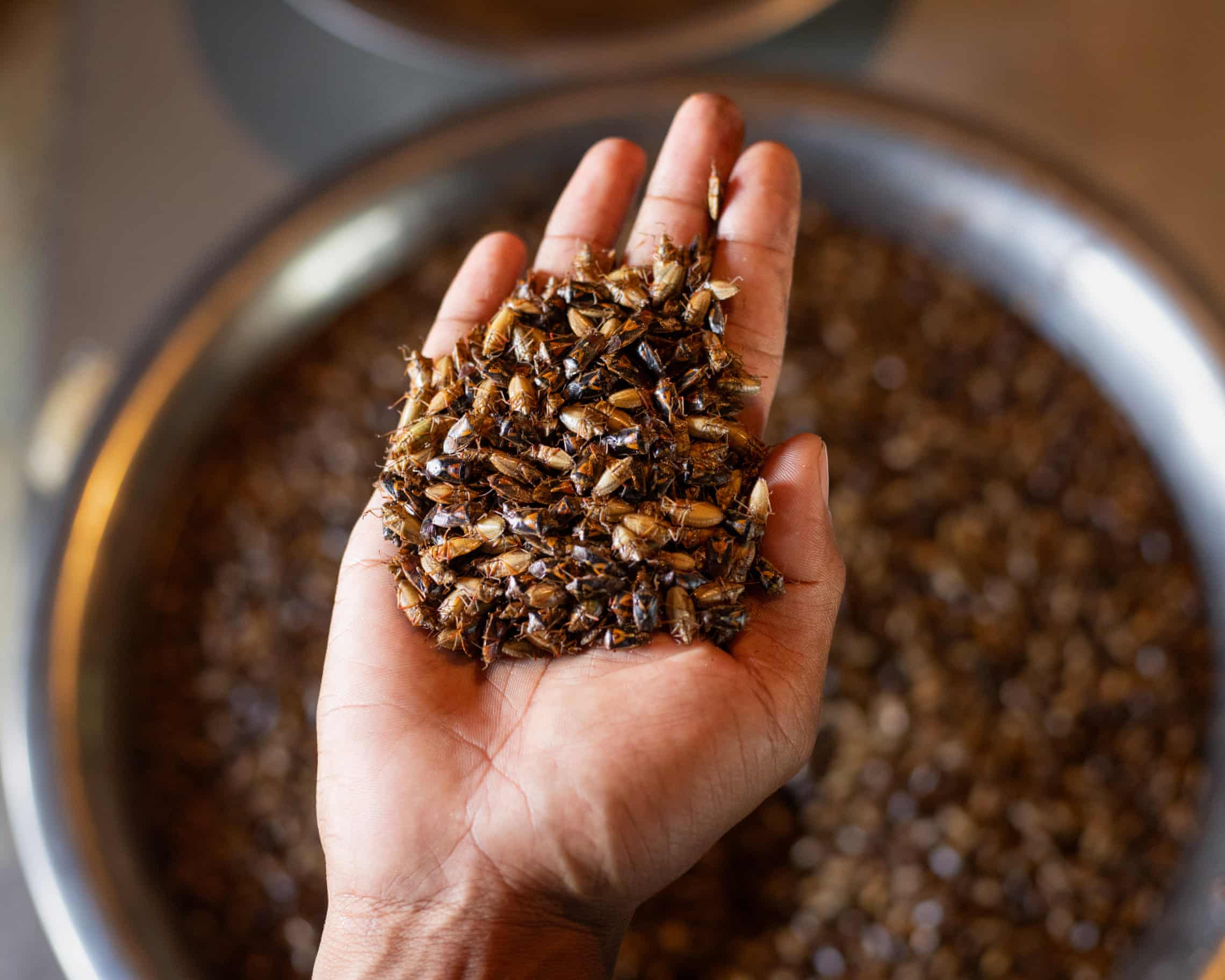
“My palette comes from many sources. I work with common plants such as cota (Navajo tea), chamisa, rabbitbrush, and sage. I also use non-native materials like insects, fungi, foods, and flowers. Each has its own season, and I collect plants according to the time of year.

“The process itself is an experiment every time. I’ve studied many dyeing methods and learned to be attentive to formulas that help obtain and preserve the colors. For me, making dyes from the earth is not only practical but also deeply connected to tradition and creativity.”

More at Hyperallergic, here. No paywall. Subscriptions encouraged.

Read Full Post »

Photo: Emily Mesner/Anchorage Daily News.
Lenora Ward, general manager at KOTZ radio station, listens to a 2022 dog-sled musher interview while on-air at the station in Kotzebue.

Few places in the US rely more heavily on public radio than Alaska. That is why people who care about Alaska rushed to bridge the gap after the current Congress decided public radio is not needed.

Iris Samuels reports for the Anchorage Daily News, “An Alaska fund has raised $3.5 million as it seeks to replace federal funding rescinded by Congress for public radio and television stations.

“Amid fundraising efforts, station leaders say they are already beginning to cut some programming. …

“Congress in July voted to rescind $1 billion in federal funding for public media across the country. … Two of Alaska’s three-member congressional delegation voted in favor of the rescission, which eliminated roughly $15 million intended for more than two dozen stations in Alaska. …

“Sen. Lisa Murkowski was one of a few Republicans in Congress who attempted to salvage the federal funding that Congress members themselves had approved last year, pointing to its importance in alerting Alaskans to natural hazards like tsunamis, earthquakes and fires.

“In a recent call hosted by a coalition of Alaska public radio and television stations, PBS President Paula Kerger said that Alaska is at the forefront of national fundraising efforts intended to — at least temporarily — supplant federal funding with money from private donors and foundations. …

“Kerger said she was ‘deeply grateful to Sen. Murkowski, who really fought for us more than any other member of Congress.’

Alaska stations banded together in the days following the July rescission vote to, with the Alaska Community Foundation, establish the Voices Across Alaska Fund, which in its first two months raised more than $3.5 million.

“The funds came from 80 donors, which include individuals, corporations and foundations in Alaska and in the Lower 48, according to Alaska Community Foundation spokesperson Ashley Ellingson. The funds will be disbursed to stations [based] on stations’ needs, Ellingson said. …

“Alaska Public Media President Ed Ulman said that since the rescission, new donors have begun giving, or existing donors have upped their contributions. …

“Funds will be distributed to Alaska stations, which are also independently fundraising, several station managers said in recent days. Even as they have pivoted to fundraising efforts, the station managers reported making several targeted cuts to their programming in response to the loss of federal funding.

“Alaska Public Media, the state’s largest public station, has paused Alaska Insight, a television news program that was broadcast across the state. Ulman said Alaska Public Media has also cut its education programming and is considering cutting Debate for the State, a program that features candidate forums for statewide offices. …

“Gretchen Gordon, general manager of KUAC, a station serving Interior Alaska, said the station has cut overnight broadcasting, eliminated some national radio programs and lost television service in Nenana in response to the federal funding cut. Gordon said KUAC is ‘determined to find ways to restore lost programs and services.’

“Kristin Hall, general manager at KYUK, which serves Bethel and the Yukon-Kuskokwim Delta, said the station lost $1.2 million in federal funding, and could eliminate more than half its staff by the end of the calendar year.

“Justin Shoman, president and general manager of KTOO, said the Juneau-based station may need to adjust its coverage of the Legislature. Gavel Alaska, a live-streaming service for legislative hearings, press conferences and trial hearings, costs more than $1 million annually to run and receives no state funding, Shoman said. Until the rescission, federal funding made up more than a third of KTOO’s annual budget. …

“The federal funding cut comes after a yearslong refusal by Gov. Mike Dunleavy to spend state dollars on public media. Starting in his first year as governor, he repeatedly vetoed funding intended for public radio stations. This year, the Legislature did not fund the grants for public radio in the budget. …

“ ‘It’s not lost on many of us that the Legislature has every single year put in funding, in particular for rural public radio,’ said Ulman. ‘And yet, there is one individual who has the power of the veto who exercises that veto and goes against — I’m just going to say it — the will of the people.’

“When Begich, Alaska’s lone U.S. House member, voted in June to claw back federal funding for public media, he reasoned that public broadcasting was no longer essential because Alaskans now use ‘pervasive cellular, satellite, and wireline technologies.’

“But Gordon, with KUAC, said many Interior residents do not have access to broadband internet. … ‘Our lawmakers need to understand that a little better,’ she said.”

Will the new fundraising levels last? Only time will tell. More at the Anchorage Daily News, here. And do read about how an Alaska public radio station saves lives, here.

Read Full Post »

Photo: Jaida Grey Eagle via MPR News.
Among her many accomplishments, Twin Cities-based author Marcie Rendon writes a mystery series about indigenous investigator Cash Blackbear. 

I read a lot of mysteries, and I gravitate toward those about different cultures, often outside North America. But indigenous cultures here are equally foreign to me, which is why I have enjoyed Marcie Rendon’s Cash Blackbear series, about a tough young Ojibwe woman who investigates crimes against members of Upper Midwest tribes, often women.

I have several articles here for you to click on if interested, but I’m going to focus on what the Minnesota-based McKnight Foundation said about Rendon when they gave her an award.

“The McKnight Foundation is pleased to announce the selection of Marcie Rendon for its 2020 Distinguished Artist Award—a $50,000 award created to honor a Minnesota artist who has made significant contributions to the state’s cultural life. Rendon, an enrolled member of the White Earth Nation, is a writer whose poems, plays, children’s books, and novels explore the resilience and brilliance of Native peoples.

“ ‘Marcie brings a strong and necessary voice to so many genres,’ said Pamela Wheelock, McKnight’s interim president. ‘She has created a tremendous body of work, including poetry, plays, lyrics, and award-winning crime novels, all while raising up other Native voices in our community. Her commitment to making art in community embodies what a distinguished artist means to Minnesota and to McKnight.’ …

“A gifted storyteller and prolific writer, Rendon is the author of the award-winning Cash Blackbear mystery series, set in Minnesota’s Red River Valley. The first novel in the series, Murder on the Red River, earned the 2018 Pinckley Prize for Debut Novel, and the second, Girl Gone Missing, was nominated for the Mystery Writers of America – G. P. Putnam’s Son’s Sue Grafton Memorial Award. Rendon … is also the author of four nonfiction children’s books, including Powwow Summer (Minnesota Historical Society Press, 2013).

“Rendon’s plays include Sweet Revenge, chosen for the Oklahoma Indigenous Theatre Company’s 2020 New Native American Play Festival. She has also curated and produced a variety of Native-focused performances at the History Theatre, the Minnesota Fringe Festival, and Patrick’s Cabaret. She is the founder of Raving Native Theater, a platform that brings voice and visibility to other Native American artists and performers.

“ ‘We are more resilient than we are traumatized,’ said Rendon. ‘Art keeps us thriving, not just surviving. I try to make room for other Native artists. Every time someone steps forward, it makes room for others to step forward.’ …

“Rendon’s poem ‘Resilience’ is also included in US Poet Laureate Joy Harjo’s digital project ‘Living Nations, Living Words: A Map of First Peoples Poetry,’ which will join the permanent collection of the American Folklife Center at the Library of Congress.

“Rendon’s awards include a 2020 Ensemble/Playwright Collaboration Grant from the Network of Ensemble Theaters and the Playwrights’ Center, and a 2020 Covid-19 artist grant from the Tiwahe Foundation for demonstrating resilience during the pandemic. Rendon was named a 2018 50 Over 50 honoree by AARP Minnesota and Pollen Midwest and received Loft’s 2017 Spoken Word Immersion Fellowship with poet Diego Vazquez. …

“Said Sandy Agustin, a member of the Distinguished Artist Award selection committee, ‘Whether she is writing about boarding schools, incarceration, or the epidemic of missing and murdered Indigenous women, she is nurturing Native voices and amplifying communities that are too often unheard, especially Native women.’

“Born in northern Minnesota in 1952, Rendon was a voracious reader, creative writer, and poet from an early age. While studying criminal justice at Moorhead State College in the early 1970s, she was part of a group of Native student activists who successfully demanded the launch of the university’s first American Indian studies department.

“After moving to the Phillips neighborhood of Minneapolis in the late 1970s, she worked as a counselor and therapist, while raising her three daughters. In 1991 she saw a performance by Margo Kane, a Cree-Saulteaux artist, that inspired Rendon to share her own poetry and writing with a wider audience. …

“She is currently collaborating with artist Heather Friedli on an upcoming installation at the Weisman Art Museum about the high rates of incarceration among Native women.”

I have read most of the Cash Blackbear books (there’s a new one just out), and I find the urgent educational energy of the series both its strength and its weakness. Rendon feels empowered by a need to educate unenlightened readers like me, and I appreciate what she’s doing. After all, injustices continue and indigenous women in particular still disappear at an intolerable rate. I’ll just say that sometimes the mission overwhelms a good yarn.

More at the McKnight Foundation, here. See also Minnesota Public Radio, here, and Visual Collaborative, here.

Read Full Post »

Photo: Larry Price/The Guardian.
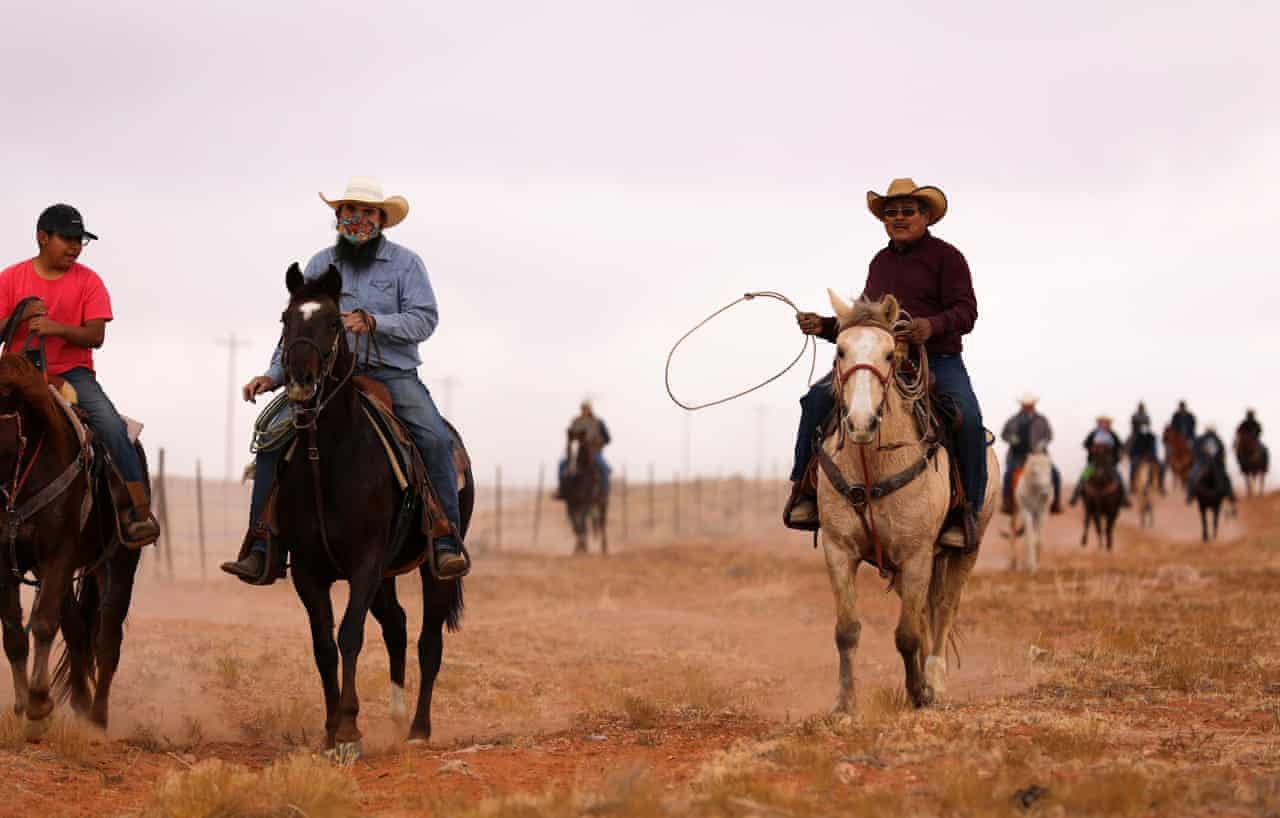
Diné voters ride on horseback through the Navajo Nation to the polls in 2020. Allie Young, a Diné grassroots organizer, started the Ride to the Polls campaign.

Elections never stop being important, and next Tuesday, Nov. 4, will be a critical one in many parts of the country as we struggle to shore up democracy. Today we learn about how hard indigenous people sometimes work to get to the polls.

Melissa Hellmann wrote at the Guardian last year about Navajo people’s understanding of voting as an important way to protect the environment.

“In Diné, or Navajo, culture, the horse symbolizes strength and resilience, as well as a connection to the earth. Cowboy culture is so relevant to Native communities, that horseback trail rides are used to draw awareness to issues within the community including suicide prevention, and alcohol and drug use, said Allie Young, a 34-year-old Diné grassroots organizer. This fall, Young has harnessed the trail ride to engage Diné voters for the presidential election: her group’s voter-registration events will culminate with 100 Indigenous voters riding on horseback to a polling station in Arizona on election day. …

“Young, founder of the Indigenous-led civic engagement program Protect the Sacred, told the Guardian. ‘[When] we’re connected with the horse, we’re then reconnected to Mother Earth and reminded of our cultural values and what we’re fighting for, what we’re protecting.’ …

“Political representation that brings needed resources into Native communities is particularly important on tribal lands, where 75% of roads remain unpaved. …

“Young said she hopes that the success of the Ride to the Polls campaign in 2020 and 2022 will encourage ‘the greatest Native turnout ever’ in the upcoming election. This year, the campaign has extended its reach with events such as skateboarding and bull-riding competitions, heavy metal and country music concerts.

“ ‘We’re trying to communicate to our community that we need to protect our tribal sovereignty,’ said Young, ‘and with that, protect our sacred sites, protect our lands, our cultures, our languages, our traditions.’

“Young launched the Ride to the Polls campaign in 2020 in response to the rapid spread of Covid-19 infections in the Navajo Nation, where some counties saw the highest death rates per capita in the nation. She wanted to ensure that her community filled out the US census to receive the funding they deserved and to elect politicians who prioritize the concerns of Native communities.

“ ‘Our nation and many tribal nations across the country were devastated by the onset of Covid-19 because our system is being chronically underfunded,’ said Young, ‘which revealed to the rest of the world what we already know: that the government is not honoring our treaty, which says that we are to receive good healthcare and education.’ She began creating culturally relevant initiatives so that young Diné citizens who felt disenfranchised would see voting as a tool to ‘rebuild our power as a community.’ …

“So far, they have registered 200 new voters and checked or updated the registrations of about 400 people.

“On 12 October, the actor Mark Ruffalo will join Ride to the Polls to help mobilize Native voters and to mark the 100th anniversary of Native Americans being granted the right to vote. …

“ ‘Indigenous people have only been able to fight for their future at the ballot box for 76 years,’ Ruffalo said in a statement. ‘Now we’re seeing a massive movement of young Indigenous folk exercise their power at the polls.’ …

“All Native Americans were finally granted the right to vote under the federal voting rights act of 1965. Still, barriers have remained that make it difficult for Diné to register to vote and cast ballots, including a lack of residential addresses since many people on the Navajo Nation use post office boxes. It also can take up to an hour to drive to a polling location, said Young. And this summer, the US Supreme Court ruled that Arizona can enforce a state law requiring prospective voters to include proof of US citizenship in registration forms, which Young said was a ‘slap in the face to Native Americans, who are the first peoples of this land, to be asked to prove their citizenship.’

“To help address some of those hurdles, Protect the Sacred is partnering with the Indigenous-led voter-engagement non-profit Arizona Native Vote. Indigenous organizers register voters and help residents find their addresses by locating their houses on Google Maps. ‘A key talking point when we talk to voters is letting them know that voting and registering to vote should not be this hard,’ Jaynie Parrish, executive director of Arizona Native Vote, said. …

“During a six-stop trail ride to register Diné citizens throughout the Navajo Nation in mid-September [2024] indigenous organizers discussed with voters the importance of casting ballots in every election. They served citizens stew and frybread while explaining to them that county elections can determine how local government operations are funded. Young said: ‘I believe that we started a movement around the power of the Native vote.’ ”

And so, they voted. We know what happened in 2024, and we know what has been happening to environmental protection since then. But every election counts in moving the needle back toward the people. So, please vote on Tuesday and at every election in the future.

More at the Guardian, here.

Read Full Post »

Any one change has a cascading effect, and for tribes’ radio stations, the recent change to Corporation for Public Broadcasting has posed an existential threat. More than music is involved here. It’s about keeping a culture alive.

Neel Dhanesha reports at Neiman Lab, “In the most remote parts of Alaska, staying in touch can involve a bit more effort than sending a text. Cell service is spotty, highways are nonexistent, and the postal service remains a vital lifeline, delivering supplies and mail by plane. But for anyone who wants to broadcast a different kind of message — a reminder to pick up milk, for example, or birthday wishes — there’s always the Muktuk Telegram.

“Named for a traditional food of whale skin and blubber, the Muktuk Telegram (also called the Mukluk Telegraph, after a phrase referring to how gossip spreads in Alaska) is sort of like an amplified shout: Someone calls into a radio station with a message, and it gets broadcast on their airwaves so that anyone in range with a radio tuned to the right frequency will hear it. Usually, the radio station broadcasting the Telegram is one of the fifteen tribal radio stations in Alaska. But now, after Congress took away $9.4 billion in previously allocated public media funding and the Corporation for Public Broadcasting (CPB) subsequently announced it will shut down, the future of those stations, the Telegram, and tribal public media across the country is up in the air.

“ ‘Stations are trying to figure it out,’ said Jaclyn Sallee, president and CEO of KNBA, a tribal radio station in Anchorage, and Koahnic Broadcast Corporation, which produces shows that are distributed to tribal radio stations across the country. …

“Indigenous radio and television stations are unique in the landscape of American media. While many are part of the NPR and PBS networks, they are mostly staffed by Indigenous reporters and producers and primarily serve audiences in tribal nations around the U.S., many of which lack broadband or cell service. According to Native Public Media, an NPR-like network for tribal stations, there are 57 tribal radio and 3 tribal television stations in 20 states in its network across the country, and most if not all of them received CPB funding before the rescissions package passed.

“ ‘When a Tribal station goes dark, the silence is more than technical,’ said Loris Taylor, president and CEO of Native Public Media, in an emailed statement to Nieman Lab. ‘These stations are not just media outlets, they are cultural infrastructure. … Without these stations, many Tribal citizens, especially elders, low-income families, and those without broadband, would lose essential access to news and public discourse.’

Among the essential services at risk are emergency alerts, which are particularly crucial in areas with gaps in cellular coverage.

“At particular risk is the Missing Endangered Persons Alert, a new type of alert similar to an AMBER alert that the Federal Communications Commission (FCC) adopted in August 2024 and that is set for national launch in September. According to the FCC’s website, ‘The MEP code could be particularly beneficial to Tribal communities, where American Indians and Alaska Natives are at a disproportionate risk of violence, murder, or vanishing.’ …

“Kathryn Squyres reported in Current, a spokesperson from Sen. Mike Rounds (R-S.D.) office explained that the Department of the Interior’s Bureau of Indian Affairs (BIA) will distribute $9.4 million of previously appropriated funding to 35 tribal radio stations in 11 states, which matches the amount those stations received from the CPB in fiscal year 2025. But it’s unclear what will happen after this year’s grants are dispersed, or to the 22 radio stations and nine states left out of that deal. …

“In an emailed statement, a spokesperson from the Department of the Interior wrote that ‘a transfer of previously appropriated federal funds allows Interior to support tribal communications infrastructure through targeted grants. Indian Affairs will administer these funds under established authorities. At this time, Indian Affairs anticipates awarding the first set of contracts by the end of Fiscal Year 2025 or early Fiscal Year 2026.’ It’s not clear where that funding is coming from, or whether other programs at the Bureau of Indian Affairs will be affected by the funding being reappropriated.

“It wouldn’t be the first time stations have been funded through the Bureau of Indian Affairs. Before the CPB was created in 1967, says Mark Trahant, who spearheaded the revival of ICT (formerly Indian Country Today), tribal stations received funding through the BIA for almost 40 years. Trahant, a member of the Shoshone-Bannock tribe of Idaho, said the funding Rounds claims to have secured is probably ‘a handshake. And I don’t think it’ll be anywhere near what’s being funded [through CPB] now.’ …

“If the DOI funding gets delayed for any reason [stations] may have to shut down. For now, said Sue Matters, station manager at KWSO, a tribal station on the Warm Springs Indian Reservation in Oregon, ‘everyone’s scrambling.’

“If stations disappear, Trahant said, he’s worried about what might fill the gap. …

“Trahant said. ‘To me, this is a question of who owns the airwaves. The great thing about CPB was that it set as a national standard that the public owns the airwaves, and they have an investment in that. I think that’s what’s really been missing from this debate.’ ”

More at Nieman Lab, here.

Read Full Post »

Photo: Danielle Khan Da Silva.
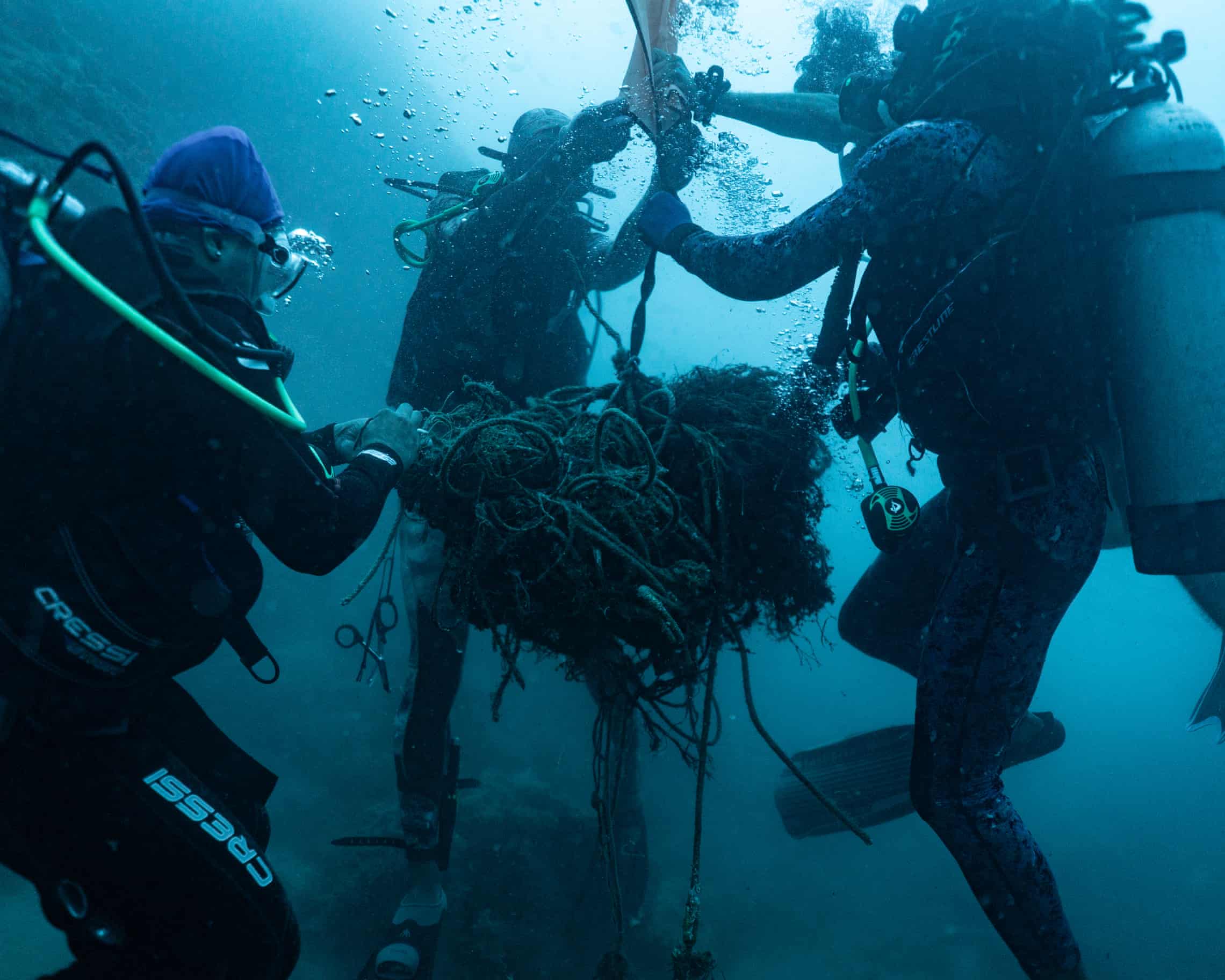
Divers risk their lives to protect whales from “ghost nets”
abandoned by fishermen.

Today’s article presents one of those impossible challenges pitting the environment against the need to make a living. In this case, it involves the ocean, specifically marine animals.

Danielle Khan da Silva has the story at the Guardian.

“After a day of scuba diving, Luis Antonio ‘Toño’ Lloreda was exhausted. Then a friend brought urgent news. ‘Toño, man, there’s a whale caught in a net out there.’ Lloreda, 43, had freed other, smaller wildlife from fishing nets but this would be his first marine animal of such size.

“The four- to five-meters-long juvenile humpback, accompanied by its mother, had a net studded with hooks wrapped around its fin and mouth. One wrong move could have been fatal for Lloreda or the whale.

‘To connect with the whale, I used what we call intuitive interspecies communication,’ says Lloreda, explaining that this involves non-verbal, energetic communication.

“ ‘I asked the mother for permission – energetically,’ he says. ‘At first, she didn’t want our help. But when I showed her we meant no harm, she let us in.

“ ‘She positioned herself below us. Then I asked the calf. When the calf became very still, I reached into her mouth and removed the net.’ The mother and calf swam for 50 meters before pausing to rest.

“Lloreda is one of nine Guardianes del Mar (Guardians of the Sea), a grassroots African-Colombian collective from six coastal communities around Colombia’s Gulf of Tribugá, a biodiversity hotspot on the Pacific coast that spans 600,000 hectares of ocean, forest and mangroves. The region, where dense Chocó rainforest meets the ocean, is a Unesco biosphere reserve and is designated a ‘hope spot‘ by the nonprofit organization Mission Blue for its ecological significance.

“Scuba diving is crucial for identifying and removing ghost fishing gear – lost or abandoned commercial nets made mostly of near-indestructible plastics – but it is prohibitively expensive. With sponsorship from Ecomares and Conservation International, Lloreda and his colleagues have trained not only in diving, but in removing fishing gear from coral with quick, precise and safe techniques.

“Many guardians double as coral gardeners and reef surveyors, collecting data for both their communities and scientific partners. Three, including Lloreda, are trained to free marine animals.

“According to WWF, 50,000 tons of fishing gear are lost or abandoned in the oceans globally each year. These ‘ghost nets’ drift across borders, ensnaring coral, turtles, sharks – and whales. In the Gulf of Tribugá alone, Guardianes del Mar estimates that 3-4 humpback whales become entangled each year. …

Guardianes del Mar is working to certify more local divers so they can have a greater impact. But it faces mounting logistical and financial hurdles.

” ‘We used to send the nets to Buenaventura for recycling, but fuel costs are too high,’ says Benjamin Gonzales, 53, one of the senior guardians. There are no roads – the communities are connected mainly by boat – so any rubbish or recycling must be transported out by boat or plane.

“Today, the nets are repurposed into bracelets and sold in Germany and locally in Nuquí, the main coastal municipality. Lead weights are melted down into new dive weights for the local shop, run by Guardianes del Mar advocate Liliana Arango.

“The spirit of mutual care between people and nature runs deep in Tribugá, where the population numbers about 7,000. African-Colombian communities here are descended from formerly enslaved people who escaped Spanish rule and crossed the jungle to reach the coast. They were welcomed by the Indigenous Emberá, and today co-govern the region through a state-recognized model of local autonomy. …

“Says Camilo Morante, 25, the youngest guardian and the group’s legal representative … ‘Everyone in this community fishes, so we can’t tell anyone to stop using nets. … The most important thing is that we raise consciousness locally so that we understand the consequences of our actions.’ “

More at the Guardian, here.

Read Full Post »

Photo: Jesse Casana.
Jonathan Alperstein, a researcher, excavates land on an unexpectedly large ancient agricultural site in Michigan.

The other day, my neighbor surprised me with a bunch of aerial photos of my New Shoreham place that were taken by her nephew’s drone. As drones are used more and more in warfare, I sure like thinking about the harmless and often useful things drones do.

In today’s example, a mystery revealed by drone led to a long-term collaboration between Menominee tribal members and non-Indigenous archaeologists in Michigan.

Nell Greenfieldboyce reports at National Public Radio (NPR), “Archeologists studying a forested area in northern Michigan say they’ve uncovered what is likely the largest intact remains of an ancient Native American agricultural site in the eastern half of the United States.

“The researchers used a drone equipped with a laser instrument to fly over more than 300 acres, taking advantage of a brief period of time after the winter snow had melted away but before the trees had put out their leaves.

“This allowed the drone to precisely map subtle features on the surface of the exposed ground, revealing parallel rows of earthen mounds. This is what’s left of raised gardening beds that were used to grow crops like corn, beans, and squash by the ancestors of the Menominee Indian Tribe of Wisconsin, in the centuries before European colonizers arrived.

“The mounds appeared to continue on beyond the surveyed area, the researchers say, showing agriculture at a surprisingly vast scale in a place that wasn’t a major population center.

” ‘We haven’t even been able to locate any significant settlement sites in this region. There’s a couple of tiny little villages,’ says Jesse Casana, a professor of anthropology at Dartmouth College and one of the authors of a new report in Science. ‘So it’s really shocking in this case to see this level of investment in an agricultural system that would require really enormous amounts of human labor to make happen.’

“It’s especially odd given the relatively poor growing conditions that far north, especially during a period of colder temperatures known as the Little Ice Age, as well as the presence of wild rice right nearby, says Madeleine McLeester, a Dartmouth anthropologist who led the research team. …

” ‘This astonishing paper shows how much we’ve underestimated the geographic range, productivity, and sustainability of intensive Indigenous agriculture across North America,’ says Gayle Fritz, an anthropologist with Washington University in St. Louis.

” ‘The study is outstanding in many ways, one being the long-term collaboration between Menominee tribal members and non-Indigenous archaeologists,’ she says — with the other being the combination of new technologies plus ‘old-fashioned, ground-based excavation and survey.’

“While some people may envision historical Native Americans as mostly hunter-gatherers or nomads, ‘that is very incorrect,’ says Casana. ‘By the time colonists arrived, what they were encountering were a lot of pretty sedentary communities all over North America who were practicing various forms of farming,’ he says. …

“The site mapped in this new study is part of Anaem Omot, which means the ‘Dog’s Belly’ in Menominee. It’s an area along the Menominee River on the border between Michigan and Wisconsin, and is of great cultural and historical significance to the Menominee tribe.

“The region contains burial mounds and dance rings. It’s also known to have agricultural ridges, ranging from 4 to 12 inches in height, because previous work back in the 1990’s had mapped some of them.

” ‘These features are really difficult to see on the ground, even when you’re walking around, and they’re difficult to map,’ says McLeester.

“That difficulty, plus concerns about proposed mining activities in the area, is why the research team — which included the tribe’s historic preservation director, David Grignon — wanted to see if new technology could reveal more acres covered with the earthen agricultural rows.

“McLeester says they thought they’d find some more rows, but also expected that others would have eroded away since the last mapping effort. …

“But the drone surveys revealed that the field system was ten times bigger than what had been previously seen. ‘Just the scale, I would say, was unexpected,’ she says. …

“Says Casana, ‘One of the interesting things about this study is that it kind of shows us a preserved window of what was probably a much more extensive agricultural landscape.’ …

Susan Kooiman of Southern Illinois University, an expert on the precontact Indigenous peoples of Eastern North America, says … ‘To find intact, ancient indigenous agricultural fields in any state, at any level, is very rare. …

” ‘The amount of work, and just how far these fields extend, is beyond anything that I think people suspected was going on this far north in eastern North America,’ she says. … ‘The question now is, what are they doing with all this stuff they were growing?’ “

More at NPR, here. (NPR is struggling since the massive federal cut. Help them out here if you can. No amount too small.)

Read Full Post »

Photo: Dani Anguiano.
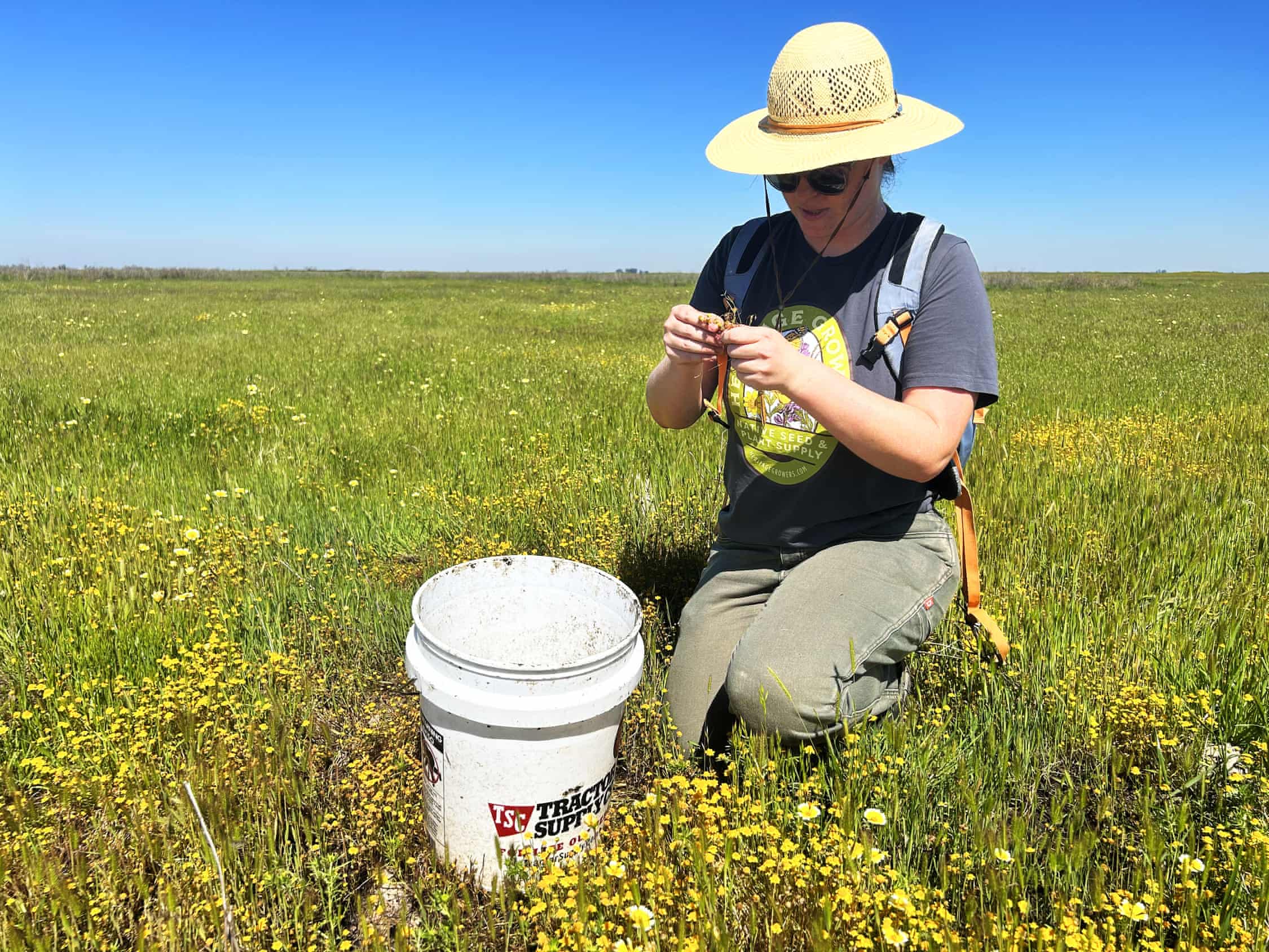
Haleigh Holgate, seed collection manager at Heritage Growers, inspects a seed in the San Luis national wildlife refuge complex on March 2025. Only the correct species will do.

I have blogged about seed banks in various countries (search on “seed bank”), and particularly about the global one that will keep seeds safe forever — if it stays frozen.

Today we learn what’s going on in California, where Heritage Growers is focused on local flora.

Dani Anguiano reported at the Guardian, “Deep in California’s agricultural heartland, Haleigh Holgate marched through the expansive wildflower-dotted plains of the San Luis national wildlife refuge complex in search of something precious.

“She surveyed the native grasses and flowering plants that painted the Central valley landscape in almost blinding swaths of yellow. Her objective on that sweltering spring day was to gather materials pivotal to California’s ambitious environmental agenda – seeds. …

“As a seed collection manager with the non-profit Heritage Growers native seed supplier, Holgate is tasked with traveling to the state’s wildlands to collect native seeds crucial for habitat restoration projects.

“The need has become particularly acute as California aims to conserve 30% of its land by 2030, with the governor pledging to restore ‘degraded landscapes’ and expand ‘nature-based solutions’ to fight the climate crisis. …

“But the rising demand for seeds far outpaces the available supply. California faces an ‘urgent and growing need’ to coordinate efforts to increase the availability of native seeds, according to a 2023 report from the California Native Plant Society. There simply isn’t enough wildland seed available to restore the land at the rate the state has set out to, Holgate said.

“Bridging the gap starts with people like Holgate, who spends five days a week, eight months of the year, traveling with colleagues to remote spots across the state collecting seeds – an endeavor that could shape California’s landscape for years.

“That fact is not lost on the 26-year-old. It’s something she tries to remind her team during long, grueling, hot days in the oilfields of Kern county or the San Joaquin valley. …

“Seeds play a vital role in landscape recovery. When fires move through forests, decimating native species and leaving the earth a charred sea of grey ash, or when farmlands come out of production, land managers use native seeds to help return the land to something closer to its original form. They have been an essential part of restoring the Klamath River after the largest dam removal project in US history, covering the banks of the ailing river in milkweeds that attract bees and other pollinators, and Lemmon’s needlegrass, which produces seeds that feed birds and small mammals.

“California has emphasized the importance of increasing native seed production to protect the state’s biodiversity. … Three-quarters of native vegetation in the state has been altered in the last 200 years, including more than 90% of California wetlands, much of them here in the Central valley.

“For the state to implement its plans, it needs a massive quantity of native seeds. … Enter Heritage Growers, the northern California-based non-profit founded by experts with the non-profit River Partners, which works to restore river corridors in the state and create wildlife habitat.

“The organization takes seed that Holgate and others collect and amplifies them at its Colusa farm, a 2,088-acre (845-hectare) property located an hour from the state capital. (The ethical harvesting rules Heritage Growers adhere to mean that they can take no more than 20% of seeds available the day of collection.) …

“Currently, the farm is producing more than 30,000 lbs of seeds each year and has more than 200 native plant varieties.

“The goal, general manager Pat Reynolds said, is to produce source-identified native seed and get as much of it out in the environment as possible to restore habitat at scale. …

“The benefit of restoring California’s wildlands extends far beyond the environment, said Austin Stevenot, a member of the Northern Sierra Mewuk Tribe and the director of tribal engagement for River Partners.

“ ‘It’s more than just work on the landscape, because you’re restoring places where people have been removed and by inviting those people back in these places we can have cultural restoration,’ Stevenot said. ‘Our languages, our cultures, are all tied to the landscape. … It’s giving the space back to people to freely do what we would like for the landscape and for our culture,’ he said. …

“The mission is worthwhile, Holgate said. The seeds she collects are expensive, but if they can be amplified and expanded, native seeds will become more abundant and restoration projects can happen more quickly.

“ ‘We can restore California faster,’ she said. … ‘I know that when I’m dreaming about a certain species, I should go check that population and see what’s happening. And normally there’s something going on where it’s like grasshoppers came in and ate all the seed, or the seed is ripe and ready, and I gotta call in a crew,’ she said. ‘I’ve really put my whole heart into this job.’ “

More at the Guardian, here. No firewall at this outstanding news site, but please support it.

Read Full Post »

Photo: Katie Orlinsky.
“On Long Island [in New York state] a group of Shinnecock women are nursing a bay back to health and, in the process, reclaiming traditions,” writes the magazine Nature.

A couple nonprofits and a few indigenous women are putting into practice one of my favorite principles: “Two and two and 50 make a million.” They are saving their small piece of the ocean from pollution and helping to bring back a better world.

Claudia Geib writes at Nature, “Danielle Hopson Begun stands waist-deep in the waveless expanse of Long Island’s Shinnecock Bay. She reaches into the water and lifts out a heavy rope, which drips with the amber and butterscotch-colored fronds of a marine plant called sugar kelp. It’s early June, and over the past eight months this kelp, anchored here, has grown from millimeter-long seedlings into foot-long golden ribbons, absorbing nitrogen and carbon from the water in the process.

“Tended by Hopson Begun and four other women from the Shinnecock Indian Nation, these lines are part of the first Indigenous-owned kelp farm on the U.S. East Coast. The kelp is harvested each year and sold locally as a natural fertilizer. But for these women, who have formed a nonprofit organization called Shinnecock Kelp Farmers, it has become something more than a crop: It is one piece of a multifront effort to reassert ancestral ties to the lands and waters their community has stewarded for thousands of years.

“Today, though, Shinnecock Bay is drastically different from the waters their ancestors once harvested wild kelp from. It’s more polluted, and the waters have grown warmer and more acidic. And almost every year since starting the farm in 2020, Hopson Begun and her partners have found their lines coated in an alga that suffocates and kills baby kelp. It significantly reduced part of their harvests — until now.

“To combat the algae, the kelp farmers have turned to cutting-edge science and technological solutions — supported by a grant from The Nature Conservancy and industry expertise from aquaculture nonprofit GreenWave — to supplement their long connection to the bay.

“ ‘There is this traditional knowledge that we have — of how the seaweed grows in the bay, and how to nurture it and prepare it for the work that it has to do,’ says Tela Troge, one of the group’s founders. If the Shinnecock Kelp Farmers can successfully grow kelp in the bay — weaving this ancestral understanding with modern science — the plant stands to help restore an ancient link to a cultural practice, while perhaps helping stem the rising tide of pollution that has invaded these waters since the arrival of colonialism.

“Among the challenges of farming kelp is simply finding the time. The kelp farmers and their friends and families — mothers, lawyers, counselors, activists — live and work in the communities of the greater Long Island and New York City area. Today about half of the nearly 1,600 enrolled members of the Shinnecock Indian Nation live on a 900-acre property on the eastern edge of Shinnecock Bay — a property surrounded by wealthy Hamptons enclaves and just a barrier island away from the Atlantic Ocean.

“Life here has always been intertwined with water. For at least 10,000 years, the ‘People of the Stony Shore’ gathered fish, mussels, scallops and clams, and cultivated oyster gardens along a vast stretch of land and waters on and around what is now called Long Island. Skilled seafarers, they relied on the Shinnecock and Peconic Bays — both local inlets — as well as the open sea. They hunted whales and exchanged white and purple wampumpeag beads they carved from the shells of hard clams, or quahog. These beads, known as wampum, remain an important touchstone for the Shinnecock, who continue to carve them as jewelry and cultural symbols.

“When Europeans arrived in the Northeast in the 1600s, they brought diseases that decimated the Shinnecock and their neighbors, razed forests to sow farms and claimed burial grounds to build towns. Over time the Shinnecock Indian Nation lost access to most of their historic hunting and fishing grounds, retaining a territory of about 1,000 acres, including the 900-acre reservation. With the spread of new people, the waters the Shinnecock relied on changed, too.

“Shinnecock Bay, in particular, suffered. The bay spans 9,000 acres, separated from the Atlantic Ocean to the south by a narrow barrier island. Warm and shallow, with an average depth of only about 6 feet, the bay’s connection to the sea has shifted over the centuries as storms alternately carved and filled in cuts through the island. A powerful 1938 hurricane created Shinnecock Inlet, a permanent opening to the Atlantic. Yet, still largely landlocked, the bay’s waters concentrated high levels of nitrogen, which seeped through the ground from cesspools and septic systems as homes and towns sprung up along its shores.

“By the 1980s, annual nitrogen-fed algal blooms turned the water ‘brown like a cup of coffee,’ says Stony Brook University researcher Ellen Pikitch, one of the co-founders of the university’s Shinnecock Bay Restoration Program. These ‘brown tides’ clouded the water, blocking sunlight from reaching eelgrass, killing fish and destroying shellfish habitat. …

“By the mid-2000s the marine life that the Shinnecock people had once relied on was nearly gone. Oyster reefs vanished. Between the 1970s and 2011, the commercial fishery for quahogs, the clams used for Shinnecock wampum and food, collapsed by more than 99%.

“At the same time, members of the Shinnecock Indian Nation had been fighting to assert their ancestral land and water claims. In 2019, an ocean-farming nonprofit called GreenWave reached out to members of the Nation. Inspired by a PBS documentary about the Shinnecock people’s long battle against Southampton’s development, one of the group’s staffers wanted to know if members of the Nation would consider working with GreenWave on a kelp farm.

“The proposal captured the interest of the future Shinnecock Kelp Farmers for multiple reasons. They knew that, historically, the Shinnecock harvested seaweed for home insulation, food and medicine, and that kelp could absorb nitrogen and carbon into its tissues. When harvested and dried for garden fertilizer and used in place of traditional fertilizers, kelp offered a way to pull excess nutrients from the bay. …

“The Sisters of St. Joseph, a Catholic religious order, joined the collaboration by providing water access from their community center along Shinnecock Bay. In 2020, five Shinnecock women — Danielle Hopson Begun, Donna Collins-Smith, Rebecca Genia, Tela Troge and her mother, Darlene Troge — took up waders and began the work of nursing kelp to life.”

There’s a lot more at Nature, here. No paywall. Great photos.

Read Full Post »

Photo: San Francisco Chronicle/Hearst Newspapers/Getty Images.
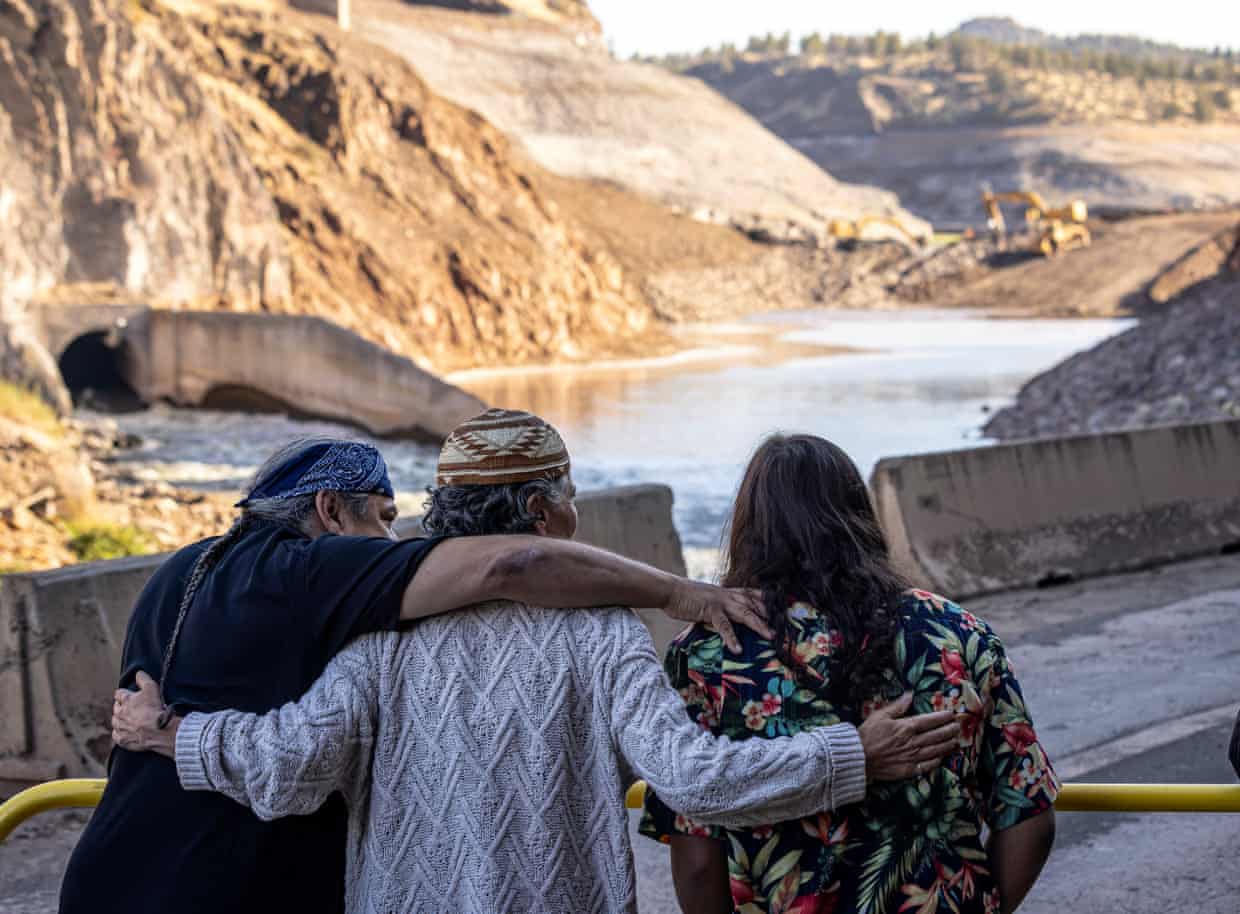
Leaf, Lisa and Chaas Hillman look on as construction crews allow the Klamath River to run freely for the first time in nearly a century, near Hornbrook, California, in August. 

Everything done to Nature for human convenience has a downside. We have dammed up many rivers over the years for water reservoirs and electricity, flooding whole ecosystems. In the last couple of decades, though, we’ve been trying our best to restore what was lost, often with the guidance of indigenous tribes that always knew better.

Gabrielle Canon has one story at the Guardian.

“Explosions roared through the canyons lining the Klamath River [in 2024], signaling a new chapter for the region that hugs the Oregon-California border. In October, the removal of four hydroelectric dams built on the river was completed – the largest project of its kind in US history.

“The blast of the final dam was just the beginning. The work to restore the river, which winds 263 miles (423km) from the volcanic Cascade mountain range in Oregon to the Pacific coast in northern California, is now under way. …

” ‘It has been more successful than we ever imagined,’ said Ren Brownell, the spokesperson for the Klamath River Renewal Corporation, a nonprofit created to oversee and implement the removal. …

“The Klamath River was once an ecological powerhouse – the third-largest salmon-producing river in the American west. Its basin covered more than 9.4m acres (3.8m hectares) and its network of wetlands was the largest in the region. The ecosystem was home to millions of migrating birds. Tribes, including the Hoopa, Karuk, Klamath, Modoc and Yurok, thrived in this bountiful and beautiful watershed for thousands of years, with the river providing both sustenance and ritual.

“Over the last hundred years, these landscapes have been drastically altered.

“After the first dam began operating in 1918 – one of four that would eventually be forged in the lower Klamath to provide hydroelectric power to communities nearby – the course of the river was changed. The dams obstructed the migration of salmon and other native species, which help carry nutrients into the systems from the ocean, to cascading effects.

“They also held on to huge stores of sediment that would otherwise have flowed downriver, and created shallow reservoirs that quickly heated when the weather warmed. Increased water temperatures in the river allowed toxic algal blooms to thrive.

“In recent decades, the climate crisis has turned up the dial, deepening droughts and fueling a rise in catastrophic fire as the region grows ever hotter. The impacts only increased as more water was diverted to support the farming and ranching in the region, and more habitat was altered by mining and logging.

“Twenty-eight types of salmon and steelhead trout, seen as indicator species that represent the health of the ecosystems they live in, have been listed as threatened or endangered.

“As the Klamath ecosystem deteriorated, there was growing recognition that removing the dams would be a crucial first step in helping the region recover and build resilience in a warming world.

“But, faced with a strong resistance to change in local communities tucked around the reservoirs and a long history of difficult battles over water in the parched landscapes in the west, dam removal seemed all but impossible. The land for the dams was taken from tribes during the throes of colonization and development and more recently supported energy corporations that had shareholders to answer to.

“Then, in 2002, disaster struck. Algae flourished in the shallow warming waters that year, exacerbated by the dams and decisions from the US Bureau of Reclamation to divert vital flows to farms, leaving little for fish. The event killed 70,000 salmon and thousands of other species, resulting in one of the worst die-offs ever to occur in the US.

“The layers of fish floating belly-up sent an important signal of the horrors that could continue into the future if the dams remained. Forming a coalition, tribes up and down the Klamath launched a fierce campaign to educate the public, inform the shareholders of the companies that owned and operated the dams, and petition their boards. They protested and attended public hearings, and engaged with state and federal officials.

“It took decades of advocacy to convince PacifiCorp, a subsidiary of Berkshire Hathaway Energy, to let go of the aging infrastructure straddling the Oregon-California border. But in the mid-aughts, assured by shifts in public opinion and incentivized by the steep costs to relicense the dams, the company agreed it was time to see them go.

“In November 2020, nearly 20 years after the die-off, an agreement was forged between a long list of stakeholders that included tribal and state governments and federal agencies. The Klamath River Renewal Corporation was created to oversee and implement the removal.

“The organization had to help bring residents near the reservoirs onboard, navigate dozens of species-management plans, and model how outdoor-recreation enthusiasts could continue to enjoy the river. Ranchers and fishers, environmentalists and farmers, and locals and visitors all had connections to the basin, and were eager to weigh in. …

“Brownell, who grew up along the riverbanks, was standing in the canyon as the blast of the first dam released flows and the river that had been held over the last hundred years found its way back to itself. …

“There were moments of trauma along the way. Over the 100 years the dams were standing, they had held back 15m cubic yards of sediment. When the dams were removed, the heavy dead organic matter had to run downriver, soaking up oxygen in the water. Extensive modeling had predicted a severe impact on aquatic life, but no one knew how bad it would get or how long it would take for the river to regain its health. Some models predicted the suffocating conditions could linger for up to a month.

“ ‘I was braced and prepared but it was still tremendously hard,’ said Brownell, recalling how the water, rid of oxygen, looked like oil as it cascaded through its banks. ‘You can easily compare a river’s health to an individual’s health,’ she said. ‘Often when someone is sick, they are going to get worse before they get better. … The whole time everyone was so excited because it felt like the start of something – I just felt sick,’ she said.

“Leaf Hillman, a Karuk tribal ceremonial leader who has dedicated decades to seeing this project come to fruition, helped keep hopes high with assurances that these were signs of healing.

“ ‘For me it was beautiful,’ he said, recalling how he felt even when the rushing waters became clouded by silt. ‘I could envision what it was going to look like – a restored river.’

“In the end, the river lacked oxygen for only two 24-hour periods, a far shorter time than scientists had feared.”

At the Guardian, here, you can read what happened next. No paywall.

Read Full Post »

Photo: Michael Fox/The World.
Rita Álvarez has been selling handicrafts and homemade jewelry on the streets of Asunción, Paraguay, for more than 40 years. She said that most of her customers in the city speak a combination of Guaraní with Spanish.

Most of our stories on indigenous languages are about struggles in the face of looming extinction.

It’s different for an indigenous language called Guaraní in Paraguay. Michael Fox reports on the phenomenon at Public Radio International’s The World.

Tomas Zayas, who lives in the Paraguayan countryside, spoke only the Indigenous Guaraní language until he was 22 years old. 

“Later, he started to speak Spanish to be better prepared as a community leader. But Guaraní has remained his main language.

“ ‘For me, Guaraní is identity,’ said Zayas, a longtime campesino leader with the Alto Parana Small Farmers Association. ‘It’s happiness. It’s beauty. Because a joke in Spanish isn’t funny at all.’ 

“The Guaraní language, along with its many dialects, comes from the Indigenous Guaraní people who have lived in this region since long before the Spanish conquest. 

“Today, nearly 300,000 Indigenous Guaraní still live in Paraguay, Brazil, Bolivia and Argentina. In some of these countries, their language has influenced Portuguese and Spanish. 

“But in Paraguay, Guaraní is spoken as an official language alongside Spanish. Most Paraguayans speak Guaraní or a mixture of Spanish and Guaraní as their first language, whether they are of Indigenous descent or not. 

“Although there are several theories about how Paraguayans have been able to preserve their Indigenous language, one that stands out focuses on the Triple Alliance War of the 1860s.

“Most of Paraguay’s male population was killed after Brazil, Argentina and Uruguay invaded the country. ‘As a question of survival, the women who were left would only speak Guaraní,’ Zayas said. ‘They passed it on to their children.’ …

“Under the dictatorship of Alfredo Stroessner, which lasted from the 1950s until the late 1980s, Guaraní was banned in Paraguay. It has also been stigmatized as a language of the poor.

“But many Paraguayans say that Guaraní is a language of metaphor and beauty.

“Rita Álvarez has been selling handicrafts and homemade jewelry on the streets of Asunción, Paraguay’s capital, for more than 40 years. ‘For me, it’s the sweetest language,’ she said. ‘Because you can say with one word in Guaraní what you would need 10 to say in Spanish.’

“She said that most of her customers in the city speak a combination of Guaraní with Spanish, or jopara, which means ‘mixture’ in Guaraní. …

“Blanca Estela González is a retired elementary schoolteacher who now teaches Guaraní at IDIPAR Language School in Asunción.

“Gonzalez said that foreigners often pick up Guaraní rather quickly, because, unlike Spanish, there are only three types of verb conjugations: past, present and future. And Gonzalez said the language has received a boost in recent decades.

“ ‘Now, it’s an official language,’ she said. ‘And half of the lessons at the public schools are taught in Guaraní.’ ” More at The World, here.

Happy New Year to all blog friends, whatever language you speak. Any plans for celebrating?

Read Full Post »

Photo: Claudia Morales.
The
Guardian reports from Bolivia: “The founders of Team Uru Uru found that totora reeds – which have long been used by their Indigenous community to build houses, boats and even floating islands – can absorb heavy metals.”

“One and two and 50 make a million.”

I still believe in that line from the Pete Seeger folk song about righting wrongs. Today I want to point out that, when it comes to protecting the environment, it’s often indigenous people who see what’s going wrong and decide to do something about it.

Sarah Johnson writes at the Guardian, “Looking out over Lake Uru Uru in the Bolivian highlands, it is hard to imagine that it once supported thousands of people, and was a sanctuary for wildlife, including 76 species of birds.

“Plastic waste now stretches as far as the eye can see, the water is tinged black or brown, and the stench is overwhelming.

“But in among the filth that chokes the water are submerged rafts that hold thousands of native reeds called totora – a bulrush that can grow to 6 metres [~20 feet] and was used to make Lake Titicaca’s famous floating islands. This aquatic plant, Schoenoplectus californicus, has been shown to be very effective at absorbing heavy metals and contaminants.

“Made of recycled plastic collected from the lake, the rafts were placed there by the Uru Uru Team, a group of about 50 Indigenous people.

“For years, lakeside communities have faced pollution from the mining industry, and from the waste of the nearby city of Oruro. The pollution also threatens flora and fauna in the lake, an internationally recognized wetland under the Ramsar convention.

“ ‘It’s very difficult to live and work in these conditions,’ says Dayana Blanco, 25, an Aymara woman who is co-founder of the Uru Uru Team and a Fulbright fellow studying peace-building at the University of Massachusetts in the US.

“ ‘The smell here is very strong and affects our health. When the sun rises and sets, it is intolerable. I had stomach ache from it once. Who knows what illnesses we could get in the future?’

“People living around the lake … used it for drinking water, fished in it, irrigated their crops with it and watered their cattle, says Blanco. This is no longer possible and many of the community have been forced to migrate.

“The lake used to be home to about 120,000 flamingos but only half that number remain. Years of damage to the lake’s fragile ecosystem has pushed wildlife into a small area of unspoiled habitat.

“Changing temperatures and rain patterns have seen Lake Uru Uru’s shoreline recede dramatically over recent years and, as Oruro city has grown, people have built houses in what were protected areas. Bolivia’s other highland lakes, all protected under Ramsar, face similar threats. …

‘Indigenous people know that if a lake dies, it’s as if the soul of a people dies,’ says Tatiana Blanco, 30, Dayana’s sister and in the Uru Uru Team.

“ ‘With colonialism and globalization, new generations have lost their way,’ she says. ‘They’ve forgotten where they’ve come from and that we are not superior to animals, plants, mountains, lakes and rivers. It is because of this lack of respect and care for nature and mother Earth that there’s an imbalance.’

“Fed up with the ever-increasing pollution, the sisters and other young women formed the Uru Uru Team in 2019.

“The first step was to clean the water. Their forebears used totora and so they decided to do the same. As well as being used to build floating platforms and houses, totora is important for treating sewage and mining wastewater as it traps minerals in its roots, leaves and stems.

“They transplanted about 600 young totora from a place where they grow in abundance and placed them on top of rafts made out of plastic bottles and a grid of sticks.

“ ‘We didn’t think the totora would grow, because the pollution is so strong. The water has a lot of heavy minerals,’ says Dayana. ‘But we’ve seen the plants remediating nature little by little and having an effect.’

“The team commissioned laboratory tests from Juan Misael Saracho University in Tarija, which found that areas in the lake with totora had reduced pollution by 30%. Flamingos and other birds have begun to return.

“The Uru Uru Team has planted about 3,000 totora plants so far. … The team’s aim is to plant 4,000 totora a year and completely clean up the lake to bring back the birds and allow the community to grow vegetables again.

“A 2023 Future Rising fellow, she is writing a graphic novel that tells the Uru Uru Team’s story from the perspective of a lake flamingo. The group has a Facebook page and international organizations, such as the United Nations children’s agency, Unicef, have provided technical support.

“Last year, the Uru Uru Team won the UN Development Programme’s 14th Equator prize, which celebrates initiatives by Indigenous peoples and other communities in adapting to and mitigating the climate crisis.”

Read more at the Guardian, here. No paywall but donations encouraged.

Read Full Post »

Photo: Alex V. Cipolle.
University of Minnesota architecture professor Jessica Garcia Fritz teaches Indigenous Design Camp campers cardboard scoring techniques on day one.

It seems like every year, the first question on the first day of school is, “What did you do over the summer?” This past summer, if you were an indigenous teen in the Twin Cities of Minnesota, you might have had some new experiences to report.

In July, Alex V. Cipolle at Minnesota Public Radio wrote about an unusual class at the Dunwoody College of Technology.

“A group of teens cuts cardboard with X-ACTO Knives. They will soon shape this cardboard into architectural models of their bedrooms. …

“ ‘It’s my first time doing something in architectural-related study,’ says Dominic Stewart of Burnsville.

“ ‘I’m excited to get that hands-on experience,’ says Carsyn Johnson of Elk River.

“They are here for the weeklong Indigenous Design Camp, the first camp of its kind in the U.S. The goal is to teach Indigenous teens about career options in architecture and design, a field where Native Americans are underrepresented.

“Two of the founders of the new camp — architects and friends Mike Laverdure and Sam Olbekson — estimate that there are only about 30 Indigenous architects total in the U.S.

“Laverdure is an enrolled member of the Turtle Mountain Band of Chippewa and a partner at DSGW Architects as well as the president of First American Design Studio. Olbekson is a citizen of the White Earth Nation and founded the firm Full Circle Indigenous Planning and Design. They are the only two practicing Native architects in Minnesota. 

“ ‘The need for creating a space for kids to become designers, Indigenous designers, is great,’ says Laverdure, who has wanted to start this camp for years. ‘Representation matters for these kids to see us as architects and designers. A lot of us who grew up in reservations or urban Indigenous communities only see a few career types.’ …

“The campers are Indigenous teens ages 14-18 from the metro area. They will be constructing architectural models all week. Campers will also tour the University of Minnesota School of Architecture and local architecture firms.

“They will also visit the American Indian Cultural Corridor on Franklin Avenue, where both Laverdure and Olbekson have designed buildings, as well as another Olbekson project, the recently completed expansion of the Red Lake Nation College downtown.

“Olbekson says, ‘to actually go and see [the buildings] and see the impact that they’re having on the community, not only as individual buildings, but how they’re forming an identity for the American Indian Cultural Corridor and how these projects are supporting education, economic development, community building, cultural development, and youth and elder spaces, I think is going to be a great way for them to understand the impact of what design, urban design, interiors, landscape, can have on creating a healthy, Indigenous urban community.’

“The camp began [with] a welcome from Laverdure, Olbekson and University of Minnesota assistant architecture professor Jessica Garcia Fritz, a citizen of the Cheyenne River Sioux Tribe. Fritz also helped start the camp.

“ ‘If you think about your home reservations, or your urban communities, you think about all the buildings that are there,’ Laverdure told the class, ‘Ninety-nine percent of all the buildings built that Indigenous people sit in are not designed by indigenous designers. … When you have Indigenous designers be a part of that process, what happens is that those buildings have a special kind of connection to the communities and that makes those buildings extra special.’

“Next came a presentation on Indigenous architecture, past and present, by Tammy Eagle Bull, who did a video call from her home in Arizona. Eagle Bull is a member of the Oglala Lakota Nation of Pine Ridge, South Dakota. In 1994, she became the first Native woman in the U.S. to become a licensed architect. …

“For the remainder of the first day of camp, Jessica Garcia Fritz guided campers in a design exercise to create their sleep space or bedroom.

“First, they taped 10 by 10-foot squares on the classroom floor to help them visualize the scale. Then they sketched blueprints of their bedrooms. Finally, they cut and scored cardboard to build shoebox-size models. …

“ ‘One of the things Tammy Eagle Bull had said this morning was, “I wish that a camp like this had existed when I was young.” I think that’s the sentiment among many of us,’ Garcia Fritz says. …

“Garcia Fritz, Laverdure and Olbekson hope this camp is the first of many. One of the goals is to expand the camp to greater Minnesota.

“ ‘Right now, it’s in the Twin Cities, but there are so many Indigenous communities regionally, up north and even in other states that could really benefit from this,’ Olbekson says. 

“ ‘Long term, we want to create a space where five to 10 years from now, we’ve got 10, 15, 20, Native designers that are out there and being a force for change,’ Laverdure says.”

More at MPR News, here.

Read Full Post »

Photo: Jean Ogden via Wikimedia.
Navajo Churro sheep.

There’s a story at National Public Radio about the special relationship between a kind of sheep and the Navajo people, or Diné. Ayesha Rascoe hosts the NPR program, which you can listen here, if you prefer.

Ayesha Rascoe: For centuries, the lives of Navajo people have been intertwined with livestock — specifically, one particular breed of sheep they’ve relied on for meat and wool. The tribe is well known for weaving the wool of Churro sheep into colorful clothing and tapestries. Those weavings can fetch thousands of dollars from collectors, but they have far more than monetary value. Raising Churro sheep and weaving their wool is an important way Navajo people pass cultural knowledge from generation to generation. KSJD’s Chris Clements visited a Navajo Churro sheep celebration.

Chris Clements: Inside a crowded farmhouse on the edge of the Navajo Nation, weavers are demonstrating how to spin, dye and treat wool from Churro sheep, which they consider sacred.

Roy Kady: Hello. My name is Roy Kady. I am from Goat Springs, Ariz.

Clements: Kady, who’s in his 60s, is standing outside, wearing an ornate turquoise necklace, earrings, bracelets, and a white hat. He’s considered a master weaver, part of centuries of Navajo citizens who’ve carried on traditional beliefs that date back to the 1500s when Churro sheep arrived with early Spanish colonists.

Kady: I’m filling these big shoes that my mother wore as an agropastoralist.

Clements: Tyrrell Tapaha is Kady’s student and his grandson, who’s here at the event. …

“Tyrrell Tapaha: There’s always been weaving in my life, whether it be his work, my grandma’s work, or my great-grandma’s work. ..

“Kady: Tyrrell [says] I want to weave a human form. Do you have any ideas how I could do that? And so I just share with him. …

“Clements: Tapaha has been learning the tricks of the trade since he was very young. When he was only 8, Kady had him teach a class on the art of finger weaving at a nearby chapterhouse. … Tapaha knows that Kady’s teachings will live on with him.

“Tapaha: At least it’ll last my lifetime, you know? And I kind of hear that in how Roy talks about his contribution to the space is like him being an older person now and kind of seeing that handed off.

“Clements: After the morning’s presentations, it’s time for lunch. The weavers roast mutton, a Churro sheep they slaughtered earlier in the day. Participants of the sheep celebration gather around the grill, watching the fire hiss and sputter as the mutton cooks. It’s common for every part of the animal to be used. Nothing, not even its hooves goes to waste.

“In 1863, the U.S. military forced Navajo people to leave their ancestral homelands and relocate to an internment camp. It’s known as the Long Walk. … It almost led to the extinction of the Churro sheep.

“Navajo people were allowed to return home four years later. Some tribal members who’d managed to escape the Long Walk, kept some Churro alive. And today, thousands of Churro sheep live on or near the Navajo Nation.”

Read more about the sheep and the passing along of Diné culture at NPR, here.

Read Full Post »

Photo: Corey Favino/Elephant Family USA/Newport Restoration Foundation.
The Great Elephant Migration installation outside Rough Point mansion in Newport, Rhode Island.
The elephants are made by indigenous people from an invasive plant.

Here’s a new way to reach audiences with a message about the importance of conservation: a giant “elephant” exhibit in a beautiful seaside setting that tourists visit anyway.

At Forbes magazine, Chadd Scott begins the story by talking about India.

“India has experienced a remarkable population explosion over the past 40 years. Several actually. One is well known. India’s human population has more than doubled since 1980. … Lesser known, and even more extraordinary in light of the country’s surging human population, has been a doubling of its elephant population over that same period, from a bottom-out of around 15,000 individuals to nearly 30,000 today. Populations of Asiatic lionstigers, and the greater one-horned rhinoceros are also increasing across the country.

“India offers a remarkable example for how humans and wildlife, even the largest of wildlife, can coexist in an ever-developing world. Sharing that message with the world is the mission of the Great Elephant Migration which debuted 100 life-sized Asian elephants in Newport, RI on July 1.

“The elephants — each based on a real, wild elephant from the Nilgiri Hills known by name and personality living alongside people in their coffee and tea plantations — were made by members of the Coexistence Collective, a group of 200 Indigenous artisans from the Nilgiri Biosphere Reserve

“The herd was produced from the Lantana camara, a toxic, invasive plant overtaking the Indian forest, pushing elephants and other wildlife out and into closer proximity to humans, with greater potential for conflict. …

“ ‘It’s a conservation miracle; it’s contrary to what’s happening everywhere else in the world and it’s definitely owed to an incredibly beautiful perspective on nature and our place within nature,’ Ruth Ganesh, trustee, Elephant Family USA, co-organizer of the Newport presentation along with Art&Newport, and co-founder of the Coexistence Collective, said at The Great Elephant Migration’s opening at Rough Point. ‘That’s what we hope the herd will spread, this beautiful perspective of coexistence and seeing other species as our biological kin.’

“The elephants, and the Indians, prove conservation is as much a mindset as a management plan.

“ ‘That culture of being able to live with animals is the most important thing, more than any of the natural variables about habitat and prey, and all of that,’ Asian elephant expert and co-founder of the Real Elephant Collective in India, Tarsh Thekaekara, told Forbes.com. The Great Elephant Migration exhibition and tour is the brainchild of he and Ganesh. His research in India has focused on human-elephant coexistence. ‘Animals will survive in human dominated landscapes if people tolerate them. That is the bottom line.’ …

” ‘The people who made the elephants [practice] kind of a fusion of Hinduism and animism,’ Ganesh told Forbes.com. Animism attributes a soul and living spirit to animals, rivers, mountains, plants, and other objects often considered inanimate. ‘There’s a spiritual tapestry that underpins the answer to the question why is India succeeding in this way despite so many challenges? It’s the spirituality. It’s this perspective.’ …

“Research published this year by scientists at Colorado State University indicates that elephants have names for each other.

“Research from 2022 demonstrates the numerous ways elephants grieve their dead and participate in post-death rituals like burial, same as humans. They communicate. Feel pain. Play. Look out for each other. …

“Seeing animals as beautiful people, seeing mountains as deities and rivers as our veins, that it’s a beautiful perspective,’ Ganesh added. …

“ ‘Not just India, in lots of traditional cultures there wasn’t a decimation of wildlife. If you look at conservation in most of the First World, it happened because there was a systematic decimation of all the wildlife,’ Thekaekara explains. ‘When settlers arrived on the North American continent, they wiped out most animals. So, then you had nothing, and you had to conserve.’ …

” ‘Set aside land for nature because you assume people cannot coexist with nature — that model of conservation was inherently separationist.’ …

“Indigenous people the world over have lived more or less harmoniously with wildlife for millennia. That has not been the case with Europeans and their descendants. …

“ ‘If people stopped killing, [animals are] going to come back,’ Thekaekara said. … ‘In coffee and tea plantations, the core of the local economy isn’t upset by the elephants. They don’t eat the coffee or tea, so people’s livelihoods are not affected. It’s only a minor adjustment to your lifestyle to be able to coexist.’ ”

More at Forbes, here. No paywall for your first articles.

Read Full Post »

Older Posts »