Feeds:
Posts
Comments

Posts Tagged ‘indigenous’

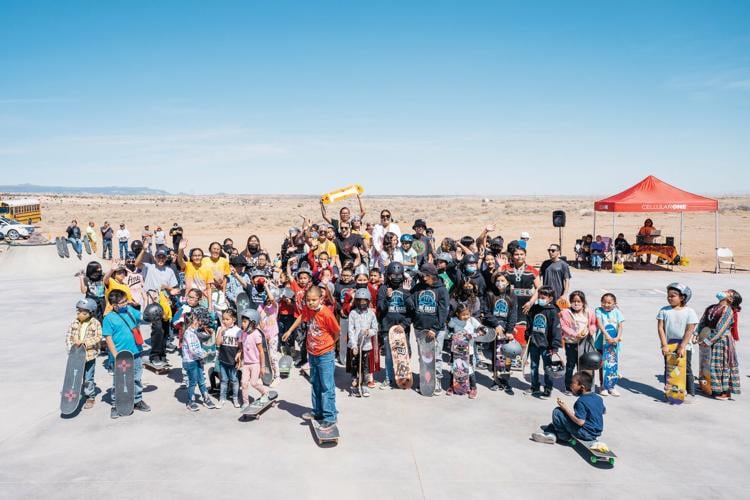
Photo: Navajo-Hopi News.
Two Gray Hills Skatepark in Newcomb, New Mexico.

The forced assimilation of indigenous children into colonist culture damaged the children, the relatives of the children, and the grown children’s descendants. In today’s story, we learn how one descendant was surprised to discover she was Navajo and looked for a way to help her long-lost community.

Roman Stubbs writes at the Washington Post, “The wind rolled off the Chuska Mountains and along the desert floor, whipping red dust and tumbleweed across the pavement of Two Grey Hills Skatepark. It was a pale Sunday morning in May, and Amy Denet Deal stood on a ledge, tying a crimson bandanna around her silver braids and smiling as she watched the children swerve down ramps in the middle of the storm.

“ ‘Amy!’ ” a young boy yelled, excited to greet the woman who helped bring the skatepark to this remote northwest corner of the Navajo Nation.

“ ‘Hi, honey. How you doing?’ she replied. ‘You’ve grown a foot since I last saw you!’

“Denet Deal, 59, considered herself younger than the boy in Diné (Navajo) years. She had reconnected with the tribe only five years earlier after a lifetime of displacement, giving up most of her belongings and a ­lofty salary as a corporate sports fashion executive in Los Angeles to move to New Mexico.

“The pandemic opened her eyes to the inequities children on the reservation face, including high rates of diabetes, mental health issues and suicide. Navajo Nation is roughly the size of West Virginia — 16 million acres stretching across Arizona, New Mexico and Utah — yet there are few opportunities for kids to play sports, with many remote areas lacking outdoor recreation and athletic facilities.

“She searched for solutions to give back and finally landed on one: Why not a skatepark?

“It took years of fundraising, with plenty of setbacks, but more than a year after it opened, she could still point to the benefits the park was bringing to her community. The kids from a nearby housing project came for free clinics held every weekend. Parents and grandparents parked their trucks near the concrete to watch, sharing food with one another in their camping chairs as the breeze stung their faces.

‘If I talk to any skateboarder, the first thing they’ll always tell me is, “Skateboarding saved my life,” ‘ Denet Deal said. …

“And so here she was again, making the four-hour drive from Sante Fe to her ancestral homeland, because visits were also helping her with the trauma of her past.

“ ‘The plus side of this is I come from displacement and a strange start in the world,’ Denet Deal said. ‘It’s really helping me heal through that work.’

“Denet Deal didn’t visit the Navajo Nation until she was in her late 30s. Her mother, Joanne, had been forced into a boarding school in Farmington, N.M., in the early 1950s. Joanne’s family had no horse or car to visit her for years. ‘She suffered all kinds of abuse and forced assimilation,’ Denet Deal said.

“Through the government’s Indian Relocation Act, Joanne left the reservation with a one-way bus ticket to Cleveland in her late teens. She got pregnant with Amy. Like thousands of other Native children in the 1960s, Amy was placed into adoption and taken in by a Catholic charity. …

“ ‘I was put up for adoption without anybody contacting my birth family, no connection to the tribe,’ Denet Deal said. ‘I grew up completely displaced from my community. I was the only Brown person in rural Indiana.’ …

“She found something to hold on to when she learned how to use a sewing machine as a child. She started making all of her own clothes and threw herself into fashion. Denet Deal developed into a rising star in the active sportswear space in the early 1990s; at 26, she was creating apparel at Reebok and by 30 she took over as design director at Puma. …

“For years, she searched for her mother. She hired a private investigator and scoured the internet. She numbed the emptiness with alcohol and work.

“In 1998, she had a breakthrough. Denet Deal convinced the Indiana Department of Health to release her record of adoption and was given Joanne’s address and phone number. She wrote Joanne a letter and received a letter back. Denet Deal visited her mother for the first time in Ohio, and together they eventually traveled to the Navajo Nation to meet other family.

“ ‘It wasn’t warm and fuzzy,’ she said. … ‘It brought back a lot of things for my mom that were hard.’ …

“Some locals rejected her because she didn’t grow up in the Navajo Nation. She was still getting to know many of her family members, and her presence could trigger reminders of a painful history for them. …

“The pandemic offered Denet Deal a chance to give back what she learned in another life. She used her past skills as a wealth generator for major corporations to help raise more than $1 million in medical supplies, food and support for a domestic violence shelter. But she wanted to do more, having seen up close the problems for children on the reservation.

“ ‘I just thought a skatepark was a really great thing to have for them.’ “

At the Post, here, you can read about the people who helped make it happen.

Read Full Post »

Photo: MassAudubon.
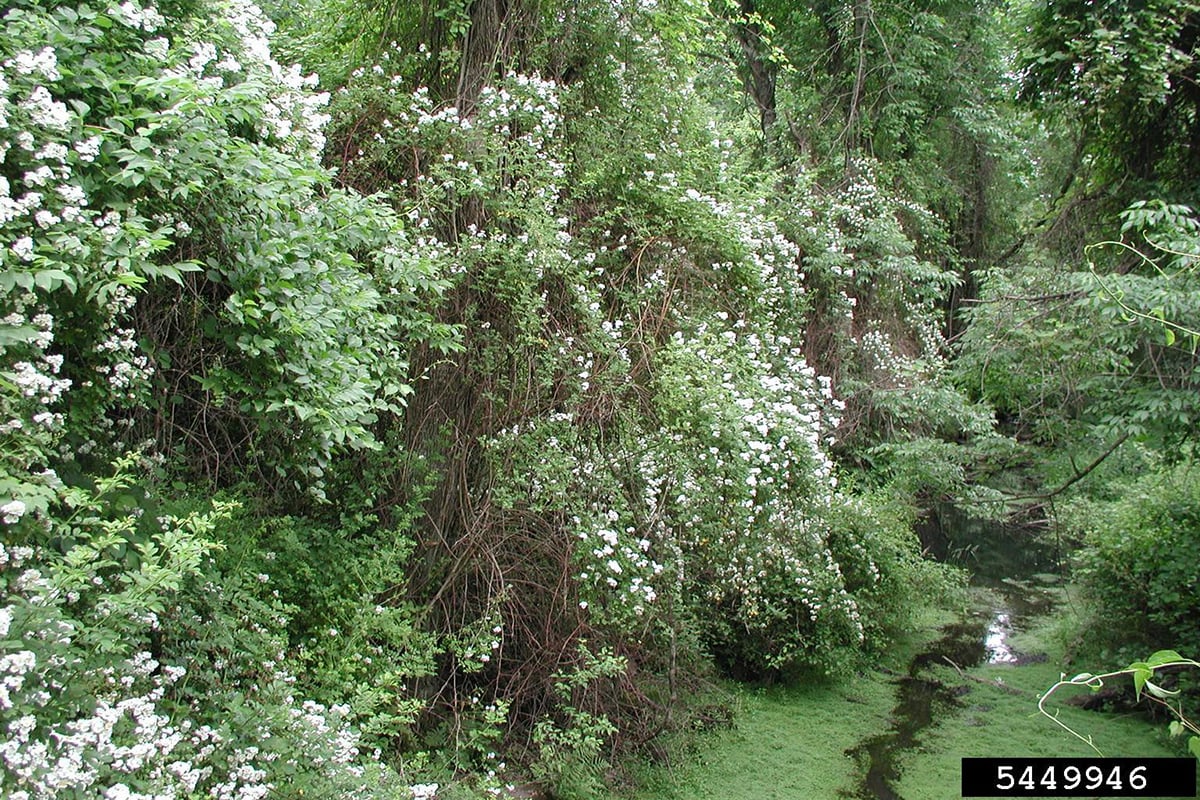
The invasive multiflora rose forms dense thickets in fields and field edges, crowding out other species.

The problem with invasive species that aren’t native to a region is that they crowd out the local species, and that has a snowball effect. We colonists crowded out indigenous people, which among other things, undermined wisdom about protecting nature. In the plant world, local pollinators don’t get what they need to pollinate. The list goes on.

Frank Carini reports at ecoRINews on how invaders hurt both the environment and the economy: “Invasive Asian shore crabs are outcompeting young lobsters. Invasive snake worms and hammerhead worms are burying themselves deeper into southern New England, where the former consumes the top layer of soil and dead leaves where the seeds of plants germinate, and the latter is toxic and transmits harmful parasites to humans and animals.

“Invasive multiflora rose and oriental bittersweet have long been embedded in the region, crowding out native vegetation and strangling trees. …

“Last summer, the Intergovernmental Science-Policy Platform on Biodiversity and Ecosystem Services (IPBES) for the United Nations issued a global assessment providing clear evidence of this growing threat.

“In a paper recently published in the journal Nature Ecology & Evolution, the authors of last year’s assessment — 88 experts representing 101 organizations from 47 countries — outline the main findings from that report and echo the need for urgent action.

Laura Meyerson, a University of Rhode Island professor of invasion science and habitat restoration ecology and editor-in-chief of the journal Biological Invasions, is a contributing lead author on the IPBES assessment and a lead author on the recent paper. …

“She said, ‘Our research produced overwhelming and unequivocal evidence that the negative impacts of biological invasions far outweigh any benefits and that those who depend most on nature suffer the worst consequences.’

“The researchers documented some 37,000 invasive species that had been introduced by people to areas around the world. Of those, about 3,500 species were considered harmful invaders that negatively affect nature and people’s quality of life. 

“The number of invasive species — major drivers of global biodiversity loss, according to Meyerson — are expected to continue to grow. Some 200 new species are expected to be added annually by human activities in regions that have not recorded such invaders before, according to the June 3 paper. And established invasives will continue to expand their ranges, spreading into new countries and choking out native species.

“The paper also noted that simple extrapolations from current impacts from invasive species are likely to underestimate the level of future impacts, and drivers of biodiversity loss, such as the climate crisis, are acting in concert and those interactions are increasing biological invasions. …

“ ‘It’s critically important that we all do our part to reverse current trends,’ Meyerson said. ‘The public can make sure that the plants they are buying for their gardens are native species. Pet owners should not release animals, like rabbits or Burmese pythons, that are no longer wanted into the wild.’

“For example, red-eared sliders — native to the Southeast, the south-central United States, and northern Mexico — are the most popular pet turtle in the United States and available at pet shops around the world. But this turtle species lives for about 30 years, so they are often released where they don’t belong after pet owners tire of them. As a result, they are considered one of the world’s 100 most invasive species.

“Meyerson is also the senior author on a global study that explored the extent of biological invasions on lands owned or managed by Indigenous people. The study was published in Nature Sustainability in late May.

“The spread of animal and plant species into new regions by humans is increasing rapidly worldwide, with thousands of species now present in regions outside their native range. The research team, which included scientists from Australia, Austria, Germany, Hungary, and the United States, investigated the spread of invasive species to lands managed by Indigenous people and found significantly fewer invaders in those areas compared with other natural areas.

“ ‘This was a really important finding because even after controlling for the remoteness and accessibility of Indigenous peoples’ lands and how land is used, in general, the numbers of invasive species are lower, as is biodiversity loss,’ Meyerson said. …

“Researchers analyzed millions of available data points from around the globe on the distribution of non-native plant and animal species. On average, there were 30% fewer non-native species on Indigenous lands. The study suggested the enormous difference is primarily due to sustainable land use, a higher proportion of forests, and lower accessibility to humans.

“Indigenous people represent ethnic groups that settled in regions long before the arrival of Europeans, such as Native Americans, the Aborigines of Australia, and the Sami in Scandinavia. About 28% of the land surface around the globe is inhabited by Indigenous people. Most of these areas are in remote regions and many have enormous importance for conservation of biodiversity such as the Amazon basin and wilderness areas in the Arctic.”

More at ecoRI News, here. No firewall. Donations solicited.

Read Full Post »

Photo: Curtis Quam via Civil Eats.
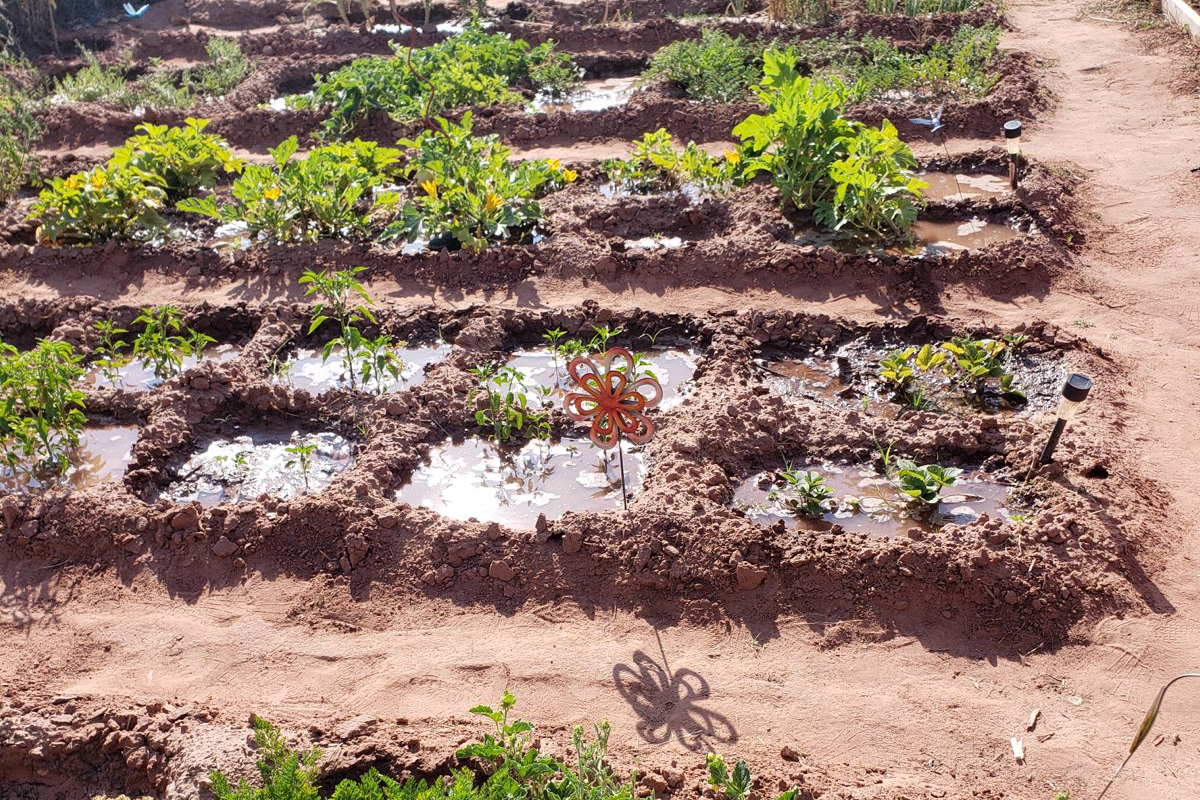
According to Civil Eats, “In the face of climate change and persistent droughts, a growing number of people from Zuni Pueblo in New Mexico and elsewhere are adopting the traditional farming practice.”

Some days, reading the news, I just feel fed up with what capitalism has done to the human race — not to mention the planet. I don’t know how to get out of my own role in this mess, but if nothing else, I can at least learn a little about indigenous ways that are different.

Samuel Gilbert describes nine practices at the Washington Post: Zuni waffle gardens, “good fire,” ancient Irrigation, the original carbon capture, dryland farming, restoring salmon runs, resilient seeds, Swinomish clam gardens, and climate-smart design.

“Since the first Earth Day in 1970,” Gilbert writes, “the world has experienced profound ecological changes. Wildlife populations have decreased by 69 percent, the result of habitat loss caused by rapid industrialization and changing temperatures. 2023 was the hottest year on record. …

“Jim Enote, 66, has been planting a traditional Zuni waffle garden (or hek’ko:we in the Zuni language) since before he could walk.

“ ‘My grandma said I started planting when I was an infant tied to a cradleboard,’ said Enote, who grew up on the water-scarce Zuni Pueblo on the southeastern edge of the Colorado plateau. ‘She put seeds in my baby hands, and I dropped seeds into a hole.’

“Enote has continued this ancient garden design, creating rows of sunken squares surrounded by adobe walls that catch and hold water like pools of syrup in a massive earthen waffle. The sustainable design protects crops from wind, reduces erosion and conserves water. …

“Before European settlers traveled to the American West, Indigenous people managed the landscape of northern California with ‘cultural burns’ to improve soil quality, spur the growth of particular plants, and create a ‘healthy and resilient landscape,’ according to the National Park Service.

“ ‘The Karuk have developed a relationship with fire over the millennia to maintain and steward a balanced ecosystem,’ said Bill Tripp, director of natural resources and environmental policy for the Karuk Tribe. ‘A good portion of the resources that we depend on, in the natural environment, are dependent on fire.’

“But in the mid-19th century, Indigenous burning was outlawed. Not only did that cause the Karuk to lose a vital part of their culture, but also, it invited potentially worse wildfires. The burns had reduced the amount of fuel accidental fires feed on. …

“Prescribed burning has returned as state and federal agencies recognize the importance of fire in managing forests. In 2022, California passed legislation affirming the right to cultural fire and is considering another bill (backed by the Karuk Tribe) to reduce the barriers to cultural burns on tribal lands. …

“In New Mexico, there are 700 functioning acequias, centuries-old community irrigation systems that have helped the parched state build water resilience. These acequias — a design from North African, Spanish and Indigenous traditions — were established during the 1600s. … Unlike large-scale irrigation systems, water seepage from unlined acequias helps replenish the water table and reduce aridification by adding water to the landscape. The earthen ditches mimic seasonal streams and expand riparian habitats for numerous native species.

“ ‘It’s a very good and sustainable system to take water from one source and put it into the community,’ said Jorge Garcia, executive director of the Center for Social Sustainable Systems and secretary of the South Valley Regional Association of Acequias. … ‘We need to maintain those knowledge systems, especially if we continue through dry years.’ …

“U.S. forests are carbon sinks, sequestering up to 10 percent of nationwide CO2 emissions. Indigenous forestry can play a critical role in reducing global warming by restoring biodiversity and health to these ecosystems, including the management of culturally significant plants, animals and fungi that contribute to healthier soil.

“ ‘We know that most of the carbon in the forest is stored in the soil, and healthy soil depends on diversity,’ said Stephanie Gutierrez, a member of the San Carlos Apache Tribe and the forests and community program director for Ecotrust. …

“Yet tribal forestry remains severely underfunded and underutilized on public lands. Indigenous Hawaiians are reintroducing ancient food forests once destroyed by overgrazing, logging and commercial agriculture. These biodiverse edible forests increase food security and build nutrient-dense soils that sequester carbon.

“The Hopi nation in Arizona receives an average of 10 inches of rain per year — a third of what crop scientists say is necessary to grow corn successfully. Yet Hopi farmers have been cultivating corn and other traditional crops without irrigation for millennia, relying on traditional ecological knowledge rooted in life in the high desert.

“ ‘I like to call traditional ecological knowledge the things my grandfather taught me,’ said Michael Kotutwa Johnson, a Hopi dryland farmer and academic. Hopi farming practices include passive rainwater harvesting, myriad techniques to retain soil moisture, and a reliance on traditional seed varieties superbly adapted to the desert.

“ ‘The fact we are able to raise crops such as maize with only 6 to 10 inches of precipitation as opposed to the standard 33 inches of precipitation is outstanding,’ Johnson said.”

Learn about the other techniques at the Post, here.

Read Full Post »

Photo: Anna Mulrine Grobe/The Christian Science Monitor.
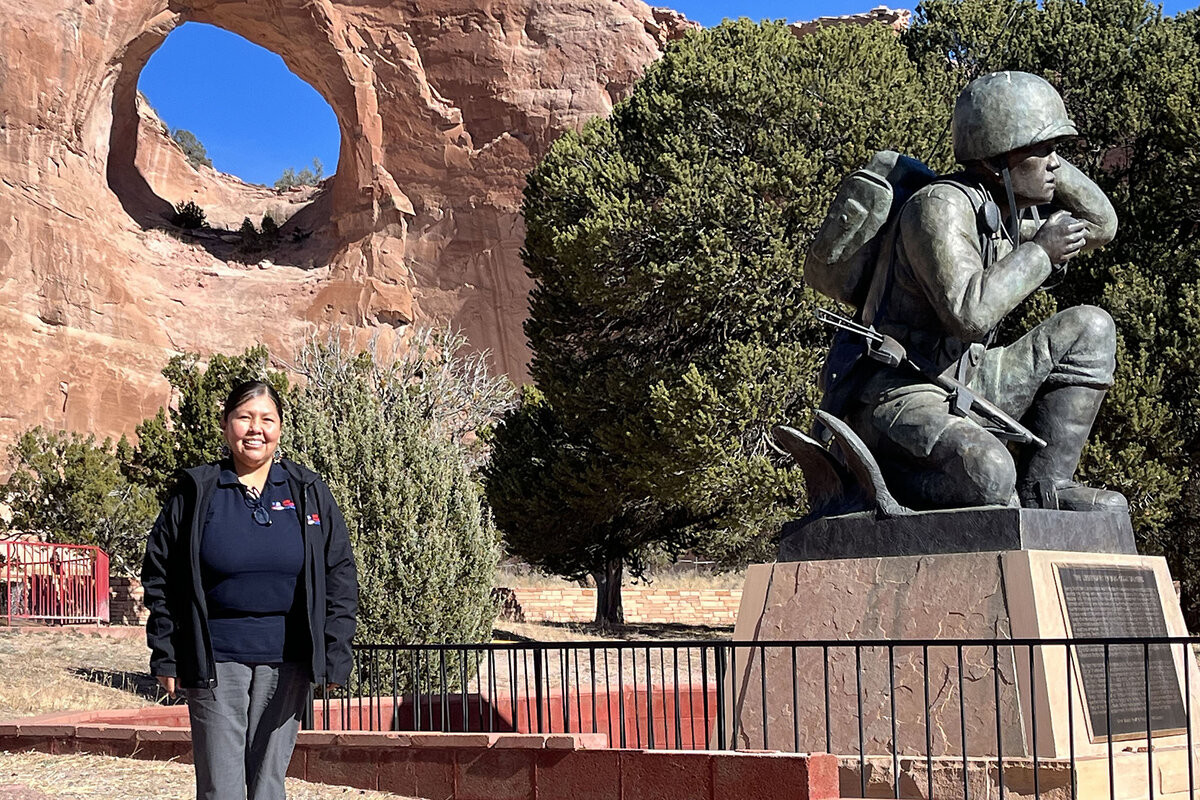
US veteran Bernadine Tyler stands at a memorial to Navajo code talkers on the Navajo Nation, in Window Rock, Arizona.

On this Memorial Day, let’s take a look at the indigenous people who have served in our military.

Anna Mulrine Grobe  writes at the Christian Science Monitor, “In her work with U.S. military veterans here on the Navajo Nation, Bernadine Tyler routinely logs 1,200 miles a month driving across an area the size of West Virginia, over high windswept plains dotted with rust-red mesas.

“Roughly one-third of homes here on America’s largest reservation don’t have electricity or running water, so Ms. Tyler, herself a member of the Navajo Nation and an Army veteran, brings services directly to her fellow vets, most of whom are over the age of 65. 

“She points out the occasional gas station and folks walking on the dusty shoulders of pot-holed roads. There’s a bus, ‘but it’s very unreliable and only runs one route,’ says Ms. Tyler, program lead for the Diné Naazbaa Partnership (DNP), which serves the Navajo Nation and receives funding from the U.S. Department of Veterans Affairs. …

“For vets without transport or refrigerators, she carries bags of ice to fill the convenience store coolers that many use to chill their food and medications. She enlists volunteers, including her sons, to help haul water and chop wood for warmth in the winter. 

“The particular challenges of accessing this care came to light during the COVID-19 pandemic, when Native American veterans living in small multigenerational homes without running water on closed tribal lands died at significantly higher rates than other former service members. The VA subsequently pledged to better serve America’s Native American community. 

“In 2020, the VA created the first advisory committee for Native American veterans. It held its first meeting in 2022 and began issuing its recommendations last year. Though they aren’t binding, the suggestions of some committees have an acceptance rate of 90%, according to the agency. …

“With this year’s 2024 defense spending bill, lawmakers also granted the Native American Indian Veterans a congressional charter, making it the first-ever group dedicated to the interests of Indigenous people in the U.S. to get the status. It is a development that took the NAIV nearly 20 years of lobbying to achieve. With the charter, NAIV can testify before Congress and, ideally, more easily help the VA process benefits claims. 

“The hope is that these developments will not only improve care, but also foment faith that, even after decades of neglect, change is possible – particularly among the 57% of Native American veterans who say their top reason for joining the military was a desire to serve their country. 

“Native American veterans are among America’s most patriotic, says Adam Pritchard, a researcher at Syracuse University’s Institute for Veterans and Military Families. ‘It’s a very important step in the right direction to acknowledge their history of the service and their ongoing needs.’ 

“ ‘Our history has much mistrust,’ Ms. Tyler says. Good-faith efforts to fix a long-broken system and build it up, she adds, can help heal old wounds, too. 

“In 1943, Thomas Begay joined the U.S. Marines. He was 16 or 17 years old – he’s not sure which. … He wanted to be an aerial gunner, Mr. Begay told the recruiter. [The recruiter sent him] to become a code talker. While he and his fellow troops practiced the top-secret tribal language with a twist, their basic training was more ad hoc than the Marine norm. 

“ ‘They got us a rubber boat, and they just dumped us way out in the ocean and said … “Learn how to get to shore,” ‘ he recalled in a 2013 discussion cataloged by the National Archives.

“Months later, after landing at Iwo Jima in February 1945, Mr. Begay and his fellow code talkers were hailed as instrumental in taking the island – and later with helping to win the war. Their code was never broken. …

“Today, Mr. Begay is living in a house where bad plumbing has damaged the floors and ceiling. ‘It’s not safe for him,’ says Karen Shirley, community coordinator for DNP, which is helping him apply for VA grants to fix up his home, or get Mr. Begay a new one. 

“ ‘How can we not support this great warrior who helped save this country, and just get him the housing he needs?’ Ms. Tyler says.”

More at the Monitor, here. No paywall. Subscriptions are reasonable.

Read Full Post »

Photo: Melanie Stetson Freeman/CSM Staff.
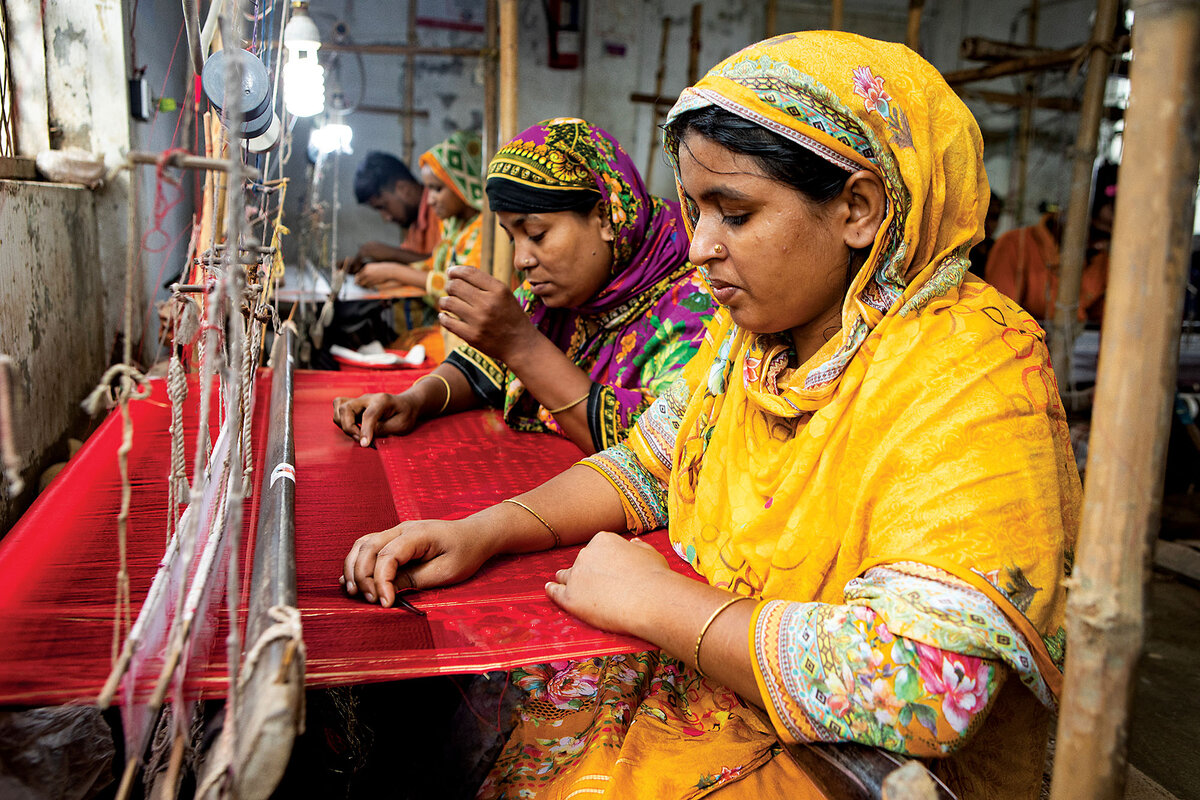
Artisans do “respectful” work on jamdanis at Abul Kalam Jamdani Weaving Factory in Bangladesh.

Recently I wrote about the the Fuller Craft Museum’s exhibit of the Red Dress, an embroidered garment “worked on by 380 individuals from 51 countries, mostly female, many of whom were vulnerable and living in poverty” — women who felt uplifted by an art project that honored their skills.

Today’s post is also about women’s handcrafts.

Sara Miller Llana reports at the Christian Science Monitor, “Two dozen artisans crouch over hand looms threaded with bright-orange and sky-blue cottons. Their fingers nimbly create a jamdani, an intricately woven sari dating back to the [16th century] Mughal Empire. …

“Made of fine cotton or silk, the jamdani was a pinnacle of fashion centuries ago. But in the 19th century, British colonizers brought in their iteration of fast fashion, and the tradition nearly went extinct. …

“After Bangladesh became an independent nation in 1971, the nongovernmental organization BRAC set out to revitalize the weaving practice. It approached artisan families like that of Anwar Islam, owner of this shop. ‘I didn’t think it was feasible, but I was happy to be part of the solution,’ says Mr. Islam. 

“Today he employs 120 weavers at Abul Kalam Jamdani Weaving Factory. …

“But this is not just a business success story. … The jamdani is seen as a story of cultural success, too. It’s part of the championing and preservation of objects from sealskin parkas in the Arctic to duck decoys and quilts across the United States that otherwise may be forgotten.

” ‘People have been striving to decorate their lives to tell the world who they are for centuries,’ says Chris Gorman, a deputy director of the American Folk Art Museum in New York. … ‘Without people championing the study and preservation of objects like these, and others, there is the possibility that people will simply forget about them, and it is hard to revive them or prove their relevance.’

“About the time the jamdani was being revived, a women’s collective was coming to life at the northernmost tip of Canada, in the town of Taloyoak.  

“Begun in 1972, the group, called Arnaqarvik, garnered a burst of fame in its day with its Inuit parkas, mitts, and boots made from caribou, wolf, and seal and patterned with dyes from tundra lichen and flowers. The collective’s work — including, eventually, duffel-wool ‘packing dolls, or miniature stuffed animals carrying their babies in parkas as the Inuit do — was showcased in New York City and the 1974 Arctic Winter Games in Alaska.

“Yet today, just as the jamdani is enjoying global appeal, the work of Arnaqarvik has been largely forgotten. So the Kitikmeot Heritage Society in Cambridge Bay, in Canada’s Nunavut territory, has set out to restore its memory in a digital archive. 

“And to mark the 50th anniversary of the collective, about 250 items in 2021 were sent back to Taloyoak in an exhibition. It was the first time most in the community found out what Arnaqarvik even was. ‘Everybody was really surprised by what their parents did in those days,’ says Arnaoyok Alookee, Arnaqarvik’s co-founder.

“Brendan Griebel, an Arctic anthropologist and manager of collections and archives for the Kitikmeot Heritage Society, says this reconnection is about far more than just the production of goods. ‘Having that physical contact ignites something in the memory and in the senses,’ he says.

“When Arnaqarvik began, the semi-nomadic Inuit of Taloyoak had only gradually moved into this permanent settlement the decade prior. The collective helped the community bridge a gap — between its Indigenous traditions and the new wage economy into which it was settling. 

“Judy McGrath co-founded the collective with Ms. Alookee when her husband was posted for work in the Arctic community. She says she still recalls the sense of purpose that craft-making gave all of them. They collected flowers with their children in 24-hour sunlight; they’d use the 24-hour darkness of winter to boil their dyes on the stove. ‘I can still feel the confidence that the skills they had mattered, and the excitement over making new things from the old, from the land,’ Ms. McGrath says.

“In Bangladesh, the rise of the jamdani was also driven by economics, to help artisans whose enormous skills couldn’t find the market for livelihoods. BRAC, the country’s largest NGO, created the brand Aarong to distribute their products. …

“Making a jamdani, which derives from the Persian words jam (floral) and dani (vase), is what weaver Mohammed Monir calls a ‘respectful’ job. … ‘When I see someone famous wearing something I made, I feel proud,’ he adds.

“Today jamdani weaving is included on UNESCO’s Representative List of the Intangible Cultural Heritage of Humanity.”

More at the Monitor, here. No firewall. Reasonable subscription. You can also sign up for their free weekend updates.

Read Full Post »

Photo: Josh Miller via American Rivers.
Klamath River, California.

We have a lot of dams in this country that are now under consideration for removal, sometimes to restore land to tribes, sometimes to benefit wildlife, often for a combination of reasons.

Debra Utacia Krol of the Arizona Republic writes at AZCentral, “Tribes and environmentalists cheered last month as crews blasted out the concrete plugs holding water behind the JC Boyle and Copco I dams, the largest of four decommissioned dams on the Klamath River, allowing silt-filled water to flow down the ancient riverbed.

“Hope also flowed downstream alongside the muddy waters that the gigantic removal project supercharges the goal of restoring the environmental health of the river basin that traverses Northern California and southern Oregon.

“The water that once covered over 2,000 acres of land surrounding the river has begun to recede, revealing artifacts like old farm equipment, foundations and bridge pilings left over from pre-dam days. But local residents worry about the fate of local wildlife like deer and eagles that get stuck in the muddy grounds and mourn the loss of non-native fish that inhabited the reservoirs’ warm-water layers.

“The tribes, environmentalists and their allies celebrated the shrinking waters as an essential next step in what they say will be a decades-long process of restoring one of the West’s largest salmon fisheries and a region the size of West Virginia back to health.

“Yurok tribal member and fisheries director Barry McCovey was amazed at how fast the river and the lands surrounding the Copco dam were revealed. …

“The 6,500-member tribe’s lands span the Klamath’s final 44 miles to the Pacific Ocean, and the Yurok and other tribes that depend on the Klamath for subsistence and cultural activities have long advocated for the dams’ removal and for ecological restoration.

“Amid the largest-ever dam removal in the U.S., rumors and misunderstandings have spread through social media, in grange halls and in local establishments. In the meantime, public agencies and private firms race to correct misinformation by providing facts and real data on how the Klamath is recovering from what one official called ‘major heart surgery.’ …

“Residents and curious tourists were alarmed to see gray, sticky mud flats and masses of dead fish where the reservoirs once filled the canyons. They also were shocked to see brown, silty water running down the now-exposed river bed, miring deer in the mud. Social media feeds lamented the scene and claimed the ecosystem had been destroyed, possibly forever.

“But the people and organizations that had planned the removal had also forecast what would most likely happen after draining the reservoirs and said what looked like a gruesome scene was expected — and temporary.

” ‘Everything we’re seeing is exactly what has been predicted,’ said McCovey, adding that the large amounts of sediment moved by waters pouring out of two tunnels blasted underneath JC Boyle and Copco I dams were accounted for during the planning process. …

“The sediment now making its way to the Pacific was always destined to wind up in the ocean, he said, just as the fish convey nutrients upstream. McCovey likened the system to how the human body works.

” ‘The river is like the arteries of the earth, and the water would be the blood,'”‘ he said. And just as how a human body functions, blood transports vital elements throughout the body, McCovey added. When arteries are blocked, blood can’t convey nutrients or carry off waste, resulting in disease. ‘When you have such a blockage, you need to have surgery to have that blockage removed,’ McCovey said. …

” ‘After the river makes a full recovery, it’ll be much healthier,’ McCovey said.

“The Yurok Tribe also contracted with Resource Environmental Solutions to collect the billions of seeds from native plants needed to restore the denuded lands revealed when the waters subsided.

“The company, known to locals as RES, took a whole-ecological approach while planning the project. In addition to rehabbing about 2,200 acres of land exposed after the four shallow reservoirs finish draining, ‘we have obligations for a number of species, including eagles and Western pond turtles,’ said David Coffman, RES’ Northern California and Southern Oregon director.

“The plan included anticipating the effects removal and restoration could have on water quality and temperature, aquatic species and other species. … The company also plans to support important pollinators like native bumblebees and monarch butterflies and protect species of special concern like the willow flycatcher. And, Coffman said, removal of invasive plant species like star thistle is also underway. In some cases, he said, workers will pull any invasives out by hand if they notice them encroaching on newly planted areas.”

The long and interesting article at AZCentral, here, covers complaints by people who felt they were not in the loop and were adversely affected, what was done to compensate them and also rescue trapped wildlife, and goals for the future.

Read Full Post »

Photo: Adri Salido.
From the Christian Science Monitor: “Elsa Cerda (with spear) leads Yuturi Warmi, a group of Indigenous women who guard against illegal mining in the community of Serena in the Ecuadorian Amazon.”

As a group of indigenous women in the Ecuadorian Amazon have shown, when something is wrong in your neighborhood, it pays to join with others and fight.

Al Jazeera wrote a good report on this last year.

“As a child, Leo Cerda would spend his mornings helping his family cultivate cassava, plantains and other fruits and vegetables in their chakra, a traditional garden in Kichwa communities.

“In the Ecuadorian village of Napo, traditions form a large part of family and spiritual life. At around 3 am each morning, before heading to their chakras, many families take part in a traditional tea ceremony. Once freed from his farming duties at around midday, Cerda recalled running to the river to swim and fish with friends. Fish would later be grilled on an open fire and eaten with large amounts of fruit.

“ ‘As a kid, I got to enjoy nature,’ Cerda told Al Jazeera.

“These days, however, the 34-year-old spends his days chasing gold miners from his community and campaigning against those who threaten to destroy his ancestral lands. …

“ ‘Within three years, everything changed,’ Cerda said. ‘The land has been poisoned. There are no more fish, except ones that are contaminated. People eat them, and they get sicker and sicker.’

“A recent study carried out in mining areas of the northeastern Andean foothills of the Ecuadorian Amazon, close to where Cerda lives, revealed high concentrations of toxic metals. They are up to 352 times above permissible limits established by environmental guidelines. …

“Mariana Capparelli, a researcher who contributed to the study, told Al Jazeera it was ‘very sad to see the conditions these communities are exposed to as well as the total degradation of an ecosystem that is so important for the entire planet.’ …

“Due to what critics say is an absence of sufficient government regulation, mining in Ecuador has led to environmental pollution and adverse effects on the health of Indigenous communities. In recent months, authorities have carried out several raids against illegal miners.

But with widespread state corruption and tip-offs given to miners, machinery is sometimes withdrawn immediately before police operations take place, activists say. …

“Ecuador has a national system of protected areas that aims to safeguard biodiversity and local ecosystems in national parks, wildlife refuges, marine reserves and other designated areas throughout the country. Although the government has taken some steps to protect local water systems, rivers have traditionally not been included in this system. …

“According to Andres Tapia, a spokesperson for the Confederation of Indigenous Nationalities of the Ecuadorian Amazon, illegal mining has become ‘uncontrollable’ in parts of the country. …

“ ‘I thought I would always be able to drink from this river,’ Eli Virkina, a member of an Indigenous Kichwa community in Napo, told Al Jazeera. ‘Now I’m at this point where maybe I shouldn’t even swim in the water. That is really heartbreaking for me.’ …

“Across Napo, Indigenous communities and organizations have been monitoring, mobilizing and resisting mining activities. To defend their land, they have formed alliances and connections across riverine communities, including the Amazon’s first women-led Indigenous guard.

“In February 2022, a landmark Constitutional Court ruling recognized the rights of Indigenous communities to have a final say over extractive projects that affect their territories. The ruling ‘offers one of the strongest legal precedents in the world, which upholds the rights of Indigenous peoples to decide on the futures of their ancestral territories,’ according to the Amazon Frontlines advocacy group.

“But in December [2022], the ruling was disregarded when the government approved a mining project in Las Naves in Bolivar province without gaining the consent of affected communities.

“In the meantime, Napo has installed four alarm systems around the village to signal when miners are close by.

“ ‘In our territory, spears were not used anymore, but now we have one in at least every house because it’s part of the way we have to defend ourselves,’ said Majo Andrade, a member of the female-led Indigenous guard Yuturi Warmi. …

“Virkina says Indigenous resistance is vital to the region’s future. ‘Once [Indigenous people] disappear, it is way easier for miners and people to come in and access the river,’ she said. ‘When we have stronger Indigenous communities, we have stronger forests and a stronger river.’ More at Al Jazeera, here.

Adri Salido has a collection of beautiful pictures at the Christian Science Monitor and adds a few more comments to the story of Yuturi Warmi: “Yuturi Warmi refers to a type of ant (Paraponera clavata) that will attack when an enemy enters its territory.

“The group, which formed in 2020, joined with other Ecuadorian and international organizations to urge the government to enforce laws against illegal extraction and to restore habitat. But officials have not acted, according to Yuturi Warmi. Since then, the group has worked to ensure that no illegal mining takes place in its community. It patrols the riverbank, conducts canoe inspections, and maintains constant surveillance. So far, it has kept intruders out of Serena. 

“The situation is far different upstream, in Yutzupino, where illegal extraction has destroyed the basin of the Jatunyacu River, a tributary of the Amazon River.”

More at the Monitor, here. No firewall. Great collection of photos.

Read Full Post »

Photo: Riley Robinson/Monitor Staff.
Kawehnokwiiosthe teaches the Mohawk language to students from both sides of the US-Canada border at the Akwesasne Freedom School, St. Regis Mohawk Reservation, northern New York.

Today many languages are in danger of dying out as the elders who speak them die off and young people don’t learn them.

Fortunately, in some places there are efforts to educate new speakers. Consider this Mohawk language school at a reservation in upstate New York.

Sara Miller Llana writes at the Christian Science Monitor, “Students and teachers, as well as some parents, sit on two wooden benches running the length of the hallway of their school, organized not by age or grade but by their clans.

“They take turns reading from the Ohén:ton Karihwatéhkwen, which translates from the Mohawk language to ‘Words before all else.’ These words, which recognize all life forces in creation, mark the day’s start at the Akwesasne Freedom School.

“But the 60-odd students here wouldn’t understand these lessons if it weren’t for this little schoolhouse at the United States-Canada border that for decades has been fighting to preserve Mohawk language and culture. ‘This makes us who we are, and if we don’t have this, who are we going to be?’ asks teacher Kawehnokwiiosthe, whose name in English means ‘She makes the island beautiful.’ …

“Kawehnokwiiosthe turns to her young pupils, who introduce themselves by their clans – Wolf, Bear, and Eel – and state that they are wisk, or age 5. Every class in K-8 that students take is full language immersion.

When a child asks a question in English, Kawehnokwiiosthe responds in Mohawk.

“Most parents pay tuition with a quilt sold at an annual auction in August. The school is run as a co-op, where parents do the cleaning (along with the students) and the maintenance work. Students come from American and Canadian sides of the border, but the school has never accepted funds from either government, says Alvera Sargent, who heads the nonprofit Friends of the Akwesasne Freedom School and is one of the last first-language speakers of Mohawk.

“That makes her precious, says Waylon Cook, former teacher and now project manager of the school’s nonprofit arm. ‘We treasure our first-language speakers,’ he says. … ‘If you lose [Mohawk], you can’t go to France like you could to learn French. There is nowhere else to do it but here.’ More at the Monitor, here.

Meanwhile, in the state of Washington, there’s an effort to bring Native language teaching into public school, too.

Lauren Gallup wrote at Northwest Public Broadcasting, “A number of Washington state public schools are partnering with tribes to bring Indigenous languages into classrooms in an effort to rectify the marred history of Native American boarding schools.

“Rachael Barger is a teacher on special assignment with Bethel School District, one of the districts partnering with the Nisqually Tribe to bring its Southern Lushootseed language into the classroom for a small subset of students. 

“5% of Bethel’s student population identifies as American Indian, Alaskan Native, two or more races or Hispanic and Native. Barger serves over 200 Title VI Indian Education Program students for the district. Title VI is a federal program that aims to meet the specific needs of Native American students. 

“The tribe and district have partnered, so far, to bring the language classes to two elementary schools for students who qualify for Title VI. Bethel School District had 461 qualifying students this last school year, which is around 2% of its student population.  Barger said those students were excited to learn the language because it felt unique to them. …

“The tribe’s partnership with the Bethel schools is part of the Nisqually Language Resource Center which started two years ago.

“ ‘It makes  it chokes me up,’ said Catalina Sanchez, research coordinator for the center. ‘It’s just something new that we’ve always needed in our community. So I’m proud of us for finally getting our own program in our schools and in our community.’

“The language work being undertaken by the tribe is part of broader efforts to expand and uplift culture and identity for the tribe. 

“ ‘You’re starting to see everything kind of awakening right now here in Nisqually,’ said Willie Frank III, chairman of the Nisqually Tribe. …

“Frank said he thinks it’s a perfect time to focus again on the tribe’s cultural traditions. ‘What I was taught was to tell our story, and, you know, keep building our people up,’ Frank said, ‘and that’s what we’re doing with all this great work in here. I think about the art, the culture and the language; that’s going to be something that sustains us.’ ” 

More at Northwest Public Broadcasting, here. No paywall for either article.

Read Full Post »

Photo: Adeline Heymann/One Ocean Expeditions.
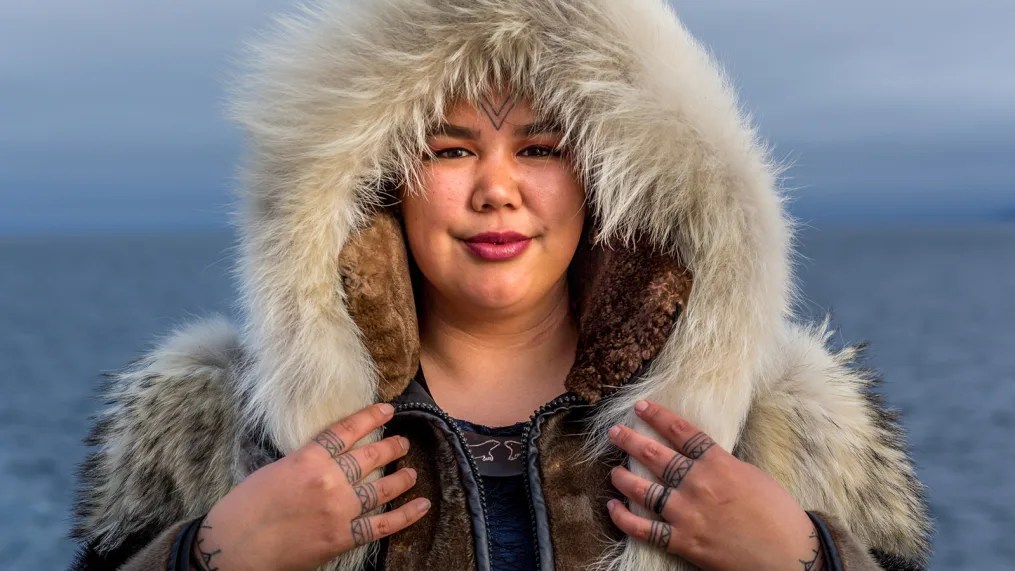
Candice Pedersen, a guide for One Ocean Expeditions in the Arctic, tells passengers that Inuit women feel empowered reclaiming traditional tattoos for themselves.

I love the radio show called The World because of the international focus. It always has a deeper take on mainstream media stories, and you can hear music you’re unlikely to be exposed to anywhere else. Recently, Joshua Coelda, Sejersdal Dreiager, and Shirsha Chakraborty reported about a tradition that is coming back from the brink: Inuit tattoo art.

“Najannguac Dalgård Christensen, 35, pulled back her sleeve on one forearm to reveal a pair of tattoos shaped like train tracks across her wrists. …

“These are traditional Inuit tattoo patterns that speak to her Indigenous Inuit heritage. The markings, she said, represent Sila, a word that carries many meanings, including ‘breath,’ ‘sky,’ ‘spirit’ and ‘universe.’

“To Christensen, who got the tattoo several years ago, it also means ‘the Greenlandic belief that we should be aware of who we are and what we can be, and that is attached to each other.’

“In precolonial times, Inuit women of Greenland, and across much of the Arctic, would have tattoos on both their bodies and faces, holding important pre-Christian spiritual meaning. Today, some Greenlandic Inuit like Christensen are reclaiming their identity through this long-lost art. 

“She said that she didn’t always embrace her Greenlander identity — because it is often associated with negative stereotypes about the Inuit diaspora living in Denmark, who colonized the North American island three centuries ago.  

“ ‘I felt empowered by getting the tattoos because it was like there was some kind of relief that I didn’t have to be embarrassed about being a Greenlander anymore,’ Christensen said. …

“The custom itself is far from new, but tattoos were some of the first traditions to be discouraged when Danish-Norwegian missionaries started colonizing the island at the beginning of the 18th century. The missionaries found tattooing incompatible with Christian faith, [Randi Sørensen Johansen, intangible cultural heritage curator at the Greenland National Museum and Archives] said. …

“As the custom disappeared, so did much of the knowledge about the tattoos’ meaning. ‘We didn’t have that tradition of writing down,’ Johansen said — Inuit passed knowledge through oral storytelling. …

“Inuit would use amulets to protect them from ‘unwelcome spirits,’ but also to help certain attributes or ensure a successful childbirth, among other things. It is likely, Johansen said, that Inuit tattoos were seen as a kind of amulet, giving strength, help or protection to the women or — in rarer cases — men who had gotten them.

“The tattoos were most often made as linear patterns across the brow and vertical lines on the chin made by using both a puncture or dot technique and a sewing technique. The latter technique consisted of pulling sinew dipped in soot under the skin with a needle made of animal bone, curator Johansen said.

“Maya Sialuk Jacobsen is one of about a dozen Inuit tattoo artists across the globe reviving this traditional art. … It was she who created Christensen’s tattoos. For over six years, she’s been helping Inuit like Christensen who live in Denmark connect with their culture through ink. Like Christensen, she is of both Danish and Greenlandic Inuit descent — a group she describes as an emerging ‘third culture’ in the Scandinavian country.

“The community is fairly small in Denmark and not well-defined demographically. According to StatBank Greenland, there are a little under 17,000 people born in Greenland currently living in Denmark. But community leaders, including from the Greenlandic House of Aalborg, aren’t even sure about the exact number of Inuit in Denmark. The number of self-identifying Inuit could be even higher, due to the presence of third-culture community members, who are partially Inuit. …

“Sialuk Jacobsen said, ‘It’s basically identity work all the time.’  Many come to her with a feeling of sadness, in search of a sense of belonging, she said. ‘They need to talk about these things, and to learn about the culture, they just want to learn.’ …

“While Sialuk Jacobsen said she uses inks and needles approved for tattooing on clients in Denmark, her research into the traditional techniques has included experimental tattooing on herself, and using her own right leg as her test area to reconstruct authentic methods of inking up.

“But in Denmark, finger, hand and face tattoos are prohibited (though it’s not illegal in Greenland). So, Sialuk Jacobsen is limited to tattooing the rest of the body. …

“The legacies of colonialism hang heavy over the community living in Denmark. Greenlanders are overrepresented among Denmark’s homeless population — accounting for 7% of people experiencing homelessness, according to VIVE.

“In recent years, Denmark’s colonial past came under public scrutiny.  For her master’s degree, Christensen looked into a form of ‘modern boarding schools.’ She found that Inuit children in Denmark are more likely than Danish children to be taken away from their families and placed in foster homes, which are almost always Danish families. 

“ ‘They learn to speak Danish, and there isn’t any focus on the Greenlandic language, so they lose their Greenlandic language. And when the parents only speak Greenlandic, they can’t talk to each other without an interpreter.’

“Christensen, who has become an activist through her research, believes the government should make it at least mandatory for Inuit children living in foster care to have lessons on Greenlandic.”

More at PRI’s The World, here, and CNN, here.

Read Full Post »

Photo: Melanie Stetson Freeman
The
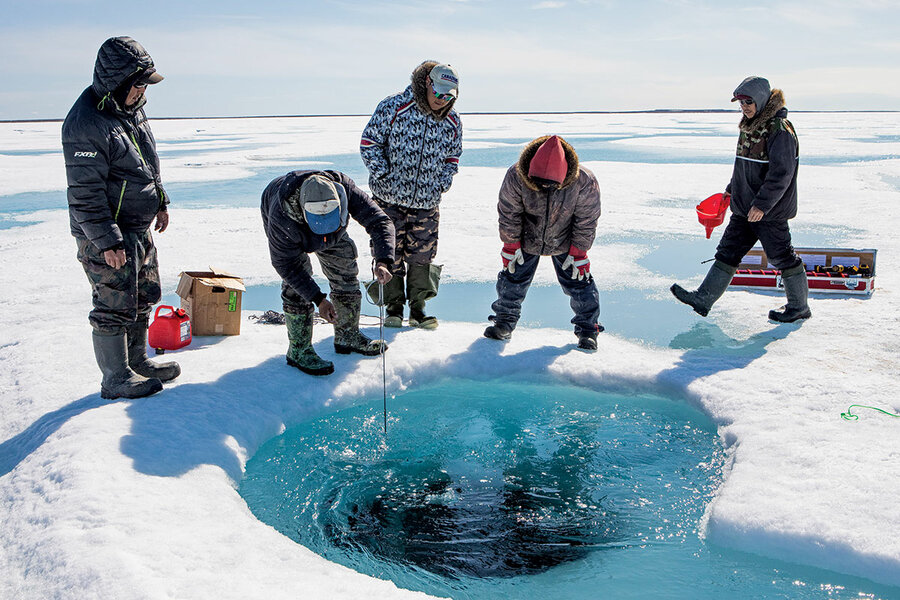
Christian Science Monitor highlights indigenous “Guardians” who made a “hole in Arctic Ocean ice – a window on climate-related changes – where they monitor water quality and measure ice thickness.

Cold parts of the world are threatened. The cold-loving people who live there are deeply concerned and are monitoring the losses for climate scientists.

Sara Miller Llana writes for the Christian Science Monitor, “Masked against the Arctic glare in orange-tinted sunglasses, Tad Tulurialik is a modern conservation ‘Guardian’ of his fast-melting homeland.

“At the start of an early summer workday that never sees the sun set, he kicks his all-terrain vehicle into gear. Safe in his ancestors’ knowledge of sea currents and ice fissures, he navigates a course right off the edge of the Canadian shore onto the aqua iridescence of the frozen Arctic Ocean. He’s following older Guardians to a manmade hole in the ice shelf, a window toward understanding climate-related changes in the sea.

“Even out on the ocean surface, his rifle is always swung over his shoulder. Wherever he sees a caribou or musk ox, it’s an existential given that he’ll take it. Food security isn’t found in a grocery aisle in this northernmost Canadian mainland settlement, tellingly named with the Inuktitut word for a caribou hunting blind.

“In some ways, as a government-paid conservation Guardian in training, the 24-year-old Mr. Tulurialik is doing what he’s done his whole life. Like most Inuit boys, he was ‘on the land’ as soon as he could walk. His childhood was spent on tundra and on sea and lake ice to hunt and fish with his grandparents, who raised him. His life was marked not by school grades but by first fox trapped, first polar bear shot. These were such priorities that he dropped out of high school.

“That could have made him part of Canada’s persistent social inequality – Indigenous youth in some of the remotest parts of the country, undereducated, underqualified, and often losing touch with rich traditions and fleeing homelands for economic opportunity. Except today, he’s part of a solution, as a member of Canada’s Indigenous Guardians, a conservation corps working in 170 far-flung Indigenous communities.

“Guided and taught by elders, he and other young Inuit born since 1989, when warming of the Arctic turned precipitous, are part of an effort to safeguard their homelands and their cultural ‘right to be cold.’ They’re also helping Canada achieve international conservation commitments made last year, when it led a global pledge at the United Nations Biodiversity Conference in Montreal to protect 30% of its land and oceans by 2030.

“For Mr. Tulurialik, who worked in construction and sewer maintenance after leaving school, a paid job as a conservationist is a dream: ‘I never thought I would work and get paid for what I grew up doing.’ 

“Together, he and his Guardian colleagues are tasked with creating a sustainable future, transforming Western-style conservation work into something that more closely resembles a traditional Indigenous environmental ethos. Guardians blend science with Indigenous knowledge in a budding conservation economy dependent on the transfer of knowledge from elders to youth. 

“The ultimate aim of the Guardians’ work in Taloyoak is to use their sustainable Inuit practices – learned orally over millennia – to support the creation and maintenance of an Indigenous Protected and Conserved Area. The size of Maine, it is one of more than 90 in development across Indigenous Canada. Here in northern Nunavut territory, the IPCA conservation plan is led by the local hunter and trapper association.

It’s nurturing an economy of land-based jobs and markets as an alternative to a future in extractive industries in a territory long eyed by mining and oil interests.

“The land will be protected from development, conserving both biodiversity and a way of life based on sustainable hunting and fishing – while sequestering huge amounts of carbon, the culprit in global warming.

“ ‘This is a win-win situation’ … says Paul Okalik, the first premier of Nunavut who now works with Canada’s World Wildlife Fund (WWF), which is supporting Taloyoak’s efforts. …

“Indigenous lands, from the Brazilian Amazon to Hawaii coastlines to Canada’s high-latitude forests, represent 20% of the globe but hold 80% of the world’s biodiversity. Inhabitants have stewarded the land for centuries. Yet in a warming climate, their homelands are in some of the most at-risk environments. 

“The Arctic is this nation’s – and arguably the world’s – crisis point. Here, warming is happening at up to four times the rate of the rest of the world, leading to melting permafrost, retreating glaciers, and receding sea ice. This has broad implications for the global ecosystem. Arctic ice melt slows ocean currents and makes the oceans more acidic – changes that have global implications for both climate patterns and sea habitats. Increased melting also creates what scientists call a ‘positive feedback loop’: As dark water replaces white snow on ice, the surfaces of the ocean and Earth absorb more sunlight rather than reflecting it. This causes even more warming. …

“Taloyoak locals have already worried about warming changing their ways. Last summer was the Northern Hemisphere’s hottest on record. The year prior, Taloyoak recorded its all-time hottest temperature of 78.8 F. Locals stayed home rather than go outside in, for them, the unbearable temperature.”

Imagine the high 70s being unbearable! The rest of North America will be learning about “unbearable” soon — if it hasn’t already.

The Monitor‘s long and intriguing feature on the work in the far north is here. No firewall.

Read Full Post »

Art: Stella Teller.
“Seated Storyteller with Four Children.”

For too long, the dominant culture has missed out on some great storytelling. Gradually that is changing, and indigenous playwrights are part of the change.

Mark Kennedy wrote at the Associated Press (AP), “The financial crisis of 2008 hit Mary Kathryn Nagle differently. As a playwright and a citizen of the Cherokee Nation, she saw parallels to events that negatively impacted Indigenous people centuries ago.

“Her play Manahatta juxtaposes the recent mortgage meltdown when thousands lost their homes to predatory lenders with the shady 17th-century Dutch who swindled and violently pushed Native Americans off their ancestral lands. …

“Nagle’s 2018 play has landed in New York City at the prestigious Public Theater this winter and it’s just the latest in a flowering of Native storytelling. From Reservation Dogs, Dark Winds and Rutherford Falls on TV to Prey on the big screen and Larissa FastHorse becoming the first Indigenous female playwright on Broadway, barriers are being broken.

“ ‘I hope it’s not a moment. I hope it’s the beginning of an era,’ says FastHorse, a member of the Sicangu Lakota Nation and a 2020 MacArthur Fellow. …

“ ‘[Most] film studios had never produced any content actually written or produced by Natives. It may have been about some Native people, but it was not written by Native people. And we’ve just seen that flipped on its head,’ Nagle said. …

“Nagle recalls moving to New York in 2010 and asking artistic directors of theaters why they weren’t producing Native work. They would answer that they didn’t know any Native playwrights or that there weren’t enough Native audiences to power ticket sales.

“ ‘Good storytelling is good storytelling, whether the protagonist is white, Black, Asian, LGBTQ — it doesn’t matter,’ said Nagle, who is on the board of IllumiNative, a nonprofit working to deal with the erasure of Native people.

” ‘There’s a lot of projects out there that are changing the narrative and that are proving that our stories are powerful and that non-Natives are really moved by them because they’re good stories.’

“Madeline Sayet, a playwright and professor at Arizona State University who also runs the Yale Indigenous Performing Arts Program, sees the contemporary Native theater movement flowing from the Civil Rights Movement of the ‘60s and ’70s and an increase in awareness of Indigenous issues ever since Native people won the right to legally practice their culture, art and religion.

“She connects the Wounded Knee occupation of 1973 to the Standing Rock standoff over the Dakota Access Pipeline in 2016 to Ned Blackhawk’s The Rediscovery of America: Native Peoples and the Unmaking of U.S History winning the National Book Award this year.

“Sayet, a member of the Mohegan Tribe who became the first Native playwright produced at the Public when her Where We Belong made it in 2020, said keeping Indigenous stories being produced depends on changing funding structures and getting long-term commitments from theaters and programs like Young Native Playwrights Contest.

“FastHorse, who made history on Broadway in 2023 with her satirical comedy The Thanksgiving Play, which follows white liberals trying to devise a culturally sensitive Thanksgiving play, has since turned her attention to helping rewrite some classic stage musicals to be more culturally sensitive. …

“She has recently reworked the book for an upcoming touring musical revival of the 1954 classic Peter Pan, which was adapted by Jerome Robbins and has a score by Moose Charlap-Carolyn Leigh and additional songs by Jule Styne, Betty Comden and Adolph Green.

“FastHorse found the character of Peter Pan complex, the pirates funny, the music enchanting but the depictions of Indigenous people and women appalling. There were references to ‘redskins’ throughout, a nonsense song called ‘Ugh-A-Wug’ and Tiger Lily fends off randy braves ‘with a hatchet.’ …

“FastHorse widened the concept of Native in the musical to encompass members of several under-pressure Indigenous cultures from all over the globe — Africa, Japan and Eastern Europe, among them — who have retreated to Neverland to preserve their culture until they can find a way back.

“The playwright said one of her guiding principles in the reworking was to make sure a little Native girl in South Dakota could see herself and celebrate. ‘Then we’ve done our job and she can join the magic instead of having to armor herself against the magic.’ …

“ ‘I think one thing I’m just hoping that people take away from this play is like, “Wow, Native stories are really compelling. Native people are incredible. They’re incredibly resilient. They’re incredibly brilliant. Yes, there’s tragedy, but they have such incredible senses of humor,” ‘ [Nagle] said.

“ ‘I want them to love my characters the way I love them. I want them to feel the heartache. I want them to feel the laughter. I want them to feel the love,’ she said. ‘And I want them to leave the theater just wanting to know more about our tribal nations and our Native people.’ ” More at AP, here.

Got ideas for a show that needs the red pencil of FastHorse? I’d start with Annie Get Your Gun. Come to think of it, that show also needs the red pencil of poor, white mountain people. Their presentation is painful, too.

Read Full Post »

Photo: Erika Schultz / The Seattle Times.
Gail White Eagle, a master cultural traditions specialist and master weaver at Muckleshoot, shows a cedar tree where she has traditionally stripped cedar bark for weaving baskets, hats, and more.

There’s always something more to learn about the generations that inhabited North America before European settlers came. Today’s article explains how indigenous people both used and managed forests, and how some continue to do so today.

Environmental reporter Lynda V. Mapes writes at the Seattle Times, “On a promontory above Puget Sound, a Douglas fir with arms bent at right angles stands above a quiet cove, where shellfish would have been gathered, long before this place was settled by newcomers. This tree was deliberately shaped by generations of hands into its current form, to mark what was here for countless years: rich clam beds, and a gathering site. … Modified trees are a connection interweaving generations of the region’s first people tightly as a cedar basket.

“ ‘It is the sacred fingerprint of the ancestors that shaped this place,’ said Sam Barr, a Samish tribal citizen and tribal historic preservation office supervisor for the Stillaguamish Tribe.

“Another tree, a cedar near the tree on the promontory over the cove, is elaborately trained to grow with branches at 90 degree angles low on its trunk that also were cut and recut so the branches would fork, and then fork again. The result is an elaborate candelabra. This is a marker tree, Barr said, that may have denoted the village that was here — today a housing development. It may also have indicated the direction toward the confluence of the deltas of the Skagit and Stillaguamish rivers that also fork and refork. …

” ‘People don’t think about it much, but we truly are living in an Indigenous garden, from which the gardeners have been forcibly removed,’ Barr said. ‘The entire landscape around the Pacific Northwest was carefully managed and stewarded by Indigenous hands. And there are traces of this everywhere.’

“Trees were stripped for bark for weaving, trees were planked for building materials, trees were made to serve as indicators of everything from trails, to a water source, a rich area for harvest, village or sacred place. …

“Trees are slow growing, and for a marker tree, it takes multiple generations of a family to curate it. … The presence of modified trees all over the landscape today, and continued traditional use of cedar in particular, binds tribes up and down the West Coast. … The Snoqualmie Tribe recently identified — and the state registered as an archaeological site — a modified tree in a lot being cleared for new homes in the Wedgwood neighborhood of Seattle. …

“Gail White Eagle, a Muckleshoot master weaver, said she always looks forward to this moment, as she paused the tribal van at a yellow gate that opens to a forest road in the foothills of Mount Rainier. She was about to enter Tomanamus Forest, 105,000 acres of forest land in King, Pierce and Lewis counties purchased by the Muckleshoot Indian Tribe in 2013. …

“The forest is in part of the territory ceded by the tribe in its treaty with the U.S. in 1855. Taking the forest back into tribal ownership was an act of healing, White Eagle said. Every tribal member can request a key to the gate, unlike at other forests that used to be theirs, now owned by other governments, corporations and individuals.

“A soft misty rain was falling as she walked into the forest, looking for trees from which she had harvested bark the previous spring. … She explained the harvesting process, which always begins with asking permission before taking anything.

She gives an explanation to the tree that its bark will be put to good use. And she often leaves a gift at the tree’s base, such as a bit of tobacco, sage or smoked fish.

“It’s a gesture of thanks and reciprocity in the relationship she holds with this tree, and this forest.

“White Eagle put her hand gently on the healing bark scar, and explained she is careful never to take a piece wider than two hands’ length. She chooses trees only big and robust enough for her to hug. And she pulls bark only in spring, when trees are full of sap, making the harvest easier on her and the tree. A tree can be harvested multiple times over many generations of users, if the harvest is done correctly.

“Tree wounds that penetrate bark damage the cambium layer, vascular tissue that is vital to movement of water and nutrients in a tree. The tree will seal and close the wound, compartmentalizing it with healing lobes to cover it and prevent rot. As long as a tree is not girdled — cut entirely around its circumference, severing all the vascular tissue — it will continue to live.

“Sometimes modified trees are recorded by tribes and government land managers as archaeological sites. But much more often, these trees are known only to the families that use them.

“Jacob Earnshaw is an independent archaeologist based in Victoria, B.C., who works to find and register modified trees as archaeological sites. His work has been entered as evidence in a right and title case in B.C. with the Nuchatlaht First Nation, who are working to prove their long presence on the northern half of Nootka Island on the northwest coast of Vancouver Island, to regain control of lands they never ceded. That case has not yet been resolved.

“Earnshaw has documented more than 1,000 years of cutting and pulling bark for harvest on Vancouver Island. The trees show management of these forests, Earnshaw said, by the island’s first people to protect what was an exhaustible resource. ‘What we are looking at is woodland management by these people who were thought of as hunter-gatherers,’ he said.

“That term is a myth, says Chelsey Geralda Armstrong, assistant professor in the Department of Indigenous Studies and School of Resource and Environmental Management Studies at Simon Fraser University in Burnaby, B.C. The first people didn’t just pick up what they needed here and there; they managed and cultivated their land and waters just as they do today — and evidence of their ancestors’ practices persists in the landscape.

“Armstrong teamed up with Earnshaw and other researchers to publish a 2022 paper that described forest gardens on Vancouver Island with still-evident remnants of cultivation, transplanting and all the other usual horticultural arts. The gardens were just part of the associated archaeological evidence of long prior use, including clam gardens, village sites, shell middens and trees in the nearby forest bearing scars of harvest for bark and other needs.

“Their work shows that far from an unpeopled wilderness, the Northwest Pacific Coast was a managed and stewarded place for thousands of years.” More at the Seattle Times, here.

Read Full Post »

Map: Wikipedia.
Eastern Abenaki tribes (Penobscot, Kennebec, Arosaguntacook, Pigwacket/Pequawket). Indigenous people often exhibit the best stewardship of natural resources.

What can we learn from people who have been taught from infancy how to live in harmony with the natural world? In an op-ed at the Washington Post, Bina Venkataraman suggests that “in Maine, a return of tribal land shows how conservation can succeed. …

“On a recent morning at the Penobscot Nation headquarters, moose mating rituals dominated the office banter: the wacky way a lovesick moose had stumbled around someone’s pickup truck [when] he heard a hunter’s [mating call]. …

“The Penobscot Nation’s record of caring for nature while still using it — hunting moose and duck while keeping their populations steady, selectively harvesting timber to preserve forests and restoring rivers to support fisheries — inspired an effort to return a 31,000-acre tract of forested land to tribal ownership.

“Late last year, the Trust for Public Land, a conservation group, bought the parcel from an industrial timber company, and today it announced it will give the land to the tribe once it pays off $32 million in loans. …

“The land is close to Mount Katahdin, sacred in Penobscot tradition, and to an 87,000-acre national monument created in 2016 in the North Woods of Maine. It contains 53 miles of streams in the watershed of the Penobscot River, which has been for the tribe a central highway and a source of food and water.

“The transfer is part of a movement to return lands to Indigenous stewardship and work with tribal communities to protect biodiversity. The hope is both to restore justice for tribes that were long ago stripped of their ancestral homelands and to learn from long-standing Indigenous practices new ways to save a beleaguered planet. The pending land return in Maine, or ‘rematriation’ as some Indigenous people call itstands out because of its scale — many previous land returns in the eastern United States have been on the order of hundreds of acres — and because the Penobscot will decide how the land will be managed.

“This is a significant change. For most of the past two centuries, Western conservationists have largely ignored Indigenous people’s knowledge of landscapes and wildlife, along with tribes’ historic claims to the land. But that is no longer tenable. Worldwide, Indigenous-managed lands host 80 percent of the world’s biodiversity, by some estimates, and encompass much of the world’s remaining intact forests, savannas and marshes. If environmentalists and political leaders hope to conserve more natural landscapes … collaboration with tribal nation leaders is critical.

Modern environmentalism has been deprived of Indigenous knowledge, in part, because it has seen nature as something apart from humans.

“Early thinkers hold some responsibility for this. John Muir, long lauded as the father of the national parks, believed that natural landscapes needed to be stripped of the Native Americans who lived on them to create his ideal of pristine wilderness. In the Muir tradition, the U.S. government drove tribal people out of areas that today are considered America’s most beloved landscapes — Yellowstone, Yosemite, the Everglades — a history documented by David Treuer, an Ojibwe writer.

“The federal government created the National Bison Range in 1908 by evicting tribal members from more than 18,000 acres of the Flathead Indian Reservation — ignoring century-old practices for keeping up the bison herd. Only recently has the government returned the land to the Confederated Salish and Kootenai Tribes, whose successful traditional methods for maintaining the herd are featured in a forthcoming ABC documentary.

“When Henry David Thoreau … traveled to the Maine woods in the 19th century, he distinguished between ‘scientific men’ and Indian guides, even as he acknowledged the latter’s navigational expertise. It’s laughable now to think that communities that had inhabited a place for centuries, gaining intimate knowledge of the natural features, flora and fauna and passing down that knowledge across generations, could have less to offer scientifically than settlers encountering those lands for the first time. Yet it was only last year that the U.S. government formally recognized how much tribes can contribute to ecological knowledge of their ancestors’ landscapes. …

“For decades, tribal members in Maine advocated bringing down Penobscot River dams that once powered saw and paper mills to restore an Atlantic salmon fishery. The Penobscot method of timber harvesting, which leaves 75- to 100-foot buffers of trees around rivers and streams, creates ideal conditions for salmon. Salmon like to spawn upriver in shady pools, created by allowing the forest at a river’s edge to thicken and birch trees to fall into it. …

“Some evidence suggests that, globally, the track record for Indigenous management of wildlife is at least as good as that of formal conservation. Researchers have shown, for instance, that Indigenous-managed lands in Canada, Australia and Brazil contain biodiversity equivalent to that of areas designated for conservation.

“But perfect alignment between tribes and environmental groups doesn’t always happen. The economic challenges that many tribes face — and their efforts to acquire land to reclaim sovereignty — often force tough decisions about development, gambling and heavy industry. Some tribal nations have greenlighted oil and gas drilling. The Penobscot have allied with conservationists to oppose a proposed zinc mine in northern Maine because of its likely harm to fisheries. But several tribal members expressed to me their misgivings about wind farms, which most environmentalists see as essential to combat climate change.

“Penobscot leaders have varying visions about how they might one day develop the land that is now being returned to them. Some imagine using it to adapt to sea-level rise — by building housing or growing food; others envision ecotourism lodges or a cultural center that could be accessed by the general public. In the near term, tribal leaders aim to make it accessible to hikers and hunters with permits and to offer public access to the national monument via an old logging road.

“In other parts of North America, co-management of conservation areas is becoming more common. … Groups such as the Trust for Public Land and the Nature Conservancy are brokering more land returns and collaborating with tribes to manage ecologically important landscapes. But more private landowners, philanthropists, nonprofit groups and governments should mimic the efforts in Maine. …

“Environmental movements might have better protected nature if they had long sought to conserve cultures and communities along with land. Earning the trust now of people who have inherited wisdom for living in balance with nature will give conservation a fighting chance on a warming planet.”

More at the Post, here.

Read Full Post »

Photo: Plant Image Library, Flickr, CC BY-SA 2.0.
Pawpaw trees provide a rich tropical fruit, whose flavor has been compared to that of mangoes and bananas. Loved by Native Americans, pawpaws once fed people escaping slavery.

Recently the environmental radio show Living on Earth took a look at a fruit long beloved of indigenous people, the pawpaw, and asked whether it might be a good plant to introduce beyond its traditional range.

“STEVE CURWOOD: In many parts of North America, it’s well past harvest time, but not for the pawpaw. The pawpaw is a native fruit in the Eastern US that ripens in the late fall. Pawpaws were a delicious food source for Native Americans, as well for people escaping from slavery on the journey North to freedom. And there are still some pawpaw patches feeding folks today, though you can’t find them in grocery stores. Last spring When Living on Earth’s Bobby Bascomb spoke with Michael Weishan, former host of The Victory Garden on PBS, about gardening amid the coronavirus, Michael offered to dig up a few of his pawpaws for Bobby to try growing at home. …

“MICHAEL WEISHAN: Welcome to my pawpaw grove. So in front of us is the tree, It’s probably now about 30 feet tall and 15 feet wide. These are big, long lanceolate leaves [about] seven, eight inches long, three inches wide. And then as you go up, you see that they’re starting to change color. And that they’re a brilliant, brilliant yellow, which is one of the great fall features of this tree. …

“BOBBY BASCOMB: I’ve never seen one in the flesh, so to speak. [I] thought that they would be maybe bigger or greener or something.

“WEISHAN: It looks something like a green potato, wouldn’t you say?

“BASCOMB: Yeah, it’s a green potato. They’re sort of stuck together like a snow man or something. …

“WEISHAN: They’re not in commercial production because they’re very variable. So it would be very hard to ship them. They’re also, here you can feel one, they’re also quite soft.

“BASCOMB: Yeah, it’s like a ripe avocado. …

“WEISHAN: These trees are very unusual in that they form thickets … and they’re all tied via underground runners. And so when you try to go dig one up, you sever the runner. …

“BASCOMB: Now do they only reproduce by sending out runners? Or can you also take a seed and grow it and get a pawpaw? …

“WEISHAN: You can definitely plant the seeds. And presumably, that’s how this was grown. And that would actually be an easier way to propagate than these cuttings because then of course, it would form the roots within the pot. …

“The flowers are really interesting, too. They’re beautiful, long [inch] and a half flowers of a dark sort of vermilion purple color. And, interestingly, they have very little smell or a very unpleasant smell depending on your nose.

[They’re] propagated by flies, and not by bees. They bloom very early, before the bees are active. …

“BASCOMB: I was under under the impression that they grow really well in the south, like the Mid-Atlantic region and New England was sort of pushing the envelope for pawpaws. But yours looks pretty good here. …

“WEISHAN: We are at the northern edge of the range. So how much further north they will go? I don’t know. You’re right. They’re very well known down in the Mid-Atlantic and southeastern United States. However, with [climate change] things are moving north. …

“Plant it. If it dies, try the seeds. … I’m just gonna cut this open and then split it apart. [You] can see it’s like a banana. So at this point, I’m gonna give you a spoon. And these are the big black seeds. And you just take the seeds out, and then scoop it out like you would custard.

“BASCOMB: Hmm! It’s so good. Not what I expected. Everybody says banana and mango. And it’s got like, the texture of banana maybe, but …

“WEISHAN: It’s a delicious eating experience prized by the Native Americans. Of course, this was a principal food source all up and down the East Coast. A beautiful tree, great flower, great fruit … and great fall color. So if you can grow one of these in your yard, I highly recommend it.

“BASCOMB: [They] taste like a tropical fruit, almost, here in New England, which is so unusual. But … we’re into November and you’re just now harvesting these. That’s pretty unusual. [Even] apples are sort of on their way out at this point.”

More at Living on Earth, here. I’m thinking Deb will know something about pawpaws. Her blog has taught me a lot about life in the South.

Read Full Post »

Photo: The Nicholson Project.
The Uptown Singerz are a DC-based intertribal Native American Northern powwow drum group that performs powwow, ceremonial, and in some cases political songs.

We are all enriched when previously below-the-radar groups begin to share their culture more widely. The featured article for today is from the Washington Post and highlights a cultural collaboration by members of several indigenous tribes.

Dana Hedgpeth writes, “When Nick Courtney came to D.C. seven years ago to work on education issues, he missed his Native American tribe in Washington state.

“Longing to connect with other Native Americans in the region, the 31-year-old member of the Makah Tribe helped form the Uptown Singerz, a Native American drum group that shares and celebrates their heritage.

“ ‘D.C. is a transient city because folks come and go, so that can be hard,’ said Courtney, who lives in Baltimore. ‘I still long for my own culture, but this fills my cup. It’s a bond, and I’m a part of something that’s allowed me to build a community here. It’s like a family for me.’

“In the United States, roughly 9.7 million people — or about 3 percent — of the overall population — identified themselves as being American Indian or Alaska Native in the 2020 Census. Fewer than 1 percent of people in the District, Maryland and Virginia said they are American Indian or Alaska Native.

“There are more than 500 federally recognized tribes in the country, and more than 70 percent of American Indians live away from their tribal reservations or communities.

“Being a part of Uptown Singerz gives members who are far from their tribes’ home ‘a renewed sense of community and family every time we sing, every time we drum,’ said Mary Phillips, the group’s lady backup singer (as the role is officially called by Native Americans), who is from the Omaha Tribe in Nebraska and the Laguna Pueblo Tribe in New Mexico. …

“The Uptown Singerz … practice several times a month and perform up to 20 events a year in theaters, rallies, community events and Native American gatherings and powwows in the D.C. region to showcase their talents and educate the public. They, along with the Zotigh Singers — who are from the Kiowa Tribe of Oklahoma and live in Waldorf, Md. — are one of the few American Indian drum groups in the D.C. region.

“ ‘Having the Uptown Singerz is so important because they help keep our culture alive here in D.C.,’ said Angela Gladue, 38, who is a powwow and hoop dancer. A Cree and a member of the Frog Lake First Nation in Alberta, Canada, Gladue moved to Northeast Washington six years ago and got to know other American Indians in the area, along with the drum groups. …

“The Uptown Singerz typically play around one large drum made from wood and dried animal hide. Sometimes they play smaller hand drums. Considered sacred and often used at events and some ceremonies, the drum for many American Indians represents the heartbeat of Mother Earth.

“They follow the Native American tradition of having only men sit around the drum. Women stand behind them and join in the singing because ‘women carry the sacred water of life,’ empowering them to ‘absorb or change the energy of the people around them or the energy of the drum,’ Phillips said. …

“For Gladue, hearing the drum and seeing American Indians from different tribes gather and dance was a special moment. … ‘People will ask, “Indians are still here?” To be around other Natives and not have to explain myself makes me feel good.’ “

More at the Post, here.

Read Full Post »

« Newer Posts - Older Posts »