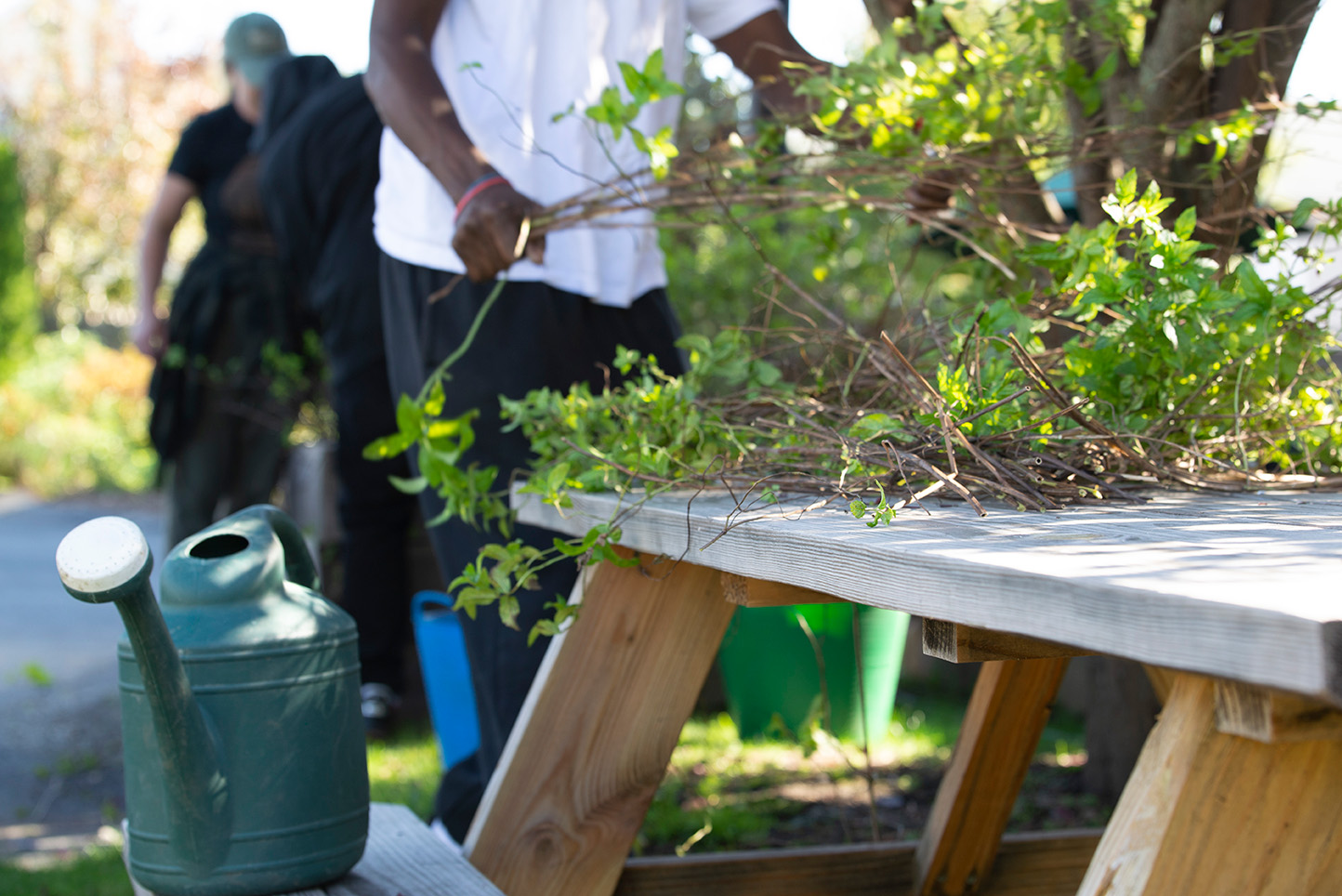
Photo: Joanna Detz/ecoRI News.
The Garden Time program in Rhode Island gives formerly incarcerated people a chance to prepare for reentry into society.
Today’s article about a program to help incarcerated people find work on the outside notes successes and failures. One of the featured participants, Anderson, ended up back in trouble with the law. Others have stuck with the hard work needed to move on.
Colleen Cronin wrote about the initiative at ecoRI News.
“The Green Jobs Reentry Training program run by Garden Time, a Providence-based nonprofit [is] an offshoot of a gardening program run by Garden Time at the Rhode Island Adult Correctional Institutions (ACI) since 2011, according to Kate Lacouture, founder and executive director. In addition to teaching incarcerated people about gardening, the ACI program also helps participants on an individual level with reentry needs when their sentences end.
“Lacouture called the ACI training a ‘pre-employment program,’ because Garden Time teaches gardening, horticulture, and other green industries and brings in employers from those fields to teach and get to know program participants. …
“When the pandemic hit, Garden Time started expanding its work outside the prison. Lacouture said the organization started a garden at Open Doors, a nonprofit focused on reentry in the city’s Silver Lake neighborhood. Working in that garden regularly planted the idea of a formal reentry and job training program for individuals who were out of prison and trying to integrate into the community, Lacouture said.
“Garden Time ran a shorter reentry training pilot program in fall 2021, and thanks to its success, it was funded by the state Department of Labor and Training as a Real Jobs Rhode Island program. This allowed Garden Time to expand the program from six to eight weeks, offer larger weekly stipends to participants ($400 a week), and provide lunch Monday through Thursday.
“For participants of the program who have just left prison, ‘it’s really nice to have a nice landing spot,’ Lacouture said.
“The program also provides students with Chromebook laptops, work boots, and other tools that participants might need on a job. They attend classes in a Manton Avenue classroom on topics such as arboriculture and nutrition, or receive hands-on training at various locations Monday through Friday. Friday mornings are spent at the Open Doors garden.
“During the last week of the program, the students participate in an internship, for which Garden Time pays.
“The internship ‘becomes like an extended job interview, like a chance for the person to prove themselves, a chance for the employer to be comfortable with it,’ Lacouture said. ‘Because a lot of times, you know, you ask an employer if they would hire formerly incarcerated people, and they don’t really know what that means. It sounds scary. They don’t know what that entails.’
“By the end of the program, those who graduate become official Providence tree keepers, receive an Occupational Safety and Health Administration (OSHA) certification for completing a 40-hour training, and hopefully find full-time positions in a green industry job, Lacouture said.
“Participants must attend most of the classes to complete the program, but on the first Friday of the 2022 session, one of Lacouture’s star students was missing.
“Attending classes can be difficult for anyone who has recently been released from prison or has a police record. Suspended or revoked licenses, little funds for car insurance or a car itself, and sporadic and mandatory parole meetings and other legal hearings can all complicate attendance.
“But Ace, who … met Lacouture inside the ACI, missed the first Friday class because of a cat.
“Ace had been working for Groundwork Rhode Island earlier that week, when he saw a stray cat and couldn’t help picking it up, Lacouture said, despite his allergy to cats. The contact caused Ace’s asthma to flare up, keeping him from Friday’s class. …
“Since Ace was released from the ACI, before COVID, he has accumulated cats, dogs, and tons of pepper plants, gotten married, and started his own landscaping business.
“He knows some of the other participants in the reentry program, living in temporary housing and lacking satisfying work, struggling to maintain their connections in the world outside prison walls, looked up to him.
“Even though his success might look easy and the way he speaks and presents himself might seem completely controlled, his journey has been long, he said. He speaks mostly light-heartedly about the past and his hijinks while also admitting to deep pain and trauma. …
“ ‘I’m always getting in trouble,’ Ace said.
“He can talk about growing up in Liberia and sneaking into a neighbor’s garden to snatch fruit in the same easy tone as he discusses the trials of his addiction. And he readily speaks about the therapist he sees regularly to help him with his addiction, as well as attending Alcoholics Anonymous meetings.
“To overcome some of his challenges, Ace said he has had to make adjustments. The green jobs program starts at 9 a.m., but Ace regularly gets there hours early. If he picks his wife up from work, often at 2, 3, or 4 o’clock in the morning, sometimes he chooses to stay up, so he knows he’ll be ready for the class, he said. …
“On an unusually cold Friday morning, John Kenny, owner of Big Train Farm in Cranston, visited Open Doors to talk to the reentry program participants about green farming practices and how they could start their own farms.
“The Farm Service Agency (FSA) within the U.S. Department of Agriculture offers several different loan programs and has targeted incentives for women and people of color.
“ ‘I’m not going to kid you,’ Kenny said, going on to explain that even with help, obtaining a loan and starting a farm isn’t easy. …
“Ace has tried to let a lot go. He knows he’s made mistakes, and he tries to make up for them. He knows his life has been unfair, but he tries not to think about it. On the other hand, injustice boils under Anderson’s skin when [the 57-year-old military veteran and former oil-platform builder] talks about the environmental hazards Black and brown Americans face and their connection to the cyclical criminal justice he and others have experienced.
“Two million people are currently incarcerated in the United States. Out of the 11 participants that arrived at the first day of the reentry program, most were men of color. Two people were white. There was only one woman in the class. The group reflects the larger pool of Americans who are or have been incarcerated. …
“Like many of the people who have been incarcerated around the country, several of the participants in Garden Time’s green jobs program were in prison for long periods or repeatedly throughout their lives.
“A 2021 study of people incarcerated in Rhode Island showed that by the 3-year post-release mark, 47% had been sentenced again to prison. Many of them had been charged again within the first six months of their release date. Education programs inside a prison, like Garden Time, can do a lot to prevent this.”
Read the rest of the long article at ecoRI News, here. No firewall at this nonprofit, but donations are welcome.


 Suzanne's Mom's Blog