Feeds:
Posts
Comments

Posts Tagged ‘integration’

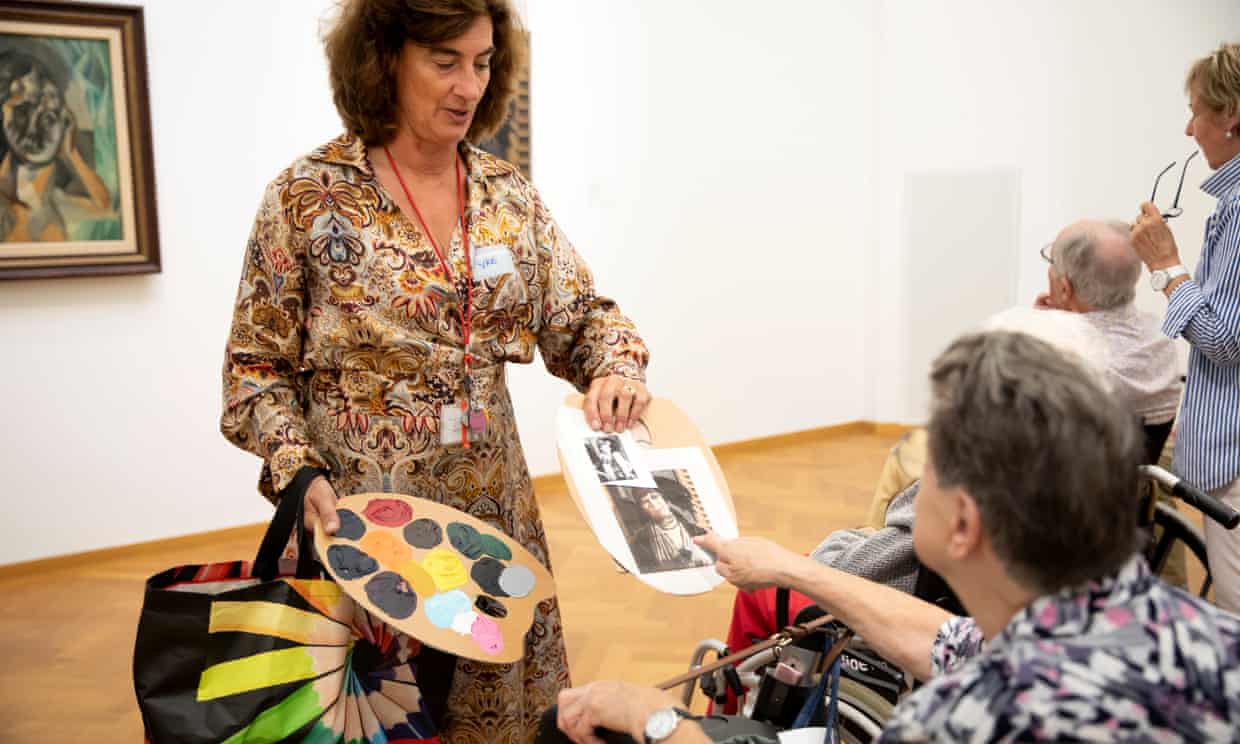
Photo: Judith Jockel/The Guardian.
As part of outreach to people in the Netherlands with dementia, Yke Prins uses a paint palette and spinning tops for a demonstration about colors.

About a year ago, I saw a meditation and breathing exercise that involves focusing on one’s five senses. Very interesting. (Click here.) Just as we don’t think about our breathing all the time, we don’t always think about how important each of our five senses is either.

Now I’m reading that one approach to reaching people with dementia also taps into the five senses. That is happening in the Netherlands, which is generally ahead of the curve on senior care. It’s from there that Senay Boztas reported today’s story for the Guardian.

“Eight people approached a fragrant carpet of lavender in the Kunstmuseum Den Haag gallery,” she writes. “Four of them had dementia and four were their relatives and carers. ‘Put your nose nearer the ground and smell it, it’s wonderful!’ called Annie Versteeg, 88, to Bwieuwkje Bruinenberg-Haisma, 90, in her wheelchair nearby.

“ ‘This tour is about color and here we have a color and it goes with a smell,’ said Yke Prins, the museum guide. ‘Do you know what it is? It is lavender. What does it make you think about?’

“This was no ordinary gallery tour, but a dedicated effort to welcome visitors with dementia and their carers. The new Art Connection tour ran for the first time [in June] and is scheduled for the last Friday afternoon of every month.

“ ‘The heart does not get dementia,’ said Maaike Staffhorst, the museum’s spokesperson. ‘People with dementia still have feelings [that] can give a sense of fulfillment. For the carer, this brings a level of equality. You can talk about the same thing.’ …

“On the inaugural tour, the residents of the Nebo care home and their carers looked at four artworks. … Prins opened up a bag of tricks: she whipped spinning tops to demonstrate how dots of color blend in front of the eye; pulled out palettes of color and, at the last work, coloring-in sheets.

“Bruinenberg-Haisma, who, her son Harry said, had been in the care home for four months after it became too difficult for him to look after her, wore a constant smile. ‘Beautiful!’ she said, several times.

“Another visitor, Jeroen Smit, 74, who was diagnosed with dementia after falling from his bicycle two years ago, said over tea before the tour that he struggled with daily life. ‘I can’t do it any more – I’m rudderless,’ he said. As the afternoon progressed, he visibly relaxed.

“The free art tours in The Hague– organized thanks to a bequest – were inspired by the Museum of Modern Art in New York’s Alzheimer’s Project. They are part of a larger push to adapt Dutch society as the population ages and one in three women and one in seven men will be diagnosed with dementia.

“This was a priority for Conny Helder, the last minister of long-term care. ‘It’s vital that we keep working to ensure that people with dementia are treated as valued members of society,’ she told the Guardian. … ‘Science shows that this can enhance cognitive functioning in many people with dementia, effectively giving them their lives back. All this requires a major change in thinking.’

“One driving force towards a ‘dementia-friendly‘ society is Alzheimer Nederland. The charity has helped create free, online training videos so everyone can recognize and respond correctly to signs of Alzheimer’s. …

“ ‘This is hugely urgent,’ said the director, Gerjoke Wilmink. ‘Right now, about 300,000 people are living with dementia in the Netherlands and this number will rise explosively to around half a million in 2040. But care and carers are not growing in tandem. It is essential that people with dementia can continue to participate … and this needs to be systematically embedded in our society.’ …

“Rotterdam’s deputy mayor for care, Ronald Buijt, described initiatives such as multilingual awareness programs for city workers and taxi drivers, and Alzheimer’s cafes for old and young. ‘The most important thing is for us to learn that these people should live as good a life as possible, and as normal a life,’ he said. ‘Let them do what they can still do.’ …

“Elsewhere in the Netherlands, a ‘participation choir‘ initiative matches singers with dementia with two supportive buddies, who pick them up and help them find their way in the songbook. ‘The musical memory stays intact for the longest time,’ said the choir’s founder, Erik Zwiers. ‘Caregivers, the audience, musicians all see that people with dementia can reach a higher artistic level than they often think. It gives a completely new view on how to deal with people with dementia – and it’s fun.’ ”

More at the Guardian, here.

Read Full Post »

I’m beginning to think that this period of history will come to be known as one of enormous creativity. It’s not just isolated incidents. I was working on the upbeat story below and skipping back and forth to Facebook, where each sign from the marches and each costume seemed to outdo the last — and where I saw women on the US-Mexico border weaving their hair together Friday — when it hit me. One and one and 50 have already made a million. And there is no sign of stopping.

The story I wanted to share is on a creative effort to help refugees, this time in the Netherlands.

Liz Alderman described it at the NY Times.

“Mahmoud al-Omar leaned over a sewing machine in the basement of a former prison being used to house refugees and began stitching jeans for a popular clothing line. With more than 15 years experience as a tailor in Syria, he zipped through one pair and moved on to another, methodically filling a small order.

“The job, set up by a Dutch organization that matches refugees with work opportunities, is only temporary. Yet after Mr. Omar fled his war-torn hometown, Aleppo, two years ago, just having a place to go each day felt like a salvation.

“ ‘Working is completely necessary to speed up integration,’ said Mr. Omar, 28, who still struggles to speak Dutch, hindering his chances of a full-time job. ‘I want to become independent as soon as possible, so I can start giving back to the country that took me in.’

“When more than one million men, women and children streamed into Europe last year to seek a haven from conflict and poverty in the Middle East and Africa, governments viewed the labor market as the quickest path to absorb newcomers. The sooner people started working, the thinking went, the faster they could get off government aid and start contributing to the economy.

“Yet permanent jobs have proven elusive. The lack of language is a big barrier, as is a skills mismatch. Some refugees do not have the right experience, while others cannot get their professional qualifications or degrees recognized.

“Private initiatives have sprung up across Europe to help. The Refugee Company, the Dutch group that steered Mr. Omar toward work, is one of scores guiding refugees into professional networks and opportunities to improve employability.” More here.

From the company’s About page: “Our mission is to empower refugees. We believe work is the best tool to integration; through work, refugees can blend in with their society and build up a new meaningful life in The Netherlands. We speed up integration by providing opportunities for newcomers upon arrival to utilize their talents again. …

“We decided Refugee Company will focus on craftsmanship. We provide work opportunities in the creation and hospitality sector, as that is where our roots lie. We see a growing demand for craftsmen and horeca [Hotel/Restaurant/Café] staff in the Netherlands.” More.

The Providence Granola Project does something similar in Rhode Island, though on a smaller scale. Language is definitely a barrier, so if you have always liked explaining English to people, consider volunteering near your home.

Photo: The Refugee Company


Read Full Post »

Sweden has taken in a lot of refugees from troubled countries, but like the U.S., it sometimes struggles to find the best approach for absorbing the influx.

At the NY Times, Suzanne Daley writes about one Swede who may have found an important way to speed integration, a way that enriches the experience of Swedes and newcomers alike.

“Last year, when Ebba Akerman, 31, was teaching Swedish to immigrants in the suburbs of this city, she ran into one of her students on the train and asked him whether he enjoyed living in her country.

“She found the answer deeply disturbing. The man shrugged, saying his life here was not much different from the one he had left behind in Afghanistan. It became clear to her that most of her students, living in neighborhoods packed with immigrants, had virtually no contact with native Swedes.

“In the months that followed, Ms. Akerman decided to try to change that, calling herself the minister of dinners in charge of the Department of Invitations and using Facebook and Instagram to try to bring individual Swedes and immigrants together for a meal, something like a dating service.

“ ‘We let people into our country, but not into our society,’ Ms. Akerman said on a recent Friday night. … ‘I finally decided that I had to do something. I could be the connector.’ …

“On a recent evening, Ms. Akerman was feeding about a dozen people, including a middle-aged couple from Bangladesh who had brought a chicken dish, a recent arrival from Cameroon with her two children, a Swedish marketing expert, the mother of one of Ms. Akerman’s friends and a young Swedish doctor in training, all of whom had been early participants in her project. All told stories of good times and miscues.

“The marketing expert, Henrik Evrell, said he had served spaghetti Bolognese, the most Swedish dish he knew, to his guest from Ivory Coast. At first they had trouble communicating because his guest’s Swedish was so poor. But soon they discovered that they both spoke French and loved the same Ivory Coast musicians. After eating, they spent the rest of the evening in front of a computer, taking turns pulling up music on Spotify that each thought the other would like.” More here.

Photo: Casper Hedberg for The New York Times
Ebba Akerman set a table on her backyard for a meal that brought Swedes and immigrants together. 

Read Full Post »