Feeds:
Posts
Comments

Posts Tagged ‘Inundation District’

Photo: Valerie Plesch/NPR.
The Washington Monument is seen from the sky lounge of the rooftop penthouse at Accolade, a former office building.

In Boston for a long time, builders of office buildings and politicians thought it was brilliant to build out some undeveloped low land called the Seaport District, or Innovation District. Environmental voices weren’t loud enough to compete with that sort of unity, never mind the tendency of that part of the city to flood. (See the movie Inundation District,)

Then came Covid.

Companies stopped relying on office buildings. Even after the intense days of the pandemic, both workers and their employers saw benefits in allowing employees to work at home.

‘There’s a concept in the industry called ‘extend and pretend.’ 

The question became, what can we do with those empty buildings?

Eleana Tworek and Jacob Fenston reported recently at National Public Radio about a growing trend to convert the buildings to housing, which unlike office space, is badly needed.

“The room looks like your typical office suite,” they write, “white walls, low ceilings, gray carpet worn thin from years of foot traffic. But for this vacant office outside Dupont Circle in Washington, D.C., real estate developers see potential.

“Matt Pestronk is the president of Post Brothers, a development company that bought the entire office building back in 2021, along with a neighboring building. Instead of making updates to attract new business tenants, Post Brothers decided to convert the old offices into more than 500 apartments.

“  ‘This location is a little bit off the beaten track for major office tenants, and it’s an incredible residential neighborhood,’ Pestronk says. …

“Cities across the U.S. are grappling with two parallel problems: too much empty office space and not enough housing. Nationally, office vacancy rates reached roughly 20% in 2024, after years of employees working from home. At the same time, the national housing shortage is in the millions. …

“Post Brothers has completed half a dozen office-to-residential conversions so far. Its project in D.C., which broke ground last month, is the largest such conversion in the city to date.

“Pestronk says the overall structure of the buildings will remain the same, but with some major additions. A lighter-colored limestone-like aggregate facade will replace the gray concrete from the 1960s, and old inefficient windows will be replaced by larger ones that let in more light per unit. …

“  ‘One of the advantages of doing conversions is that we don’t have to dig a hole for a foundation because there’s already one,’ he says.

“Plans for the completed building include luxury amenities such as a pool and a dog park. Projected rent for a one-bedroom apartment is around $4,000 per month, but 60 units will be set aside as affordable housing. …

“Tracy Loh, a fellow at the Brookings Institution who studies adaptive reuse of old buildings, says the scale of the shortage far outpaces what conversions can provide.

” ‘Office-to-residential conversion is not going to solve the housing crisis,’ she says. But she argues that these projects still matter.

” ‘ It does kill two birds with one stone, in terms of providing some housing supply,’ Loh says. And it tends to create housing in central, transit-accessible areas that are in high demand. …

“Loh says this downturn is unlike past office slumps and warns developers against relying on old cyclical patterns to continue.

” ‘There’s a concept in the industry called “extend and pretend,” ‘ she says. ‘In times past when there’s been a glut of supply in office space, it has gradually resolved itself over time with new growth and new demand.’

“This slump in office demand is likely to persist, though. In our digital age, office storage is less essential because files live on our computers. So even when workers are coming into the office, employers need less space per employee.

“D.C. leaders are responding to that shift. Since 2024, the city has completed 11 office conversions, creating nearly 2,000 new apartments. Mayor Muriel Bowser has made adaptive reuse a focus of her administration, offering incentives such as a 20-year property tax abatement to encourage developers to move forward.

“Today, D.C. has the second-largest number of planned office-to-residential conversions in the country, just behind New York City. But it’s a trend that’s gaining popularity more broadly, in cities from Dallas to Manchester, New Hampshire.”

More at NPR, here.
Read Full Post »

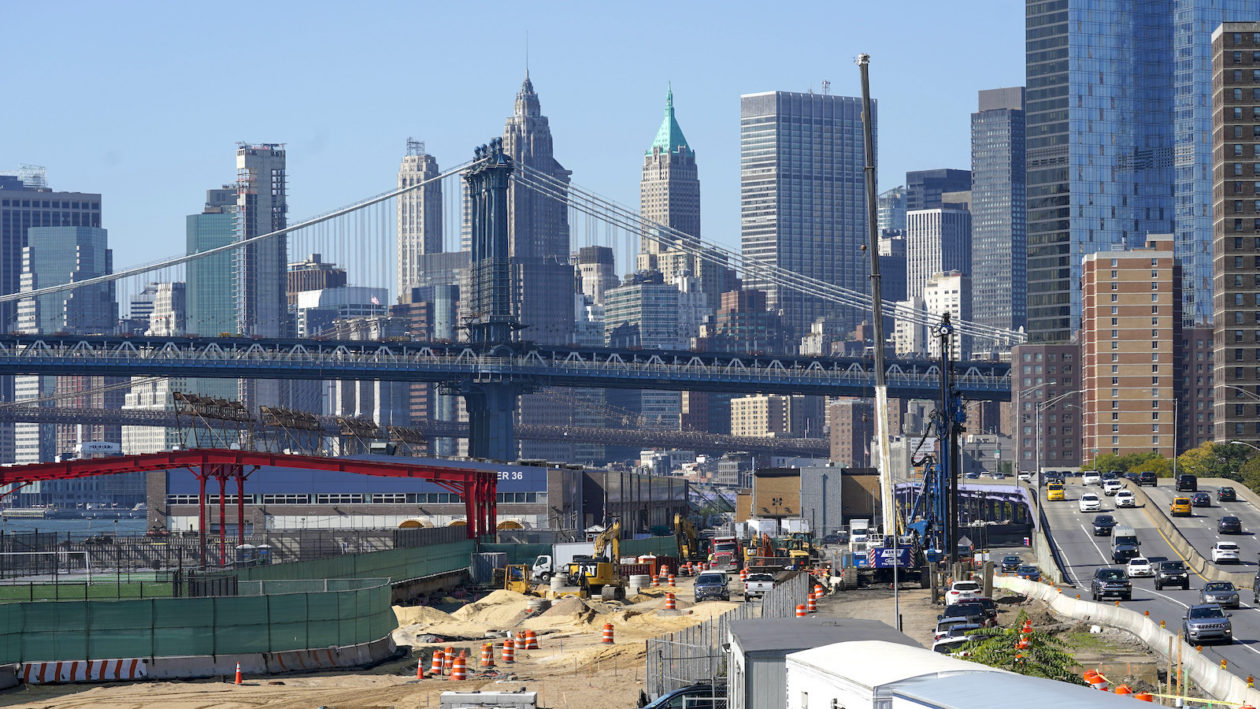
Photo: Mary Altaffer/AP.
Construction underway on a flood resiliency project in East River Park in Manhattan in October 2022. Hello, Boston! See this?

For years there have been voices crying in the wilderness about the danger Boston faces from flooding. A city originally lifted from the sea like the Netherlands, Boston has powerful “progress” fanatics that have allowed the Seaport area to be overbuilt in the last 20 years. The Boston Globe’s David Abel even made a movie about it, calling the city’s touted Innovation District the Inundation District.

Meanwhile, in New York City, politicians have heeded a painful lesson from Hurricane Sandy.

Andrew S. Lewis writes at Yale Environment360, “On a recent morning in Asser Levy Playground, on Manhattan’s East Side, a group of retirees traded serves on a handball court adjacent to a recently completed 10-foot-high floodwall. Had a sudden storm caused the East River to start overtopping this barrier, a 79-foot-long floodgate would have begun gliding along a track, closing off the playground and keeping the handball players dry. In its small way, this 2.4-acre waterfront park is a major proof of concept for a city at the forefront of flood resilience planning — a city working toward living with, and not against, water.

“The Asser Levy renovation, completed in 2022, is part of East Side Coastal Resiliency (ESCR), the largest urban resiliency project currently underway in the United States. Over the next three years, at a total cost of $1.8 billion, ESCR will reshape two-and-a-half miles of Lower Manhattan’s shoreline. But ESCR is just one link in a much larger, $2.7 billion initiative called the BIG U — a series of contiguous flood resilience projects that runs from Asser Levy, near 25th Street, around the southern tip of Manhattan, and up to Battery Park City, along the Hudson River. When finished, the BIG U will amount to 5.5 miles of new park space specifically designed to protect over 60,000 residents and billions of dollars in real estate against sea level rise and storm surges.

“The BIG U was conceived in the aftermath of 2012’s Superstorm Sandy, which flooded 17 percent of New York City and caused $19 billion in damage. Like Hurricane Katrina in 2005, Sandy helped push New York … toward embracing the Dutch concept of ‘living with water,’ which emphasizes building infrastructure that can both repel and absorb water while also providing recreational and open space.

“In New York, ESCR, like any large infrastructure project slated for a densely populated place, has moved in fits and starts. Still, New York is making significant progress. ‘Anything that’s on the scale of Manhattan is always going to be so much bigger and more complicated,’ says Amy Chester, director of Rebuild by Design, the post-Sandy design competition from which ESCR was born. ‘And yet a lot has been done.’

“The ESCR project area encompasses a flood-prone wedge of Manhattan’s natural topography — a ‘pinch point’ between two higher stretches of shoreline. Some 400 years ago, when the island was inhabited by the Lenni-Lenape, this shoreline was woods and marsh that never rose more than a few feet above sea level. Tidal creeks drained from uplands dense with American chestnut, aster, and goldenrod, winding through spartina meadows to the river. Today, that landscape is lost beneath four separate public housing complexes, whose roughly 10,000 residents count on East River Park to buffer their homes from a waterway that has risen 8 inches since the mid-20th century.

“Because ESCR is the first segment of the BIG U to get underway, its path has been rocky, from debates about its final design, to budget cuts, to new concerns about the evolving risks of climate change, including the extreme rain events that New York experienced this year. …

“In 2018, the administration of Mayor Bill de Blasio quietly revamped the design: it would be faster and cheaper, the mayor’s team said, to wipe the park clean, elevate the landscape with more than a million tons of fill, then build anew on top.

“Unlike the kind of permeable buffers championed by the Dutch, the raised park would function more like a hard barrier. … Opposition to the redesign remains, but many residents of the public housing complexes, which are at high risk of flooding, support it. In the fall of 2021, demolition crews got to work. …

“The park will be landscaped with pathways and vegetation beds that snake around and through sports fields, an amphitheater, and playgrounds to form a terraced topography that will function as a berm to keep water from city streets. More floodwalls and retractable gates will run the park’s length and extend into surrounding streets, where archaic infrastructure will be overhauled so stormwater is less likely to mix with wastewater during flooding. …

“Other segments of the BIG U are also underway. In the Battery, at the city’s southern tip, the waterfront is being elevated with fill. Next, floodwalls, higher-capacity drainage, and new park space will be installed. Similar projects to protect the historic South Street Seaport area and the Financial District remain in the planning and design phase. …

” ‘Building a level of resilience capacity across society is critically important,’ says Henk Ovink, the former Netherlands Special Envoy for International Water Affairs and one of the creators of Rebuild by Design. ‘If you don’t invest in the most vulnerable links, the chain breaks.’ ”

Read more at Yale e360, here. No firewall. Donations solicited.

Read Full Post »