Feeds:
Posts
Comments

Posts Tagged ‘invasive’

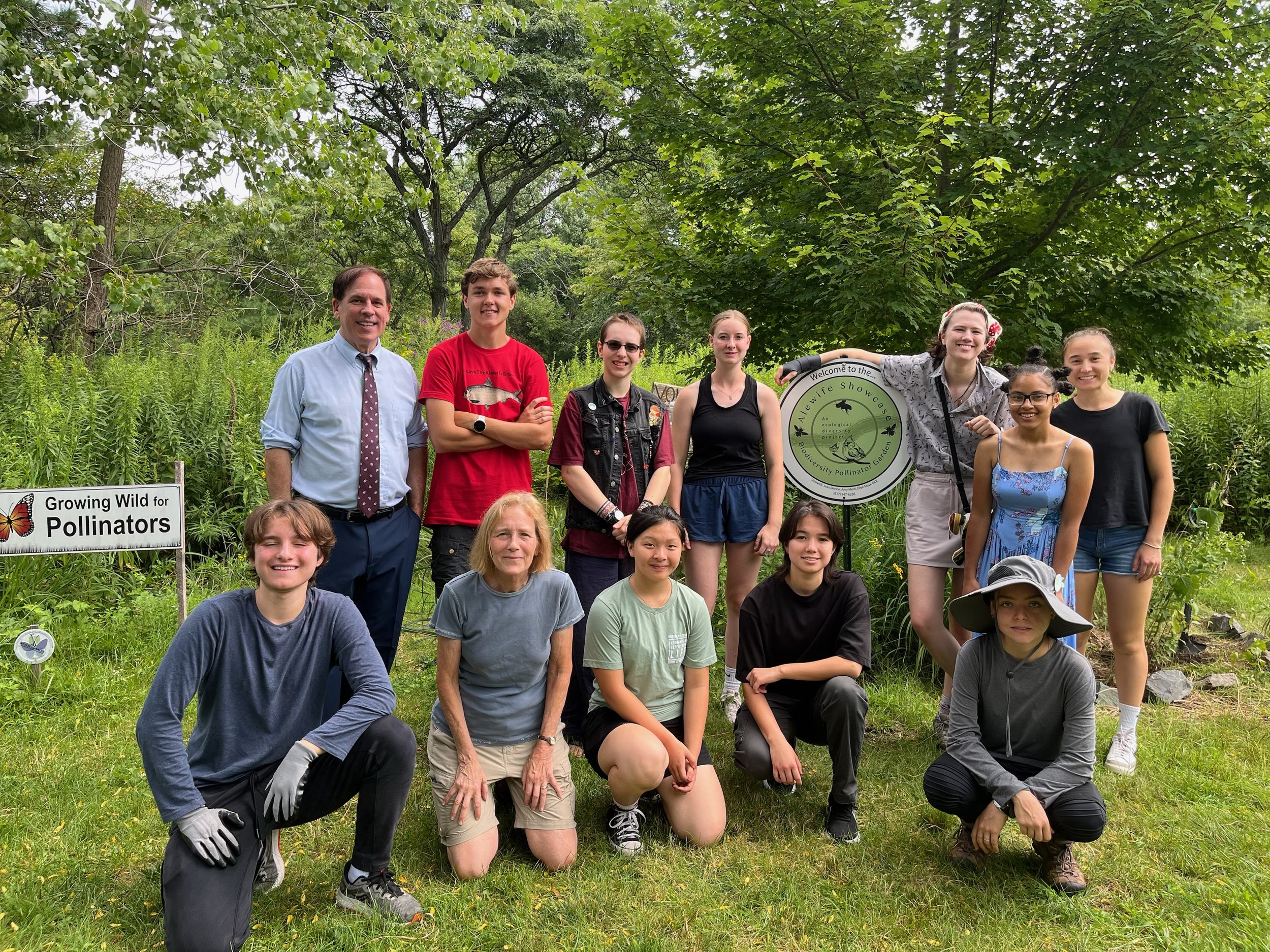
Photo: Devine Native Plantings.
Jean Devine, founder of Biodiversity Builders, is in the front row, second from left. She engages young people in the important work of improving the environment.

Recently, I blogged about my friend Jean Devine, founder of Biodiversity Builders, and described how she took me on a tour of local urban forests. (Click here.)

Now I find that Edible Boston has caught up with her and is highlighting the amazing environmental work Jean’s been doing with young people.

Nicole Estvanik Taylor writes, “Ask the average Gen Z-er to name their favorite native plant and you might expect a blank stare. But for alumni of the Biodiversity Builders program, the hard part is narrowing it down.

“Strawberries come to mind for Jasmine Rancourt, International School of Boston graduating senior — ‘or maybe butterfly weed, because it’s really pretty and vibrant … and it attracts butterflies, obviously.’

“Belmont High School’s Sophia Shaginian chose to plant bleeding heart in front of her house because it’s ‘absolutely gorgeous’ and ‘blooms all summer long.’

“Leia Ahmad-LeBlanc of Arlington Catholic High School gravitates to the striking red pods of wild sumac. ‘You can actually make lemonade out of it, and it’s a good source of food for animals.’

“And UMass Amherst student Kira O’Neill is partial to black birch trees: ‘They have such beautiful yellow leaves in the fall. And if you scratch a twig, it smells like root beer.’ 

“The students got to know these and many other plant species native to Massachusetts through a six-week paid summer internship created and run by Jean Devine, a Belmont-based environmental educator, native plant coach and specialty landscaper.

“Entering its fourth year, Biodiversity Builders has provided 55 high school students from Arlington, Belmont and Cambridge with hands-on experience designing and installing native plant gardens and removing invasive flora. The curriculum also covers entrepreneurial concepts like mission and marketing and culminates in a native plant sale run entirely by the students. …

“It’s only been a decade or so that Devine herself could tell you much about birch trees or bleeding hearts. …

“ ‘I was looking for opportunities to mentor youth and get them outdoors as an antidote to “nature-deficit disorder,” ‘ she says, referencing a term coined by journalist Richard Louv in his book Last Child in the Woods.

“A walk with a scientist opened Devine’s eyes to the ecological value of native plants, including as a source of food and shelter for pollinators and other wildlife, and the threat invasives pose to biodiversity. Teaching kids how to restore this balance struck her as ‘an ideal project with a purpose that helped the world and the youth at the same time.’ …

“After several years running nature programs for school kids in Cambridge and Brookline, she launched her own business, Devine Native Plantings, in 2021. Biodiversity Builders followed a year later, operating as a nonprofit under the fiscal sponsorship of the Vermont-based Tiny Seed Project. It partners with the Cambridge Mayor’s Summer Youth Employment Program to support the participation of students from that city and covers the rest of its budget through grants and crowdfunding. This July, it will recommence with a fresh batch of 14 high school students and a pair of college mentors, plus four young professionals interested in the Biodiversity Builders approach.

“ ‘Jean is so high energy and enthusiastic about the curriculum,’ says O’Neill, who did the program in 2022 and returned last summer as a mentor. ‘She very easily connects with the students … and she knows so many of the people in the area doing similar kinds of work.’

“Among her many affiliations, Devine is a co-founder of the Mystic Charles Pollinator Pathways Group, which maps local gardens that support declining populations of native bees, butterflies and birds. She guided Belmont High School’s Climate Action Club in creating a pollinator garden and is part of an intergenerational committee of Belmont residents organizing to plant a Miyawaki miniforest. As a member of the Native Plant Community Gardeners group in Cambridge, she’ll help install Danehy Park’s first pollinator garden this summer — with upkeep to come from the 2025 Biodiversity Builders crew. …

“For 2024 Biodiversity Builders participant Rancourt, who has artistic leanings, planning gardens that are aesthetically pleasing and ecologically useful was a highlight of the program.

“ ‘It turns out you have many colorful native plants that can be used,’ Rancourt reasons, ‘instead of those other plants that are colorful but look like plastic for pollinators.’ …

“Ahmad-LeBlanc, part of last summer’s cohort, says she applied to Biodiversity Builders after watching her sister go through the experience two years prior.

“ ‘She would always come home covered in dirt, she would have to wear super high socks because there were a lot of ticks, but she had a great time,’ she says. When it was her turn to get dirty, she understood why. ‘I think it was easier for us to process the information because it was all really hands-on … It’s a way that we’re not usually able to learn in school.’

“The Alewife reservation is Biodiversity Builders’ home base, but the students tend plots in other community spaces. … Last summer they removed invasives at Mass Audubon’s Habitat Education Center and Wildlife Sanctuary with the aid of its resident goats; toured Mount Auburn Cemetery with a herpetologist, a horticulturalist and an artist; and took the T to East Boston for birdwatching in Belle Isle Marsh. They also donned gloves and climbed into canoes with the Mystic River Watershed Association to remove thick, spiny mats of invasive water chestnuts from the Arlington Reservoir—filling 270 laundry baskets by day’s end.

“ ‘It was just amazing how we were all collaborating and working all together,’ says Shaginian, who shared a canoe with Devine. ‘I remember how big that pile was. It was huge.’

“Shaginian says pulls like that one, or the sweaty hours spent uprooting black swallow-wort along the edge of the Minuteman Bike Path, impressed upon her both the enormity of the problem and the importance of doing her part. …

“ ‘For me, the idea of getting paid to do gardening, which I did at my house for fun, was novel and exciting,’ says O’Neill, ‘and definitely cemented the idea that I wanted to study something related to working outside when I got to college.’ “

More at Edible Boston, here, and at this blog, here.

Read Full Post »

Photo: Lilian Carswell/USFWS.
Sea otter.

According to the state of Washington’s Fish and Wildlife department (WDFW) , the European green crab is a menace. That is something we’ve noticed in Rhode Island, where it’s pushing out the delicious blue claw crabs.

WDFW says, “The European green crab (Carcinus maenas) is a globally damaging invasive species that poses a threat to native shellfish, eelgrass, and estuary habitat critical for salmon and many other species.

“Potential impacts include destruction of eelgrass beds and estuarine marsh habitats, threats to the harvest of wild shellfish and the shellfish aquaculture industry, salmon and forage fish recovery, and a complex array of ecological impacts to food webs. Research is ongoing regarding potential impacts on juvenile Dungeness crab and crab fisheries.

“In areas where European green crabs have been able to establish large populations for extended periods of time, they have had dramatic impacts on other species, particularly smaller shore crabs, clams, and small oysters. While green crabs cannot crack the shell of a mature oyster, they can prey upon young oysters, and will dig down six inches to find clams to eat.

One green crab can consume 40 half-inch clams a day, as well as other crabs its own size.

“Their digging can have significant negative impacts on eelgrass, estuary and marsh habitats.”

But here’s a ray of hope.

Manuela López Restrepo reports at National Public Radio (NPR), “A new study has found that a restored sea otter population might be the solution. …

“As it turns out, sea otters — which are listed as threatened under the Endangered Species Act — love to eat these crabs. One estimate by researchers in California found that a group of otters in Elkhorn Slough consumed somewhere between 50,000-120,000 crabs a year.

“A new study, published in the Biological Invasions journal, found that there was a direct relationship between the two species: if an area had a healthy population of sea otters, it would also have a low green crab population.

“Yes, says ecologist Rikke Jeppesen, whose team at Elkhorn Slough Reserve on the California coast published the recent study.

” ‘It’s really a win-win scenario if we can support a native threatened species, the sea otter, which in turn then helps control an invasive invertebrate,’ Jeppesen told ‘All Things Considered.’ … ‘Sea otters are our assistant managers of the estuary for invasive species control.’

“What’s more, they’re biologically predisposed to eating a lot of crabs, she said.

” ‘Sea otters rely on fur for insulation as opposed to seals, which rely on blubber. Blubber insulates much better, so sea otters have to eat a lot to keep warm,’ she said. ‘It’s basically a weasel in the water. And weasels are super active. They have a high metabolism. So to sustain sea otter health and keep warm, they just need to eat a lot.’ “

More at NPR, here. An interview with the researcher is here. And a previous study in Nature showed similar results, here.

Read Full Post »

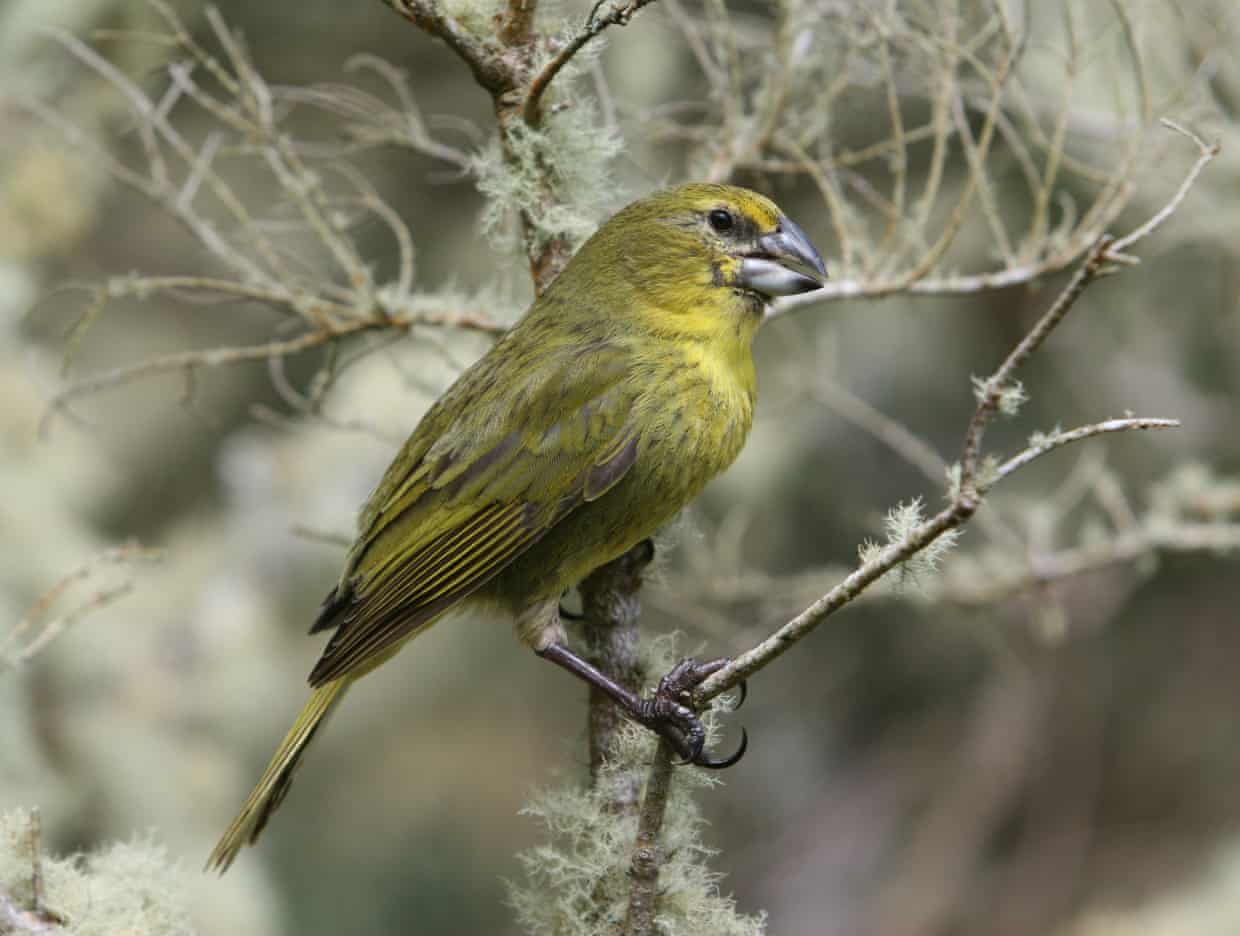
Photo: Peter Ryan.
Surveys before 2019 found that the number of breeding pairs of Wilkins’ bunting was 120 and going down. Then a wasp got involved.

Before I get into today’s story about efforts to save the habitat of a rare bird, I want to explain where this is happening. Nightingale Island is in the South Atlantic, a bit closer to Cape Town, South Africa, in the east than to Buenos Aires, Argentina, in the west.

Wikipedia says, “Nightingale Island is an active volcanic island in the South Atlantic Ocean, 3 square kilometres (1.2 sq mi) in area, part of the Tristan da Cunha group of islands. They are administered by the United Kingdom as part of the overseas territory of Saint Helena, Ascension and Tristan da Cunha.

“Nightingale Island is [uninhabited but] regularly visited for scientific purposes and research. It is one of the only stops for birds in the Atlantic and sees millions of them visit it annually.” More.

I read the following report on saving the island’s threatened Wilikins’ bunting and couldn’t help wondering how we balance two goods: the need to save species and the need to prevent introduced species (in this case a wasp) from creating unanticipated future havoc.

Helena Horton wrote at the Guardian, “A tiny parasitic wasp has given a lifeline to one of the world’s rarest bird species by killing off an invasive insect that was threatening its survival.

“The Wilkins’ bunting lives on Nightingale Island, part of the Tristan da Cunha \ group; the world’s most remote inhabited archipelago. It eats the fruit of the Phylica arborea, the island’s only native tree.

“But around 2011, scientists began to notice signs of an unwelcome visitor. An invasive, sap-sucking scale insect had been, it seems, accidentally introduced on to the island by humans. These insects secrete honeydew, which encourages the growth of a sooty mould that weakens and eventually kills Phylica arborea. Their arrival threatened to destroy the forest, and the tiny bird population among with it.

“This news was devastating to the scientists who study and protect the little yellow bird, as its numbers had been suffering. Huge storms in 2019 destroyed much of the forest, and surveys before the storm found there were only about 120 breeding pairs of the bird remaining.

“The RSPB, Centre for Agriculture and Bioscience International, Food and Environment Research Agency and Tristan da Cunha Government hatched an unorthodox plan to save the buntings, releasing a small parasitoid wasp called Microterys nietneri, which prevents the scale insects from breeding. They would also set up a tree nursery to boost the number of trees and improve the biosecurity on the island to stop invasive species coming in future.

“But first, the wasps had to survive the trip from London – almost a month by land, sea and air. Dr Norbert Maczey, an entomologist at CABI, said: ‘The wasps faced an epic journey. Firstly, a flight from London to Cape Town, in a cool bag, followed by an enforced stay in a hotel room as part of a staff member’s Covid quarantine. Next came a week-long boat journey to Tristan with temperatures sometimes dropping below zero. Finally, there was a further boat trip to Nightingale Island. It seemed like luck and time was against us but some of the wasps made it.’

“Fewer than 10% of the wasps survived the trip, but in April 2021 the first release took place, and there were more over the next two years. Slowly a population of wasps has started to establish itself. …

“Surveys in February this year showed that despite losing approximately 80% of the forest, there are still an estimated 60-90 pairs of Wilkins’ bunting on Nightingale. Although the population has reduced, the forest has recovered in the short period since the wasps were released, and the scientists think numbers of buntings should stabilize and will have a chance to recover over the next few years.

“David Kinchin-Smith, the RSPB’s UK overseas territories project manager, said: … ‘Hopefully we, and the wasps, have given the buntings a much-needed lifeline.’ ” More at the Guardian, here.

Do you have an opinion on this approach?

And from Wikipedia, something curious about the remote islands: “Edgar Allan Poe‘s The Narrative of Arthur Gordon Pym of Nantucket alluded to Nightingale Island, Inaccessible Island, and Tristan da Cunha.”

Read Full Post »

Photo: MassAudubon.
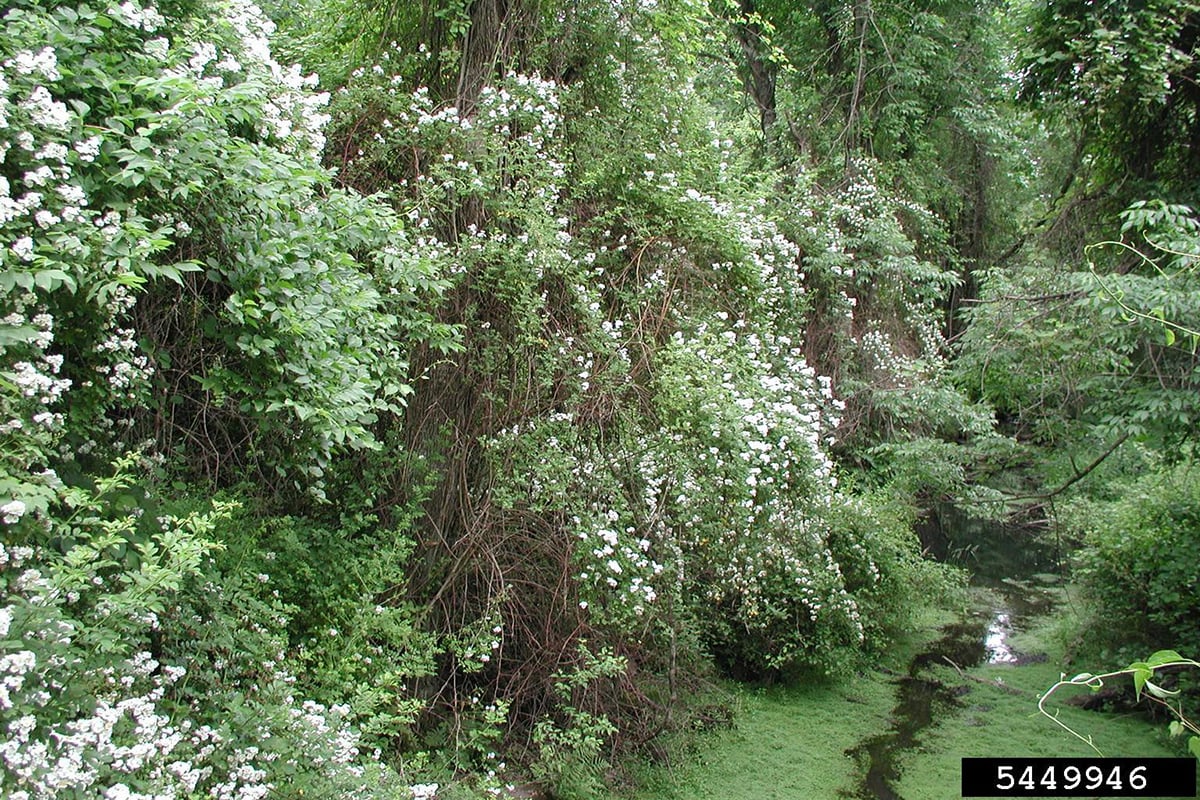
The invasive multiflora rose forms dense thickets in fields and field edges, crowding out other species.

The problem with invasive species that aren’t native to a region is that they crowd out the local species, and that has a snowball effect. We colonists crowded out indigenous people, which among other things, undermined wisdom about protecting nature. In the plant world, local pollinators don’t get what they need to pollinate. The list goes on.

Frank Carini reports at ecoRINews on how invaders hurt both the environment and the economy: “Invasive Asian shore crabs are outcompeting young lobsters. Invasive snake worms and hammerhead worms are burying themselves deeper into southern New England, where the former consumes the top layer of soil and dead leaves where the seeds of plants germinate, and the latter is toxic and transmits harmful parasites to humans and animals.

“Invasive multiflora rose and oriental bittersweet have long been embedded in the region, crowding out native vegetation and strangling trees. …

“Last summer, the Intergovernmental Science-Policy Platform on Biodiversity and Ecosystem Services (IPBES) for the United Nations issued a global assessment providing clear evidence of this growing threat.

“In a paper recently published in the journal Nature Ecology & Evolution, the authors of last year’s assessment — 88 experts representing 101 organizations from 47 countries — outline the main findings from that report and echo the need for urgent action.

Laura Meyerson, a University of Rhode Island professor of invasion science and habitat restoration ecology and editor-in-chief of the journal Biological Invasions, is a contributing lead author on the IPBES assessment and a lead author on the recent paper. …

“She said, ‘Our research produced overwhelming and unequivocal evidence that the negative impacts of biological invasions far outweigh any benefits and that those who depend most on nature suffer the worst consequences.’

“The researchers documented some 37,000 invasive species that had been introduced by people to areas around the world. Of those, about 3,500 species were considered harmful invaders that negatively affect nature and people’s quality of life. 

“The number of invasive species — major drivers of global biodiversity loss, according to Meyerson — are expected to continue to grow. Some 200 new species are expected to be added annually by human activities in regions that have not recorded such invaders before, according to the June 3 paper. And established invasives will continue to expand their ranges, spreading into new countries and choking out native species.

“The paper also noted that simple extrapolations from current impacts from invasive species are likely to underestimate the level of future impacts, and drivers of biodiversity loss, such as the climate crisis, are acting in concert and those interactions are increasing biological invasions. …

“ ‘It’s critically important that we all do our part to reverse current trends,’ Meyerson said. ‘The public can make sure that the plants they are buying for their gardens are native species. Pet owners should not release animals, like rabbits or Burmese pythons, that are no longer wanted into the wild.’

“For example, red-eared sliders — native to the Southeast, the south-central United States, and northern Mexico — are the most popular pet turtle in the United States and available at pet shops around the world. But this turtle species lives for about 30 years, so they are often released where they don’t belong after pet owners tire of them. As a result, they are considered one of the world’s 100 most invasive species.

“Meyerson is also the senior author on a global study that explored the extent of biological invasions on lands owned or managed by Indigenous people. The study was published in Nature Sustainability in late May.

“The spread of animal and plant species into new regions by humans is increasing rapidly worldwide, with thousands of species now present in regions outside their native range. The research team, which included scientists from Australia, Austria, Germany, Hungary, and the United States, investigated the spread of invasive species to lands managed by Indigenous people and found significantly fewer invaders in those areas compared with other natural areas.

“ ‘This was a really important finding because even after controlling for the remoteness and accessibility of Indigenous peoples’ lands and how land is used, in general, the numbers of invasive species are lower, as is biodiversity loss,’ Meyerson said. …

“Researchers analyzed millions of available data points from around the globe on the distribution of non-native plant and animal species. On average, there were 30% fewer non-native species on Indigenous lands. The study suggested the enormous difference is primarily due to sustainable land use, a higher proportion of forests, and lower accessibility to humans.

“Indigenous people represent ethnic groups that settled in regions long before the arrival of Europeans, such as Native Americans, the Aborigines of Australia, and the Sami in Scandinavia. About 28% of the land surface around the globe is inhabited by Indigenous people. Most of these areas are in remote regions and many have enormous importance for conservation of biodiversity such as the Amazon basin and wilderness areas in the Arctic.”

More at ecoRI News, here. No firewall. Donations solicited.

Read Full Post »

Photo: Sydney Walsh for NPR.
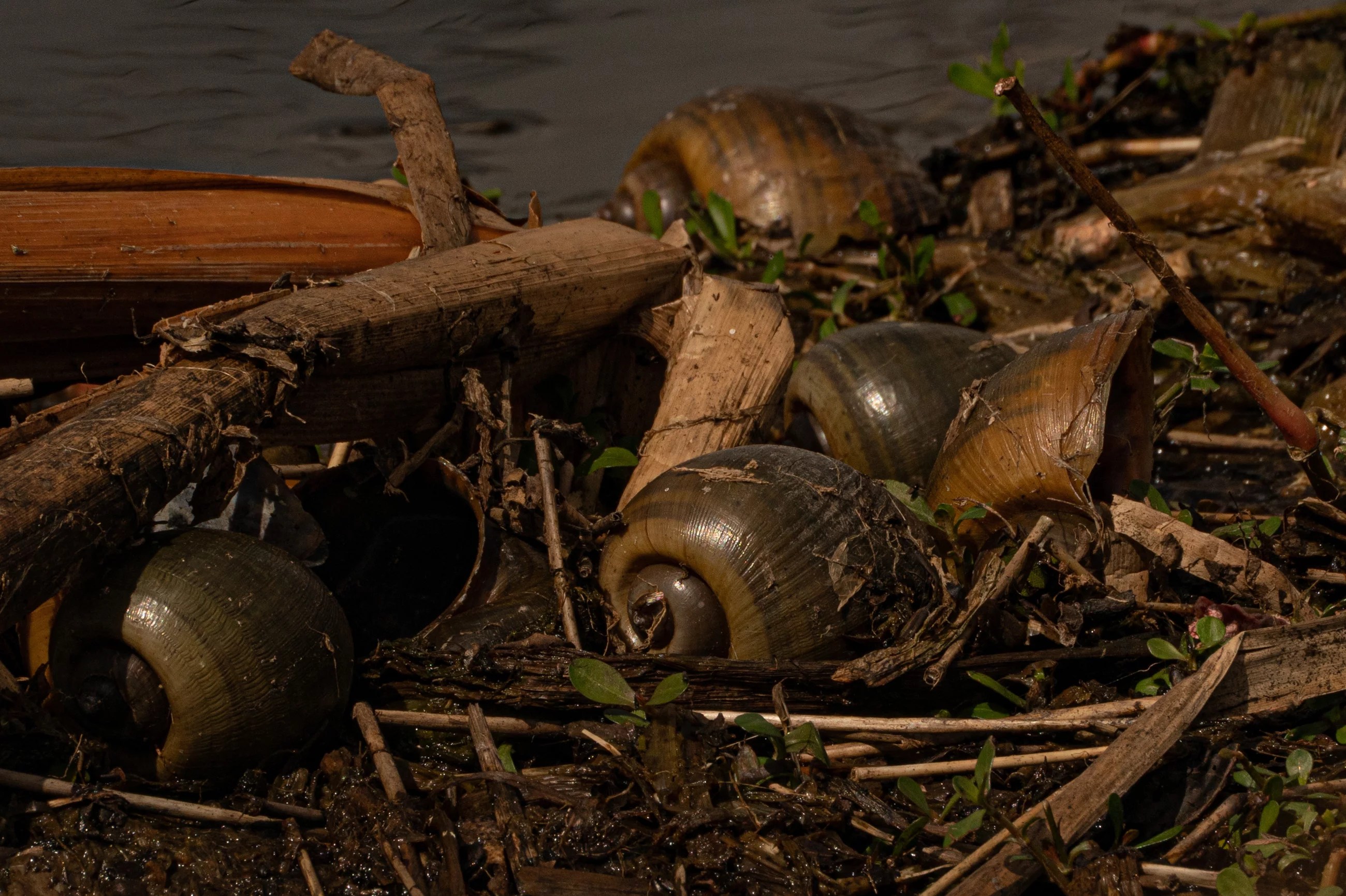
Apple Snail shells along the banks of Lake Okeechobee in Moore Haven, Fla. The snails are an invasive species, but they are helping an endangered bird stage a comeback.

“It’s an ill wind that blows nobody good.” We don’t like invasive species as a rule, but in today’s story, one kind is saving an endangered bird. Proving once again that life is complicated.

Greg Allen reports at NPR (National Public Radio), “In Florida’s Everglades, few species are more closely tied to the habitat’s health than an endangered bird, the snail kite. The Everglade snail kite is a raptor, similar to a hawk, that eats just one thing: snails.

“Over the last century, as much of the Everglades was drained, the bird’s population declined precipitously. But the kite has bounced back recently thanks to an exotic snail. It’s a rare case of an invasive species having a positive impact.

Robert Fletcher, a University of Florida professor who directs a snail kite monitoring program, says the invasive species was first spotted in 2004. Within a few years, it had expanded through much of the Everglades. ‘And it was around that time,’ he says, ‘that we started to see snail kite number increase.’

“Few people pay closer attention to the snail kite than Tyler Beck. He manages Florida’s the endangered bird’s population for Florida’s Fish and Wildlife Conservation Commission. On the western edge of Lake Okeechobee, Tyler Beck uses an airboat to motor through marshes looking for kites. … Overhead, [one] alarmed kite makes a rapid clicking call as it hovers and swoops over the airboat.

“University of Florida researcher Brian Jeffrey wades through thigh-deep water toward the area he thinks the nest might be. Jeffrey directs a field team that monitors Florida’s snail kite population. He finds the nest, but it’s 20 feet up, too high to count the eggs or see if any have hatched. Other members of his team will be back soon with a ladder to check on the nest.

“Jeffrey has three field teams that cover thousands of square miles counting and tracking Florida’s snail kites. The kites—and the field teams–range from Everglades National Park on the southern tip of Florida all the way up to Paynes Prairie Preserve State Park, near Gainesville. …

“Snail kites aren’t flashy. Males are a slate gray, females a splotchy brown. They get their name from their ability to seemingly float in the air. They were one of the last bird species discovered in the U.S. because of where they live, often hidden in the Everglades.

“Beck says the species is uniquely adapted to subsist almost entirely on a resource usually abundant in the freshwater marshes: apple snails. ‘They have these really long talons that hook around the shell and get a good grip on it to lift it out of the water and carry it away,’ he says. And, they have a long, hooked bill they use to pry the snails from their shells.

“Over the past century, as much of their habitat was drained and water stopped flowing through parts of the Everglades, the snail kite population plummeted. It was one of the first birds put on the endangered species list in the 1960’s. Droughts contributed to the snail kite’s decline and by 2007, there were fewer than 800 remaining. ‘Right shortly after that though, this invasive snail came in, and just started flourishing, getting into every wetland, having these big population booms,’ Beck says. …

“Beck eases the airboat up next to a willow tree where he’s spotted a nest. Standing in the boat, this one is at eye level. He says, ‘We’ve got two little nestling snail kites. These are probably about ten days old. The parents, you can hear them over us, they’re upset that we’re at their nest.’ Beck and Jeffrey mark the location, water levels, height of the nest and then motor away. The parents soon return, carrying snails.

“No one’s sure about how the exotic snails were introduced into the Everglades. They’re related to Florida’s apple snails and are commonly used in home aquariums. The invader, the Island apple snail, is found in similar habitat in South America and is larger than its Florida cousin. …

“Efforts to restore Florida’s Everglades have helped the snail kite, bringing back native vegetation and restoring the flow of water to once-parched marshes. It’s been in the works for more than 30 years with a cost of more than $20 billion. But progress is incremental and hard to measure. In the meantime, scientists say the invasive snail may have saved the snail kite.

“But University of Florida scientist Robert Fletcher is concerned about the potential impact the species will have on the Everglades over the long-term. He says, ‘What we should be thinking about is how do we restore native snails to get those benefits.’ “

More at NPR, here. Lots of pictures. No firewall.

Read Full Post »

Goats are becoming increasingly popular for controlling invasive plant species.

Joanna Jolly writes at the BBC News Magazine, “Each country has its own invasive species and rampant plants with a tendency to take over. In most, the techniques for dealing with them are similar — a mixture of powerful chemicals and diggers. But in the US a new weapon has joined the toolbox in recent years — the goat.

“In a field just outside Washington, Andy, a tall goat with long, floppy ears, nuzzles up to his owner, Brian Knox. Standing with Andy are another 70 or so goats, some basking in the low winter sun, and others huddled together around bales of hay. …

” ‘We started using them around this property on some invasive species. It worked really well, and things grew organically from there.’

“They are now known as the Eco Goats — a herd much in demand for their ability to clear land of invasive species and other nuisance plants up and down America’s East Coast. …

“One of the reasons goats are so effective is that plant seeds rarely survive the grinding motion of their mouths and their multi-chambered stomachs — this is not always the case with other techniques which leave seeds in the soil to spring back.

“One of the more high profile jobs they have worked on was cleaning up the Congressional cemetery in Washington two years ago. Large crowds came to watch as the animals spent a week chomping the overgrowth of Honeysuckle, Ivy and Poison Ivy. …

“This is one of the things he likes about taking goats into urban areas — the response of the city-dwellers, who are ‘fascinated,’ he says, to see how efficiently the goats gobble up the vegetation. …

“Goats aren’t a silver bullet. Knox often combines the goat clearance with some manual root cutting and even with a chemical treatment if needed. But his goats have started to make an impact on the weeds choking America and, he says, they are having a lot of fun doing it.”

More of the story — and some great pictures —  here.

Photo: BBC News

Read Full Post »

At some point in my childhood, family friends raised goats. It seemed exotic. The Gordon children drank goat’s milk. And we learned that goats will eat anything when my brother tried to pat a goat and lost his mitten.

In addition to mittens, goats eat weeds, and increasing numbers of individuals and groups are deciding to use goats instead of herbicides to control weeds.

Evan Allen writes in the Boston Globe, “According to the US Fish and Wildlife Service, the use of goats to control invasive species, already common out West, is becoming more common across the East Coast.

“Goats love woody shrubs and vines, making them ideal weed-whackers. Using goats cuts down on the need for herbicides, and, unlike tractors, goats don’t require diesel fuel to do their job. And nimble goats can easily maneuver across rocky or marshy surfaces that humans and machines can’t safely reach.

“ ‘Folks are looking for long-term means of control,’ said Eric Schrading, private lands coordinator at the Fish and Wildlife Service. ‘As the last 30-plus years have gone by, we’ve started to, maybe not abandon chemical control, but use that as only one tool in the toolbox.’ …

“In Wellesley, the goats were shuttled out to the Boulder Brook Reservation in a bright pink truck driven by a crew from the Goat Girls: Hope Crolius, owner of the Amherst-based business, and two of her goatherds.” Read more here.

For a video about goat weed control, check out this clip from Bear Creek Park in Colorado.

Read Full Post »