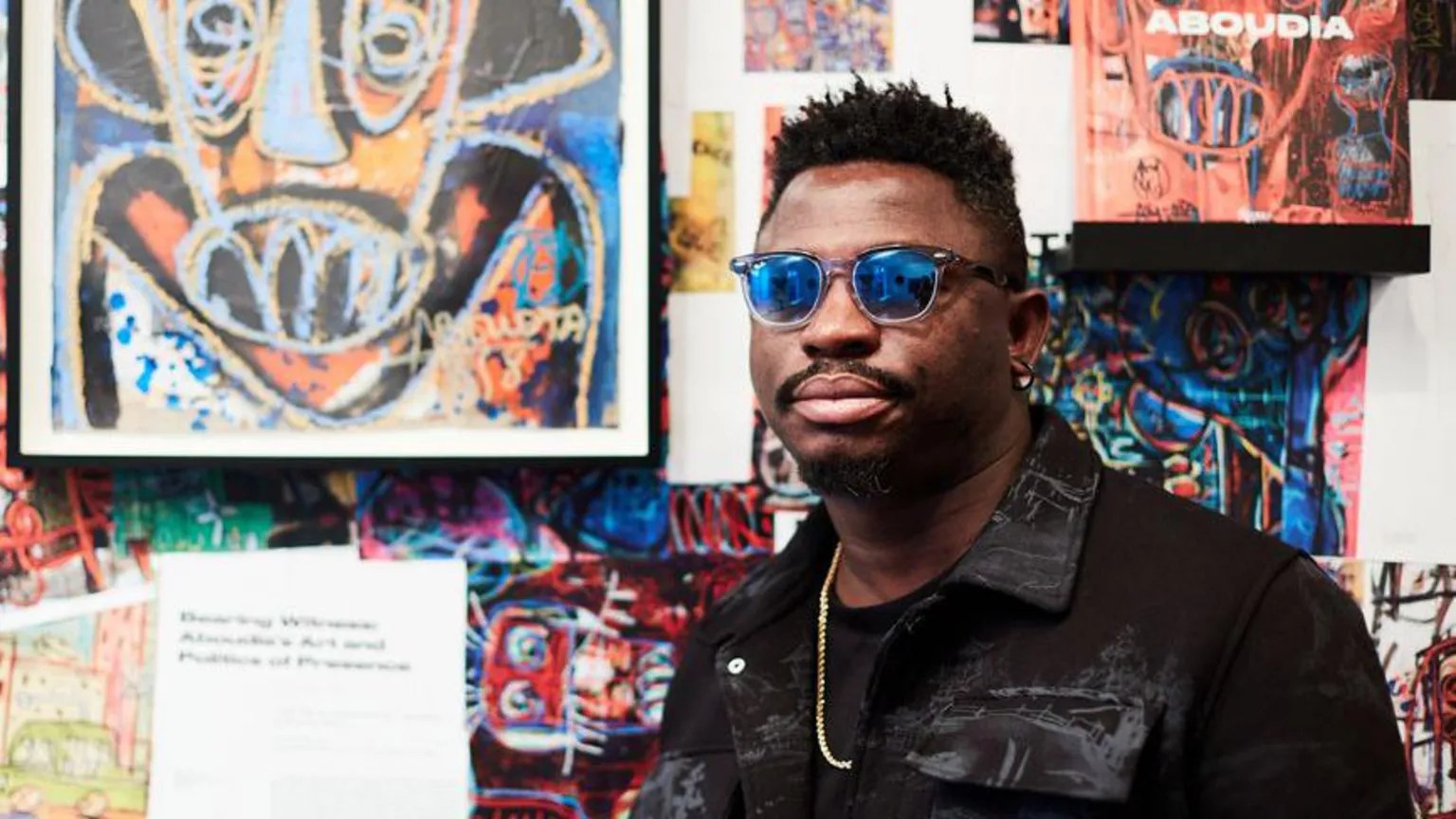
Photo: Larkin Durey.
Aboudia’s work has been shown in exhibitions held in Abidjan, London, New York and Tel Aviv. Hiscox Artist Top 100 says he sold more than even Banksy in one year.
The art world is becoming more international, and that’s a good thing. For too long, people have used their own world’s cultural references to judge the quality of art. And how can only one culture be the only worthy measure?
Wedaeli Chibelushi reports at the BBC about an African that is currently making a big splash internationally.
“Back in September, global art experts were taken aback by the name topping a fresh list of the world’s best-selling artists.
“Aboudia, a graffiti-inspired artist from Ivory Coast, had beaten well-known names, like Damien Hirst and Banksy, to sell the most pieces at auction the previous year.
“According to the Hiscox Artist Top 100, Aboudia, real name Abdoulaye Diarrassouba, had flogged 75 lots. One of these canvasses had gone for £504,000 ($640,000).
“Leading online marketplace Artsy called Aboudia’s triumph ‘striking,’ while The Guardian said market experts were ‘blindsided by the ranking.
“Months later, sitting in a London gallery plastered with his paintings, Aboudia tells me the survey results were no surprise to him. ‘Because if you work hard, the success is going to come,’ he says. …
“Aboudia’s mellow disposition clashes with the art surrounding him – his vividly colored, heavily layered canvases feature a cast of cartoon-like figures plucked from the streets of Abidjan, Ivory Coast’s largest city. Through a blend of oil sticks, acrylic paints and recycled materials like newspapers, Aboudia depicts the hardships of life in downtown Abidjan.
He particularly focuses on the children who live and work on the city’s streets.
“His eyewitness portrayals of Ivory Coast’s 2011 civil war are equally arresting. Figures gaze at the viewer with vacant eyes, while armed soldiers and skulls crank up the intensity. …
“Aboudia was born in 1983, in Abengourou, a small town around [124 miles] from Abidjan. In a 2012 essay, the artist said he was kicked out of his home aged 15 after telling his father he wanted to paint for a living.
“After being cast out, the young Aboudia pressed on and enrolled in art school. Due to a lack of financial support, he slept in his classroom after the other students went home for the day. These uncomfortable nights paid off — after graduating in 2003 the soon-to-be-star was accepted into Ivory Coast’s leading art school, École des Beaux-Arts.
“Abidjan’s École des Beaux-Arts would expose Aboudia to the Ivorian art icons whose influence can be found in his current work. For instance, Aboudia’s focus on his direct surroundings and his use of recycled materials can be traced back to Vohou Vohou, a modernist collective established in the 1970s by artists like Youssouf Bath, Yacouba Touré and Kra N’Guessan.
“Aboudia began to veer away from traditional styles of art, instead using untamed brushstrokes and earthy colors to recreate graffiti produced by Abidjan’s underprivileged children. In Aboudia’s words, these young, de facto street artists ‘draw their dreams on the world.’
“The children are his main influence, he says. …
“After establishing his core style, Aboudia would lug his paintings around the galleries of central Abidjan, hoping for a way in.
” ‘It was very hard. … They’d say: “Are you crazy? What is this work? You better go to London, to United States or Paris, because this work … here it doesn’t make sense,” ‘ Aboudia recalls.
“The adversity did not end there. In 2010, Laurent Gbagbo, the then president of Ivory Coast, refused to step down after losing an election to rival Alassane Ouattara. A civil war broke out, killing 3,000 people and forcing another 500,000 from their homes.
“Throughout the four-month conflict, Aboudia sought refuge in his basement studio, documenting the horrors he saw when venturing above ground.
“The war ended with Mr Gbagbo’s dramatic capture by UN and French-backed troops — and Aboudia emerged from his haven with 21 disconcerting paintings.
“Art-lovers and journalists from Ivory Coast and beyond lauded his work and Aboudia’s ascent to global success began. He was championed by renowned art collectors Charles Saatchi and Jean Pigozzi — and went on to exhibit his work at prestigious venues like Christie’s New York and the Venice Biennale.
“Aboudia’s first solo exhibition was at the setting for this interview, London’s Larkin Durey (then named the Jack Bell gallery). Owner Oliver Durey, who has now known Aboudia for over a decade, tells the BBC: ‘There is something we can all relate to in his paintings; hiding amidst the uncertainty and horror there are balanced moments of strength and beauty.’
“African art expert Henrika Amoafo [notes] reasons for his success … like his ‘authenticity, the really raw emotional power that he’s able to convey, the way that he speaks to urban life, the way that he speaks about conflict and its impact on children.’ …
“Aboudia’s rise also coincides with that of the African art market. In 2021, art analysis firm ArtTactic reported that the auction sales value of contemporary and modern African art surged by 44% to a record high of $72.4m. …
“Aboudia’s rise has led to him splitting his time between his country of birth and New York. When he is back in Ivory Coast, he pours his efforts into the Aboudia Foundation, an organization he launched to support the country’s children and young artists.
“This is yet another example of the star’s drive — but when I ask him if he has any plans lined up for his career, he … says he takes things one day at a time.”
More at the BBC, here. No paywall.


 Suzanne's Mom's Blog