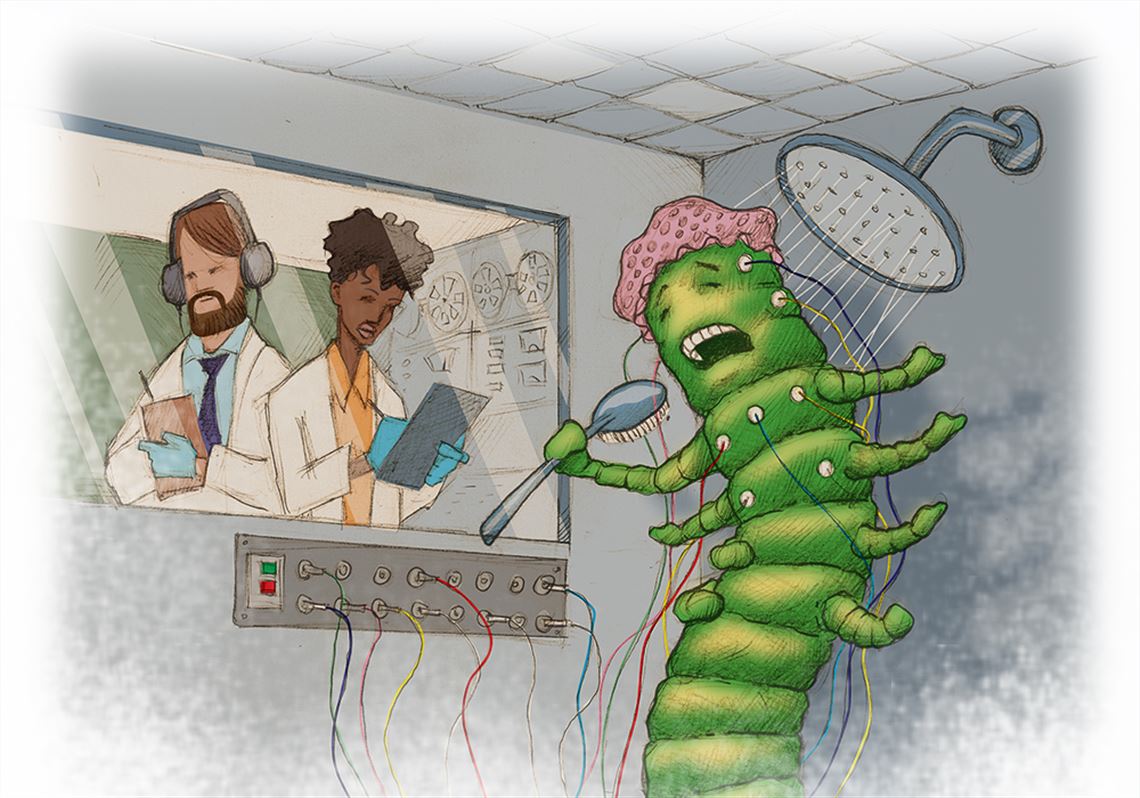
Are you ever annoyed by the same tune going ’round and ’round in your head for hours — maybe even days? Drives me crazy. As fast as I can get to a radio, I put on a music station to drive the tune out. Here’s a theory about that repeating phenomenon.
Jeremy Reynolds reports at the Pittsburgh Post-Gazette, “In the dark corners of the internet hides a playlist of some of the most torturous, addictive music known to man. That’s right, Spotify, SoundCloud and Apple Music all have playlists of ‘Baby Shark’ remixes. Do doo, do do, do do, do.
“Would you walk 500 miles to get away from that tune? Will your poker face crack the thousandth time it plays in your head? Does it remind you of somebody that you used to know? Do you value the sound of silence?
“You aren’t alone. These so-called earworms — gross — are annoying but useful, as new research published in the Journal of Experimental Psychology in June helps illuminate the exact function these loops play. …
“Music therapists and shrewd marketers have long taken advantage of music’s ability to trigger memory. As research continues to illuminate how the process works, their techniques and goals are likely to become increasingly refined and targeted.
[Per Janata, a researcher at the University of California, Davis] says earworms help your brain encode and parse through daily memories and sensations that may not have anything to do with the exact moment when you first heard the tune. As it plays over and over in your head, you may come to associate memories or sensations different from those you experienced on first listening.
“These musical fragments became a kind of sorting mechanism that triggers clearer recall at a later date, especially when the tune plays once more, according to the study Spontaneous Mental Replay of Music Improves Memory for Incidentally Associated Event Knowledge. …
“In general, musicians and scientists alike have concluded that faster music with simple, repetitive melodies and harmonies are more likely to loop in the brain. …
“[Pittsburg composer Nancy Galbraith] differentiates between musical ‘hooks,’ a fragment designed to catch the ear, and earworms. Many earworms come from song hooks, but not all hooks become earworms. …
“ ‘Tchaikovsky was a really great hook writer, but we don’t really call them that in classical music,’ she said. ‘Personally I don’t associate them with anything specific. It’s more of an emotion or sensation.’ …
“Music therapists already use music’s ability to trigger a range of emotional states with their patients. According to Brittany Meyer, a neurologic music therapist at UPMC Children’s Hospital of Pittsburgh, music’s ability to activate multiple parts of the brain simultaneously makes it a useful tool for rebuilding and strengthening pathways in the brain.
“ ‘Repetition is really great for creating earworms,’ Ms. Meyer said. ‘And we know that music is great for both encoding and retrieving memories.’
“She explained that music can trigger reaction in both the hippocampus, which plays a role in learning and memory, and the amygdala, which is involved in experiencing emotions. So listening to the same music at a later date can trigger the same emotions as when the listener last experienced the music.
“Ms. Meyer also said that a patient’s prior associations with a tune are more important than the inherent characteristics of the tune itself. For example, she cited an experience working with a child on the autism spectrum who didn’t want to brush his teeth. Ms. Meyer made up a song about brushing teeth to the tune of a song he liked. Then his mother could sing with him every night, which helped him remember to brush his teeth.
“Mr. Janata wonders how long it will be before this research is used in a more targeted way. Many Americans above a certain age can recall a few jingles from their childhoods and the products they advertised, and some educators use songs or tunes to help memorize information.
“But the possibilities don’t stop there. Mr. Janata’s recent study found that music can function as a targeted memory aid. That means learning names or new faces or places could one day be paired with an individual tune, almost like a personalized musical tag.
“Mr. Janata is exploring that idea in his research and attempting to observe how the brain responds to musical stimuli and earworms using neural imaging technology. …
“ ‘That’s what our current experiments are trying to show and see whether that’s possible.’ ”
More at the Post-Gazette, here.

 Suzanne's Mom's Blog